Key takeaways
- Peec AI is a solid monitoring tool, but it stops at showing you data — it doesn't help you create content to improve your AI visibility.
- The most useful alternatives in 2026 combine tracking with built-in content generation, gap analysis, or optimization workflows.
- If you're being outranked in ChatGPT, Perplexity, or Google AI Overviews, knowing about it isn't enough — you need tools that help you act on it.
- Promptwatch, Writesonic, Relixir, SearchAtlas, and Orchly.ai are the five alternatives worth looking at if content generation is a priority.
- Pricing ranges from ~$99/mo to $579/mo depending on how many sites, prompts, and articles you need.
There's a specific frustration that comes with AI visibility tools that only monitor. You log in, you see that a competitor is getting cited in ChatGPT for three prompts you care about, and you're not. Then the dashboard just... sits there. No suggestions. No content brief. No path forward. Just a number that makes you feel bad.
Peec AI falls into this category. It does what it says — tracks brand presence in AI-generated summaries, monitors Google AI Overview visibility, and gives you prompt-level analytics. For a team that just wants to know where they stand, it's fine. But the moment you ask "okay, so what do I do about it?", you're on your own.
That's the gap this guide is about. The five alternatives below all go further than monitoring. Each one has some form of built-in content generation, gap analysis, or optimization workflow that helps you actually improve your AI search visibility — not just measure it.
Why content generation matters for AI search
AI search engines like ChatGPT, Perplexity, and Google's AI Mode don't rank pages the way traditional search does. They cite sources. They pull from content that directly answers the questions users are asking. If your website doesn't have a page that clearly addresses a specific prompt, you won't be cited — full stop.
That means the path to better AI visibility runs through content. Specifically, content that:
- Answers the exact questions AI models are being asked
- Is structured in a way that's easy for AI crawlers to parse and extract
- Covers topics your competitors are already being cited for
Monitoring tools tell you which prompts you're missing. Content generation tools help you fill those gaps. The best platforms in 2026 do both.
The 5 best Peec AI alternatives with content generation
1. Promptwatch — the most complete action loop
Promptwatch is the platform that comes closest to solving the full problem: find the gaps, create the content, track the results.

The core differentiator is what Promptwatch calls its action loop. The Answer Gap Analysis shows you exactly which prompts your competitors are being cited for that you're not — not just a list of missing keywords, but the specific questions AI models are asking that your site can't answer. From there, a built-in AI writing agent generates articles, listicles, and comparisons grounded in real citation data (880M+ citations analyzed). This isn't generic AI content — it's engineered around what actually gets cited.
On the tracking side, Promptwatch monitors 10 AI models: ChatGPT, Perplexity, Google AI Overviews, Google AI Mode, Claude, Gemini, Meta/Llama, DeepSeek, Grok, and Mistral. Page-level tracking shows which specific pages are being cited, by which models, and how often. There's also AI crawler log monitoring — real-time logs of when ChatGPT, Claude, and Perplexity crawl your site, which pages they read, and what errors they hit. Most competitors don't have this at all.
A few other things worth knowing: Promptwatch tracks Reddit and YouTube as citation sources (both heavily influence AI recommendations), monitors ChatGPT Shopping carousels, and includes prompt volume and difficulty scoring so you can prioritize which gaps to fill first.
Pricing starts at $99/mo for one site and 50 prompts, with a Professional tier at $249/mo (2 sites, 150 prompts, 15 articles/month, crawler logs) and Business at $579/mo. Free trial available.
In a 2026 comparison of 12 GEO platforms, Promptwatch was the only one rated as a "Leader" across all categories — largely because it's the only one that closes the loop from monitoring to optimization.
2. Writesonic — GEO-focused with strong content workflows
Writesonic has evolved well beyond its origins as an AI writing tool. Its GEO suite now tracks brand visibility across ChatGPT, Google AI Mode, Gemini, Perplexity, and Claude, and pairs that tracking with content optimization workflows.
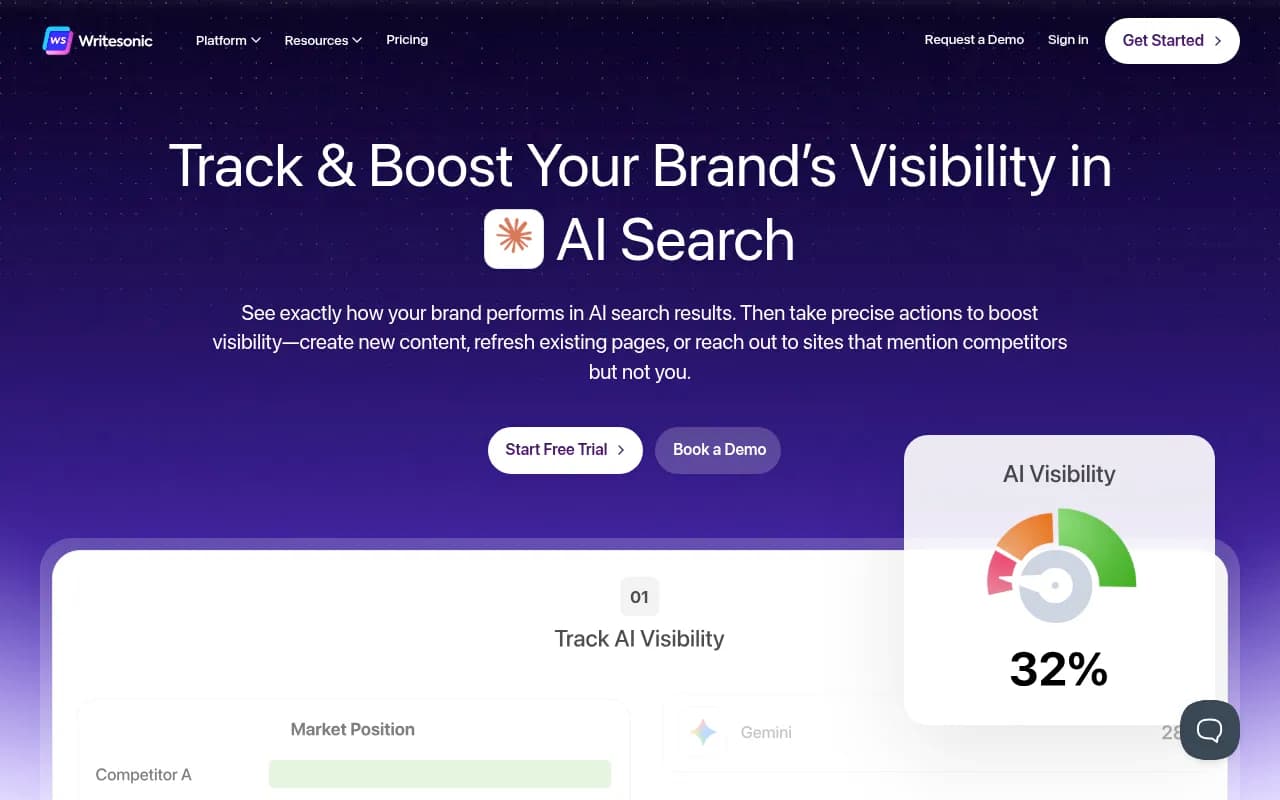
What makes Writesonic relevant here is that it's built around the idea that visibility and content are the same problem. The platform can identify which topics you're missing from an AI search perspective and help you generate content to address them — all within the same interface. For marketing teams that are already using Writesonic for content production, adding AI visibility tracking on top is a natural extension.
It's worth noting that Writesonic's GEO features are newer and still maturing compared to dedicated platforms. If deep prompt analytics or crawler log data is important to you, you'll want to compare carefully. But for teams that want a single tool covering both content creation and AI visibility, it's one of the more coherent options at around $199/mo.
3. Relixir — all-in-one GEO with automated content generation
Relixir takes an aggressive approach to the content generation problem. The platform analyzes what AI models are citing in your category, identifies the gaps on your site, and then generates content automatically — not just briefs, but full articles ready for review and publishing.
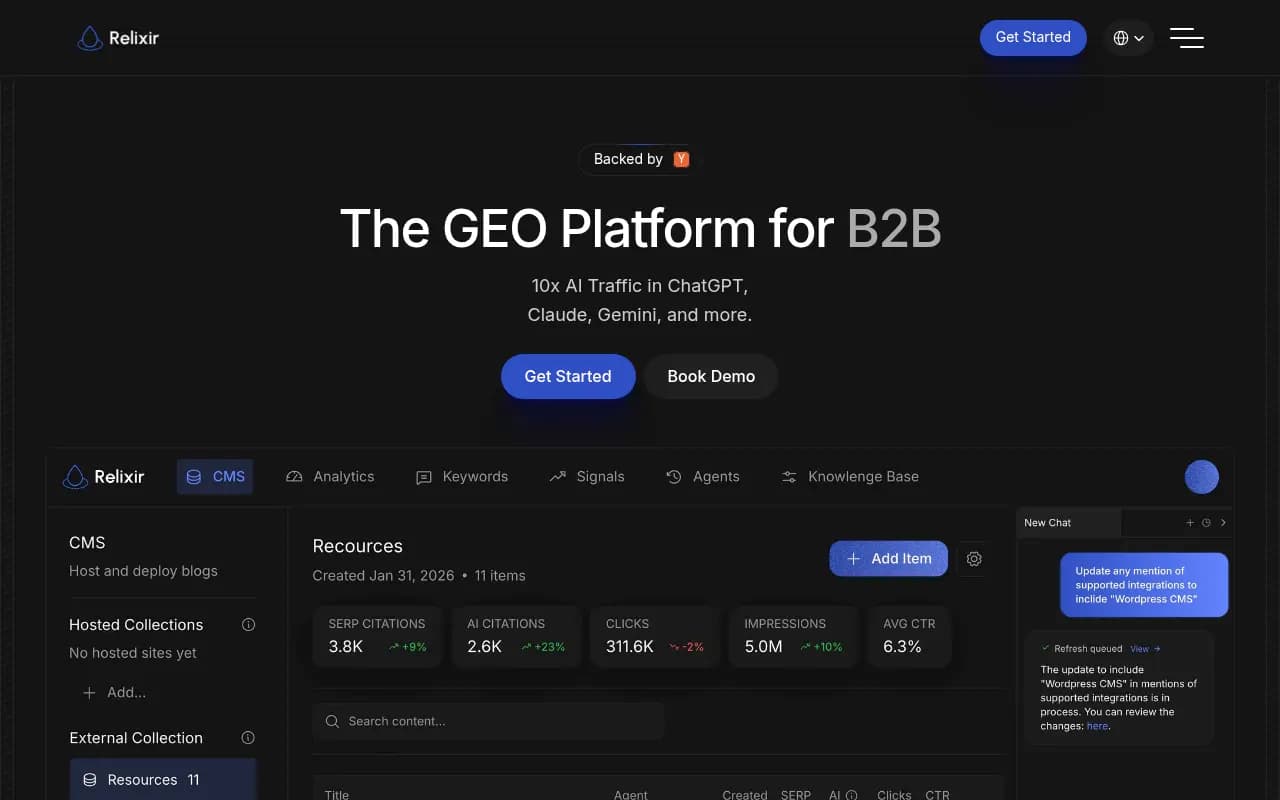
The pitch is speed. If you're behind on AI visibility and need to close the gap quickly, Relixir's automated pipeline can produce a lot of content in a short time. The tradeoff is that automated content at scale requires careful editorial oversight — you'll want a process for reviewing what goes out.
Relixir also includes competitive analysis showing which domains are winning citations for specific prompts, which helps you understand not just what content to create but what angle to take. It's a solid option for growth teams that want to move fast and have the editorial bandwidth to manage the output.
4. SearchAtlas LLM Visibility — SEO + AI visibility in one platform
SearchAtlas has built out a serious AI visibility layer on top of its existing SEO platform. The LLM Visibility module tracks brand citations across major AI engines and connects that data to the site's broader SEO toolset — keyword research, content briefs, on-page optimization.

The content generation angle here is that SearchAtlas can deploy fixes and generate content directly, rather than just flagging issues. For teams that are already managing traditional SEO alongside AI visibility, having both in one place reduces a lot of context-switching. The platform is particularly useful if you're trying to optimize for both traditional search rankings and AI citations simultaneously, since the two increasingly overlap.
It's an enterprise-leaning platform, so pricing and feature depth reflect that. But for larger marketing teams or agencies managing multiple clients, the unified approach is genuinely valuable.
5. Orchly.ai — content ops platform built for AI visibility
Orchly.ai is the most content-ops-focused option on this list. Where other platforms treat content generation as a feature, Orchly treats it as the core product — it writes, optimizes, and publishes content specifically designed to get cited by AI models.
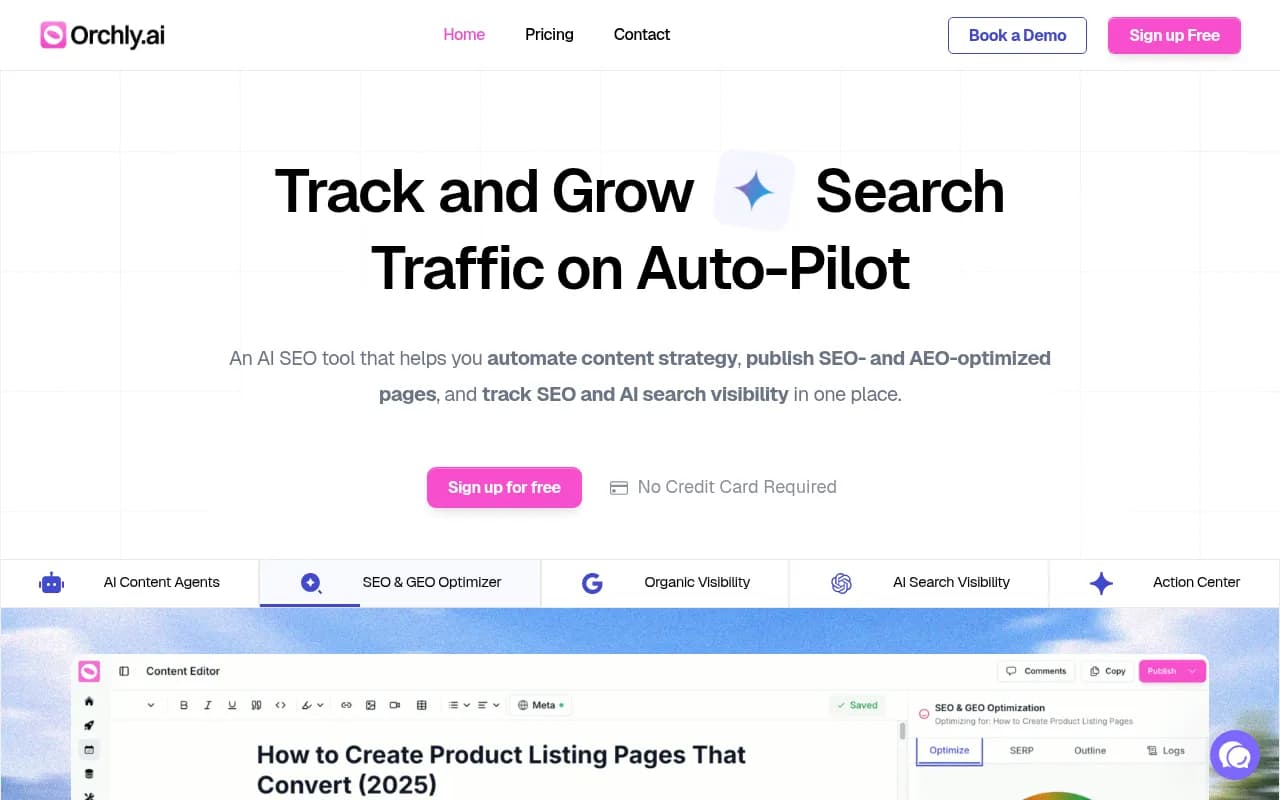
The workflow is built around what Orchly calls "AI-ready content": structured, factual, well-sourced articles that match the format AI models prefer when selecting citations. The platform analyzes which content types and structures are currently being cited in your category, then generates content that follows those patterns.
For teams that have identified their AI visibility gaps but are bottlenecked on content production, Orchly is worth a close look. It's more specialized than Promptwatch or Writesonic — it doesn't try to do everything — but what it does, it does well.
How these tools compare
| Tool | AI models tracked | Built-in content generation | Gap analysis | Crawler logs | Starting price |
|---|---|---|---|---|---|
| Promptwatch | 10 (ChatGPT, Perplexity, Claude, Gemini, Grok, DeepSeek, Mistral, Meta AI, Google AIO, Google AI Mode) | Yes — articles, listicles, comparisons | Yes — Answer Gap Analysis | Yes | $99/mo |
| Writesonic | 5 (ChatGPT, Perplexity, Google AI Mode, Gemini, Claude) | Yes — integrated with content creation suite | Partial | No | $199/mo |
| Relixir | Multiple | Yes — automated full articles | Yes | No | Custom |
| SearchAtlas LLM Visibility | Multiple | Yes — deploys fixes and content | Yes | No | Custom |
| Orchly.ai | Multiple | Yes — core product focus | Partial | No | Custom |
| Peec AI (for reference) | Google AIO, ChatGPT-style | No | No | No | ~€89/mo |
What to look for when choosing
The table above gives you a quick comparison, but a few questions will help you narrow it down faster:
How many AI models do you need to track? If you're focused on Google AI Overviews specifically, most tools will cover you. If you care about ChatGPT, Perplexity, Claude, and others, you need a platform that monitors all of them. Promptwatch covers the most (10 models).
Do you have content production bandwidth? Some tools generate content automatically; others produce briefs that your team then writes. If you're already stretched thin, automated generation (Relixir, Orchly) is more useful. If you have writers who need direction, gap analysis and briefs (Promptwatch, SearchAtlas) may be enough.
Are you managing one site or many? Agency teams and multi-brand companies need multi-site support, which varies significantly by platform and pricing tier.
Do you need to connect visibility to revenue? This is where most tools fall short. Promptwatch's traffic attribution (via code snippet, Google Search Console integration, or server log analysis) is one of the few ways to actually connect AI citations to business outcomes.
The honest take on Peec AI
Peec AI isn't a bad tool. It was genuinely useful when it launched — one of the first platforms to take AI Overview visibility seriously and give teams prompt-level data. For a brand that just wants to monitor its AI presence without doing anything about it, it still works.
The problem is that "monitoring only" is increasingly hard to justify as a budget line item. AI search is moving fast. Brands that are being cited in ChatGPT and Perplexity today didn't get there by accident — they created content specifically designed to answer the questions those models are being asked. A tool that shows you the gap but doesn't help you close it is only solving half the problem.
If you're evaluating alternatives, the question isn't just "which tool tracks more AI models?" It's "which tool helps me do something about what I find?" That's the distinction that separates monitoring dashboards from optimization platforms.
Bottom line
For most marketing teams in 2026, the right move is a platform that combines monitoring with content generation — because the two problems are inseparable. You can't improve your AI visibility without creating content, and you can't create the right content without knowing where your gaps are.
Promptwatch is the most complete option if you want the full loop: gap analysis, content generation, multi-model tracking, crawler logs, and traffic attribution in one place. Writesonic makes sense if you're already using it for content and want to add AI visibility on top. Relixir and Orchly.ai are worth considering if content production speed is the main bottleneck. SearchAtlas fits teams that want to manage traditional SEO and AI visibility together.
Pick the one that matches where your team is actually stuck — and make sure it can help you get unstuck, not just show you how stuck you are.