Key takeaways
- Promptwatch is the strongest all-around alternative if AI search visibility and content optimization are your priorities -- it tracks 10 AI models, generates content grounded in citation data, and closes the loop with traffic attribution.
- Otterly.AI is the most affordable entry point for teams that just need brand monitoring across AI engines without a big budget commitment.
- Peec AI suits marketing teams that want clean dashboards and competitor benchmarking but don't need content generation.
- Scrunch AI and Brandlight are better fits for mid-market and enterprise brands that need white-label reporting or Fortune 500-grade support.
- Slate itself is a workflow automation platform -- if you're looking for pure AI visibility tracking rather than content workflow automation, most of these alternatives are a better fit.
Slate is an interesting product. It positions itself as an AI-powered workflow and automation platform for SEO and content teams -- think programmable agents that draft articles, refresh pages, interlink content, and push directly to your CMS. It's genuinely useful if your main problem is operational: too many pages, not enough hands, too many repetitive tasks.
But a lot of people land on Slate looking for something slightly different. They want to know how their brand appears in ChatGPT, Perplexity, or Google AI Overviews. They want to track AI citations, understand why competitors are getting recommended and they're not, and then do something about it. Slate touches on AI visibility -- it mentions tracking AI citation rates -- but that's not its core. It's primarily a content automation and workflow tool.
If you're in that second camp, you're probably looking for a dedicated AI visibility or GEO (Generative Engine Optimization) platform. The tools below are the ones worth considering.
The best Slate alternatives in 2026
Promptwatch

Promptwatch is the alternative I'd point most people toward first, and not just because it's the most feature-complete option. It's because it actually helps you do something with what you find.
Most AI visibility tools show you a dashboard. You see your brand mentioned 34% of the time across a set of prompts, your competitor is at 61%, and then... the tool stops. You're left figuring out what to do next on your own.
Promptwatch is built around a different idea. It finds the gaps (which prompts are your competitors winning that you're not even showing up for), then helps you create content to close those gaps, then tracks whether that content actually starts getting cited. That loop -- find, fix, track -- is what separates it from the monitoring-only crowd.
Specific things worth knowing: it monitors 10 AI models including ChatGPT, Claude, Perplexity, Gemini, Grok, DeepSeek, and Copilot. It has real AI crawler logs, so you can see when ChatGPT or Perplexity actually reads your pages and which ones they skip. It tracks Reddit and YouTube as citation sources, which most competitors ignore entirely. And it has ChatGPT Shopping tracking if you're in e-commerce and care about product recommendation carousels.
The content generation side is grounded in citation data from over 880 million citations analyzed -- so the articles it helps you write aren't generic SEO filler, they're built around what AI models actually want to cite.
Compared to Slate: Slate automates content workflows and CMS publishing. Promptwatch optimizes for AI search visibility. They're solving adjacent but different problems. If you want to know why ChatGPT isn't recommending your brand and what to do about it, Promptwatch is the right tool.
Pricing starts at $99/month for the Essential plan (1 site, 50 prompts, 5 articles), $249/month for Professional (2 sites, 150 prompts, 15 articles, crawler logs), and $579/month for Business (5 sites, 350 prompts, 30 articles). A 7-day free trial is available.
Best for: Marketing and SEO teams that want to track AI visibility and actually improve it, not just watch the numbers.
Otterly.AI
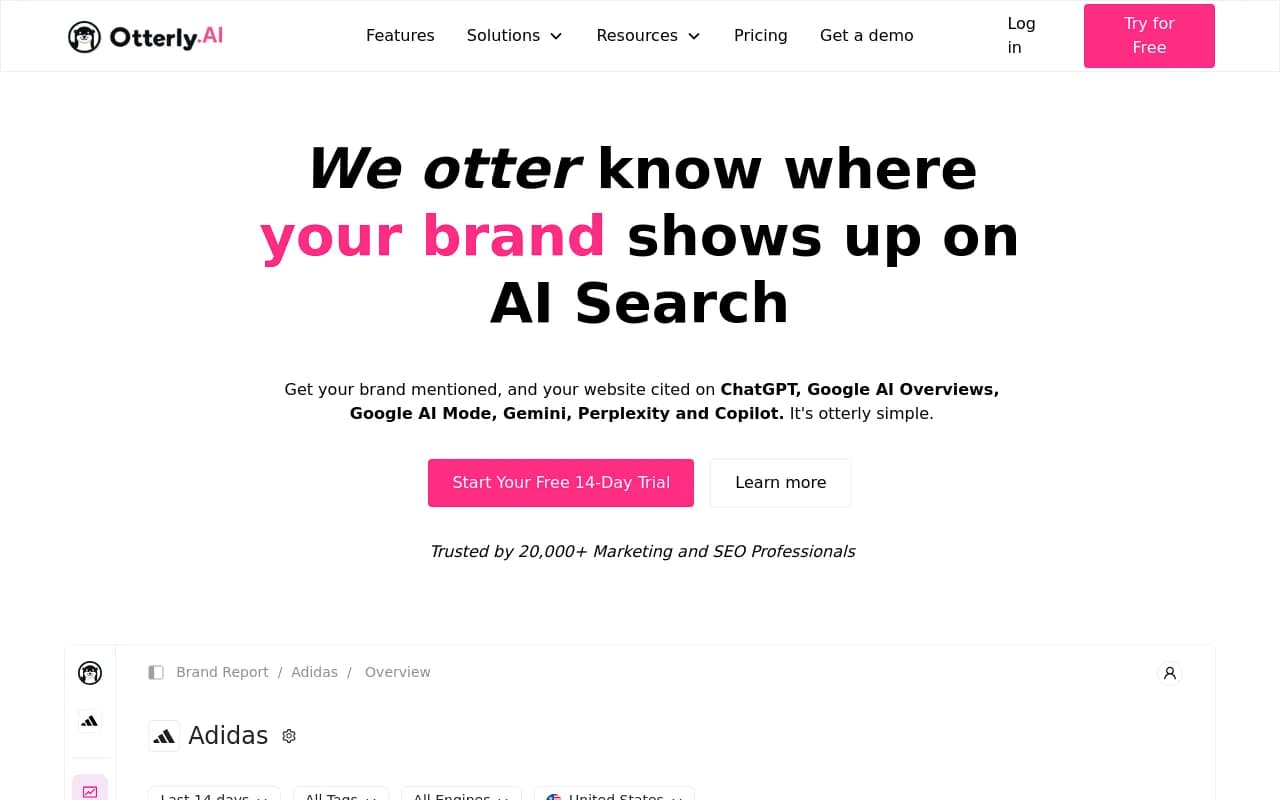
Otterly.AI is the budget-friendly option in this space, and it's more capable than its price suggests. Starting at $29/month for the Lite plan (15 prompts), it's the most accessible entry point for teams that want to start monitoring AI search without committing to a serious budget.
The platform tracks brand mentions across ChatGPT, Perplexity, and Google AI Overviews, shows you competitor coverage over time, and includes GEO audit features. The brand coverage charts are clean and easy to read -- you can see at a glance how your mention rate compares to competitors across a date range.
Where Otterly falls short is depth. It's a monitoring tool. There's no content generation, no crawler logs, no Reddit or YouTube citation tracking, and no traffic attribution. You'll see that your brand coverage dropped from 45% to 38% last week, but you won't get much help understanding why or what to do about it.
That said, 30,000+ marketing professionals use it, and there are real case studies showing meaningful results (Bacula Systems, Videoloft). It works. It's just limited in scope.
Compared to Slate: Slate is about automating content workflows. Otterly is about monitoring AI brand presence. They barely overlap. If you're coming from Slate and want AI visibility tracking on a tight budget, Otterly is a reasonable starting point.
Pricing: $29/month (Lite, 15 prompts), $189/month (Standard, 100 prompts), custom pricing for Premium. 14-day free trial, no credit card required.
Best for: Small teams and solo marketers who want basic AI brand monitoring without a big spend.
Peec AI
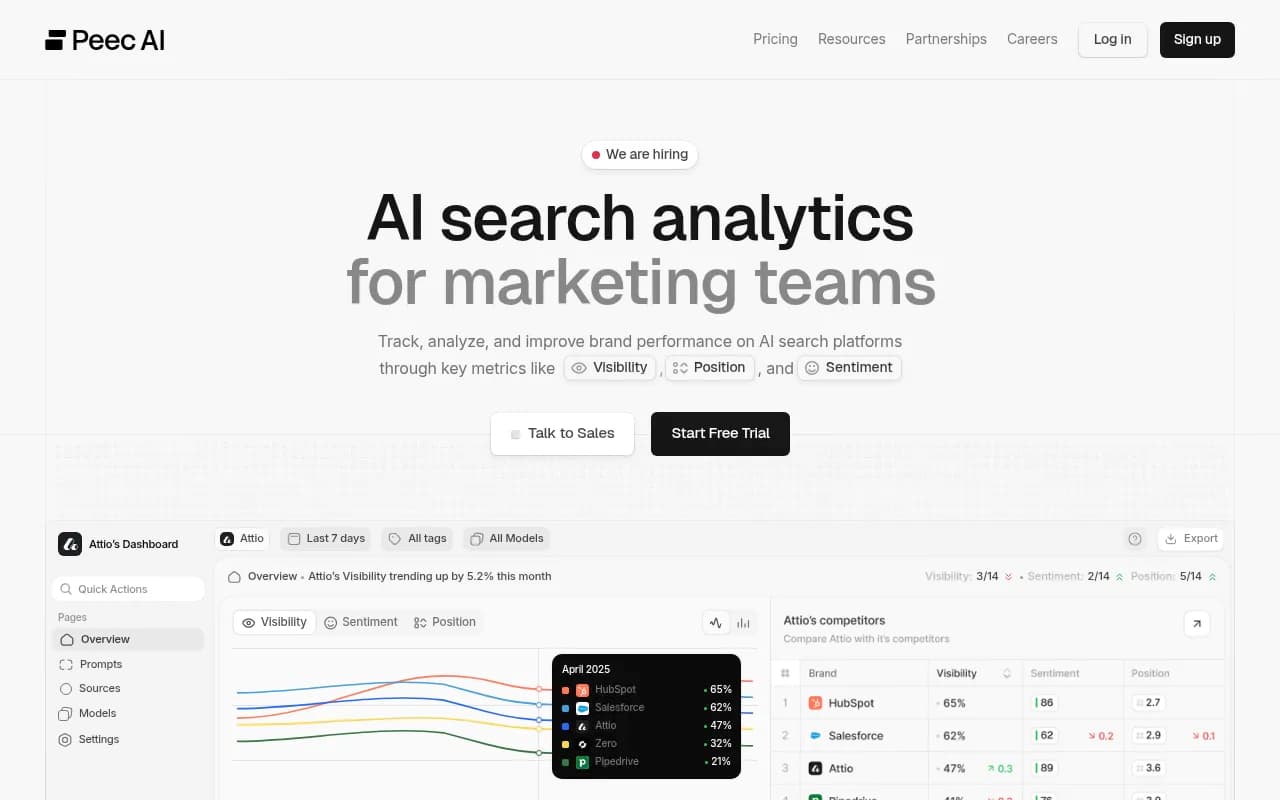
Peec AI sits between Otterly and Promptwatch in terms of depth. It tracks visibility, position, and sentiment across ChatGPT, Perplexity, and Gemini, with clean dashboards that marketing teams tend to find intuitive. The competitor benchmarking is solid -- you can see your visibility score against named competitors on a chart, which makes it easy to present to stakeholders.
The prompt-level tracking is a genuine strength. You can add your own prompts, organize them with tags, and track performance across countries. That flexibility matters if you're in a niche where the default prompt suggestions don't quite fit your category.
The honest limitation: Peec AI is monitoring-only. No content generation, no crawler logs, no traffic attribution connecting AI visibility to actual revenue. You'll know you're at 47% visibility and Salesforce is at 62%, but the tool won't tell you what content to create to close that gap.
Compared to Slate: Again, these are different tools solving different problems. Slate automates content operations. Peec AI monitors AI search performance. If you're evaluating Slate alternatives for AI visibility specifically, Peec AI is a cleaner, more focused option than Slate for that use case.
Pricing: Free trial available. Paid plans from $95/month (Starter), $245/month (Pro), $495/month (Advanced).
Best for: Marketing teams that want structured AI visibility reporting and competitor benchmarking without needing content optimization features.
Scrunch AI
Scrunch AI is a GEO platform that tracks citations, competitor visibility, and brand mentions across ChatGPT, Perplexity, Claude, and other LLMs. It's positioned at the mid-market level -- more capable than Otterly or Peec AI, but without the full action loop that Promptwatch offers.
The white-label reporting on the Professional plan is a meaningful differentiator for agencies. If you're managing AI visibility for multiple clients and need to send branded reports, Scrunch handles that in a way that some cheaper tools don't.
The platform is solid for monitoring and competitive analysis. Where it's weaker is on the optimization side -- there's no built-in content generation or crawler log analysis, so you're still doing a lot of the "what do we do about this?" work manually.
Pricing is on the higher end for what you get: the Starter plan runs $250-300/month for 1 brand and 100 prompts, and the Professional plan is $500/month for 3 brands and 300 prompts. That's a meaningful investment for monitoring-only capabilities.
Compared to Slate: Slate is workflow automation. Scrunch is AI visibility monitoring with decent reporting. If you need white-label client reporting for AI search performance, Scrunch is worth a look.
Pricing: Starter ~$250-300/month, Professional $500/month, Enterprise custom.
Best for: Mid-market brands and agencies that need white-label AI visibility reporting and are willing to pay for it.
Brandlight.ai
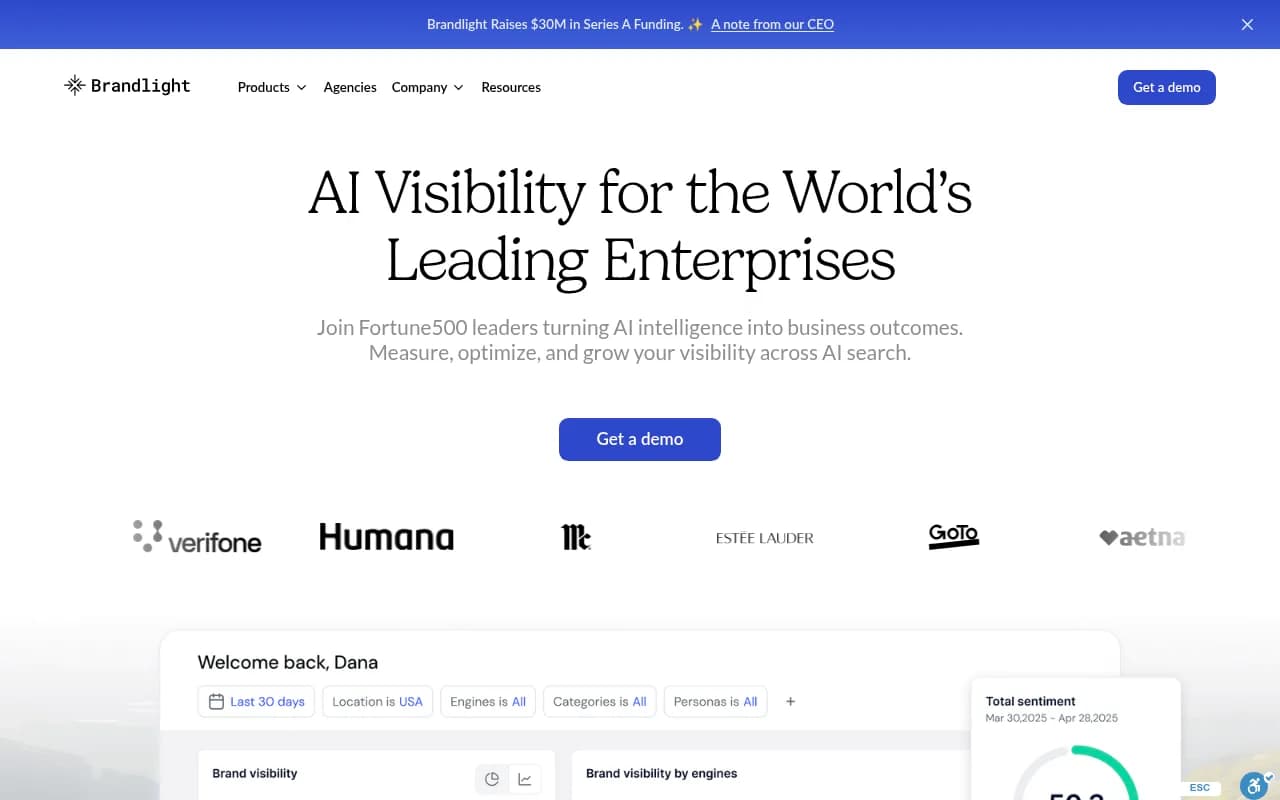
Brandlight is the enterprise play in this space. It raised $30M in Series A funding and counts Fortune 500 companies among its customers -- Humana, MasterCard, Estee Lauder, and others appear on their site. That customer base tells you something about who this product is built for.
The platform tracks brand mentions, sentiment, and citations across AI-driven search engines, with the depth and support structure that large organizations expect. Custom enterprise pricing, dedicated support, and the kind of onboarding that comes with a $750/month activation fee.
For most teams reading this, Brandlight is probably overkill. The pricing starts at $199/month with activation fees that push the real entry cost higher, and the product is clearly optimized for large marketing organizations with complex reporting needs and multiple stakeholders.
That said, if you're at a company where "we need to present AI visibility data to the CMO and the board" is a real sentence, Brandlight's enterprise positioning and Fortune 500 credibility might be exactly what you need to get internal buy-in.
Compared to Slate: Slate is a content automation tool for SEO teams. Brandlight is an enterprise AI visibility platform. Very different tools for very different organizational contexts.
Pricing: Custom enterprise pricing. Base plans from $199/month with activation fees around $750/month.
Best for: Enterprise marketing teams at large organizations that need AI visibility tracking with enterprise-grade support and reporting.
Profound
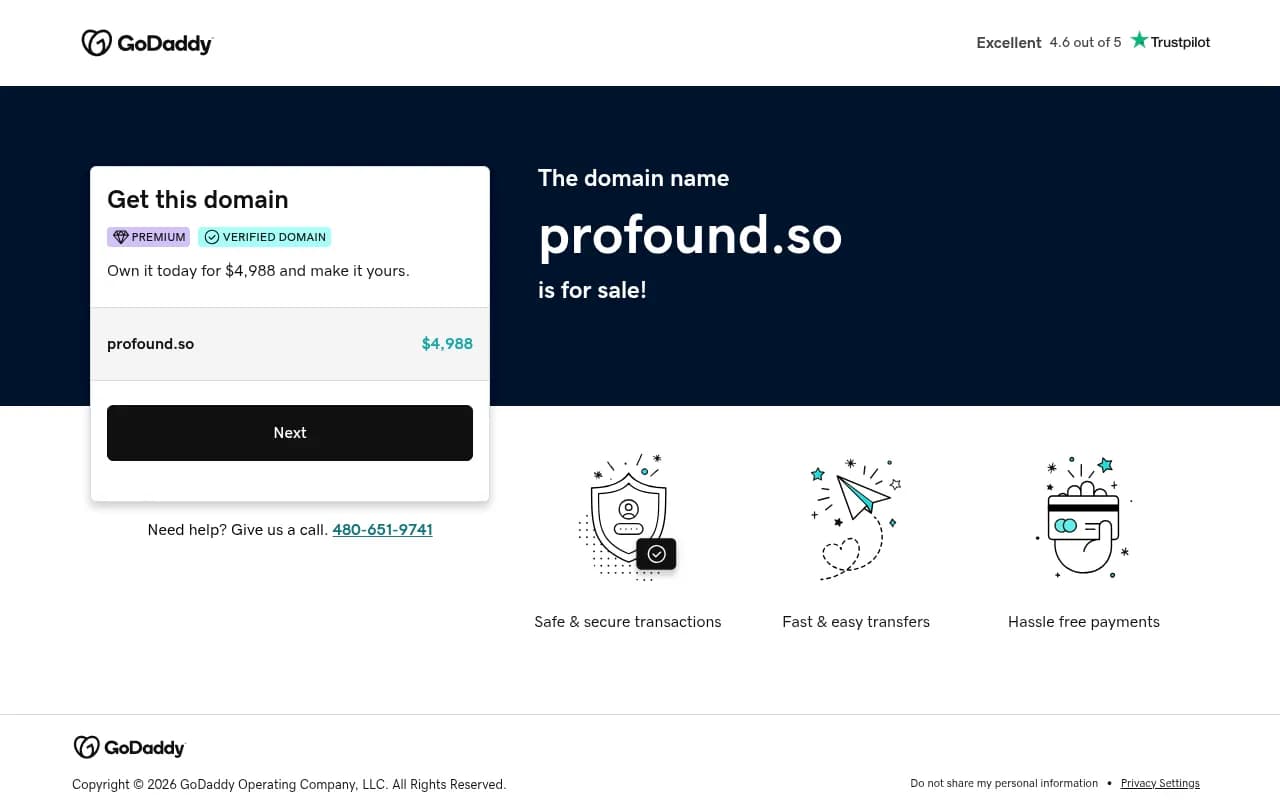
Profound was a notable player in the AI visibility space, positioned as an all-in-one enterprise platform for monitoring and optimizing brand presence across AI search engines. At the time of writing, their domain (profound.so) appears to have lapsed and is listed for sale -- which is worth noting if you're evaluating it.
If Profound is still operating under a different domain or has relaunched, the core product was competitive with Promptwatch and Scrunch at the enterprise level. But given the domain situation, I'd verify their current status before committing to any plan.
Pricing was reportedly from $99/month (Starter) to $579/month (Business), with enterprise custom pricing.
Best for: Worth investigating current status before evaluating.
How Slate compares to these alternatives
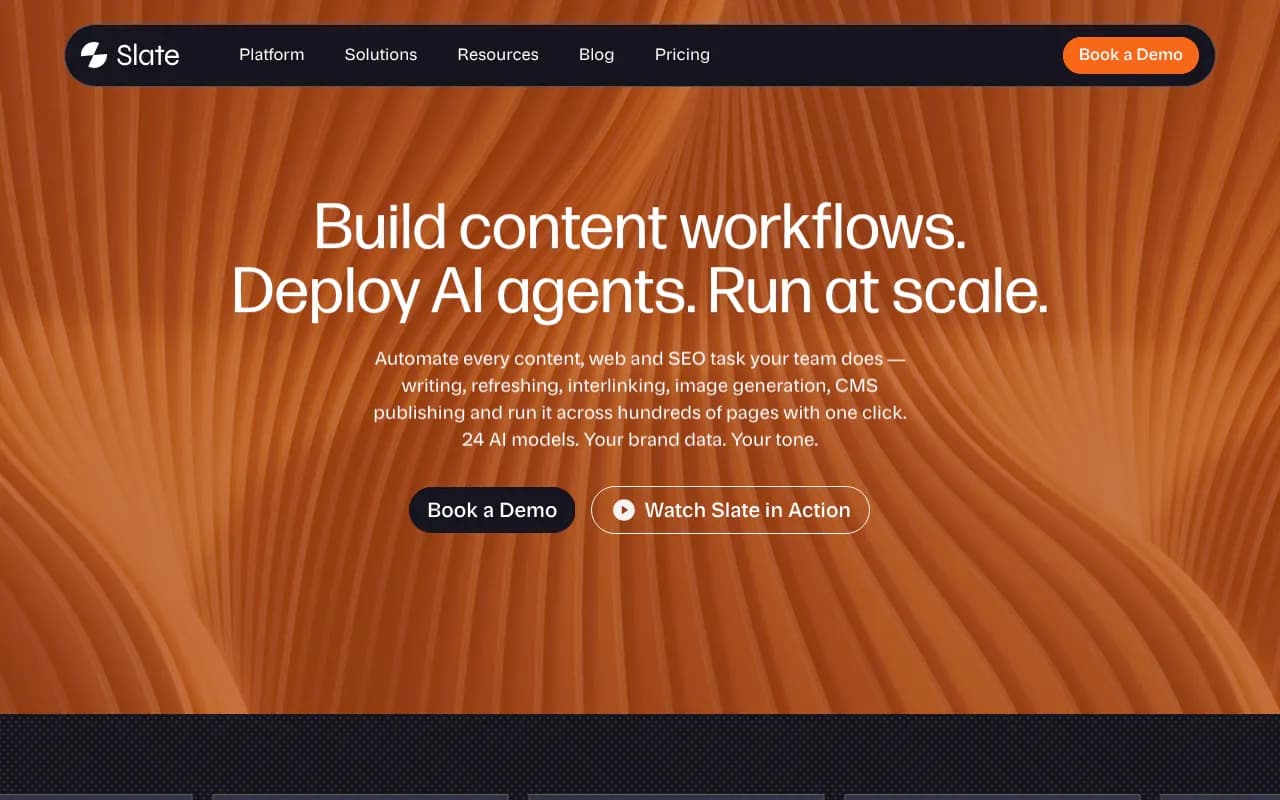
It's worth being clear about what Slate actually is, because the positioning can be confusing. Slate is a content and SEO workflow automation platform. Its core value is letting you build programmable agents that run on a schedule -- monitoring rankings, drafting content, refreshing pages, generating images, publishing to your CMS. It integrates with Claude via MCP, connects to your analytics and search console, and lets you run workflows across hundreds of pages with one click.
That's genuinely useful. If you have a large content operation and you're drowning in manual tasks, Slate's automation capabilities are real.
But Slate is not primarily an AI search visibility platform. It mentions tracking AI citation rates as one output metric, but the core product is about content workflow automation, not about understanding how ChatGPT or Perplexity perceives your brand, which prompts you're winning or losing, or what content you need to create to improve your AI search presence.
The tools in this list -- particularly Promptwatch, Otterly.AI, and Peec AI -- are purpose-built for that AI visibility use case. They track the specific prompts your customers are typing into AI engines, show you where your brand appears (and where it doesn't), and in Promptwatch's case, help you create content that actually gets cited.
Which alternative should you pick?
Here's a quick decision guide:
-
You want the most complete AI visibility platform with content optimization built in: Promptwatch. It's the only option here that covers monitoring, content gap analysis, content generation, crawler logs, and traffic attribution in one place.
-
You're on a tight budget and just need to start tracking AI brand mentions: Otterly.AI at $29/month is the obvious starting point.
-
You want clean dashboards and competitor benchmarking for internal reporting: Peec AI hits that sweet spot between simplicity and depth.
-
You're an agency that needs white-label reporting for clients: Scrunch AI or Promptwatch (which also has agency plans with custom pricing).
-
You're at a Fortune 500 company and need enterprise-grade support: Brandlight.ai.
-
You actually want Slate's workflow automation capabilities but also need AI visibility: Consider running Slate for content automation alongside Promptwatch for AI visibility tracking -- they're complementary rather than competing.
The AI search visibility space is moving fast. A year ago, most of these tools barely existed. The meaningful difference between them isn't features on a checklist -- it's whether the tool helps you take action or just shows you a dashboard. That's the question worth asking before you commit to any of them.