Sight AI Review 2026
Combines AI search tracking, SEO/GEO content generation, and automated website indexing to optimize brand presence across AI engines.
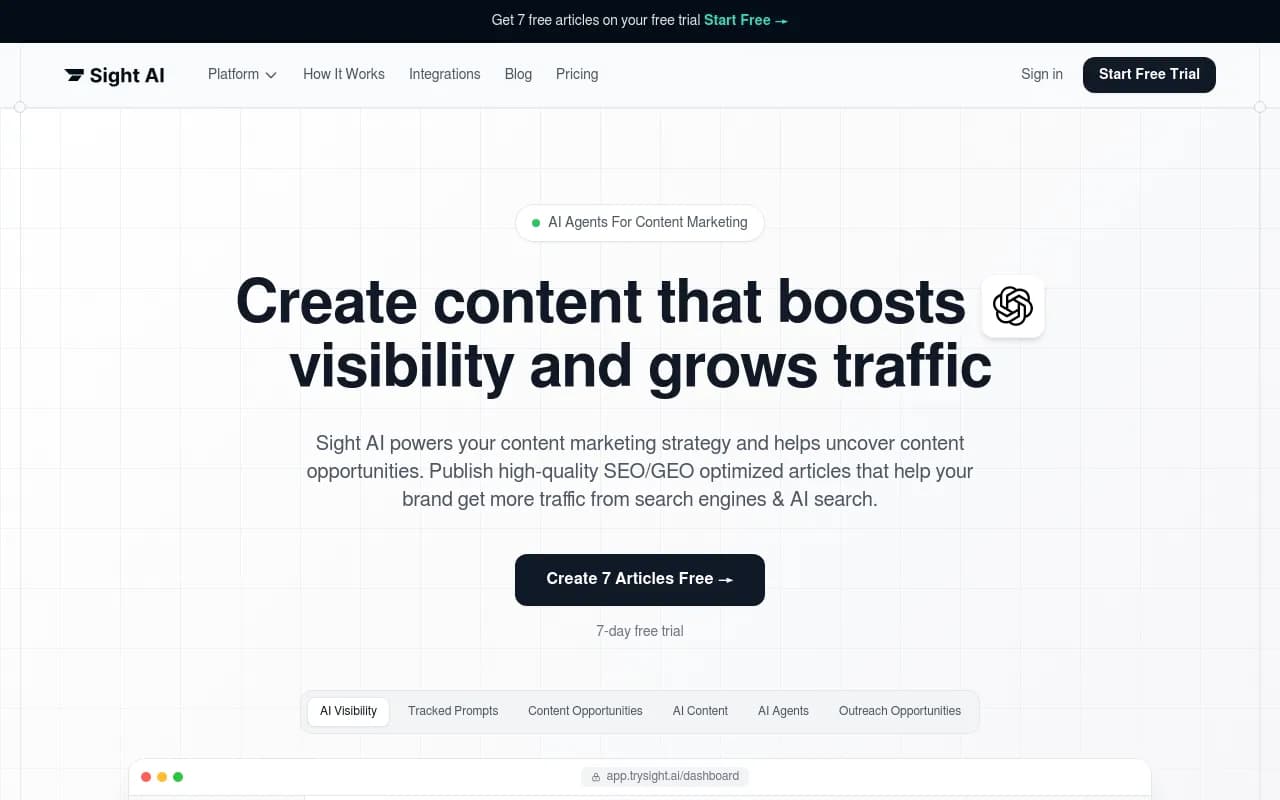
Sight AI positions itself as an end-to-end AI visibility and content marketing platform. It monitors how your brand appears in AI search engines like ChatGPT, Claude, Perplexity, Gemini, and Grok, then helps you create the content you're missing and ensures it gets indexed quickly. The platform targets marketers, founders, and agencies who want to grow organic traffic without the manual grind of traditional content production.
Key takeaways
- Monitoring-only approach: Sight AI tracks brand mentions and sentiment across 5 AI models but lacks the depth of platforms like Promptwatch, which monitors 10+ models, provides AI crawler logs, traffic attribution, Reddit/YouTube tracking, and ChatGPT Shopping insights.
- Content generation is the core strength: 13+ specialized AI agents produce long-form SEO/GEO articles (2,500-4,500 words) based on tracked prompts and content gaps. Autopilot mode can publish one article per day automatically.
- Fast indexing via IndexNow: Auto-submits new URLs to Google and Bing as soon as they're published, helping content appear in search results faster than manual submission.
- Limited competitive intelligence: No prompt volume estimates, difficulty scoring, query fan-outs, or page-level citation tracking -- features that Promptwatch uses to prioritize high-value, winnable prompts.
- Best for content-first teams: If your primary goal is publishing AI-optimized articles at scale, Sight AI delivers. If you need comprehensive AI visibility analytics, optimization tools, and traffic attribution, you'll hit limitations quickly.
Key features
AI Visibility Tracking: Sight AI monitors your brand mentions across ChatGPT, Claude, Perplexity, Gemini, and Grok. You see how many times your brand appeared in AI responses over the past 7 days, broken down by model. The dashboard shows mention trends over time and an overall AI Visibility Score (0-100%). Sentiment analysis tells you whether AI models are talking about your brand positively, negatively, or neutrally. This is useful for spotting sudden drops or spikes in visibility, but it's surface-level compared to platforms that track specific prompts, citation sources, and page-level performance. You won't see which exact pages are being cited or how competitors are positioned for the same prompts.
Content Opportunity Discovery: The platform scans AI responses to identify topics and questions where competitors appear but you don't. It surfaces these as "content opportunities" -- gaps you can fill by publishing new articles. This is conceptually similar to Answer Gap Analysis in other tools, but Sight AI doesn't provide prompt volume estimates, difficulty scores, or query fan-outs to help you prioritize. You're left guessing which opportunities are worth pursuing. There's no Reddit or YouTube tracking to surface discussions that influence AI recommendations, a channel most competitors ignore entirely.
AI Content Generation with 13+ Agents: This is where Sight AI shines. The platform uses a multi-agent system to research, outline, write, optimize, and format long-form articles. You choose from three content types: Listicles (numbered lists like "Top 10 Marketing Tools"), Step-by-Step Guides (tutorials and how-tos), and Explainers (in-depth concept breakdowns). Articles range from 2,500 to 4,500 words and are optimized for both traditional SEO and GEO (Generative Engine Optimization). The agents handle keyword research, competitor analysis, internal linking suggestions, meta descriptions, and image sourcing. Output quality is solid -- the examples on their site read like real blog posts, not generic AI filler. You can edit articles in-app before publishing or sync them directly to Webflow, WordPress, or other CMS platforms.
Autopilot Mode: Set it and forget it. Sight AI can automatically generate and publish one article per day based on your tracked prompts and content opportunities. This is a huge time-saver for teams that need consistent output but lack the bandwidth to manage content production manually. The risk is publishing low-quality or off-brand content if you don't review it first, but for high-volume content strategies, it's a compelling feature.
Website Indexing: As soon as an article is published, Sight AI auto-submits the URL to Google and Bing via IndexNow. It also keeps your sitemap updated so search engines crawl your most important pages without delays. Faster indexing means your content gains traction sooner, which can help you outrank competitors and get cited by AI models faster. This is a practical feature that most AI visibility tools don't offer, though it's table stakes for SEO automation platforms.
CMS Integrations: Direct publishing to Webflow is highlighted on the site. WordPress and other platforms are likely supported via API or Zapier, but the documentation doesn't specify. If you're using a less common CMS, you may need to copy-paste articles manually.
Tracked Prompts: You define specific prompts (questions or queries) you want to monitor across AI models. The platform checks these daily and reports whether your brand was mentioned, how it was positioned, and what sentiment was expressed. This is useful for tracking brand reputation and competitive positioning, but it's limited to the prompts you manually configure. There's no automatic discovery of new prompts or trending queries in your niche.
Outreach Opportunities: Sight AI surfaces link building and outreach opportunities based on AI responses. If a competitor is cited in an AI answer, you can reach out to the source and pitch your content as an alternative. This is a nice addition, but it's not clear how actionable these opportunities are or whether the platform provides contact details and outreach templates.
Who is it for
Sight AI is built for marketers, founders, and agencies who want to grow organic traffic through consistent content publishing. If you're a SaaS founder managing a blog with 10-50 articles and you need to scale to 100+ without hiring a full-time writer, Sight AI can help. The autopilot mode and AI agents handle the heavy lifting, freeing you to focus on strategy and distribution. Agencies managing multiple client blogs will appreciate the ability to generate and publish content at scale without burning out their team.
It's also a fit for content-first SEO teams that prioritize volume and speed over deep competitive analysis. If your strategy is "publish more, rank more," Sight AI delivers. You're not spending hours on keyword research or manual writing -- you're letting the AI agents do the work and reviewing the output before it goes live.
Who should NOT use Sight AI: Teams that need comprehensive AI visibility analytics, traffic attribution, or optimization tools beyond content generation. If you want to understand how AI models discover your content (crawler logs), which pages are being cited (page-level tracking), or how AI visibility translates to actual traffic (visitor analytics), Sight AI doesn't provide those capabilities. You're limited to high-level mention counts and sentiment scores. For that level of depth, you'd need a platform like Promptwatch, which offers AI crawler logs, 880M+ citations analyzed, prompt volumes and difficulty scoring, Reddit/YouTube tracking, and traffic attribution.
Sight AI also isn't ideal for teams that need multi-language or multi-region tracking. The platform doesn't mention support for non-English prompts or region-specific AI responses, which limits its usefulness for global brands.
Integrations and ecosystem
Sight AI integrates directly with Webflow for one-click publishing. WordPress support is implied but not explicitly documented on the site. Other CMS platforms (Contentful, Sanity, Ghost, etc.) may require manual export or API integration. The platform uses IndexNow for automatic URL submission to Google and Bing, which is a standard protocol supported by both search engines.
There's no mention of API access for developers or custom integrations. If you want to pull Sight AI data into your own dashboards or build custom workflows, you're likely out of luck. The platform is designed as a self-contained tool, not a data source for other systems.
No browser extensions or mobile apps are mentioned. You're working in the web app only.
Pricing and value
Sight AI offers four pricing tiers:
- Lite: $49/month for 25 tracked prompts, outreach opportunities, and basic AI visibility tracking. No content generation included. This is a testing tier for teams that want to monitor AI mentions before committing to content production.
- Starter: $99/month for 50 tracked prompts and 50 AI-generated articles per month. This is the entry point for content generation and the best value for small teams or solo founders.
- Pro: $199/month (most popular) for more tracked prompts and articles. Specific limits aren't listed on the pricing page, but this tier likely includes autopilot mode and priority support.
- Advanced: Custom pricing for enterprise teams with higher volume needs.
All plans include a 7-day free trial with 7 free articles. Annual billing is available with a discount (percentage not specified).
How does this compare to competitors? Promptwatch starts at $99/month for 1 site, 50 prompts, and 5 AI-generated articles, but includes AI crawler logs, traffic attribution, and Reddit/YouTube tracking -- features Sight AI lacks. Otterly.AI and Peec.ai are monitoring-only tools with no content generation, so they're cheaper ($50-150/month) but less useful for teams that want to act on the data. Profound and Scrunch offer similar feature sets to Sight AI but at higher price points ($300-500/month).
Sight AI's pricing is competitive for content generation but expensive for monitoring-only use cases. If you're paying $99/month and only using the tracking features, you're overpaying. The value is in the AI agents and autopilot mode.
Strengths and limitations
Strengths:
- Content generation at scale: 13+ AI agents produce high-quality, long-form articles that are optimized for both SEO and GEO. The autopilot mode is a game-changer for teams that need consistent output without manual effort.
- Fast indexing: Auto-submission to Google and Bing via IndexNow helps content appear in search results faster, giving you a competitive edge.
- Simple setup: The platform is easy to use and doesn't require technical expertise. You can start tracking prompts and generating content within minutes.
- Content variety: Three article types (listicles, guides, explainers) cover most content marketing needs.
Limitations:
- Monitoring-only capabilities: Sight AI tracks brand mentions and sentiment but lacks the depth of platforms like Promptwatch. No AI crawler logs, traffic attribution, Reddit/YouTube tracking, ChatGPT Shopping insights, prompt volume estimates, difficulty scoring, query fan-outs, or page-level citation tracking. You see high-level mention counts but can't drill down into which pages are being cited or how AI models discover your content.
- Limited competitive intelligence: No tools to prioritize content opportunities based on search volume, difficulty, or competitor performance. You're guessing which gaps to fill instead of using data to make strategic decisions.
- No multi-language or multi-region support: The platform doesn't mention support for non-English prompts or region-specific AI responses, which limits its usefulness for global brands.
- Unclear CMS integrations: Webflow is the only explicitly supported CMS. WordPress and other platforms may require manual export or API work.
- No API or developer tools: You can't pull Sight AI data into your own systems or build custom workflows.
Bottom line
Sight AI is a solid choice for content-first teams that want to publish AI-optimized articles at scale without the manual grind. The 13+ AI agents and autopilot mode deliver real value for marketers, founders, and agencies who prioritize volume and speed. The fast indexing via IndexNow is a nice bonus that helps content gain traction sooner.
But if you need comprehensive AI visibility analytics, optimization tools, or traffic attribution, Sight AI falls short. It's a monitoring-and-content tool, not a full optimization platform. For teams that want to understand how AI models discover their content, which pages are being cited, and how AI visibility translates to actual traffic, Promptwatch is the stronger alternative. Promptwatch offers AI crawler logs, 880M+ citations analyzed, Reddit/YouTube tracking, ChatGPT Shopping insights, prompt volumes and difficulty scoring, and traffic attribution -- capabilities Sight AI doesn't provide.
Best use case in one sentence: SaaS founders and agencies that need to publish 50+ AI-optimized articles per month without hiring a full-time content team.
Frequently asked questions
Similar and alternative tools to Sight AI