Key takeaways
- Surfer SEO is the closest direct competitor to Clearscope — similar content scoring approach, slightly lower entry price, and a bigger community. Good all-around swap.
- Frase is the best pick if you want research, brief creation, writing, and optimization in one place at a lower price point than Clearscope.
- MarketMuse goes deeper on topic authority and content inventory analysis — better for large sites with hundreds of existing pages.
- GrowthBar is the budget-friendly option for solo bloggers and small teams who want AI writing + SEO guidance without a steep learning curve.
- Promptwatch is the right choice if your priority has shifted toward AI search visibility — tracking and improving how your brand appears in ChatGPT, Perplexity, and Gemini, not just Google rankings.
- Semrush Writing Assistant makes sense only if you're already paying for Semrush and want a bundled content checker without adding another tool subscription.
- Content Harmony and Dashword are strong agency-oriented picks for teams that live and die by content briefs.
Clearscope has been a go-to content optimization tool for a few years now, and for good reason. Its keyword grading system is clean, the Google Docs integration works well, and the content reports are genuinely useful for writers who don't want to think too hard about SEO. But at $189/month for the Essentials plan, it's not cheap — and that price buys you a fairly narrow set of features. You get content optimization and some topic research. That's mostly it.
People start looking for alternatives for a few different reasons. Some find the pricing hard to justify, especially solo writers or small teams who don't need enterprise-grade tooling. Others want more: AI writing assistance, content brief generation, competitor gap analysis, or visibility tracking that goes beyond Google. And increasingly, teams are asking whether optimizing for Google rankings is even the right frame anymore, given how much search traffic is now flowing through ChatGPT, Perplexity, and Gemini.
Whatever your reason for looking, here's an honest breakdown of the best Clearscope alternatives in 2026.
The alternatives
Promptwatch

Promptwatch is a different kind of tool from the others on this list, and it's worth understanding what that difference actually means before deciding if it belongs in your stack.
Clearscope helps you optimize content to rank on Google. Promptwatch helps you understand and improve how your brand appears when people ask ChatGPT, Claude, Perplexity, Gemini, or any of the other major AI models a question. These are increasingly separate problems. A page that ranks #1 on Google might not get cited by ChatGPT at all. A competitor with weaker traditional SEO might dominate AI responses in your category.
What makes Promptwatch more than a monitoring dashboard is the action loop it's built around. It shows you which prompts your competitors are visible for but you're not (Answer Gap Analysis), then helps you create content specifically designed to get cited by AI models, then tracks whether that content is working. That cycle -- find gaps, generate content, measure results -- is what separates it from tools that just show you a visibility score and leave you to figure out the rest.
Specific things it does that most content optimization tools don't: AI crawler logs (see exactly which pages ChatGPT and Perplexity are crawling and how often), citation source analysis (which Reddit threads, YouTube videos, and domains AI models are pulling from), ChatGPT Shopping tracking, and prompt volume/difficulty scoring so you can prioritize what to go after.
It monitors 10 AI models: ChatGPT, Perplexity, Claude, Gemini, Google AI Overviews, Google AI Mode, Grok, DeepSeek, Meta/Llama, Mistral, and Copilot.
Pricing starts at $99/month (Essential: 1 site, 50 prompts, 5 articles), $249/month (Professional: 2 sites, 150 prompts, 15 articles, crawler logs), and $579/month (Business: 5 sites, 350 prompts, 30 articles). There's a 7-day free trial.
Compared to Clearscope, Promptwatch doesn't replace it for traditional Google SEO content optimization -- the keyword grading and on-page scoring that Clearscope does well isn't what Promptwatch is built for. But if you're asking "why isn't my brand showing up when people ask AI tools about my category?", Promptwatch is the tool that actually answers that question and helps you do something about it.
Best for: Marketing and SEO teams who want to build visibility in AI search engines, not just Google. Especially useful for brands in competitive categories where AI recommendations are starting to drive real traffic.
Surfer SEO
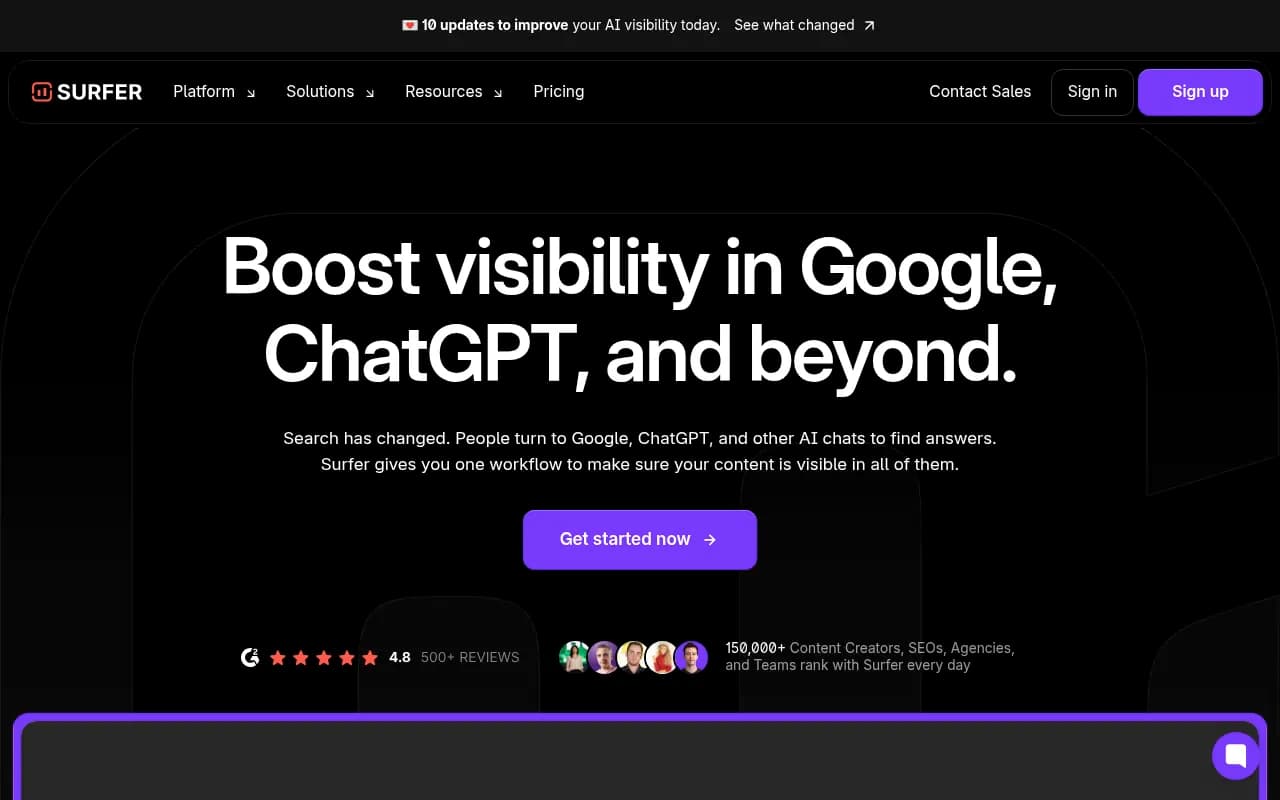
Surfer is probably the most direct Clearscope competitor on this list. Both tools analyze top-ranking pages for a keyword, extract semantic terms and topics, and give you a content score as you write. The core workflow is nearly identical.
Where Surfer pulls ahead: it has a more complete content creation workflow. You can go from keyword research to outline to full draft inside Surfer, whereas Clearscope is more focused on the optimization layer. Surfer's SERP Analyzer is also more detailed if you want to dig into what exactly the top-ranking pages are doing structurally.
Where Clearscope pulls ahead: the content editor is cleaner and less overwhelming, which writers tend to appreciate. Clearscope's grading system is also a bit more intuitive for non-SEO users.
Pricing: Surfer starts at $99/month (Essential: 30 articles/month, 1 user), going up to $399/month (Max: 300 articles, 10 users, 30 AI articles). That's meaningfully cheaper than Clearscope at the entry level, and you get more articles per month. Annual billing saves 20%.
One thing worth noting: Surfer has been expanding its AI search visibility features, positioning itself as a tool for both Google and AI search optimization. It's not as deep as a dedicated AI visibility platform, but it's moving in that direction.
Best for: Teams that want a Clearscope-like experience with more built-in writing assistance and a lower starting price. Also good if you want one tool that handles both content creation and optimization.
Frase
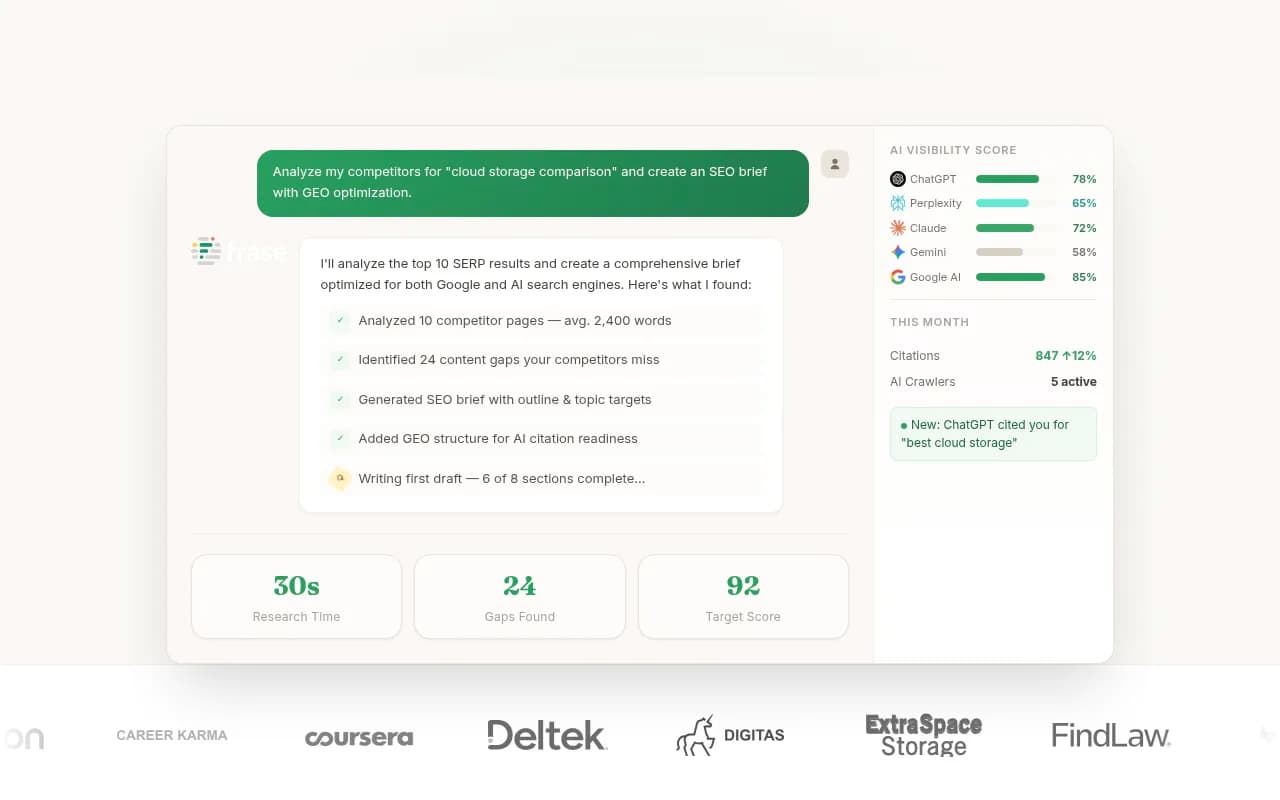
Frase has quietly become one of the more complete content tools in this space. It does research, brief creation, AI writing, and optimization scoring -- all in one platform, at a price that undercuts both Clearscope and Surfer.
The research layer is genuinely strong. Frase pulls in SERP data, surfaces the questions people are asking, and maps out what topics the top-ranking pages cover. The brief builder is fast and produces usable output. And the optimization scoring works similarly to Clearscope's -- you get a target score and see which terms you're missing.
Where Frase has historically been weaker: the AI writing quality has been inconsistent, and the optimization scoring isn't quite as refined as Clearscope's. Some users find the interface a bit cluttered compared to Clearscope's focused editor.
Frase has also been expanding into GEO (Generative Engine Optimization) territory, with tracking for visibility in ChatGPT and Perplexity. It's not as deep as a dedicated AI visibility tool, but it's a sign of where the product is heading.
Pricing: $39/month (Solo: 1 user, 10 articles/month), $114/month (Basic: 3 users, 30 articles), $214/month (Team: unlimited users, 100 articles). 7-day free trial, no credit card required. Significantly cheaper than Clearscope across the board.
Best for: Content teams that want research, briefs, writing, and optimization in one tool without paying Clearscope prices. Especially good for teams producing high article volumes.
MarketMuse
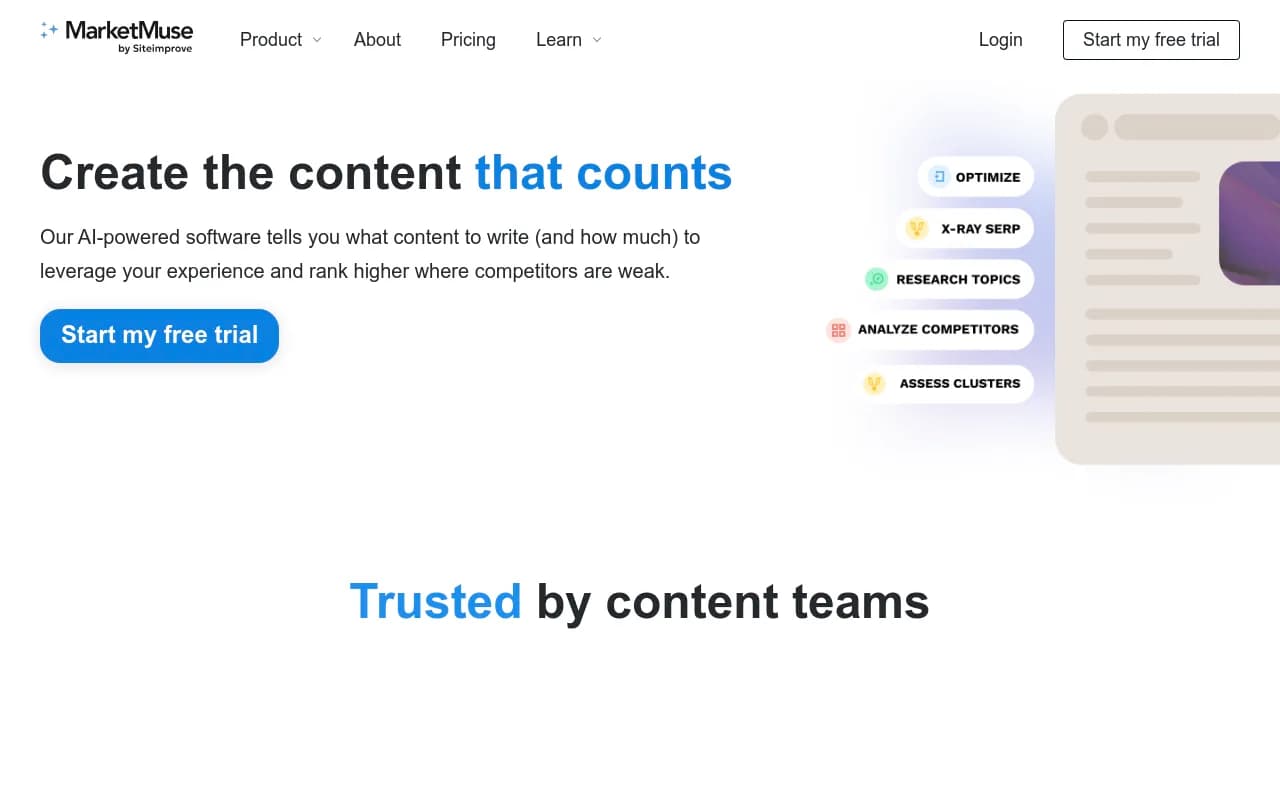
MarketMuse operates at a different level than most content optimization tools. Rather than just analyzing a single keyword and telling you what to include in one article, it analyzes your entire content inventory and tells you where your topical authority is strong, where it's weak, and which topics are worth pursuing given your existing footprint.
The "personalized difficulty" concept is genuinely useful: a topic might be hard for a new site to rank for but easy for you specifically, because you already have strong coverage in adjacent areas. MarketMuse surfaces those opportunities in a way that keyword tools and standard content optimizers don't.
The trade-off is complexity and price. MarketMuse takes longer to learn than Clearscope, and the free tier is limited to 10 queries per month. Paid plans start at $150/month. For a solo writer or small team producing a handful of articles per month, it's probably overkill. For a larger site with hundreds of pages trying to build systematic topical authority, it's one of the better tools available.
Compared to Clearscope, MarketMuse is less about optimizing individual articles and more about deciding which articles to write in the first place. They solve adjacent problems.
Best for: SEO strategists and content teams at larger organizations who need to make data-driven decisions about content prioritization, not just article-level optimization.
GrowthBar
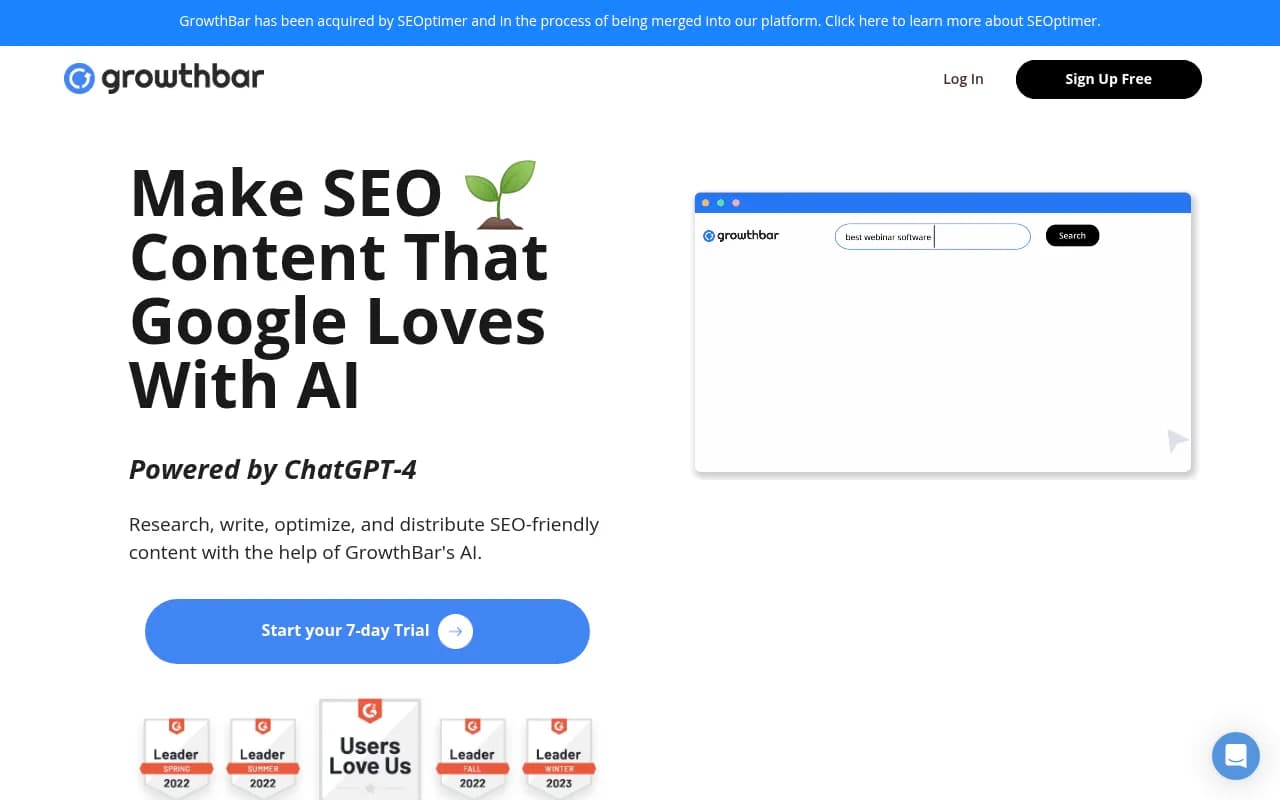
GrowthBar is the most accessible tool on this list -- both in terms of price and learning curve. It's built for bloggers and smaller content teams who want AI-assisted writing with SEO guidance baked in, without needing to become an SEO expert.
The workflow is simple: enter a keyword, get an SEO-optimized outline with suggested headings, keywords, and word count, then use the AI writing assistant to fill it in. The content grader checks your draft against the top-ranking pages as you go.
What it doesn't do as well as Clearscope: the semantic analysis isn't as deep, and the content scoring is less nuanced. If you're doing serious SEO work for a competitive niche, you'll probably feel the limitations. But for a blogger or small marketing team trying to produce decent SEO content efficiently, it gets the job done at a fraction of the price.
Pricing: $36/month (Standard) to $149.25/month (Agency) with annual billing. 7-day free trial. That's dramatically cheaper than Clearscope's $189/month entry point.
Best for: Solo bloggers, freelance writers, and small marketing teams who want AI writing + basic SEO optimization without a steep price tag or learning curve.
Semrush Writing Assistant
The Semrush Writing Assistant is a content optimization tool that lives inside the broader Semrush platform. It analyzes your text against top-ranking pages for your target keywords and gives you recommendations on related terms to include, readability improvements, tone consistency, and plagiarism.
The main selling point is integration: if you're already using Semrush for keyword research and rank tracking, the Writing Assistant is right there. It also has add-ons for Google Docs, WordPress, and Microsoft Word, which is genuinely convenient.
The main limitation: it's not as focused or refined as Clearscope for pure content optimization. The recommendations can feel more generic, and the tool is clearly a supporting feature within a larger platform rather than a purpose-built content optimizer. Semrush also uses fixed prompts for its AI search monitoring features, which limits flexibility.
Pricing: Included in Semrush plans -- Pro at $139.95/month (10 checks/day), Guru at $249.95/month (30 checks/day), Business at $499.95/month. If you're already paying for Semrush Guru or higher, you're getting this for free. If you'd need to upgrade just for it, the math probably doesn't work.
Best for: Teams already on Semrush who want a content optimization layer without adding another tool to their stack.
MarketMuse
Already covered above -- see the MarketMuse section.
Content Harmony
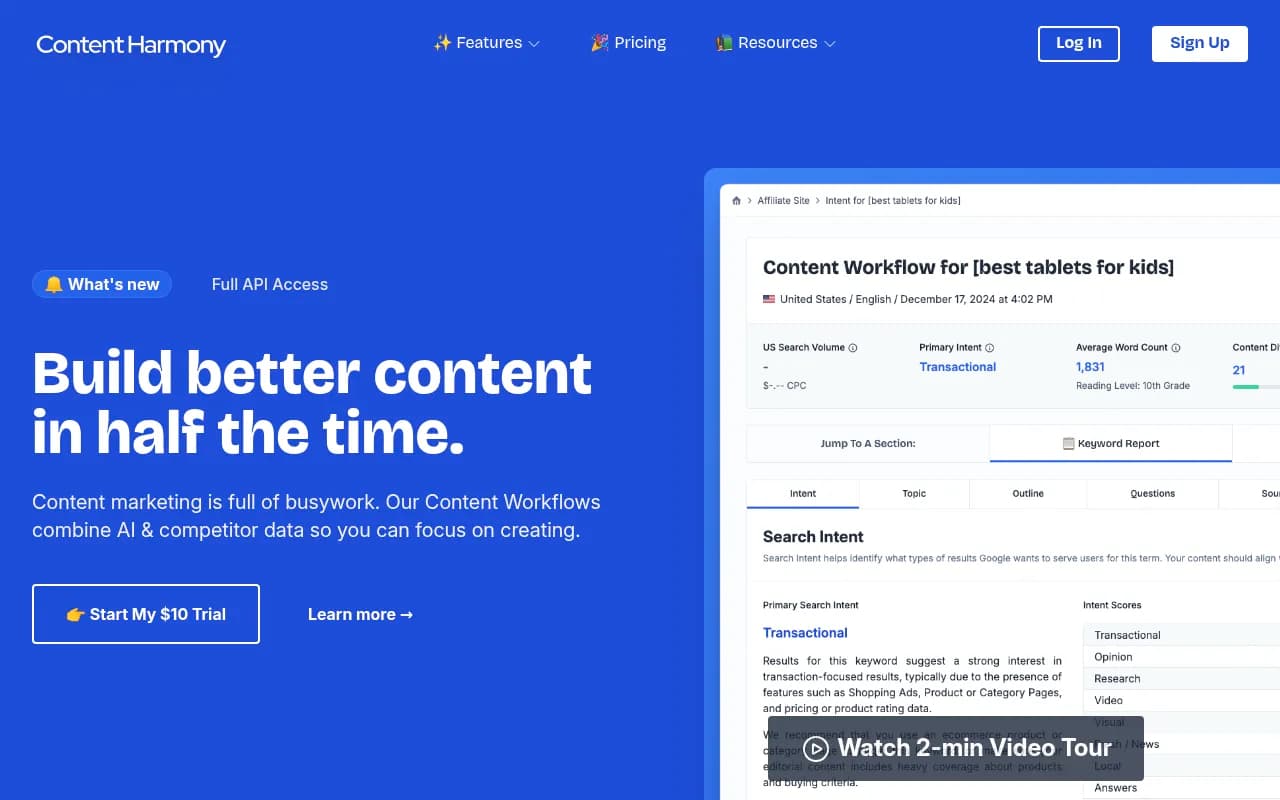
Content Harmony is built specifically for content brief creation, and it's very good at that specific job. The workflow covers keyword research, search intent analysis, competitor structure mapping, topic modeling, and brief generation -- all the things a content strategist would normally spend an hour or two doing manually.
What sets it apart from Clearscope is the emphasis on the brief rather than the optimization score. Clearscope is most useful when a writer is actively drafting or editing. Content Harmony is most useful before writing starts -- it helps you figure out exactly what a piece needs to cover, what structure makes sense, and what questions readers are asking.
The unlimited users model is a genuine advantage for agencies. Most tools charge per seat, which gets expensive fast. Content Harmony's credit-based pricing means you pay for the work you do, not the number of people doing it.
Pricing: $99/month (~10 workflows), $249/month (~30 workflows), $579/month (~100 workflows). $10 trial for 10 workflows available.
Best for: Agencies and content teams that produce high volumes of briefs and want a reliable, repeatable process for brief creation. Less useful as a real-time writing optimizer.
Dashword
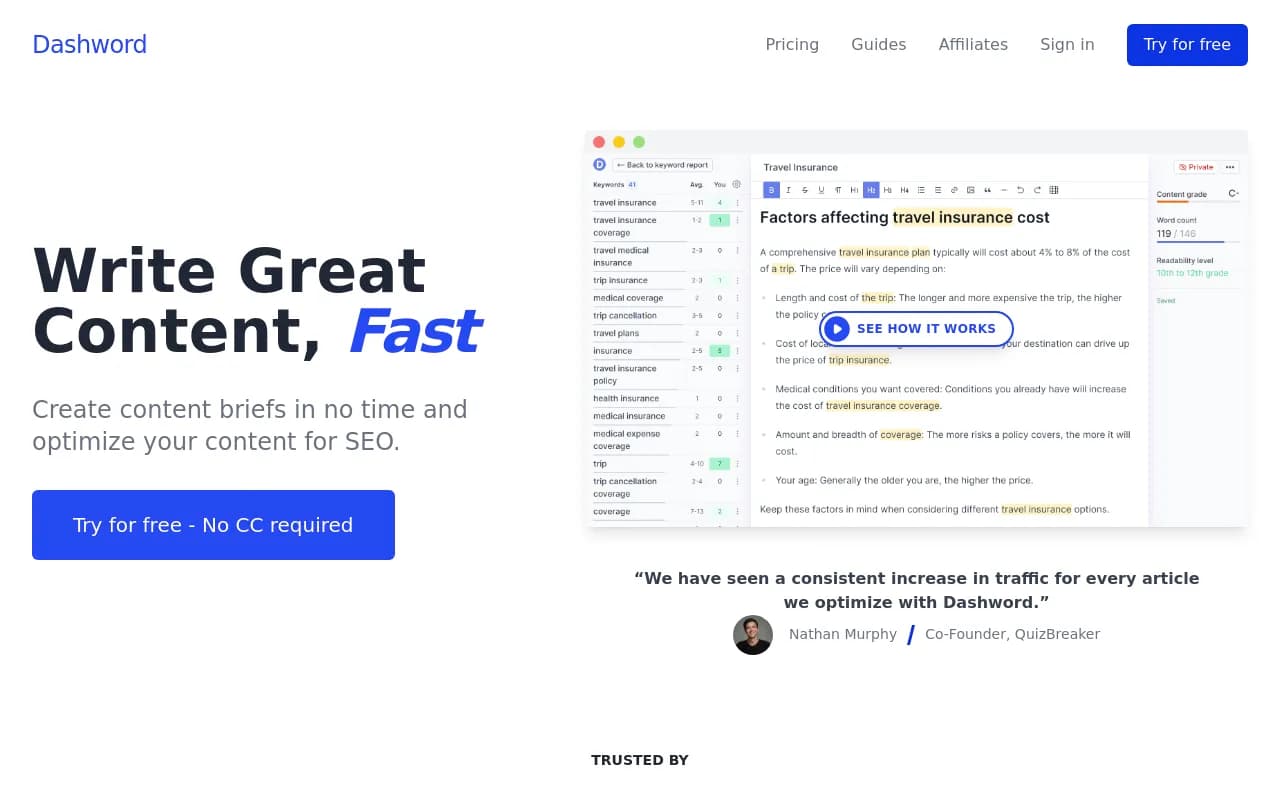
Dashword is a lean, no-frills content optimization tool that covers the basics well: content briefs, real-time optimization scoring, and post-publication monitoring. The interface is clean and the learning curve is minimal.
The post-publication monitoring feature is worth calling out -- Dashword tracks your published pages, alerts you when traffic drops, and generates updated keyword reports weekly. Most content optimization tools stop at publication. Dashword keeps watching, which is useful for teams managing large content libraries.
Where it falls short compared to Clearscope: the semantic analysis isn't as sophisticated, and the AI writing features are more limited. It's a simpler tool, which is either a feature or a bug depending on what you need.
Pricing: Free trial available, paid plans from $39/month. One of the more affordable options on this list, and there's no credit card required to try it.
Best for: Small to mid-size teams that want straightforward content optimization and ongoing content monitoring without paying for features they won't use.
How to choose
The right tool depends on what problem you're actually trying to solve.
If you want a direct Clearscope replacement with similar functionality at a lower price, Surfer SEO is the obvious starting point. If you want research and brief creation bundled in with optimization, Frase is worth a serious look -- it does more than Clearscope at a lower price, even if it's not quite as polished in any single area.
For teams with large content inventories who need to think strategically about what to create and update, MarketMuse is in a different league. For agencies that live by content briefs, Content Harmony is purpose-built for that workflow. For budget-conscious solo creators, GrowthBar or Dashword get the job done without the enterprise price tag.
And if your question is less "how do I rank on Google?" and more "why isn't my brand showing up when people ask AI tools about my category?", that's a different problem entirely -- one that Promptwatch is built to solve. Traditional content optimization tools don't track AI citations, don't analyze what sources ChatGPT is pulling from, and don't help you create content specifically engineered to get cited by AI models. That gap is only going to matter more as AI search continues to grow.
Most teams will end up using more than one tool here -- a content optimizer for Google SEO work, and a dedicated AI visibility platform for the AI search side. The two problems are related but distinct, and the tools that try to do both usually do neither as well as the specialists.