Key takeaways
- In consumer banking, brand-owned sites supply only about 6.8% of ChatGPT citations. Wikipedia, Bankrate, and Investopedia supply roughly 68% between them, according to The Financial Brand's analysis of banking AI citation share.
- Challenger and online-first banks (Ally, SoFi, Marcus, Capital One, Discover) consistently out-cite the traditional "Big Four" on product-specific prompts like "best HYSA" or "best business checking," per 5W PR's Banks AI Visibility Index.
- Reddit's share of ChatGPT citations fell from roughly 3.8% to 0.5% almost overnight on August 14, 2026, per Promptwatch's data. If your fintech strategy leaned on Reddit threads for ChatGPT visibility, that bet just got a lot weaker, though Google AI Overviews still cites Reddit more gradually.
- The SEC has already fined firms for "AI washing" (Delphia and Global Predictions, $400,000 combined in March 2024), which means AI-generated marketing claims are not a compliance-free zone just because an algorithm wrote them.
- AI hallucination rates on finance queries run as high as 41% in some benchmark studies. For YMYL content, that's not a curiosity, it's a liability surface.
Why this matters more in fintech than almost anywhere else
Most marketers now accept that AI answer engines, ChatGPT, Perplexity, Google AI Overviews, Gemini, Copilot, are becoming a real discovery channel. For fintech, the stakes are higher than for, say, a travel brand or a SaaS tool. Financial content sits in Google's YMYL bucket (Your Money, Your Life), and that classification carries over into how AI models weigh trust, authorship, and evidence before they'll cite you.
It also means the downside of getting it wrong is bigger. A hallucinated product feature in a travel chatbot is annoying. A hallucinated APY, fee structure, or eligibility rule in a finance chatbot is the kind of thing that gets you a regulatory letter. The Air Canada case, where a tribunal held the airline liable for its chatbot inventing a refund policy that never existed, is the analogy every fintech compliance team should keep pinned above their desk. "The algorithm made a mistake" was not a defense. It won't be one for you either.
So this guide is split into three parts: who actually gets cited in fintech AI answers right now, what that means for your content strategy, and how to run a program that doesn't get you an SEC letter.
Who actually gets cited in financial AI answers
This is the part that should reset most fintech marketers' expectations. The brands with the biggest AI citation share are not necessarily the brands with the biggest balance sheets.
JPMorgan Chase controls roughly 28.4% of consumer-banking AI citation share, more than Bank of America, Wells Fargo, Citi, and Capital One combined, despite holding only around 12-13% of US deposits, according to The Financial Brand's analysis. That's an outlier in the other direction, Chase's Sapphire card line gives it a defensible, specific product position that AI models can point to. Meanwhile, 22 of the top 75 US banks have a citation share under 0.3%. They are, functionally, invisible in AI answers.
The bigger pattern: third-party comparison and affiliate sites dominate. NerdWallet alone adds about 9.6% of banking citations. NerdWallet, The Points Guy, and Bankrate together supply roughly 62% of card-related answers. A separate Fintel Connect study found non-financial-institution content, meaning affiliates and publishers, appeared in 60% of AI responses to financial product queries across credit cards and high-yield savings accounts, with NerdWallet and Bankrate alone representing 15% of all cited sources.
The Goodie AI study of 5.7 million citations across ChatGPT, Gemini, Claude, and Perplexity found something that should sting: no traditional bank or neobank made the top 10 cited domains on any of the four models. NerdWallet was the "universal constant," the single most cited domain across every model tested.
The upside for challenger brands: 5W PR's index found that online-first banks out-cite the Big Four on product-specific prompts, not because they're more trusted in the abstract, but because they have a clearer product position that comparison sites can point to. Categories like "best bank for freelancers" are what 5W PR calls a citation vacuum, Mercury, Bluevine, Novo, Found, and Relay rotate through without a stable leader. That's an opening, not a dead end.
What this means for your strategy
If your content team's instinct is "we need to out-rank Bankrate," stop. Promptwatch's domain-rank data shows mid-authority domains (DR 46-75) capture nearly half of all ChatGPT citations, while the very top authority tier (DR 91-100) has actually shrunk to around 3% of citations by mid-August 2026. You don't need to be the most authoritative site on the internet. You need to be the most specific, most current, most clearly structured source for a narrow query.
The realistic play for most fintechs is a hybrid one: win the narrow, product-specific prompts where you can be the single best answer (your own fee structure, your own eligibility rules, your own rates), and build relationships with the affiliate and comparison sites that are already winning the broad "best of" prompts, because they are where AI engines are already looking.
Where AI engines are actually pulling content from
A few specific, recent shifts matter for anyone planning a fintech content calendar right now.
Reddit cratered on ChatGPT, but not on Google. ChatGPT's citation of Reddit dropped from about 3.8% to 0.5% almost overnight on August 14, 2026, an 86% relative collapse, per Promptwatch's Reddit citation data. Google AI Overviews and AI Mode pulled back far more gradually over the same window (11.3% and 30.5% relative declines). If your community strategy was built entirely around seeding Reddit threads to get picked up by ChatGPT, that channel just got a lot less reliable. It's still worth it for Google surfaces.
Content format is shifting toward how-tos and documentation, away from pure product pages. Promptwatch's August 2026 content-type breakdown for ChatGPT shows product pages slipping from about 30% to 25% share over the month, while how-to content more than doubled (4.3% to 9.1%) and documentation-style pages rose from 3.3% to 8.2%. For fintech, that argues for fewer glossy landing pages and more plain explainers: "how overdraft protection actually works," "how APY compounding is calculated," that kind of thing.
LinkedIn matters differently depending on the engine. Per Promptwatch's LinkedIn citation data, ChatGPT increasingly cites LinkedIn company pages (33.68% of its LinkedIn citations, up from 23.84%) over Pulse articles, while Google AI Mode and AI Overviews still favor Pulse-style long-form articles (around 34.5% share). For B2B fintech, payments infrastructure, embedded finance, lending platforms, that's a real split: keep your LinkedIn company page complete and current if you care about ChatGPT visibility, but keep publishing Pulse articles if Google's AI surfaces matter more to your buyers.
YouTube beats X for B2B fintech, full stop. Across engines, Reddit dominates ChatGPT's social citations, but Google AI Overviews, Grok, and Perplexity all lean toward YouTube. X never exceeds 0.25% citation share on any engine tracked, per Promptwatch's social media citation breakdown. If you're debating where to put video explainer budget, YouTube is the answer, not short-form X threads.
ChatGPT only cites around 5 sources per response, Google AI Overviews cites around 10. That's a meaningful difference in how competitive the "slots" are. Perplexity sits near 10 as well and is unusually stable day to day, which makes it a decent testbed for GEO experiments before you scale a tactic elsewhere.
Ads are creeping into ChatGPT's answers. Ads now appear in roughly 32% of citation-enabled ChatGPT Search responses as of mid-August 2026, up from zero before May 27, 2026, according to Promptwatch's ad tracking data. Competitor-comparison prompts ("best high-yield savings account") made up 8.6% of ad-bearing responses. If you're planning paid media inside AI search, that's worth budgeting for now, not next year.
The compliance risk nobody's content calendar accounts for
Fintech marketing has three overlapping regulatory regimes to worry about when AI enters the picture: UDAAP enforcement from the CFPB and FTC, FINRA Rule 2210 and the SEC's Marketing Rule (206(4)-1) for anything securities-adjacent, and the model-risk framework under Fed SR 11-7 plus the OCC's 2024 guidance, which explicitly treats LLM-based marketing tools as "models" requiring inventory, validation, and ongoing monitoring if they touch eligibility logic or consumer decisions.
The SEC has already shown it will enforce on this. In March 2024, it charged Delphia (USA) Inc. and Global Predictions Inc. a combined $400,000 for "AI washing," making false or misleading claims about their AI capabilities. Delphia claimed to be "the first regulated AI financial advisor" with "expert AI-driven forecasts" it couldn't substantiate. SEC Chair Gary Gensler's line at the time: "Investment advisers should not mislead the public by saying they are using an AI model when they are not... Such AI washing hurts investors." A month later, five more advisers were charged for Marketing Rule violations tied to AI and performance claims. This is not a one-off; Sidley's review of SEC enforcement activity shows the Marketing Rule being applied broadly through 2024 and 2025, with penalties ranging from $45,000 to $45 million.
FINRA has flagged three specific risk categories under heaviest scrutiny: outputs that are confidently wrong (hallucinations that mislead clients or regulators), client data fed into unsecured AI tools, and a lack of explainability when regulators ask firms to justify an automated decision.
The practical fix isn't to avoid AI content tools, it's to put compliance review in the pipeline from day one instead of bolting it on at the end. A realistic rollout timeline for a compliance-aligned AI marketing program runs around 120 days, with sign-off from Compliance, Model Risk, and FINRA supervisors happening in week one, not week twelve. Skipping that step tends to cost 30 to 90 days of rework later, once legal catches something that should have been caught earlier.
Measuring AI visibility: what to actually track
Most marketing teams have no idea whether AI engines mention them at all, which is the starting problem. A baseline audit is simple to run even without software: pick 15 to 20 prompts your actual customers would type ("best savings account for freelancers," "is [your product] FDIC insured"), run them across ChatGPT, Perplexity, Gemini, and Google AI Overviews, and record whether you appear, where, and how you're described.
That manual spreadsheet approach works for a first pass but doesn't scale, and it won't catch the crawler-level signals that explain why you are or aren't showing up. That's where a dedicated AI visibility platform earns its keep, especially for a fintech brand where the gap between "invisible" and "cited" is often a specific, fixable content or technical issue.
| Platform | Starting price | Finance-specific features | Best for |
|---|---|---|---|
| Promptwatch | $95/mo (Essential) | Crawler logs, citation trend decay, content gap analysis, Agent Chat, CMS publishing | Teams that want monitoring and the content fix in one platform |
| Profound | $295/mo | FactCheck and Citation Decay features, enterprise AEO reporting | Enterprise brands with dedicated AEO budget |
| Ahrefs Brand Radar | $199/mo (plus existing Ahrefs plan) | Built on a 448M+ prompt database; weaker for low-search-volume niche fintech | Established brands with existing search volume |
| AthenaHQ | $95/mo | Predictive citation engine, free tier available | Early-stage teams testing the waters |
| PromptRush | $19/mo | Dedicated finance vertical, accuracy-checking of cited sources | Fintechs wanting a finance-specific, low-cost starting point |
| Otterly.AI | $29/mo | Basic multi-engine tracking | Small teams on a tight budget |

What separates a platform like Promptwatch from a pure tracker is the step after "you're not being cited." Promptwatch's crawler logs (Agent Analytics) show exactly when GPTBot, ClaudeBot, PerplexityBot, and 400+ other crawlers hit your pages and whether they encounter errors, which turns "why aren't we cited" from a guess into a diagnosis. Its Content Agents can then draft and publish GEO-optimized updates to your CMS, Webflow, Framer, or WordPress, under a review workflow you control, rather than leaving the fix as a to-do item nobody owns. For a regulated industry, that review-inbox model matters: you get the speed of automated content production with a human compliance check before anything ships.
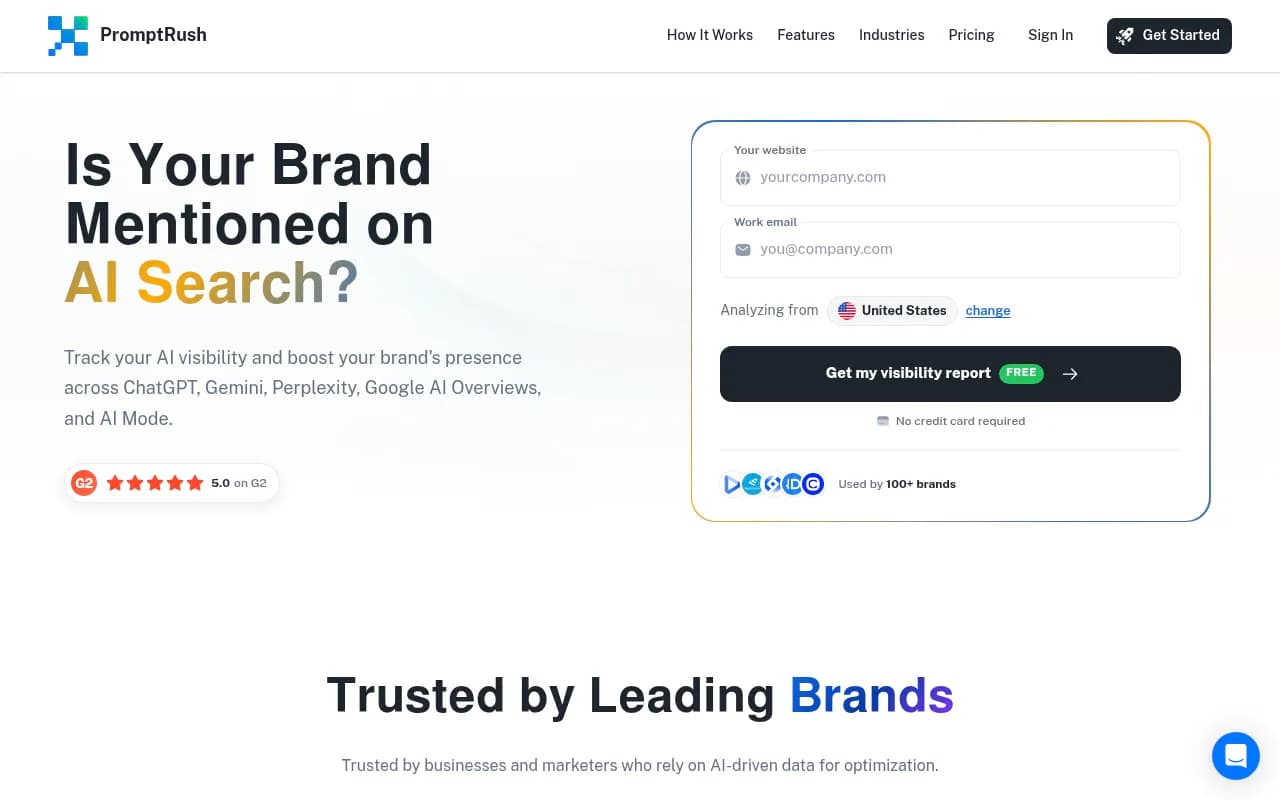
PromptRush is worth a specific callout because it built a finance-specific product: it tracks how ChatGPT, Gemini, Claude, and Google describe your financial products specifically, and checks the accuracy of what's cited against your actual terms. For a smaller fintech team that just needs a sanity check on whether AI is describing your APY or fee structure correctly, that's a reasonable low-cost starting point before investing in a full GEO program.
Ahrefs Brand Radar is the safer bet if you already run an Ahrefs subscription for traditional SEO and want AI visibility bolted onto data you already trust, though its own documentation flags limited coverage for brands with little existing search volume, worth knowing if you're a newer fintech challenger rather than an established player.
A practical content playbook for fintech GEO
A few concrete moves, based on what's actually getting cited right now:
- Write for the narrow prompt, not the broad category. You will not beat Bankrate on "best credit cards 2026." You might beat everyone on "what's the foreign transaction fee on [your card]," because you're the only source with a definitive, current answer.
- Put a specific number in every few hundred words. Promptwatch's content-type data shows documentation and how-to formats rising sharply in ChatGPT citations. Vague marketing copy doesn't get lifted into an answer; a specific rate, fee, or threshold does.
- Treat your LinkedIn company page as owned media, not an afterthought. If ChatGPT visibility matters to your B2B audience, an up-to-date, detailed company page carries real citation weight now.
- Put SME review and verifiable authorship on everything YMYL. Visible credentials and a professional bio footprint Google and AI models can cross-reference are part of the trust signal, not a nice-to-have.
- Don't skip the affiliate relationship just because you'd rather own the citation. If NerdWallet, Bankrate, or a category-specific comparison site is already the consensus source AI engines pull from, getting accurately and favorably represented there is often faster than trying to displace them.
- Build your robots.txt and WAF rules around AI crawlers deliberately, not by default. Compliance-heavy fintech sites often block bots broadly; make sure you're not accidentally blocking the crawlers that drive your citations.
For teams that want to look beyond one platform, the GEO software directory at bestgeosoftware.com is a reasonable place to compare more options side by side, and surferstack.com covers the broader content and SEO tooling layer if you're building out the production side of a GEO program rather than just the monitoring side.
The honest summary
AI visibility in fintech isn't really a new discipline so much as an old one, YMYL E-E-A-T, with a faster feedback loop and a less forgiving regulator. The brands winning citations right now aren't necessarily the biggest balance sheets, they're the ones with the clearest, most current, most specific answer to a narrow question, published somewhere AI engines already trust to pull from. Get the compliance review built into your workflow from the start, because the SEC has already shown it will fine firms for AI-related marketing claims, and the liability doesn't go away just because an algorithm generated the copy.
If you're responsible for both the monitoring and the fix, that's genuinely the harder part to solve with a manual spreadsheet. 1001 SEO Media works with fintech and finance clients on exactly this kind of compliant content and GEO program, if you'd rather not build the pipeline from scratch.