Key takeaways
- Scrunch is a solid AI visibility monitoring tool -- it shows you where your brand appears across AI search engines, but stops there.
- Promptwatch goes beyond monitoring: it identifies content gaps, generates content engineered to get cited by AI models, and tracks whether that content actually improves your visibility.
- The core difference is passive vs active. Scrunch tells you what's happening. Promptwatch helps you change it.
- For teams that just want a dashboard to report on AI visibility, Scrunch may be enough. For teams that want to grow their AI visibility, the monitoring-only approach has a ceiling.
- Pricing, feature depth, and use case fit differ significantly -- this guide breaks down exactly where each platform wins and loses.
The GEO tool market has grown fast enough in 2026 that the category itself has split into two distinct types of product: monitoring dashboards and optimization platforms. Scrunch sits firmly in the first camp. Promptwatch sits in the second -- and argues, pretty convincingly, that monitoring without optimization is just expensive reporting.
This isn't a hit piece on Scrunch. It's a genuinely useful comparison for anyone trying to decide where to spend their budget. Both tools have real strengths. But they're built for different jobs, and picking the wrong one will leave you either overpaying for features you don't use or stuck with data you don't know how to act on.
What Scrunch actually does
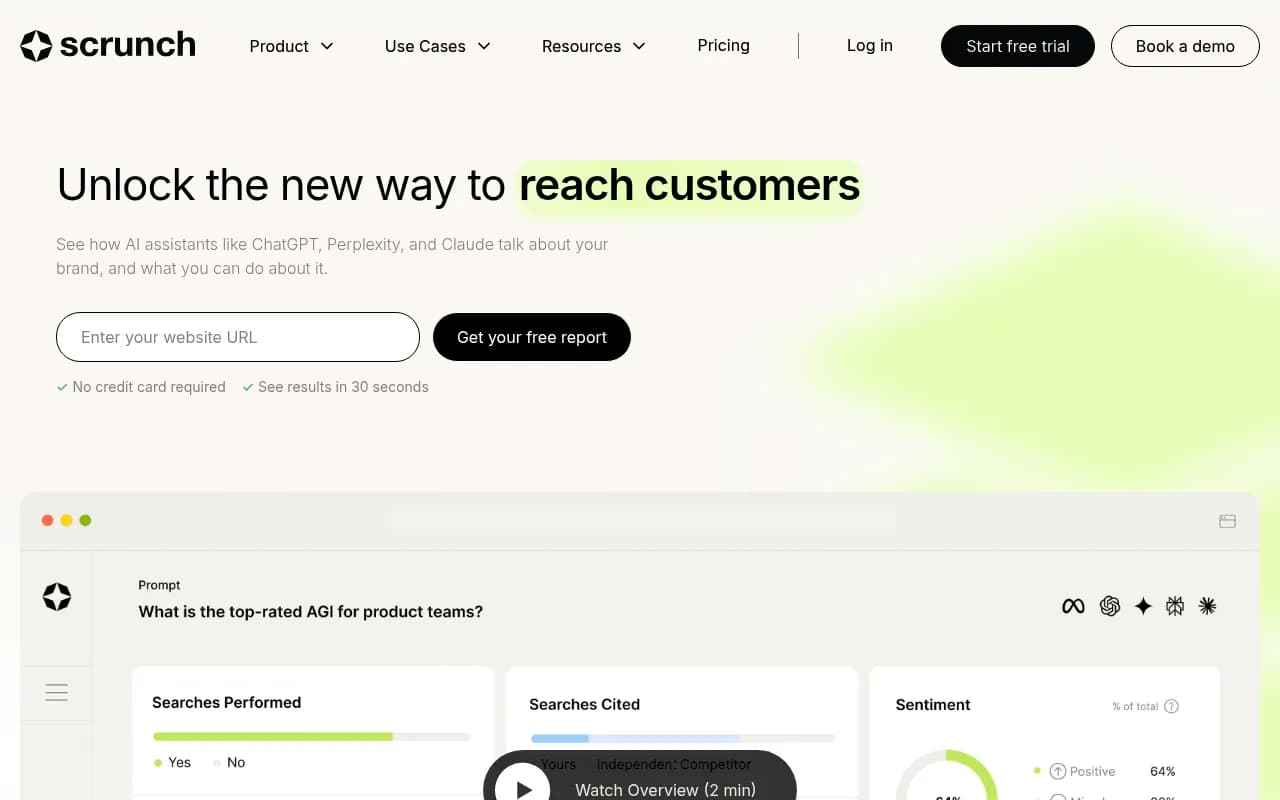
Scrunch monitors how your brand appears across AI search engines -- ChatGPT, Perplexity, Claude, Gemini, and others. You set up prompts relevant to your industry, and Scrunch tracks whether your brand gets mentioned, how often, and with what sentiment.
The platform has a clean interface, reasonable prompt coverage, and a competitor comparison view that lets you see how rivals are performing across the same queries. It's genuinely useful for understanding your baseline AI visibility and tracking changes over time.
Where Scrunch stops: it gives you the data, then leaves you to figure out what to do with it. There's no content gap analysis, no built-in content generation, no crawler logs showing you how AI bots are actually interacting with your site, and no traffic attribution connecting AI citations to actual visits or revenue. You see the score. You don't get a playbook for improving it.
What Promptwatch actually does
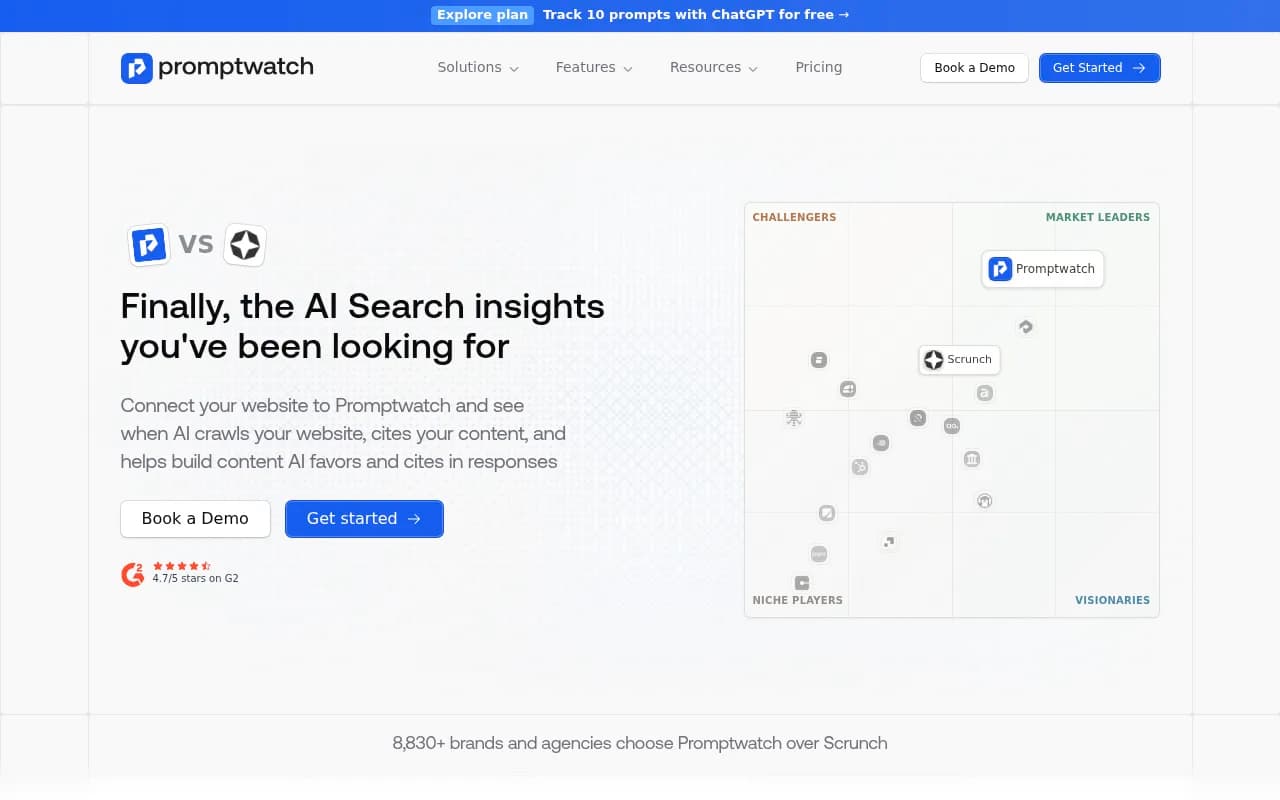
Promptwatch covers the monitoring layer too -- tracking your brand across 10 AI models including ChatGPT, Perplexity, Claude, Gemini, Grok, DeepSeek, Copilot, Mistral, Meta AI, and Google AI Overviews. But the monitoring is the starting point, not the product.
The platform is built around what it calls an action loop:
- Find the gaps -- Answer Gap Analysis shows you which prompts your competitors are visible for but you're not. Not vague categories. Specific prompts, with the actual content your site is missing.
- Create content that gets cited -- A built-in AI writing agent generates articles, listicles, and comparisons grounded in citation data from 880M+ analyzed citations. The output is calibrated to what AI models actually cite, not generic SEO content.
- Track the results -- Page-level tracking shows which pages are being cited, by which models, and how often. Traffic attribution (via code snippet, Google Search Console integration, or server log analysis) connects visibility improvements to real business outcomes.
On top of that, Promptwatch has AI crawler logs -- real-time logs of when ChatGPT, Claude, Perplexity, and others crawl your site, which pages they read, and what errors they hit. Most competitors don't have this at all. It's the kind of feature that sounds technical but is genuinely useful: if an AI model can't properly crawl your site, your content can't get cited no matter how good it is.

Feature-by-feature comparison
| Feature | Scrunch | Promptwatch |
|---|---|---|
| AI model coverage | Multiple (ChatGPT, Perplexity, Claude, Gemini) | 10 models (ChatGPT, Perplexity, Claude, Gemini, Grok, DeepSeek, Copilot, Mistral, Meta AI, Google AI Overviews) |
| Brand visibility tracking | Yes | Yes |
| Competitor comparison | Yes | Yes (with heatmaps) |
| Prompt volume & difficulty scoring | No | Yes |
| Query fan-out analysis | No | Yes |
| Answer gap analysis | No | Yes |
| AI content generation | No | Yes (built-in writing agent) |
| AI crawler logs | No | Yes |
| Reddit & YouTube tracking | No | Yes |
| ChatGPT Shopping tracking | No | Yes |
| Traffic attribution | No | Yes (snippet, GSC, server logs) |
| Conversion tracking | No | Yes |
| Multi-language / multi-region | Limited | Yes |
| Looker Studio integration | No | Yes |
| API access | Limited | Yes |
| G2 rating | Not listed | 4.7/5 |
The table tells the story pretty clearly. Scrunch covers the monitoring basics. Promptwatch covers those same basics and then adds the entire optimization layer on top.
Where Scrunch wins
Scrunch isn't without merit. A few scenarios where it makes sense:
Simpler reporting needs. If your team just needs to show stakeholders a monthly AI visibility score and you're not yet ready to act on the data, Scrunch's cleaner interface might be less overwhelming.
Earlier-stage teams. If you're just getting started with GEO and want to understand what AI visibility even looks like before investing in optimization, Scrunch is a lower-commitment entry point.
Budget constraints. Depending on your tier, Scrunch may come in at a lower price point -- though you should weigh that against what you're actually getting.
The honest caveat: if you're using Scrunch and your AI visibility isn't improving, you'll eventually hit a wall. The data tells you you're invisible. It doesn't tell you how to become visible.
Where Promptwatch wins
For most marketing and SEO teams actively trying to grow their AI search presence, Promptwatch's advantage is structural. Monitoring-only tools create a loop where you see bad numbers, guess at fixes, and hope things improve. Promptwatch closes that loop.
The Answer Gap Analysis is the feature that stands out most. Instead of telling you "your brand appears in 12% of relevant prompts," it tells you "here are the 47 specific prompts where your competitors appear and you don't, and here's the content your site is missing to change that." That's actionable in a way that a visibility score isn't.
The crawler logs are underrated. Knowing that Perplexity's bot visited your site three times last week but kept hitting 404 errors on your product pages is the kind of insight that changes what you prioritize. You can't fix what you can't see.
And the traffic attribution piece matters more than people expect. AI visibility is still hard to justify to finance teams without connecting it to revenue. Promptwatch's ability to tie AI citations to actual traffic and conversions makes the business case for GEO investment much easier to make.
Pricing comparison
Promptwatch's pricing is public:
- Essential: $99/month -- 1 site, 50 prompts, 5 articles/month
- Professional: $249/month -- 2 sites, 150 prompts, 15 articles/month, crawler logs, city/state tracking
- Business: $579/month -- 5 sites, 350 prompts, 30 articles/month
- Agency/Enterprise: custom pricing
A free trial is available, and annual billing comes with a discount.
Scrunch's pricing isn't as transparently published, which makes direct comparison harder. Based on available information, it's positioned as a mid-to-higher-tier product, though without the optimization features that justify Promptwatch's price points.
For teams comparing on pure cost, the right question isn't "which is cheaper?" but "which one can actually move the needle on AI visibility?" A monitoring tool that doesn't help you improve is a cost, not an investment.
Who each tool is actually for
Scrunch is a reasonable fit if:
- You need a straightforward AI visibility dashboard for reporting purposes
- You have a separate content team that will act on insights independently
- You're in an early discovery phase and not yet ready to invest in optimization
Promptwatch is a better fit if:
- You want to actively grow your brand's presence in AI search results
- You need to connect AI visibility to traffic and revenue
- You're managing multiple sites or clients (agency use case)
- You want to understand how AI crawlers interact with your site
- You're competing in a category where rivals are already investing in GEO
The broader context: why "monitoring-only" has limits in 2026
The GEO tool market started as a monitoring market. The first wave of tools -- Scrunch, Otterly.AI, Peec.ai, and others -- were essentially dashboards that answered the question "are we visible in AI search?" That was genuinely useful in 2023 and 2024 when most brands didn't even know the question existed.
In 2026, that question is answered. Most serious marketing teams know their AI visibility score. The new question is "how do we improve it?" -- and that's where monitoring-only tools run out of road.


The platforms that have pulled ahead are the ones that help you do something with the data. Promptwatch's content generation, gap analysis, and attribution features are a direct response to this shift. So are tools like Profound (strong enterprise feature set, though at a higher price) and AthenaHQ (monitoring-focused but with some optimization capabilities).

The pattern is consistent: brands that monitor without optimizing see flat AI visibility over time. Brands that use their monitoring data to drive content creation and technical fixes see measurable improvement.
A note on content quality in AI search
One thing worth saying clearly: the content generation features in Promptwatch aren't just about volume. The writing agent is grounded in citation data -- it analyzes what sources AI models actually cite and generates content calibrated to those patterns. That's different from a generic AI writer that produces SEO filler.
This matters because AI models are selective about what they cite. A 2,000-word article that doesn't match the structure, depth, or specificity that models like ChatGPT and Perplexity look for won't get cited regardless of how well it's written by human standards. Promptwatch's approach of building content around real citation patterns is the right way to think about this problem.
Bottom line
Scrunch is a competent monitoring tool. If all you need is visibility data, it does that job.
But if you're trying to actually improve your brand's presence in AI search -- to show up more often, in more prompts, across more models -- monitoring alone won't get you there. You need to know what content is missing, create it in a format AI models want to cite, and track whether it's working.
That's what Promptwatch is built to do. For most teams with an active GEO mandate, it's the more complete tool.
The free trial is worth running if you're on the fence. Seeing your own Answer Gap Analysis for the first time tends to make the decision pretty clear.