Key takeaways
- Scrunch, Otterly.AI, and Peec AI are all legitimate AI visibility monitoring tools, but they stop at the data -- none of them help you act on what they find
- Otterly.AI is the most accessible entry point (plans start at $29/month), Peec AI has the strongest analytics depth, and Scrunch is positioned more toward enterprise use cases
- All three share the same core gap: no content gap analysis, no AI content generation, no crawler logs, and limited or no traffic attribution
- If you're just starting out and want to understand where you stand in AI search, any of these can work; if you want to actually improve your visibility, you'll need something that goes further
- Platforms like Promptwatch close the loop between monitoring and action -- find gaps, generate content, track results
There's a pattern in the AI visibility tools market right now. A company builds a dashboard that queries ChatGPT, Perplexity, and a few other models with your target prompts, records whether your brand shows up, and presents the results in a clean interface. They call it an "AI visibility platform." They charge anywhere from $29 to several hundred dollars a month. And then they stop.
Scrunch, Otterly.AI, and Peec AI all follow this pattern to varying degrees. That's not a knock on them -- monitoring is genuinely useful, and these tools do it reasonably well. But if you're evaluating them, you should understand exactly what you're buying and what you're not.
This guide breaks down each tool honestly, then explains what the monitoring-only model systematically leaves out.
What these tools actually do
Before getting into the differences, it's worth being clear about what all three share. Each one lets you:
- Set up a list of prompts relevant to your business
- Run those prompts across one or more AI models (ChatGPT, Perplexity, Gemini, Claude, etc.)
- See whether your brand appears in the responses
- Track that visibility over time
That's the core loop. Where they differ is in how many models they cover, how deep their analytics go, how the interface works, and what they charge.
Otterly.AI
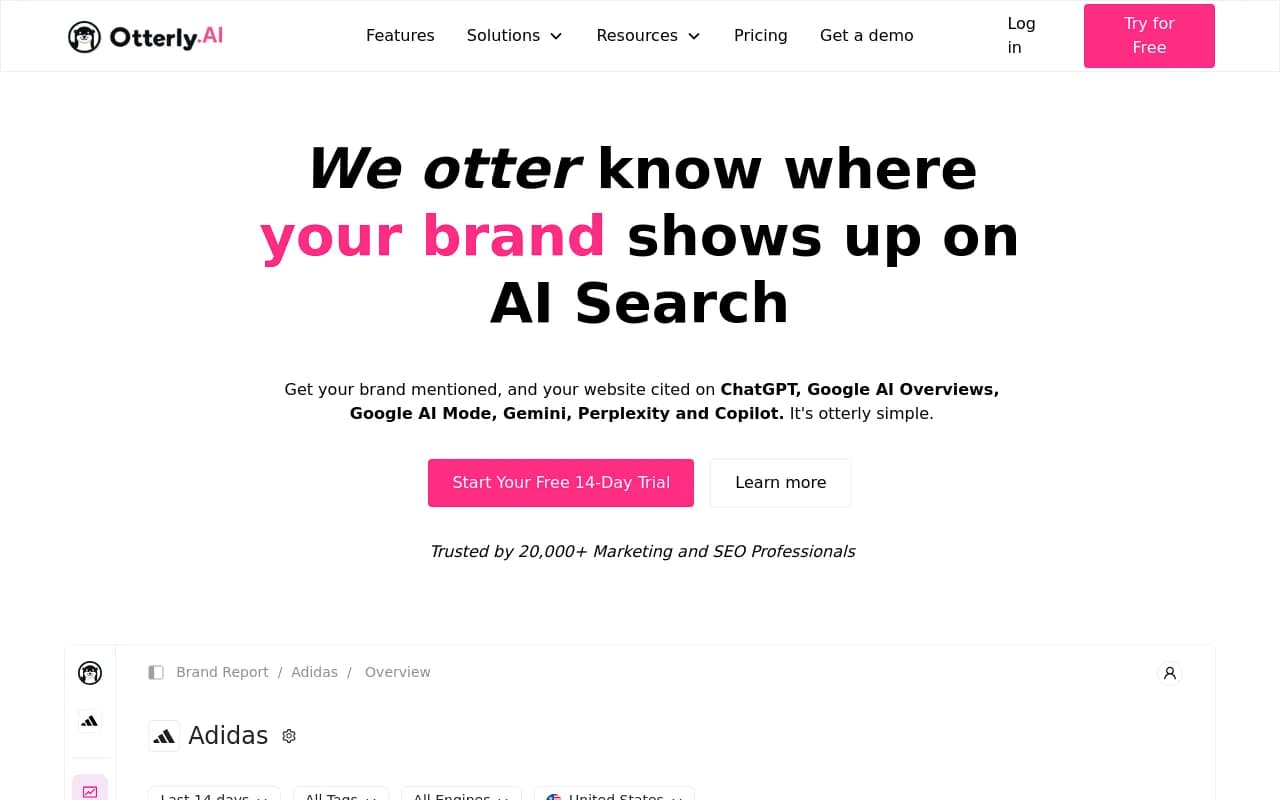
Otterly.AI is probably the most accessible of the three. It's the tool most often recommended for teams that want to dip a toe into AI visibility monitoring without committing to a significant budget or a complex setup.
Plans start at $29/month, which puts it within reach for small marketing teams and solo practitioners. The interface is clean and relatively intuitive -- you can get a basic monitoring setup running in under an hour.
Coverage includes ChatGPT, Perplexity, Google AI Overviews, and a handful of other models. The prompt tracking is straightforward: you define your prompts, Otterly runs them on a schedule, and you see your brand's share of voice over time.
Where Otterly starts to show its limits is depth. The analytics are surface-level by design. You can see that your brand appeared (or didn't), but you don't get much context about why -- which pages are being cited, what content the AI is drawing on, or what your competitors are doing differently. There's no content gap analysis, no suggestion of what to write next, and no way to connect your AI visibility to actual website traffic.
For a team that just wants to know "are we showing up in ChatGPT?" and track that number over time, Otterly works. For a team that wants to do something about it, the tool runs out of road quickly.
Peec AI
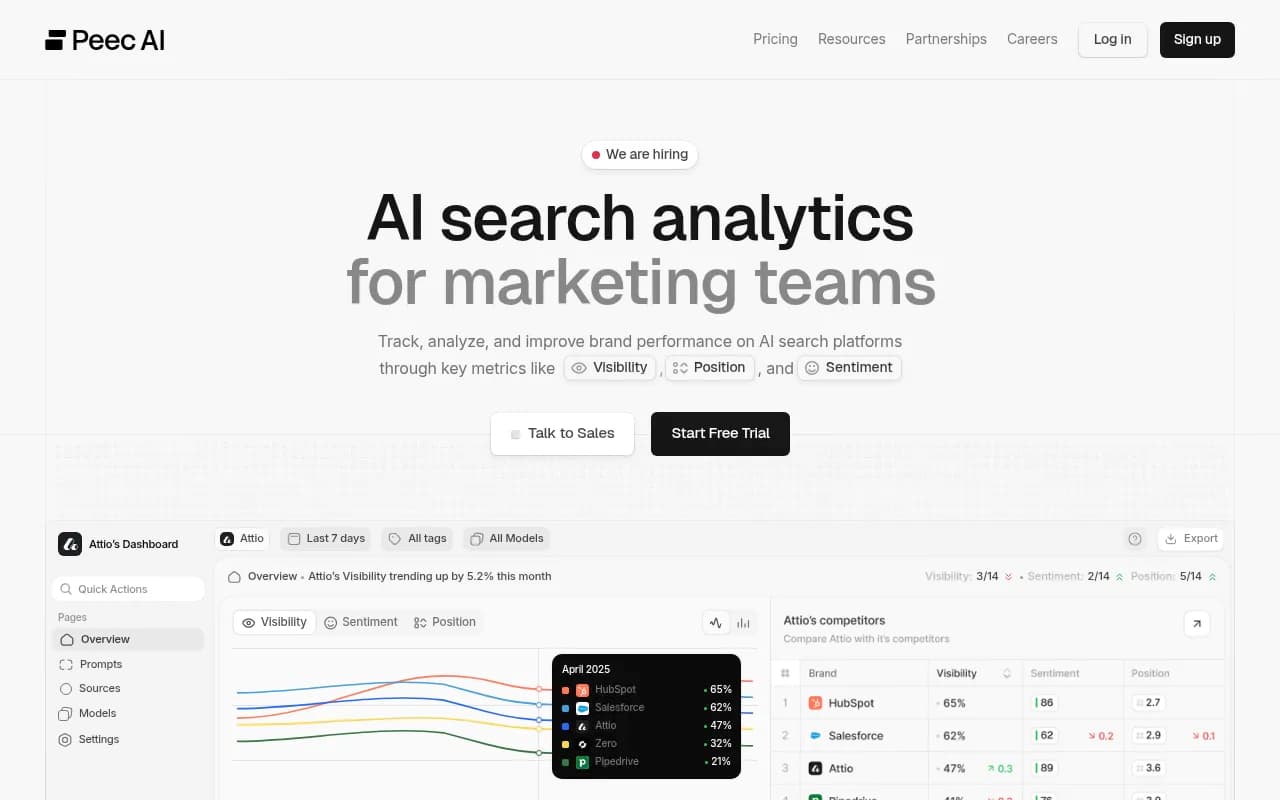
Peec AI is the most analytically ambitious of the three. According to Surmado's 2026 market overview, Peec raised $29M and hit $4M+ ARR in its first ten months -- which is a meaningful signal that it's found real traction, particularly in the mid-market.
The platform goes deeper than Otterly on the analytics side. You get more granular breakdowns of prompt performance, competitor comparisons, and some sentiment analysis around how your brand is being described (not just whether it appears). The research features are stronger than most monitoring-only alternatives, as noted in Erlin AI's 2026 roundup.
Pricing sits above Otterly but below the enterprise-tier tools like Profound or Scrunch. It's a reasonable fit for marketing teams at mid-sized companies that want more than basic monitoring but aren't ready for a five-figure annual contract.
The limitation is the same one that affects the whole category: Peec monitors, but it doesn't optimize. You can see that a competitor is appearing in prompts you're missing. You can't use Peec to figure out what content to create to close that gap, generate that content, or track whether your new content actually improved your AI visibility. The data is good. The action layer doesn't exist.
Scrunch
Scrunch (also listed as Scrunch AI) is positioned toward the enterprise end of the market. It's well-funded and has real clients, but it's less transparent about pricing than Otterly or Peec -- which is usually a sign that deals are negotiated rather than self-serve.
The tool focuses on a specific question that most monitoring tools address only partially: not just whether your brand appears, but how AI assistants like ChatGPT and Claude characterize your brand when they mention it. That's a meaningful distinction. A brand can appear frequently in AI responses but be described in ways that are inaccurate, outdated, or unflattering -- and a tool that only counts mentions misses that entirely.
Scrunch's sentiment and characterization tracking is a genuine differentiator within the monitoring-only category. If your primary concern is brand safety and narrative control in AI responses (rather than share-of-voice growth), Scrunch addresses that more directly than Otterly or Peec.
That said, the same structural gap applies. Scrunch tells you how you're being described. It doesn't help you change it. There's no content generation, no gap analysis showing which prompts competitors own that you don't, and no crawler logs showing how AI engines are actually reading your site.
Side-by-side comparison
| Feature | Otterly.AI | Peec AI | Scrunch |
|---|---|---|---|
| Starting price | ~$29/month | Mid-market (not public) | Enterprise (custom) |
| AI models covered | ChatGPT, Perplexity, Google AIO, others | Multiple LLMs | ChatGPT, Claude, others |
| Prompt tracking | Yes | Yes | Yes |
| Competitor monitoring | Basic | Yes | Yes |
| Sentiment/characterization | Limited | Some | Strong |
| Content gap analysis | No | No | No |
| AI content generation | No | No | No |
| Crawler logs | No | No | No |
| Traffic attribution | No | No | No |
| Reddit/YouTube tracking | No | No | No |
| Best for | Entry-level monitoring | Mid-market analytics | Enterprise brand safety |
What all three are missing
This is the part that matters most, and it's worth being direct about it.
The gap between data and action
Every one of these tools will show you a dashboard. Some dashboards are prettier than others. Some have more data points. But the fundamental output is the same: a report telling you where you stand.
What none of them do is tell you specifically what to do about it. If your brand is invisible for a set of high-value prompts, you need to know:
- Which prompts are your competitors winning that you're not?
- What content is your site missing that would make AI models more likely to cite you?
- What should you actually write, and how should you write it to get cited?
- Did the content you created actually improve your visibility?
Monitoring tools answer none of these questions. They show you the score. They don't coach you on how to improve it.
No crawler log visibility
AI models crawl websites to build their knowledge. Understanding which of your pages they're reading, how often they return, and whether they're hitting errors is genuinely important for diagnosing why you're not being cited. None of these three tools give you that.
No traffic attribution
If you're spending money on AI visibility tools, you presumably want to connect that visibility to business outcomes. How many visitors are actually arriving from AI search? Which pages are driving that traffic? None of these tools close that loop. You're left with visibility scores that may or may not correlate with anything that matters to your business.
No Reddit or YouTube tracking
A significant portion of what AI models cite comes from Reddit threads, YouTube videos, and forum discussions -- not just brand websites. If a Reddit thread is shaping how ChatGPT describes your category, you'd want to know. None of these three tools surface that.
What to use if you want to actually optimize
If monitoring is all you need -- a sanity check on whether your brand is appearing in AI search -- then Otterly.AI is probably the most cost-effective starting point, Peec AI is worth considering if you want more analytical depth, and Scrunch makes sense if brand characterization and narrative accuracy are your primary concerns.
But if you want to move from "we know we're invisible" to "we've fixed it," you need a platform that goes further.
Promptwatch is built around that action loop. It monitors across 10 AI models (ChatGPT, Perplexity, Claude, Gemini, Google AI Overviews, DeepSeek, Grok, Copilot, Meta AI, and Mistral), but the monitoring is the starting point, not the endpoint.

The Answer Gap Analysis shows you exactly which prompts competitors rank for that you don't -- and what content your site is missing that would change that. The built-in AI writing agent then generates articles, listicles, and comparisons grounded in citation data from over 880 million citations analyzed. And page-level tracking shows you whether your new content is actually getting cited, by which models, and how often.
It also includes AI crawler logs (so you can see which of your pages ChatGPT and Perplexity are actually reading), Reddit and YouTube tracking, ChatGPT Shopping monitoring, and traffic attribution via GSC integration, code snippet, or server log analysis.
That's the difference between a monitoring dashboard and an optimization platform.
How to think about the choice
The honest framing is this: monitoring tools are useful for awareness. They tell you there's a problem. Optimization platforms help you solve it.
If you're a small team with a limited budget and you just want to establish a baseline -- to know whether you're showing up at all -- Otterly.AI at $29/month is a reasonable place to start. You'll quickly hit its ceiling, but the entry cost is low.
If you're a mid-market marketing team with real budget and a mandate to improve AI visibility, Peec AI gives you better data to work with. But you'll still need to figure out the "what do we do about this" part yourself.
If you're at an enterprise with brand safety concerns and a need to understand how AI models are characterizing your brand (not just whether you appear), Scrunch addresses that more specifically than the others.
And if you're at any stage and you want a tool that doesn't just tell you the problem but helps you fix it, the monitoring-only category isn't the right fit. Promptwatch's Professional plan at $249/month includes crawler logs, content generation, and the full optimization loop -- which is a different category of tool entirely, not just a more expensive version of the same thing.
The bottom line
Scrunch, Otterly.AI, and Peec AI are real tools that do what they say. The issue isn't that they're bad -- it's that the category they belong to has a structural ceiling. Monitoring tells you where you are. It doesn't move the needle.
In 2026, with AI search traffic converting at 4-5x the rate of traditional search (per Conductor's State of AEO/GEO report), the cost of being invisible in AI responses is real and measurable. A tool that tells you you're invisible but doesn't help you fix it is only solving half the problem.
Know what you're buying before you buy it.