Key takeaways
- Scrunch is built around controlling what AI agents ingest from your site, with a strong focus on agent experience and technical delivery of content to AI crawlers.
- Bluefish AI targets brand protection at the enterprise level, with a focus on how AI models perceive and represent your brand.
- Promptwatch is the only platform of the three that closes the full loop: find where you're invisible, generate content to fix it, and track whether that content gets cited.
- All three are enterprise-grade, but they solve meaningfully different problems. Choosing the wrong one wastes budget and months of onboarding time.
- If your team needs to act on AI visibility data, not just report on it, the platform you pick matters more than most vendors will admit.
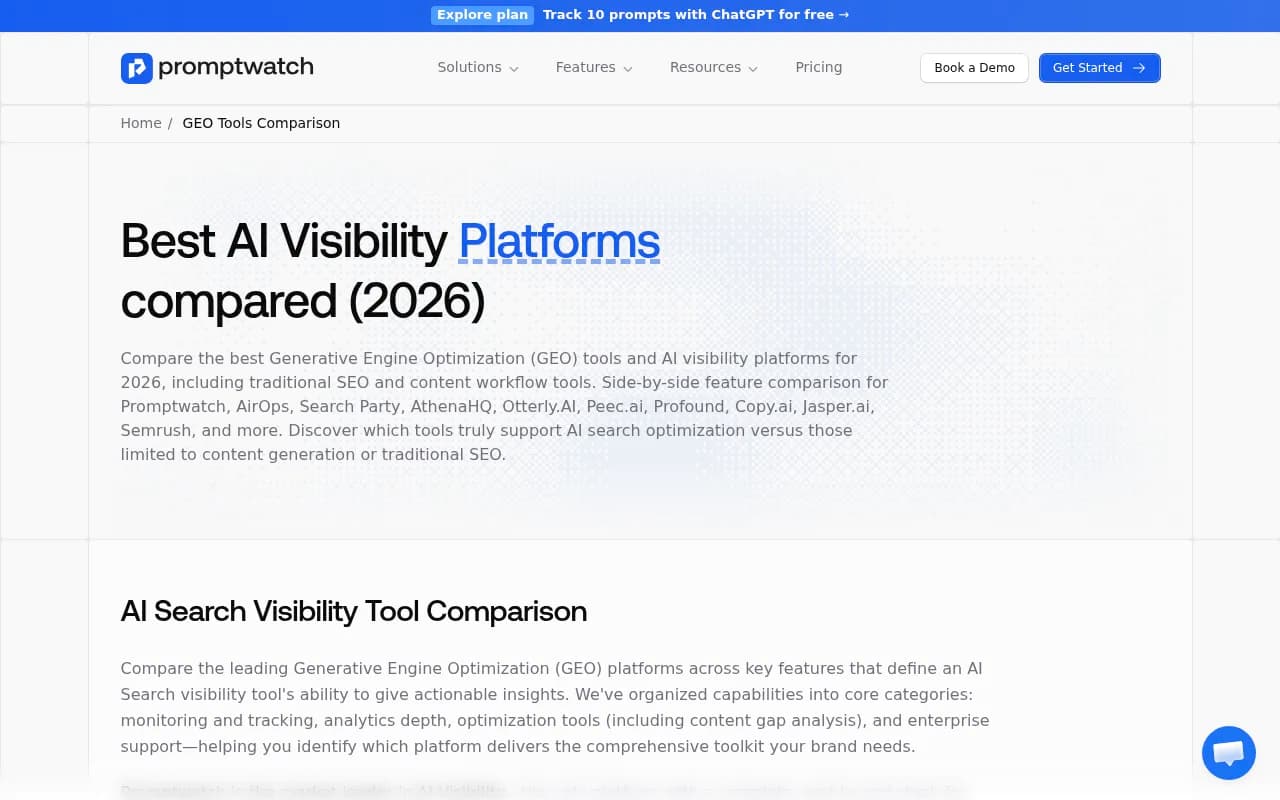
The GEO platform market has gotten crowded fast. Between summer 2025 and spring 2026, the space raised over $300M in funding, and now every tool claims to be the "enterprise leader." Scrunch, Bluefish AI, and Promptwatch are three of the most frequently shortlisted platforms for mid-market and enterprise teams. They're all real, they're all capable, and they're all genuinely different.
This guide cuts through the positioning to explain what each platform actually does, where each one falls short, and which type of organization is best served by each.
What we mean by "enterprise GEO"
Generative Engine Optimization is the practice of improving how your brand appears when someone asks ChatGPT, Claude, Perplexity, Gemini, or Google's AI Overviews a question relevant to your business. For enterprise teams, this means tracking dozens or hundreds of prompts across multiple AI models, multiple markets, and multiple competitors, then doing something about the gaps.
The "enterprise" part matters because the stakes are higher. A Fortune 500 brand losing AI visibility to a competitor isn't just an SEO problem, it's a revenue problem. And the tools that serve enterprise teams need to handle scale, security, integrations, and multi-stakeholder reporting, not just a dashboard with some prompt tracking.
With that framing in place, here's how the three platforms actually stack up.
Scrunch: built for agent experience, not just monitoring
Scrunch positions itself around what it calls "Agent Experience" (AXP), which is a genuinely different angle than most GEO tools take. The idea is that AI agents (ChatGPT, Perplexity, Claude, etc.) crawl and consume your website differently than human visitors do, and most websites are not optimized for that consumption pattern.
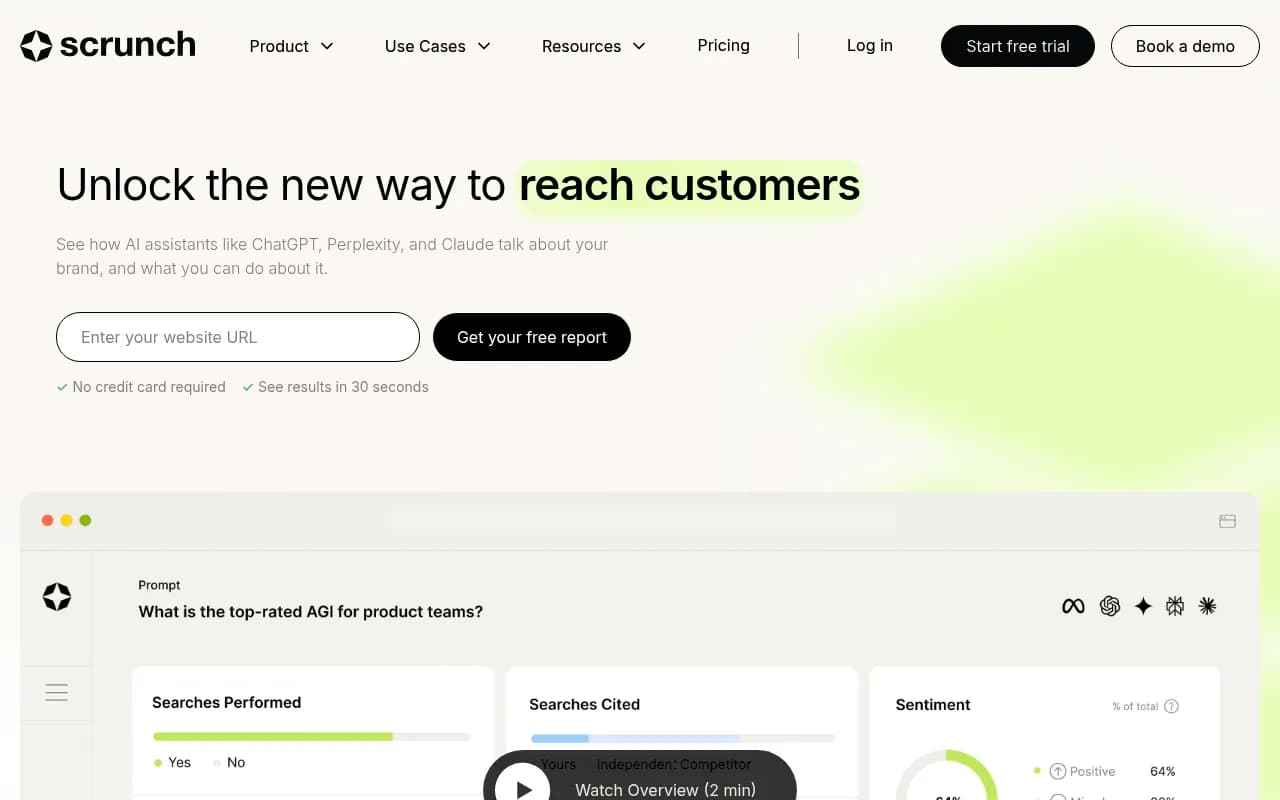
Scrunch's platform breaks into two main areas. The first is agent traffic analysis: understanding which AI crawlers are hitting your site, what they're reading, and how they're navigating your content. The second is the AXP layer, which lets you deliver AI-optimized content directly to AI agents, essentially controlling what they ingest rather than just hoping they find the right pages.
This is a real differentiator. Most GEO platforms track what AI models say about you. Scrunch tries to influence what AI models see when they crawl you. According to Scrunch's own comparison (which, yes, they wrote themselves), only Scrunch and Adobe LLM Optimizer deliver AI-optimized content directly to AI agents at the enterprise level.
Scrunch also carries SOC 2 Type II certification, SSO, and RBAC, which matters for enterprise security reviews. Their shopping module tracks AI search performance at the product level, which is useful for e-commerce brands.
Where Scrunch falls short
The agent experience angle is compelling, but it's still primarily a technical and monitoring play. Scrunch shows you what AI agents see and gives you some control over it, but it doesn't generate content to fill the gaps it finds. If your AI visibility problem is that competitors are getting cited for topics you've never written about, Scrunch can surface that, but you'll need another tool (or your own content team) to actually fix it.
Pricing is enterprise-tier and requires a demo to get specifics. That's fine for large organizations, but it means smaller teams often can't self-serve their way in.
Bluefish AI: brand protection at enterprise scale
Bluefish AI takes a different angle. Where Scrunch focuses on the technical delivery of content to AI agents, Bluefish focuses on brand equity: how AI models perceive, represent, and recommend your brand across different contexts.
The platform is built for mid-market and enterprise organizations that are worried about AI models misrepresenting their brand, recommending competitors instead of them, or generating inaccurate information about their products. This is a real problem. AI models can and do hallucinate brand details, recommend outdated pricing, or simply ignore a brand entirely in favor of a competitor with better-structured content.
Bluefish monitors brand mentions across AI models and tracks sentiment, accuracy, and share of voice. It's particularly strong for brands with complex product lines or regulated industries where AI misrepresentation carries real risk.
Where Bluefish falls short
Bluefish is fundamentally a monitoring and protection tool. It tells you how AI models are representing your brand and flags problems. What it doesn't do well is help you fix those problems systematically. There's no built-in content generation, no answer gap analysis that shows you which prompts competitors are winning that you're not, and no crawler log data showing which pages AI agents are actually reading.
Nick Lafferty's 2026 GEO tools roundup describes Bluefish as "best for mid-market and enterprise organizations that need to protect their brand equity and manage how AI bots view them," which is accurate. If brand protection is your primary concern, Bluefish is worth evaluating. If you want to grow your AI visibility, not just defend it, you'll hit the platform's limits quickly.
Promptwatch: the only one that closes the loop
Promptwatch is built around a different philosophy than either Scrunch or Bluefish. The core argument is that monitoring your AI visibility is only useful if you can act on what you find. Most platforms stop at step one. Promptwatch is designed to complete all three steps: find the gaps, create content to fill them, and track whether that content gets cited.

Used by 6,700+ brands and agencies including Booking.com and Center Parcs, Promptwatch monitors 10 AI models: ChatGPT, Perplexity, Google AI Overviews, Google AI Mode, Claude, Gemini, Meta/Llama, DeepSeek, Grok, and Mistral. That's broader coverage than either Scrunch or Bluefish.
The answer gap analysis is the feature that most directly separates Promptwatch from monitoring-only tools. It shows you exactly which prompts your competitors are visible for that you're not, and what content your site is missing to compete for those prompts. That's not a vague recommendation to "create more content." It's a specific list of topics, angles, and questions that AI models want answers to but can't find on your site.
From there, Promptwatch's built-in AI writing agent generates articles, listicles, and comparisons grounded in real citation data (880M+ citations analyzed). The content isn't generic SEO filler; it's engineered based on what actually gets cited by AI models. Once you publish, page-level tracking shows which pages are being cited, how often, and by which models. Traffic attribution connects that visibility to actual revenue through a code snippet, GSC integration, or server log analysis.
Promptwatch also includes AI crawler logs (real-time logs of AI crawlers hitting your site), Reddit and YouTube insights (surfacing discussions that influence AI recommendations), ChatGPT Shopping tracking, and competitor heatmaps.
Where Promptwatch fits best
Promptwatch is strongest for marketing and SEO teams that want to grow their AI visibility, not just measure it. The action loop (find gaps, create content, track results) is what makes it an optimization platform rather than a reporting tool. If you're a team that needs to show results, not just dashboards, this is the most complete option of the three.
Pricing is transparent and self-serve: Essential at $99/mo (1 site, 50 prompts, 5 articles), Professional at $249/mo (2 sites, 150 prompts, 15 articles, crawler logs, city-level tracking), and Business at $579/mo (5 sites, 350 prompts, 30 articles). Agency and enterprise pricing is available on request. There's a free trial.
Side-by-side comparison
| Feature | Scrunch | Bluefish AI | Promptwatch |
|---|---|---|---|
| AI model coverage | Multiple (undisclosed count) | Multiple | 10 models |
| Brand monitoring | Yes | Yes (core focus) | Yes |
| AI crawler logs | Yes (agent traffic) | No | Yes |
| Answer gap analysis | Limited | No | Yes |
| Content generation | No | No | Yes (AI writing agent) |
| Citation tracking | Yes | Yes | Yes (880M+ citations) |
| Page-level tracking | Yes | Limited | Yes |
| Reddit/YouTube insights | No | No | Yes |
| ChatGPT Shopping | Yes | No | Yes |
| Traffic attribution | No | No | Yes |
| SOC 2 Type II | Yes | Unconfirmed | Yes |
| Self-serve pricing | No (demo required) | No (demo required) | Yes ($99/mo+) |
| Free trial | Yes | No | Yes |
| Best for | Technical AI agent optimization | Brand protection & equity | Full-cycle GEO optimization |
How to choose between them
The honest answer is that these three platforms solve different problems, and the right choice depends on what your team is actually trying to accomplish.
Choose Scrunch if your primary concern is technical: you want to control what AI agents ingest from your site, you need detailed agent traffic analysis, and you have a development team that can act on technical recommendations. Scrunch's AXP layer is genuinely differentiated for organizations that want to influence AI crawling behavior directly.
Choose Bluefish AI if your primary concern is brand protection: you're in a regulated industry, you have a complex product line, or you've seen AI models misrepresent your brand and you need to monitor and manage that systematically. Bluefish is built for defensive AI visibility work.
Choose Promptwatch if your primary concern is growth: you want to find where competitors are winning in AI search and create content to compete, you need to show your team or clients that AI visibility work is driving real traffic and revenue, and you want a single platform that handles monitoring, content creation, and attribution without switching tools.
The Promptwatch comparison page at promptwatch.com puts it plainly: most competitors are monitoring-only dashboards that show you data but leave you stuck. That's a fair characterization of both Scrunch and Bluefish in the context of content-driven GEO growth.
What the broader market says
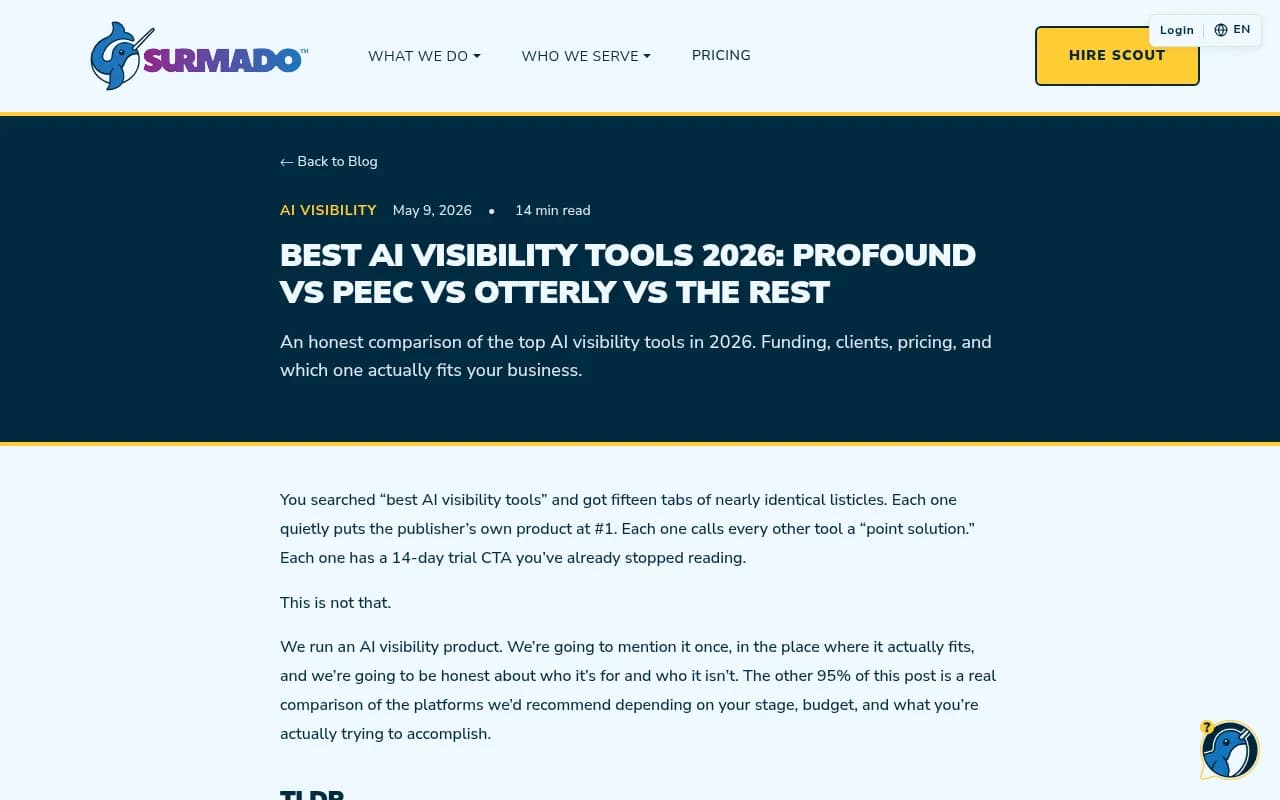
Surmado's 2026 AI visibility tools comparison notes that the market now includes well-funded players across multiple categories: Profound at $155M raised and $1B valuation for the largest enterprises, Peec AI as the fastest-growing mid-market analytics platform, and Otterly as the most accessible entry-level monitoring tool. Scrunch and Bluefish are both listed as "well-funded, all real, all enterprise-focused."
What the market analysis makes clear is that the category is splitting into two types of tools: monitoring platforms that show you data, and optimization platforms that help you act on it. Scrunch and Bluefish sit firmly in the monitoring camp, with Scrunch adding a technical delivery layer that's genuinely unique. Promptwatch is the clearest example of an optimization platform in this comparison.
For enterprise teams evaluating GEO platforms in 2026, the most important question to ask any vendor is: "After I see the data, what does your platform help me do next?" The answer to that question will tell you more than any feature matrix.
The bottom line
Scrunch, Bluefish AI, and Promptwatch are all legitimate enterprise GEO platforms. None of them are vaporware. But they're built for different jobs.
If you need to control what AI agents see when they crawl your site, Scrunch is worth a demo. If you need to protect your brand from AI misrepresentation, Bluefish is worth evaluating. If you need to grow your AI visibility and connect that growth to revenue, Promptwatch is the most complete option available at a price point that doesn't require a six-figure contract to get started.
The GEO category is still young enough that most organizations haven't fully committed to a platform yet. That's actually an advantage: you can pick based on what you need now, not what the market told you to buy two years ago.