Key takeaways
- Qwairy's plans run from $74/mo (Starter, billed annually) to $432/mo (Business), with Enterprise starting at $1,090/mo
- The platform covers 10 AI engines including ChatGPT, Perplexity, Gemini, Claude, Grok, and Google AI Overviews
- Crawler analytics and Looker Studio integration are locked to the Business plan -- a meaningful gap if you need those features at a lower budget
- Content generation is not part of Qwairy's core offering; it's primarily a monitoring and intelligence platform
- If you need to go beyond monitoring and actually fix your AI visibility gaps, platforms like Promptwatch include content generation and optimization tools that Qwairy doesn't offer
Qwairy has built a solid reputation in the GEO space. It's used by recognizable brands like TotalEnergies, Match Group, and Meilleurtaux.com, and its pricing page claims 2,000+ brands and agencies. That's not nothing.
But "trusted by 2,000+ brands" doesn't tell you whether the price is right for your situation. So let's actually look at what you get at each tier, where the value drops off, and when you'd be better served by something else.
What Qwairy's plans actually include
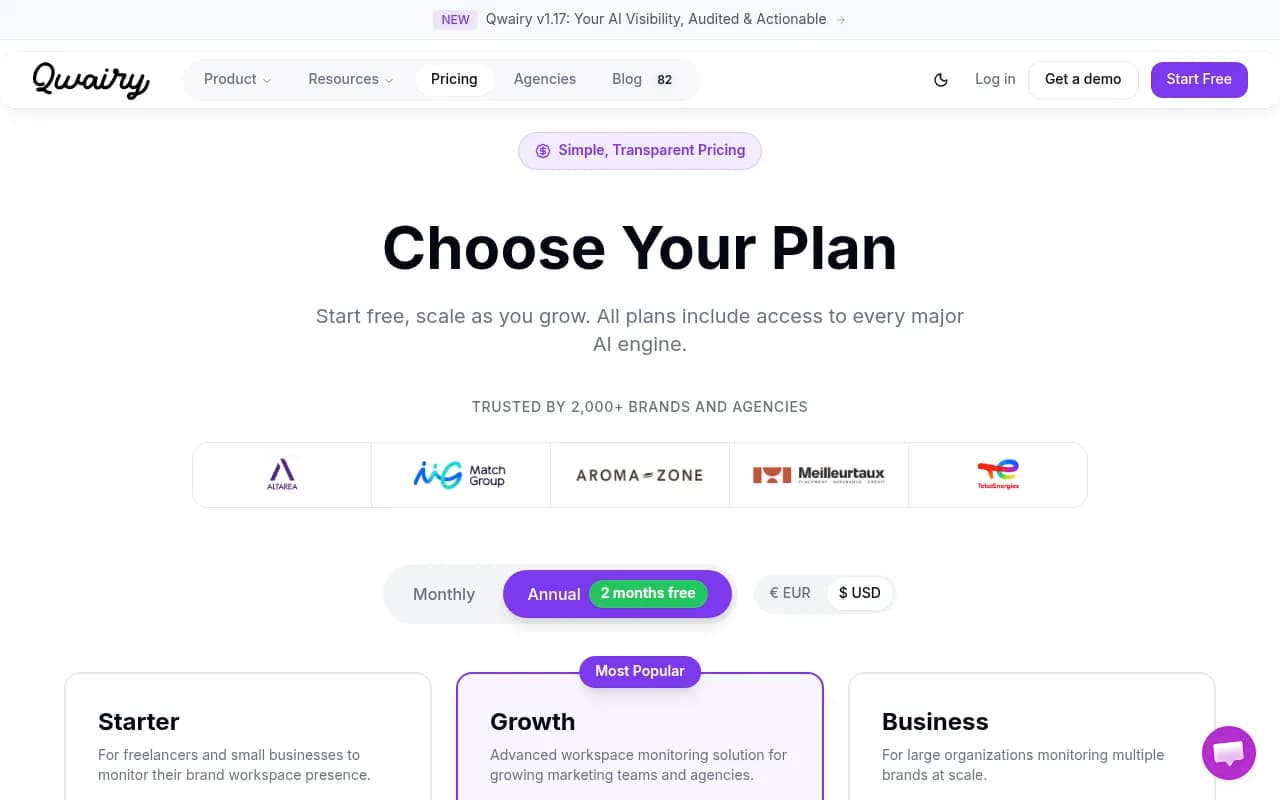
Qwairy uses a credit-based model. Every time it queries an AI engine to check your brand's visibility for a tracked prompt, it uses credits. The number of prompts you can track and the monthly credit pool are the two main levers that differentiate plans.
Starter -- $74/mo (annual) or $89/mo (monthly)
You get 100 prompts, 1,300 credits per month, and one workspace. All AI providers are included -- ChatGPT, Perplexity, Gemini, Grok, Claude, Copilot, Mistral, DeepSeek, Google AI Overviews, and Google AI Mode. Unlimited team members is a nice touch at this price point.
This is genuinely useful for a solo consultant, a small brand with one product line, or a freelancer who wants to keep tabs on how AI engines describe their clients. 100 prompts sounds like a lot until you realize you probably want to track 10-15 prompts per competitor, plus your own brand queries, plus category-level questions. It fills up fast.
Growth -- $190/mo (annual) or $229/mo (monthly)
The jump to 300 prompts and 3,900 credits is significant. You also get up to 5 workspaces, which makes this the first tier that works for agencies managing multiple clients. The REST API and MCP access are added here too -- useful if you want to pull data into your own dashboards or connect Qwairy to other tools.
This is where most growing marketing teams will land. The price is reasonable for what you get, though the lack of crawler analytics at this tier is a gap worth noting.
Business -- $432/mo (annual) or $519/mo (monthly)
800 prompts, 10,400 credits, up to 20 workspaces, crawler analytics, Looker Studio integration, and a dedicated account manager. This is the tier where Qwairy starts to feel like a proper enterprise tool rather than a monitoring dashboard.
Crawler analytics -- which shows you how AI crawlers are actually hitting your site, which pages they're reading, and where errors occur -- is genuinely valuable. The fact that it's gated to the $432/mo plan means smaller teams have to make a real budget decision to access it.
Enterprise -- from $1,090/mo
Custom everything: unlimited prompts, unlimited workspaces, white-label dashboards, SSO, custom domain (geo.yourcompany.com), and expert GEO strategy support. This is for large agencies or enterprise brands running multiple properties.
The credit system: what it means in practice
Credits are consumed each time Qwairy checks a prompt across an AI engine. The Starter plan's 1,300 credits sounds like a lot, but if you're tracking 100 prompts across even 5 AI engines, that's 500 checks per cycle -- and most plans run checks multiple times per month to catch changes.
Qwairy doesn't publish a clear credit-per-check breakdown on its pricing page, which makes it hard to calculate exactly how often your prompts get refreshed. This is worth asking their sales team about before committing, especially if you're on the Starter plan and want daily or near-daily monitoring.
Qwairy plan comparison
| Feature | Starter | Growth | Business | Enterprise |
|---|---|---|---|---|
| Monthly price (annual) | $74 | $190 | $432 | From $1,090 |
| Prompts tracked | 100 | 300 | 800 | Unlimited |
| Monthly credits | 1,300 | 3,900 | 10,400 | Unlimited |
| Workspaces | 1 | 5 | 20 | Unlimited |
| AI engines covered | 10 | 10 | 10 | 10 |
| REST API & MCP | No | Yes | Yes | Yes |
| Crawler analytics | No | No | Yes | Yes |
| Looker Studio | No | No | Yes | Yes |
| Dedicated account manager | No | No | Yes | Yes |
| White-label | No | No | No | Yes |
| Free trial | 14 days | 14 days | 14 days | Demo |
What Qwairy does well
The AI engine coverage is genuinely broad. Ten engines including Google AI Mode (which many competitors miss) and DeepSeek puts Qwairy ahead of tools that only cover ChatGPT and Perplexity.
The source intelligence introduced in v1.11 is one of the more interesting features in the GEO space right now. Rather than just telling you whether you're mentioned, it shows you where AI engines are getting their information -- which Reddit threads, YouTube channels, and authority sites are shaping how AI describes your brand.
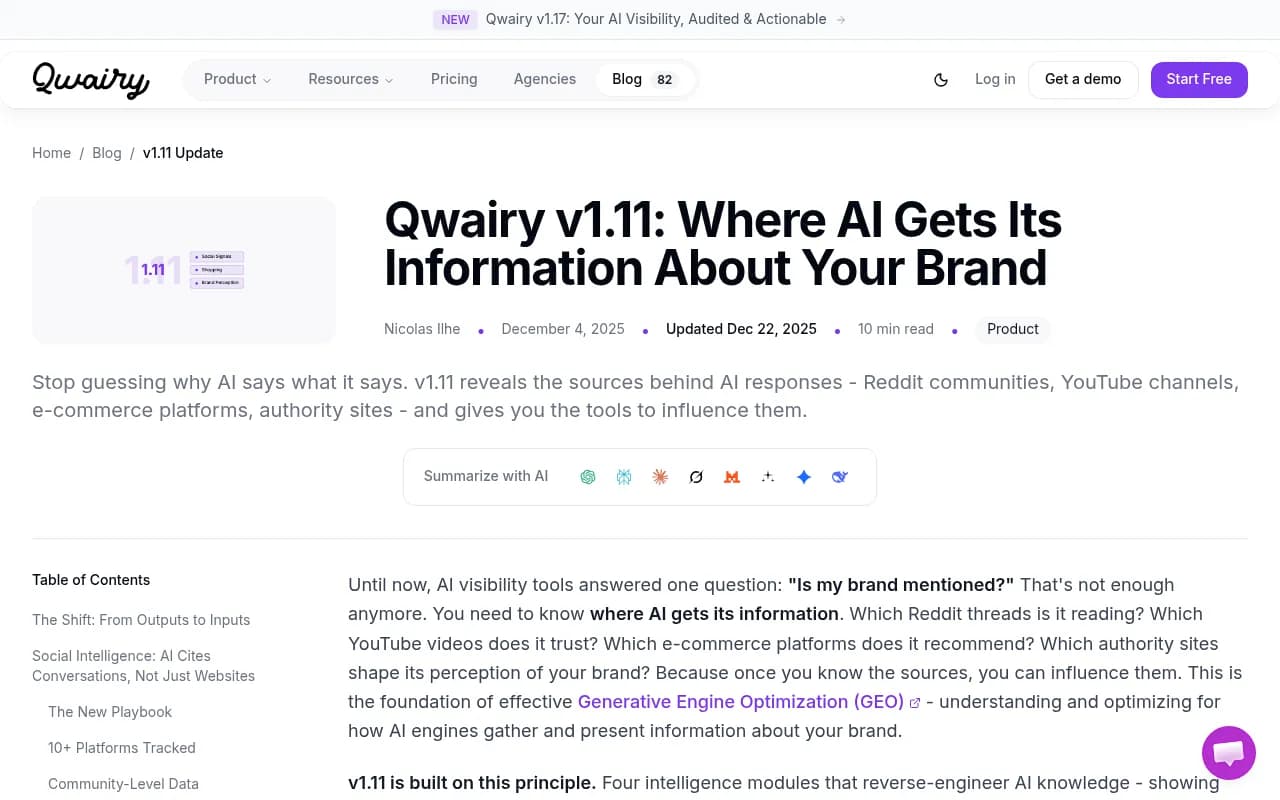
That shift from "you're mentioned 60% of the time" to "you're mentioned because r/saas and TechCrunch cite you" is genuinely useful. It tells you where to focus your off-site efforts instead of just staring at a visibility score.
The 240+ country coverage and multi-language support also matter if you're running international campaigns. Most cheaper tools are US/English-only.
Where Qwairy falls short
The biggest gap is content. Qwairy tells you what's happening and where the sources are, but it doesn't help you create content to close the gaps it identifies. If you find out that AI engines aren't citing you for a key category query, you're on your own to figure out what to write and how to write it.
For teams that want a full loop -- find gaps, generate content, track results -- Qwairy is only part of the solution. You'd need to pair it with a separate content tool, which adds cost and friction.
Crawler analytics being locked to the $432/mo Business plan is also a real limitation. Understanding how AI crawlers interact with your site is foundational to GEO, not an enterprise add-on. Competitors like Promptwatch include crawler logs at lower price points.
The credit system adds some opacity. You can't easily tell how frequently your prompts are being checked without doing the math yourself, and the pricing page doesn't make this transparent.
How Qwairy compares to alternatives
Here's an honest look at how Qwairy stacks up against the main alternatives at similar price points.
| Tool | Starting price | Content generation | Crawler logs | AI engines | Best for |
|---|---|---|---|---|---|
| Qwairy | $74/mo | No | Business plan only | 10 | Monitoring + source intelligence |
| Promptwatch | $99/mo | Yes (Content Agents) | Professional plan | 11 | Full GEO optimization loop |
| Otterly.AI | ~$49/mo | No | No | 4-5 | Budget monitoring |
| Profound | Custom | No | Limited | 6+ | Enterprise monitoring |
| Peec AI | ~$49/mo | No | No | 4-5 | Basic monitoring |
| Athena HQ | Custom | No | No | 6+ | Monitoring-focused enterprise |



When Qwairy is the right choice
Qwairy makes sense if:
- You want broad AI engine coverage (especially Google AI Mode and DeepSeek) without building a custom monitoring setup
- Source intelligence -- knowing why AI mentions you, not just whether it does -- is a priority for your strategy
- You're managing multiple brands or clients and need workspace separation (Growth plan and above)
- You're in a non-English market and need multi-language, multi-region monitoring
The Starter plan at $74/mo is a reasonable entry point for small teams or consultants who want to get a baseline read on their AI visibility before committing to a larger investment.
When you should look elsewhere
If your goal is to actually improve your AI visibility -- not just measure it -- Qwairy's monitoring-only approach will leave you with a lot of data and not much to do with it.
Promptwatch is built around what it calls an "action loop": find gaps with Answer Gap Analysis, generate content with Content Agents that are grounded in real prompt and citation data, then track how that content performs as AI engines start citing it. That full cycle is something Qwairy doesn't offer.
If budget is the primary concern and you just need basic brand mention tracking across ChatGPT and Perplexity, tools like Otterly.AI or Peec AI come in cheaper and cover the basics. They won't give you Qwairy's source intelligence or country coverage, but they'll tell you whether you're being mentioned.
For agencies that need white-label reporting and client-facing dashboards at scale, Qwairy's Enterprise plan competes with Promptwatch's agency tier -- though Promptwatch's content generation capabilities give it an edge for agencies that want to offer GEO as a service, not just reporting.
Is Qwairy worth it?
At $74/mo for Starter, yes -- if monitoring is what you need. It's a well-built tool with genuinely useful source intelligence, broad AI engine coverage, and a clean interface that G2 reviewers consistently praise for its usability.
At $190/mo for Growth, it's still reasonable for agencies managing a handful of clients, especially with API access included.
The Business plan at $432/mo is where the value calculation gets harder. You're paying for crawler analytics and Looker Studio, which are useful but not unique. At that price, you're in territory where platforms that include content optimization and generation become serious competitors.
The honest summary: Qwairy is a strong monitoring platform that does its core job well. If you want to move from monitoring to optimization -- actually fixing the gaps it finds -- you'll need to either pair it with other tools or switch to a platform that handles the full workflow.
Bottom line
Qwairy's pricing is transparent and the plans are logically structured. The 14-day free trial (no credit card required) is a low-risk way to see whether the source intelligence and prompt monitoring fit your workflow before committing.
Just go in with clear expectations: this is a monitoring and intelligence tool, not an optimization platform. If you want to track your AI visibility, understand where AI engines are getting their information, and report on it across multiple brands, Qwairy delivers. If you want to close the gaps it identifies, you'll need more than what Qwairy offers on its own.