Key takeaways
- GEO platforms split cleanly into two camps: monitoring-only tools that show you data, and optimization platforms that help you act on it. Knowing which camp a tool sits in is the most important buying decision you'll make.
- Promptwatch is the only platform in this comparison that covers the full loop -- tracking, content gap analysis, AI content generation, crawler logs, and revenue attribution -- in a single product.
- Profound is a strong enterprise analytics tool but starts at $399/month and requires a sales call to get started. It's built for data teams, not content teams.
- Geostar is the most accessible entry point (free tier available), which makes it useful for testing the category before committing budget.
- Superlines leans heavily on content generation but lacks the prompt tracking depth and citation analytics that make GEO optimization actually measurable.
The GEO platform market has gotten crowded fast. Two years ago there were maybe five tools worth considering. Now there are dozens, and they all use the same language -- "AI visibility," "citation tracking," "brand monitoring" -- which makes it genuinely hard to tell them apart.
This guide cuts through that. We're looking at five platforms that come up regularly in 2026 discussions: Profound, Promptwatch, Atomic AGI, Geostar, and Superlines. Some of these are well-funded and enterprise-grade. Others are scrappier and newer. All of them are trying to solve the same core problem: your brand is invisible in AI search results, and you need to fix that.
The question is which one actually helps you do it.
What we're actually comparing
Before getting into the tools, it's worth being precise about what "tracking depth" and "optimization" mean in this context, because vendors use both terms loosely.
Tracking depth covers: how many AI models are monitored, whether the tool tracks real user-facing responses (not just API outputs), prompt volume data, page-level citation tracking, and whether you can see competitor visibility side by side.
Optimization covers: content gap analysis (what topics are you missing?), content generation grounded in prompt data, AI crawler logs (which pages are AI bots actually reading?), and traffic attribution (does any of this connect to revenue?).
A tool that only does tracking is a dashboard. A tool that does both is an optimization platform. The distinction matters because dashboards tell you you're losing -- they just don't help you stop.
The platforms
Promptwatch
Promptwatch is the most complete platform in this comparison. It monitors 10 AI models -- ChatGPT, Perplexity, Google AI Overviews, Google AI Mode, Claude, Gemini, Meta/Llama, DeepSeek, Grok, and Mistral -- and tracks real user-facing responses rather than API outputs alone. That distinction matters more than it sounds: what ChatGPT shows a user in its interface can differ meaningfully from what the API returns, especially for shopping recommendations and local results.
The core differentiator is what Promptwatch does after the tracking. Answer Gap Analysis shows you exactly which prompts competitors rank for that you don't -- not as a vague category observation, but as specific questions with prompt volume estimates and difficulty scores. From there, Content Agents generate articles, listicles, and briefs built around those gaps, grounded in citation data, competitor analysis, and your brand guidelines. It's not generic AI writing -- it's content engineered to answer the specific questions AI models are already exposing as gaps in your site.
The AI Crawler Logs feature is something most competitors don't have at all. You can see which pages ChatGPT, Claude, Perplexity, and other AI crawlers are actually reading, how often they return, what errors they encounter, and when a page moves from "crawled" to "cited." That's the kind of operational intelligence that turns GEO from a reporting exercise into something you can actually manage.
Other capabilities worth noting: Reddit and YouTube insights (both channels directly influence AI recommendations), ChatGPT Shopping tracking, offsite citation analysis, and multi-language/multi-region monitoring with persona targeting.
Pricing starts at $99/month for the Essential plan (1 site, 50 prompts, 5 articles). Professional is $249/month (2 sites, 150 prompts, 15 articles, crawler logs). Business is $579/month (5 sites, 350 prompts, 30 articles). A free trial is available.

Profound
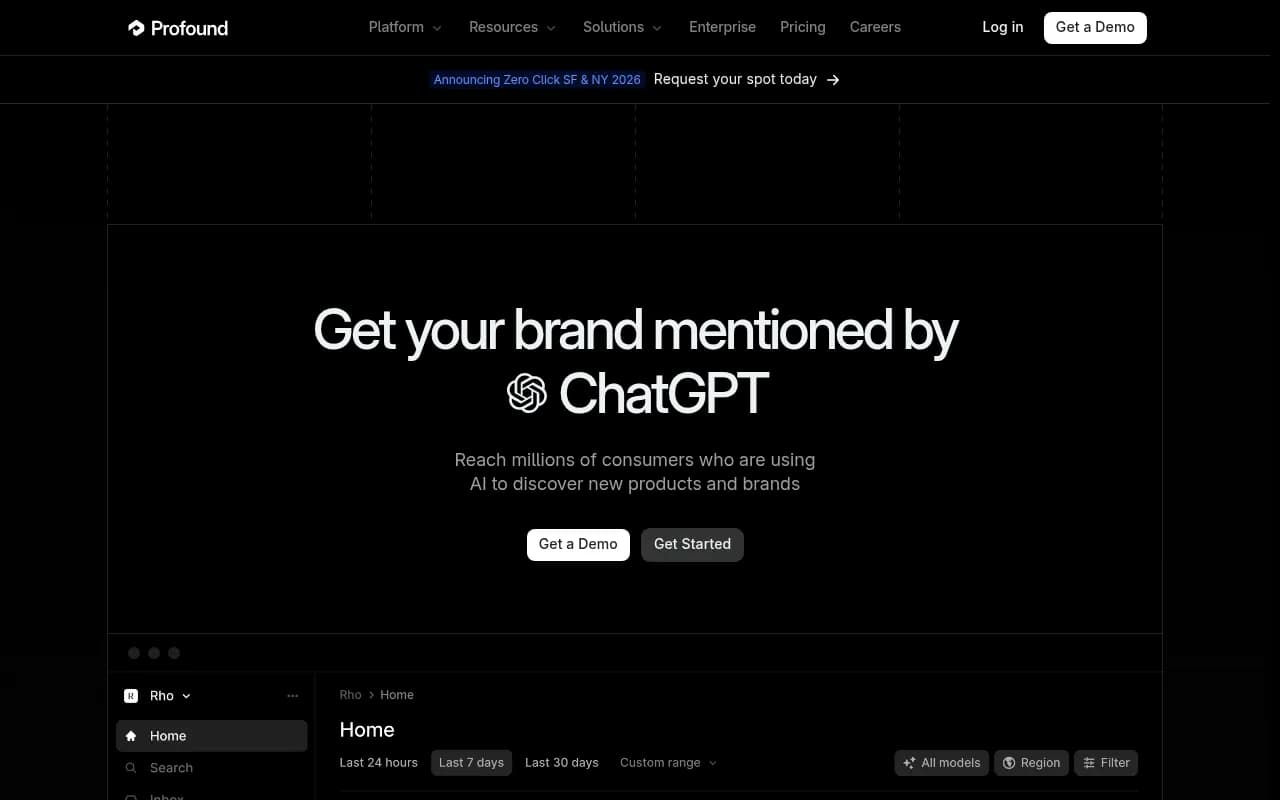
Profound is the enterprise analytics option in this group. It has strong prompt tracking infrastructure -- the company claims 400M+ real user conversations inform its data -- and the platform is genuinely good at showing you where your brand appears across AI models and how that changes over time.
In 2026, Profound shipped autonomous Agents and MCP integration, which is a meaningful product move. The Agents can run prompt monitoring workflows without manual intervention, and MCP opens up integration possibilities for enterprise tech stacks.
Where Profound falls short is on the optimization side. It's an analytics-first product. There's no content generation, no content gap analysis in the sense of "here's what to write," and no AI crawler logs. If your team is primarily data-oriented -- analysts who want to understand AI visibility trends and feed that data into other workflows -- Profound is a reasonable fit. If your team needs to act on the data directly, you'll find yourself exporting reports and figuring out next steps elsewhere.
The pricing is also a real consideration. Profound's Growth plan starts at $399/month, and getting started requires a sales call rather than a self-serve signup. That's fine for enterprise procurement processes, but it's a friction point for teams that want to evaluate quickly.
Atomic AGI
Atomic AGI is a newer entrant in the GEO space. It positions itself around AI-native content workflows -- the idea being that you should be creating content specifically designed for how AI models consume and cite information, rather than retrofitting traditional SEO content.
The tracking capabilities are more limited than Profound or Promptwatch. Atomic AGI covers the major models (ChatGPT, Perplexity, Claude, Gemini) but doesn't offer the same depth of prompt volume data, competitor heatmaps, or page-level citation tracking. It's more of a content-first tool that has added some monitoring features, rather than a monitoring-first tool that has added content capabilities.
Where it's interesting is in the workflow design. The platform is built around content briefs that incorporate AI search signals, and the generation quality is solid. For smaller teams that primarily need help creating AI-optimized content and want basic visibility tracking alongside it, Atomic AGI is worth evaluating. For teams that need serious tracking depth or attribution, it's not there yet.
Pricing information is less transparent than the other tools in this comparison -- you'll need to contact them for current plans.
Geostar
Geostar's main selling point is accessibility. It has a free tier, which makes it one of the few GEO tools you can actually try without a credit card or a sales conversation. The free version covers basic prompt tracking across a handful of AI models and gives you a sense of where your brand stands.
The paid tiers add more prompts, more models, and some basic reporting features. According to independent testing published in mid-2026, Geostar performs reasonably well as a starting point for teams new to GEO -- it's not overwhelming, the interface is clean, and it gets you oriented quickly.
The limitations become apparent when you need depth. Geostar doesn't have content generation, crawler logs, Reddit/YouTube insights, or attribution. It's a monitoring tool, and a fairly basic one. The free tier is genuinely useful for initial audits or for convincing stakeholders that AI visibility is worth investing in. But most teams will outgrow it within a few months of serious GEO work.
Superlines
Superlines sits in an interesting middle position. It combines AI content generation with some visibility tracking, which sounds like the right combination -- and in some ways it is. The content generation is fast and the platform has a reasonably intuitive interface.
The problem is that the tracking side is thin. Superlines monitors a smaller set of AI models than Promptwatch or Profound, and the prompt data lacks the volume estimates and difficulty scoring that help you prioritize which gaps to close first. Without that prioritization layer, content generation becomes somewhat arbitrary -- you're creating content, but you're not necessarily creating it for the highest-value gaps.
The attribution story is also underdeveloped. There's no clear path from "we published this article" to "our AI visibility improved for these specific prompts" to "this drove measurable traffic." That loop matters if you're trying to justify GEO investment to leadership.
Superlines is best suited to content teams that want AI-assisted writing with some basic AI search awareness baked in, but aren't yet running a serious GEO program.
Head-to-head comparison
| Feature | Promptwatch | Profound | Atomic AGI | Geostar | Superlines |
|---|---|---|---|---|---|
| AI models tracked | 10 | Multiple (enterprise) | 4 major | 4-6 | 3-5 |
| Real user-facing responses | Yes | Yes | Partial | Partial | No |
| Prompt volume data | Yes | Yes | Limited | No | No |
| Competitor heatmaps | Yes | Yes | No | No | No |
| Page-level citation tracking | Yes | No | No | No | No |
| AI crawler logs | Yes | No | No | No | No |
| Content gap analysis | Yes | No | Partial | No | No |
| AI content generation | Yes | No | Yes | No | Yes |
| Reddit/YouTube insights | Yes | No | No | No | No |
| ChatGPT Shopping tracking | Yes | No | No | No | No |
| Traffic attribution | Yes | No | No | No | No |
| Free trial / free tier | Free trial | No (sales call) | Contact | Free tier | Free trial |
| Starting price | $99/mo | $399/mo | Contact | Free | Contact |
| Best for | Full GEO optimization | Enterprise analytics | Content-first teams | GEO beginners | Content teams |
Tracking depth: who actually wins
If tracking depth is your primary criterion, the honest answer is that Promptwatch and Profound are in a different tier from the other three.
Profound has strong prompt data infrastructure and the enterprise integrations to match. If you're a large brand with a dedicated analytics team and you need deep historical data, competitive benchmarking, and the ability to plug GEO data into your existing BI stack, Profound is worth the price.
Promptwatch covers more of the tracking surface area -- page-level citations, crawler logs, Reddit/YouTube signals, ChatGPT Shopping -- and does it at a lower price point with self-serve access. The crawler logs in particular are something Profound doesn't offer, and they're genuinely useful for diagnosing why certain pages aren't being cited even when they should be.
Atomic AGI, Geostar, and Superlines are meaningfully behind on tracking depth. That's not a fatal flaw if your needs are simpler, but it's worth being honest about the gap.
Optimization: who helps you act
This is where the comparison becomes clearest. Only two platforms in this group -- Promptwatch and Atomic AGI -- have content generation at all. And only Promptwatch connects content generation to prompt data, citation analytics, and crawler intelligence in a way that makes the output measurable.
Profound is explicitly not an optimization platform. It's analytics. That's a deliberate product choice, not a gap -- but it means you need other tools to act on what Profound shows you.
Geostar and Superlines don't have the data depth to support serious optimization. Geostar is a monitoring starter kit. Superlines is a content tool with light monitoring attached.
Which platform fits which team
The right tool depends heavily on where you are in your GEO journey and what your team actually needs to do with the data.
If you're new to GEO and want to understand the category before spending real budget, start with Geostar's free tier. It'll show you the basics without any commitment.
If you're a content team that wants AI-assisted writing with some basic AI search awareness, Superlines or Atomic AGI are worth a look -- though be clear-eyed that you're not getting serious tracking depth.
If you're an enterprise brand with a data team and you primarily need analytics to inform strategy (with other tools handling execution), Profound is a legitimate option. Just budget accordingly and expect a sales process.
If you want one platform that covers the full loop -- finding gaps, creating content to close them, tracking the results, and connecting visibility to revenue -- Promptwatch is the only tool in this comparison that does all of that. The $99/month entry point and free trial make it easy to verify that before committing.
A note on the broader market
These five platforms don't exist in isolation. The GEO tool market has 20+ players in 2026, and a few others are worth knowing about depending on your specific needs.

Otterly.AI is a lightweight monitoring option that's cheaper than most ($29/month) and works well for teams that just need basic brand mention tracking across AI models.
Scrunch is doing something technically interesting -- serving AI-optimized content at the CDN edge -- which is a different approach to the problem than any of the five platforms above.

AthenaHQ added Shopify revenue attribution in 2026, which makes it more interesting for e-commerce brands specifically, though it remains monitoring-focused for most use cases.
The common thread across all of these: most tools stop at monitoring. They show you where you're invisible. The harder problem -- and the one fewer tools solve -- is what to do about it.
Bottom line
The GEO platform category is maturing, but it's still early enough that the gap between "monitoring dashboard" and "optimization platform" is enormous. Most of the tools in this comparison sit firmly in the first camp.
Profound is the best pure analytics option if budget isn't a constraint and you have a team to act on the data separately. Geostar is the right starting point if you're not ready to spend. Atomic AGI and Superlines are content tools with GEO features bolted on -- useful in specific contexts, not serious optimization platforms.
Promptwatch is the only tool here that closes the loop: it finds the gaps, helps you create content to fill them, tracks whether that content gets cited, and connects the whole thing to revenue. For teams that want to treat GEO as a measurable, repeatable growth channel rather than a monitoring exercise, that's the meaningful difference.