Key takeaways
- Peec AI is a clean, easy-to-use AI visibility monitoring tool -- but it stops at monitoring. It tells you where you're invisible; it doesn't help you do anything about it.
- Promptwatch covers the full loop: find gaps, generate content engineered for AI citation, and track whether it's working -- all in one platform.
- Peec AI limits standard plans to three AI models. Promptwatch monitors 10+ models (ChatGPT, Claude, Perplexity, Gemini, Grok, DeepSeek, Copilot, Meta AI, Mistral, Google AI Overviews) even at entry tier.
- For teams that just need a visibility dashboard, Peec AI is fine. For teams that need to actually improve their AI search presence, a monitoring-only tool creates a bottleneck.
- The gap between "we can see the problem" and "we fixed the problem" is where most GEO strategies stall in 2026.
There's a version of this comparison where both tools get equal billing, where we weigh the pros and cons carefully and conclude that "it depends on your use case." That version would be dishonest.
Peec AI and Promptwatch are not doing the same thing. One monitors. The other monitors and acts. If you're spending money on AI visibility software in 2026 and your AI search presence isn't improving, the tool you're using probably falls into the first category.
Let's get into the specifics.
What Peec AI actually does
Peec AI is a solid monitoring tool. The interface is clean, setup takes about three minutes, and the citation tracking works well. You can see where your brand appears across AI responses, which competitors are getting cited instead of you, and how your visibility changes over time.
For teams that have never tracked AI visibility before, it's a reasonable starting point. Unlimited seats, a 7-day free trial with no credit card required, and a straightforward UI make it easy to get buy-in internally.
But the ceiling appears quickly.
Standard plans cover only three AI models. If you need broader coverage -- say, tracking how you appear in Grok, DeepSeek, or Mistral alongside ChatGPT -- you're looking at a custom enterprise conversation. And regardless of which plan you're on, Peec AI's output is a dashboard. It shows you data. It doesn't tell you what content to create, doesn't generate that content, and doesn't connect visibility changes back to traffic or revenue.
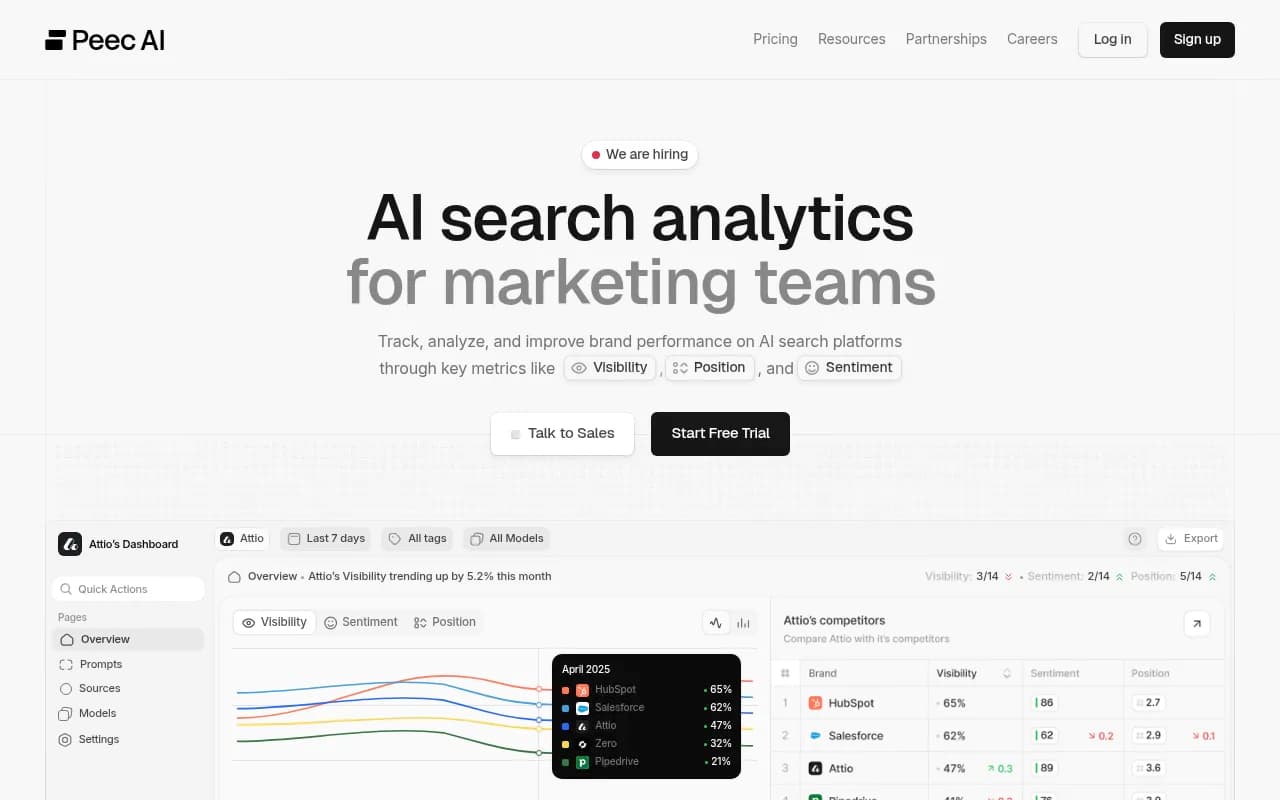
The most consistent criticism in Peec AI reviews is exactly this: it's monitoring only. You see the gap. You're on your own to close it.
That's not a minor limitation. In 2026, knowing you're invisible in AI search without a clear path to fix it is like getting a diagnosis with no treatment plan.
What Promptwatch actually does
Promptwatch is built around a different premise: visibility data is only useful if it leads to action.
The platform monitors 10+ AI models -- ChatGPT, Claude, Perplexity, Gemini, Grok, DeepSeek, Copilot, Meta AI, Mistral, and Google AI Overviews -- and tracks how your brand appears across all of them. That's the monitoring layer, and it's genuinely good. But it's the starting point, not the product.

What happens after you see the data is where Promptwatch separates itself.
The action loop
The core workflow looks like this:
- Answer Gap Analysis identifies the specific prompts where competitors are getting cited and you're not. Not vague categories -- the actual questions and topics that AI models are answering without mentioning you.
- The built-in AI writing agent generates articles, listicles, and comparisons grounded in real citation data. Promptwatch has processed over 880 million citations, so the content recommendations aren't generic SEO filler -- they're based on what AI models actually cite.
- Page-level tracking shows whether your new content is getting picked up. You see which pages are being cited, how often, and by which models. Traffic attribution (via code snippet, Google Search Console integration, or server log analysis) connects visibility to actual revenue.
This loop -- find gaps, create content, track results -- is what makes Promptwatch an optimization platform rather than a reporting tool.
Other capabilities worth knowing about
Beyond the core loop, a few features stand out:
AI Crawler Logs show you in real time which AI crawlers (ChatGPT, Claude, Perplexity, etc.) are hitting your website, which pages they're reading, and whether they're encountering errors. Most competitors don't offer this at all. It's genuinely useful for diagnosing why certain pages aren't getting cited despite ranking well in traditional search.
Prompt Intelligence gives you volume estimates and difficulty scores for each prompt, plus query fan-outs that show how one prompt branches into sub-queries. This lets you prioritize high-value, winnable prompts instead of guessing.
Reddit and YouTube Insights surface the discussions that directly influence AI recommendations -- a channel most monitoring tools ignore entirely. AI models frequently cite Reddit threads and YouTube content; knowing which ones are shaping responses in your category is a real competitive advantage.
ChatGPT Shopping Tracking monitors when your brand appears in ChatGPT's product recommendations and shopping carousels -- something that matters a lot for ecommerce brands and is almost entirely absent from competing tools.
Side-by-side comparison
| Feature | Peec AI | Promptwatch |
|---|---|---|
| AI models monitored | 3 (standard plans) | 10+ (all plans) |
| Brand visibility tracking | Yes | Yes |
| Competitor benchmarking | Yes | Yes |
| Answer Gap Analysis | No | Yes |
| AI content generation | No | Yes (built-in writing agent) |
| Page-level citation tracking | Limited | Yes |
| Traffic attribution | No | Yes (GSC, snippet, server logs) |
| AI Crawler Logs | No | Yes (Professional+) |
| Prompt volume/difficulty scoring | No | Yes |
| Query fan-outs | No | Yes |
| Reddit/YouTube insights | No | Yes |
| ChatGPT Shopping tracking | No | Yes |
| Multi-language/multi-region | Yes | Yes |
| Pricing (entry) | ~€89/mo | $99/mo |
| Free trial | 7-day (no CC) | Yes |
The monitoring features are roughly comparable. Everything after that is Promptwatch.
The real cost of monitoring-only tools
Here's the problem with monitoring-only tools in 2026: the data they produce creates urgency without direction.
You log in, see that a competitor is appearing in 60% of AI responses for your target prompts while you're appearing in 12%, and then... what? You know the problem exists. You don't know which specific content gaps are causing it, which prompts are worth targeting, what angle AI models want to see covered, or whether the content you create afterward actually moved the needle.
Teams using monitoring-only tools typically end up doing one of two things. They stack additional tools -- a content platform, a keyword research tool, a traffic analytics tool -- to fill the gaps. Or they produce content based on intuition and hope it works. Neither approach is efficient, and neither closes the loop.
The monitoring-only model made sense in 2023 and early 2024 when AI visibility was a new concept and just knowing where you stood was valuable. In 2026, that's table stakes. The competitive question isn't "are we visible?" -- it's "how do we get more visible, faster, and can we prove it's working?"
Who should use Peec AI
Peec AI is genuinely useful for a specific type of team: one that needs a clean, low-friction visibility dashboard and is handling content creation and optimization through separate workflows already.
If you're an agency that has its own content production process and just needs to show clients where they stand in AI search, Peec AI does that well. If you're a small team doing an initial audit of your AI visibility before deciding on a larger investment, the 7-day trial is a low-risk way to get oriented.
But if your goal is to actually improve your AI search presence -- not just measure it -- you'll hit the ceiling fast.
Who should use Promptwatch
Promptwatch is built for teams that need to move, not just monitor. That includes:
Marketing and SEO teams at brands where AI search is already driving meaningful traffic (or where it should be). The content generation and gap analysis features mean you can act on data the same week you find it, rather than handing off to a separate workflow.
Digital agencies managing multiple clients across different categories. The multi-site plans, Looker Studio integration, and API access make it practical to run AI visibility programs at scale. The agency and enterprise tiers include custom pricing for larger portfolios.
Any brand in a competitive category where competitors are already investing in GEO. If your competitors are appearing in ChatGPT and Perplexity responses and you're not, monitoring that gap without fixing it just means watching the problem get worse.
Promptwatch is used by 6,700+ brands and agencies including Booking.com and Center Parcs, which gives you some sense of the scale at which it operates.
Pricing in context
Peec AI starts around €89/month. Promptwatch's Essential plan is $99/month (1 site, 50 prompts, 5 articles per month). The Professional plan at $249/month adds crawler logs, state/city tracking, 150 prompts, and 15 articles. Business is $579/month for 5 sites.
On paper, the entry prices are similar. But the value calculation is different. Peec AI at €89/month gives you a monitoring dashboard. Promptwatch at $99/month gives you monitoring plus content gap analysis plus AI article generation. If you're stacking Peec AI with a content tool and a traffic analytics tool to get equivalent functionality, the cost comparison shifts significantly.
A note on the broader market
It's worth acknowledging that Peec AI isn't uniquely limited here -- most AI visibility tools in 2026 are monitoring-first. Otterly.AI, AthenaHQ, and several others operate on the same model: show you the data, leave the fixing to you.


The monitoring-only category isn't wrong, exactly -- it's just incomplete for teams that need results, not reports. Promptwatch's positioning as an optimization platform (rather than a tracker) is what makes it the more useful tool for most marketing teams in 2026.
The bottom line
Peec AI is a good monitoring tool. If monitoring is all you need, it's a reasonable choice.
But in 2026, most teams don't need more data about the problem -- they need a path to fixing it. Promptwatch gives you the monitoring layer and then keeps going: gap analysis, content generation, page-level tracking, traffic attribution, crawler logs, Reddit and YouTube insights. The full loop.
The gap between knowing you're invisible and doing something about it is where most GEO strategies stall. Promptwatch is built to close that gap. Peec AI is built to show it to you.
That's not a subtle difference. It's the whole game.