Key takeaways
- Otterly.AI is the most affordable entry point for agencies, but it's a monitoring-only tool with no content generation or gap analysis.
- AthenaHQ has strong GA4 and Google Search Console integrations, making it useful for teams that already live in analytics dashboards, but it doesn't help you create content.
- Search Party is agency-oriented by design but has limited prompt metrics and no content gap analysis -- it's more of an implementation partner than a self-serve platform.
- Promptwatch is the only platform in this comparison that closes the full loop: find visibility gaps, generate content to fill them, and track the results. For agencies that need to show clients measurable progress, that matters.
The GEO and AI visibility space has gone from a niche curiosity to a crowded market in about 18 months. Every agency is getting asked the same question by clients: "Are we showing up in ChatGPT? What about Perplexity?" And now there are dozens of tools claiming to answer that.
But for agency teams specifically, the question isn't just "which tool tracks AI visibility?" It's "which tool helps us actually move the needle for clients, manage multiple brands, and prove ROI?" Those are different questions, and they lead to different answers.
This guide focuses on four platforms that come up most often in agency conversations: Otterly.AI, Promptwatch, AthenaHQ, and Search Party. I've compared them across the dimensions that actually matter for agency work -- not just feature checklists.
What agencies actually need from an AI visibility platform
Before getting into the tools, it's worth being specific about what "good for agencies" means. A solo consultant tracking one brand has different needs than an agency managing 20 clients.
Agency-specific requirements tend to cluster around four things:
- Multi-client management: Can you run separate workspaces or brand profiles without data bleeding between clients?
- Reporting: Can you generate white-label or client-ready reports without manually exporting CSVs?
- Actionability: Can you show clients not just where they're invisible, but what to do about it?
- Pricing that scales: Does the per-seat or per-brand pricing model make sense as you grow?
Keep those in mind as we go through each platform.
Otterly.AI

Otterly.AI has built a real following in the agency world, and the reasons are pretty straightforward: it's affordable, it's easy to set up, and it tracks six AI platforms with what the company claims is 99% citation accuracy. For an agency that needs to quickly spin up monitoring for a new client, that's genuinely useful.
The Gartner Cool Vendor 2025 recognition and a 4.9/5 rating across 250+ reviews suggest it's not just marketing -- people actually like using it.
Where Otterly.AI runs into trouble is the ceiling. It's a monitoring dashboard. You can see where your client is being cited (or not), track share of voice against competitors, and get alerts when something changes. What you can't do is figure out why you're not being cited, generate content to fix the gap, or track whether new content you published actually moved the needle.
For an agency that's just getting started with AI visibility reporting, Otterly.AI can be a reasonable first step. But if a client asks "okay, we're not showing up -- what do we do?" you'll need other tools to answer that.
Best for: Agencies that want affordable, fast monitoring for multiple clients and are comfortable handling the optimization work separately.
AthenaHQ
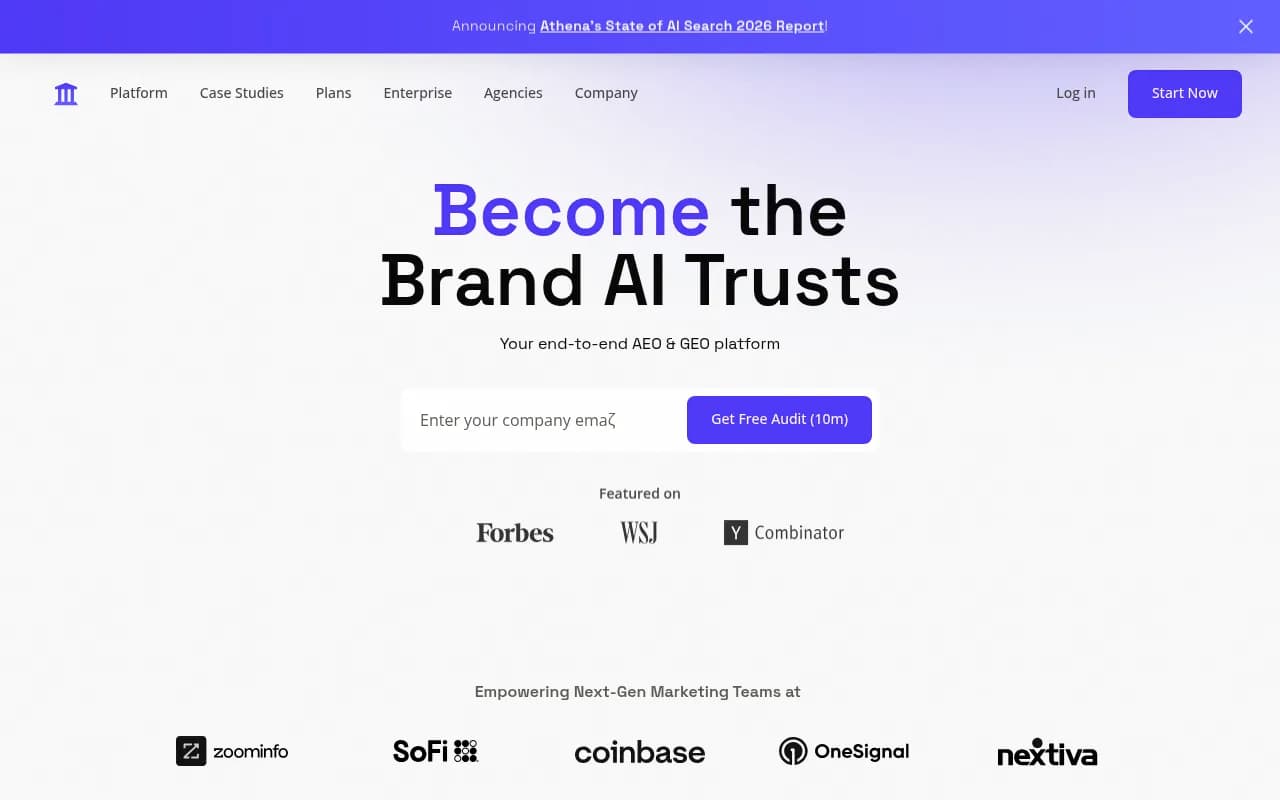
AthenaHQ's strongest differentiator is its native analytics integrations. GA4 and Google Search Console connections mean you can tie AI visibility data to actual traffic and conversion data without manual exports. For agencies that already have clients set up in GA4, that's a meaningful workflow improvement.
The platform covers 8+ AI search engines and has a reasonably clean interface for tracking brand mentions and share of voice. It's monitoring-focused, which means it's good at showing you the current state of things.
The gap is the same as Otterly.AI: AthenaHQ doesn't help you optimize. There's no content gap analysis, no content generation, and no crawler log data to understand how AI engines are actually discovering (or failing to discover) your client's pages. You get a clear picture of where you stand, but the path from "here's your visibility score" to "here's how we improved it" requires work outside the platform.
Pricing is also on the higher end relative to what you get, which can be a friction point when pitching AI visibility services to clients who are still skeptical about the channel.
Best for: Agencies with analytics-heavy workflows that need AI visibility data to sit alongside GA4 and GSC data in a unified view.
Search Party
Search Party
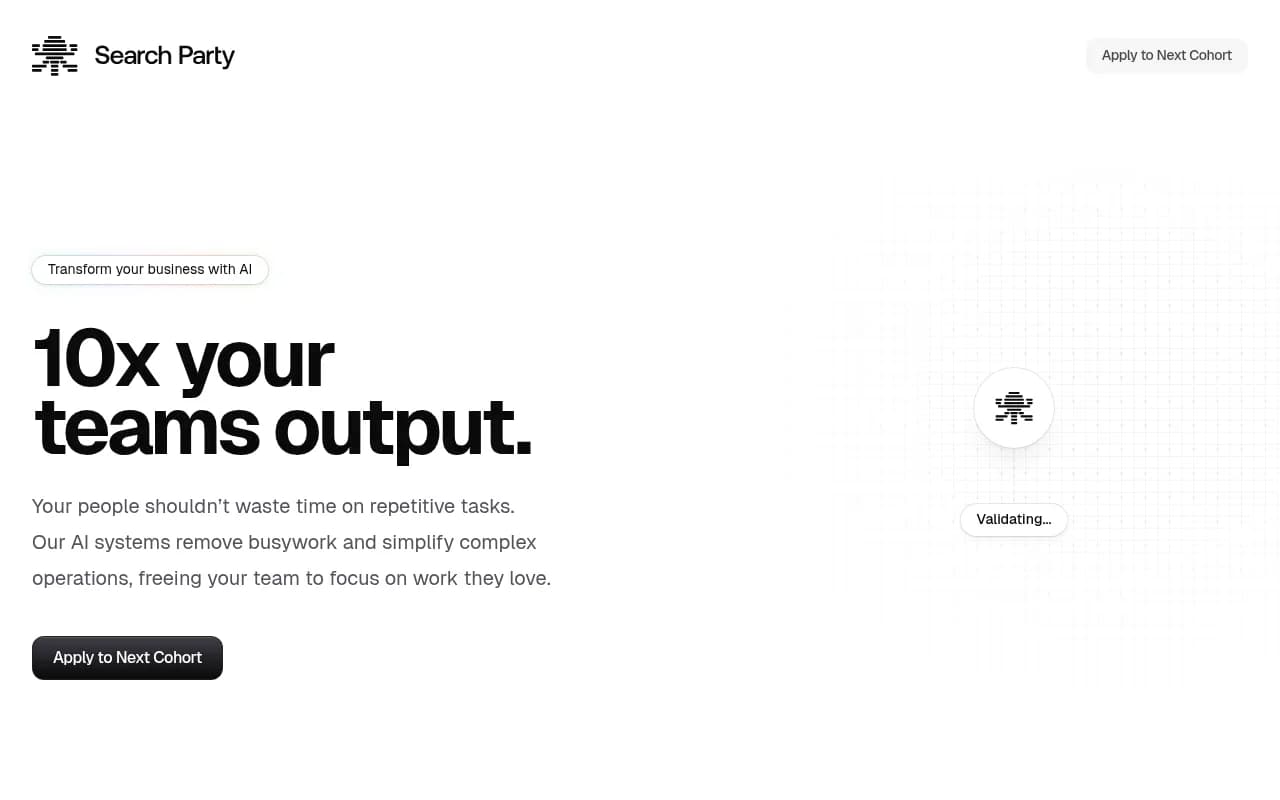
Search Party takes a different approach than the other three platforms here. It's positioned more as an AI implementation partner -- building custom automation systems -- than a self-serve monitoring tool. That's useful for some agency models, particularly those doing bespoke AI strategy work for enterprise clients.
The tradeoff is that it's not a platform you spin up quickly. There's less self-serve infrastructure, prompt metrics are limited compared to dedicated GEO tools, and there's no content gap analysis. If you're an agency that wants to hand clients a dashboard and show them their AI visibility score over time, Search Party isn't really designed for that.
Where it might fit: agencies that are building custom AI workflows for clients and want a partner rather than a SaaS tool.
Best for: Agencies doing custom AI implementation work rather than standardized AI visibility reporting.
Promptwatch

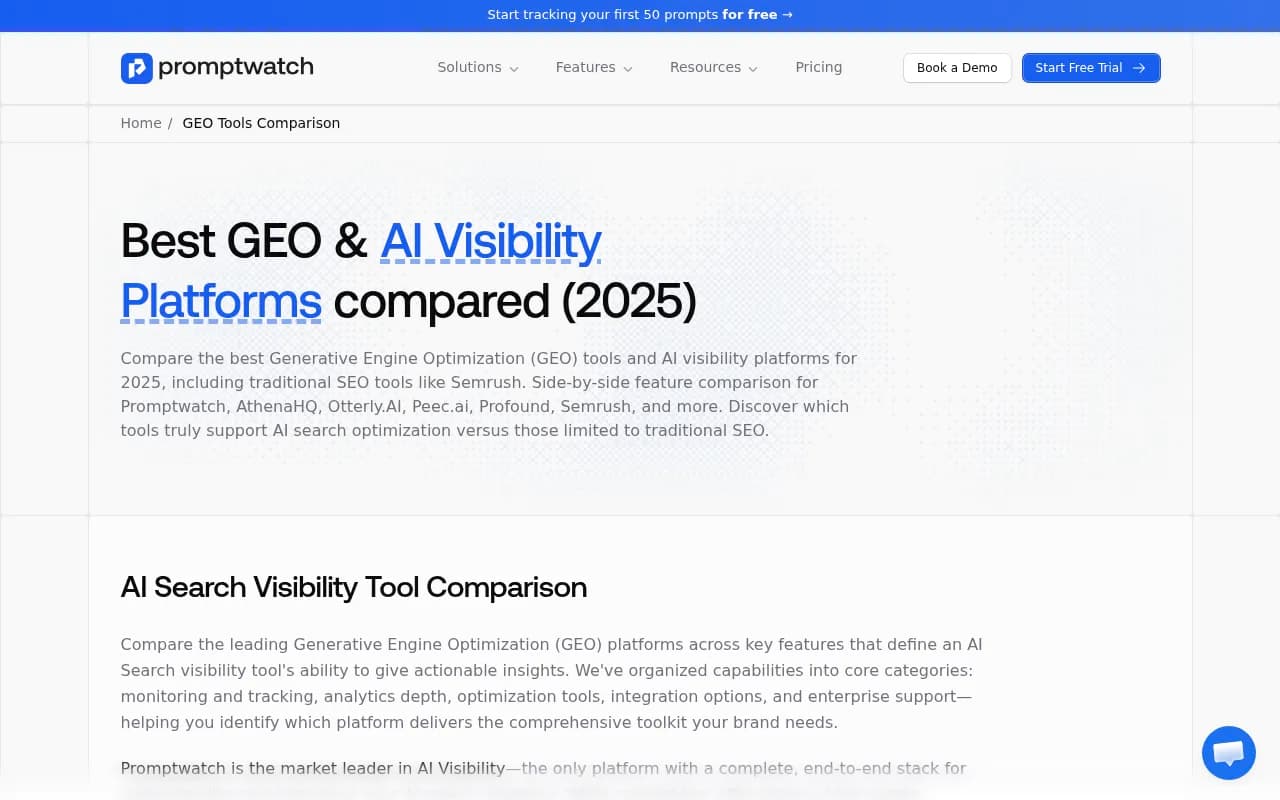
Promptwatch is the only platform in this comparison that's built around a full optimization loop rather than just monitoring. The difference matters more for agencies than for any other buyer type, because agencies need to show clients progress, not just data.
The core workflow is: find gaps (Answer Gap Analysis shows which prompts competitors rank for that your client doesn't), create content to fill them (Content Agents generate articles, listicles, and briefs grounded in real prompt data), and track whether it worked (page-level citation tracking and agent analytics show the timeline from publish to crawl to citation).
For agency teams specifically, a few capabilities stand out:
The AI Crawler Logs feature is something most competitors don't have at all. It shows real-time logs of AI crawlers hitting your client's website -- which pages they read, errors they encounter, and how often they return. When a client asks "why isn't ChatGPT citing our product page?" you can actually answer that question instead of guessing.
Prompt Intelligence gives you volume estimates and difficulty scores for each prompt, so you can prioritize which gaps are worth filling. This is useful when you're managing a client's content roadmap and need to justify why you're writing about topic A before topic B.
The multi-site pricing structure (Professional at $249/mo for 2 sites, Business at $579/mo for 5 sites) is designed for teams managing multiple brands. Agency and enterprise pricing is available for larger portfolios.
One honest note: Promptwatch is a Dutch company (Amsterdam-based), which creates timezone challenges for US-based teams that need real-time support. That's a real consideration if your agency is US-focused and support responsiveness matters to you.
Best for: Agencies that need to show clients measurable improvement in AI visibility, not just a monitoring dashboard.
Head-to-head comparison
| Feature | Otterly.AI | AthenaHQ | Search Party | Promptwatch |
|---|---|---|---|---|
| AI model coverage | 6 platforms | 8+ platforms | Limited | 10 platforms |
| Monitoring & tracking | Yes | Yes | Partial | Yes |
| Content gap analysis | No | No | No | Yes |
| Content generation | No | No | No | Yes |
| AI crawler logs | No | No | No | Yes |
| GA4 / GSC integration | Limited | Yes | No | Yes (via integrations) |
| Prompt volume & difficulty | No | No | No | Yes |
| Reddit & YouTube insights | No | No | No | Yes |
| ChatGPT Shopping tracking | No | No | No | Yes |
| Multi-client management | Yes | Yes | Yes | Yes |
| White-label reporting | Partial | Partial | No | Yes |
| Pricing (entry) | ~$29/mo | Higher end | Custom | $99/mo |
| Agency/custom pricing | Yes | Yes | Yes | Yes |
| Best for agencies | Monitoring only | Analytics-heavy teams | Custom AI builds | Full optimization loop |
How to choose
The honest answer is that the right tool depends on what your agency is actually selling.
If you're selling AI visibility reporting -- clients pay you to tell them where they stand -- Otterly.AI or AthenaHQ can handle that at a reasonable price point. Otterly.AI is cheaper and faster to set up. AthenaHQ is better if clients want their AI visibility data connected to GA4.
If you're selling AI visibility improvement -- clients pay you to actually move the needle -- you need a platform that helps you do that, not just measure it. Promptwatch is the only tool in this comparison that covers the full loop from gap identification to content creation to result tracking.
Search Party sits in a different category entirely. If your agency is doing custom AI implementation work and you need a partner rather than a SaaS dashboard, it's worth a conversation. But it's not a direct substitute for the other three.
One practical suggestion: before committing to any platform, ask the vendor specifically how they handle multi-client workspaces and what the reporting workflow looks like. The feature matrix can look similar across tools, but the actual day-to-day experience of managing 10 client accounts varies enormously.
The monitoring-only trap
There's a pattern worth naming explicitly. Several platforms in the GEO space -- and Otterly.AI and AthenaHQ both fall into this -- are fundamentally dashboards. They show you data. They don't help you act on it.
That's fine if you have a separate content team, a separate strategy process, and a separate way to track whether your content changes are working. But for most agency teams, that means you're stitching together three or four tools to do what one platform should do.
The agencies getting the most value from AI visibility tools right now are the ones that can close the loop internally: identify a gap, create content, publish it, and see the citation data change. Platforms that only do step one of that process are useful, but they're not the whole answer.
Pricing reality check
Pricing in this category is genuinely confusing because most vendors don't disclose what's included at each tier without a sales conversation. Here's what's publicly known:
- Otterly.AI starts around $29/mo, making it the most accessible entry point
- AthenaHQ is on the higher end and typically requires a demo before pricing is shared
- Search Party uses custom pricing based on scope of work
- Promptwatch's Essential plan is $99/mo (1 site, 50 prompts, 5 articles), Professional is $249/mo (2 sites, 150 prompts, 15 articles, crawler logs), and Business is $579/mo (5 sites, 350 prompts, 30 articles). Agency/enterprise pricing is available.
For agencies, the per-site pricing model at Promptwatch is worth paying attention to. At the Business tier, you're covering 5 client sites for $579/mo -- that's $116/site/month for a platform that includes content generation. If you're billing clients for AI visibility services, the math can work.
Bottom line
For most agency teams in 2026, the question isn't really "which monitoring tool should I use?" It's "how do I build an AI visibility service that clients will pay for and that actually delivers results?"
Monitoring is the easy part. Any of these four platforms can tell you where a client stands in AI search. The harder part is doing something about it -- and that's where the platforms diverge significantly.
If your agency wants to go beyond reporting and actually improve client visibility in ChatGPT, Perplexity, Google AI Mode, and the other platforms eating into traditional search traffic, Promptwatch is the most complete option available right now. The crawler logs alone are worth it for diagnosing why specific pages aren't being cited -- something you simply can't do with a monitoring-only tool.
That said, if budget is the primary constraint and you just need to start tracking, Otterly.AI gets you in the door. Just go in knowing you'll need to build the optimization workflow yourself.