Key takeaways
- MCP, REST APIs, and webhooks solve three different problems: AI-agent access, deterministic programmatic access, and event-driven alerts. Most mature GEO stacks use all three.
- MCP does not replace your REST API. Most MCP servers call REST APIs behind the scenes, so a good API makes a good MCP server possible.
- Webhooks win when the logic is fixed and speed matters, like alerting your team the moment ChatGPT citation volume drops. REST wins for bulk pulls, pagination, and scheduled pipelines. MCP wins when an AI agent needs to reason across multiple tools.
- GEO platforms increasingly gate API and MCP access behind pricing tiers, and the tiers vary wildly. Check integration access before you buy, not after.
- MCP has real security rough edges in 2026, including tool poisoning and rug-pull attacks. Keep a human in the loop for anything that touches production content.
Why this choice matters more in GEO than in most other marketing stacks
GEO workflows have a peculiar property: the thing you're monitoring changes shape constantly. ChatGPT doesn't behave like a stable API consumer. Promptwatch's data on query fan-outs shows that a single prompt can explode into multiple separate web searches, and the average query length has dropped from roughly 117 characters in early December 2025 to around 53 characters by April 2026. ChatGPT increasingly searches like keyword input rather than full sentences. Your monitoring infrastructure has to keep up with an engine that keeps re-architecting its own retrieval behavior.
The citation inventory is also tighter than most people assume. Promptwatch's average sources per response data shows ChatGPT cites around 5 sources per web-search-triggered response, while Google AI Overviews and Perplexity both hover near 10. Microsoft Copilot is the wildcard, swinging from under 2 sources to nearly 17 within a few weeks. When there are only five slots and your competitor holds three of them, you don't check a dashboard once a week. You want signal pushed to you the moment something shifts.
That's the real reason the MCP vs REST vs webhook question matters for GEO specifically. Each method maps to a different tempo of work: scheduled bulk analysis, instant alerts, and conversational exploration by an AI agent. Pick the wrong one and you're either drowning in manual dashboard checks or paying for an agentic layer you never use.
The three methods in plain terms
If you already know this, skip ahead. But the vocabulary gets muddy fast, so a quick grounding helps.
REST API: the workhorse. Your application sends an HTTP request to a known endpoint, gets a structured response back, done. Stateless, deterministic, battle-tested for fifteen-plus years. If you've ever written a cron job that pulls metrics from an endpoint, you've used REST the way it was intended.
Webhook: a reverse API call. Instead of you polling an API asking "anything new?", the platform pushes a JSON payload to your endpoint the instant a defined event happens. You expose a URL, authenticate the caller, and react.
MCP (Model Context Protocol): a standard, now stewarded by the Linux Foundation's Agentic AI Foundation after Anthropic donated it in December 2025, that lets AI agents discover and call tools dynamically. The agent doesn't need a hardcoded endpoint. It reads a tool manifest, figures out what's available, and reasons across multiple calls to complete a task. The original HTTP+SSE transport was deprecated in spec version 2025-03-26 and replaced by Streamable HTTP, which is what current remote MCP servers use.
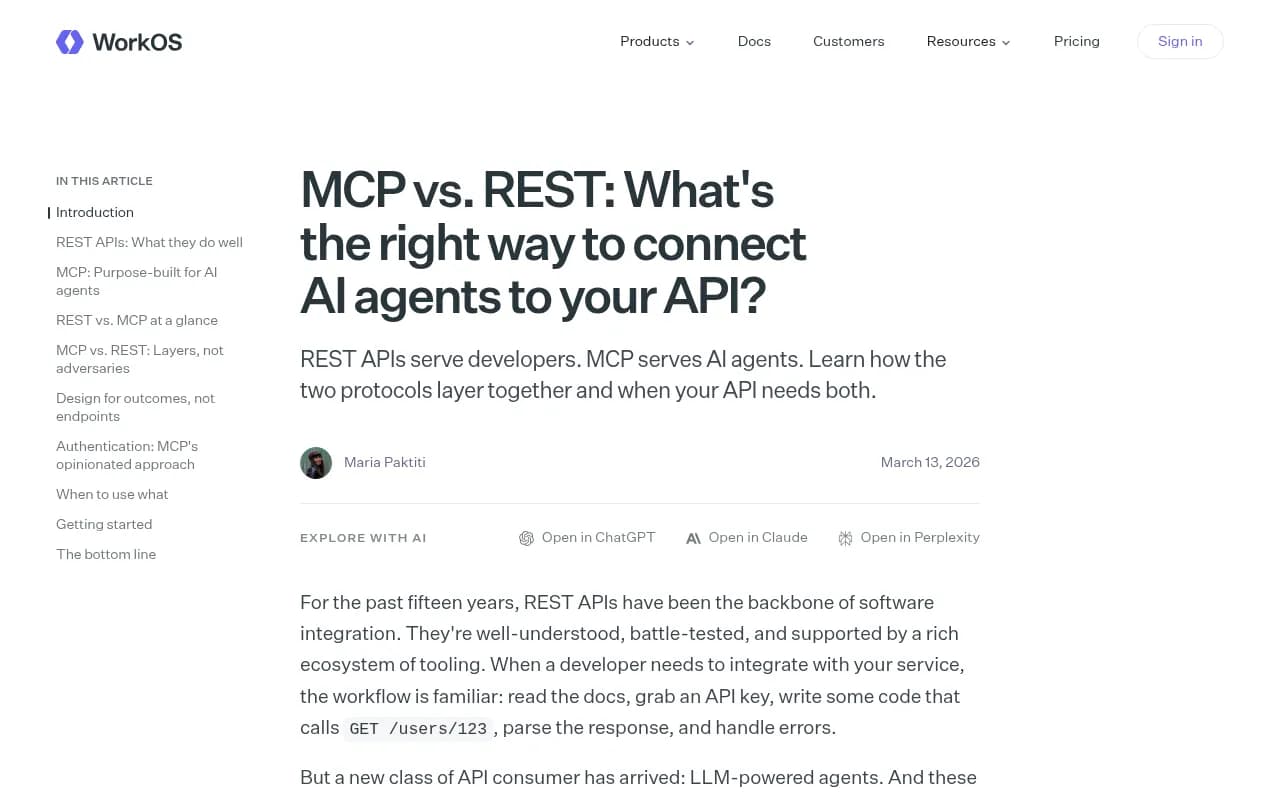
The key insight, and one that took the industry a while to internalize: MCP doesn't replace APIs. Most MCP servers are thin layers that translate an LLM's tool calls into REST API requests. WorkOS frames it well: your REST API handles the business logic, MCP wraps it in a layer AI agents can actually work with.
How they compare
| Dimension | REST API | Webhook | MCP server |
|---|---|---|---|
| Consumer | Developer or application | Your event handler | AI agent or LLM |
| Direction | You pull data | Platform pushes events | Agent discovers and calls tools |
| Best for | Bulk pulls, pagination, scheduled pipelines | Instant alerts, threshold breaches | Multi-step reasoning across tools |
| Latency profile | On demand | Near real time | Slower, context-rich |
| Determinism | Fully predictable | Predictable per event | Depends on the model |
| Pagination handling | You control it | N/A | Agents often struggle with it |
| Security surface | API key management | Endpoint authentication | Prompt injection, tool poisoning |
| Maturity | 15+ years | 15+ years | ~2 years, spec still evolving |
One counter-intuitive point worth sitting with: MCP can increase your total API call volume rather than reduce it. Each agent request can trigger many underlying API calls as the model reasons and iterates. Tinybird documented this firsthand when prototyping a PR-review agent: MCP worked instantly with zero code for the prototype, but in production, pulling and iterating through data was faster and more reliable via direct API calls.
When each one fits a GEO workflow
Use REST when the logic is fixed and the volume is high
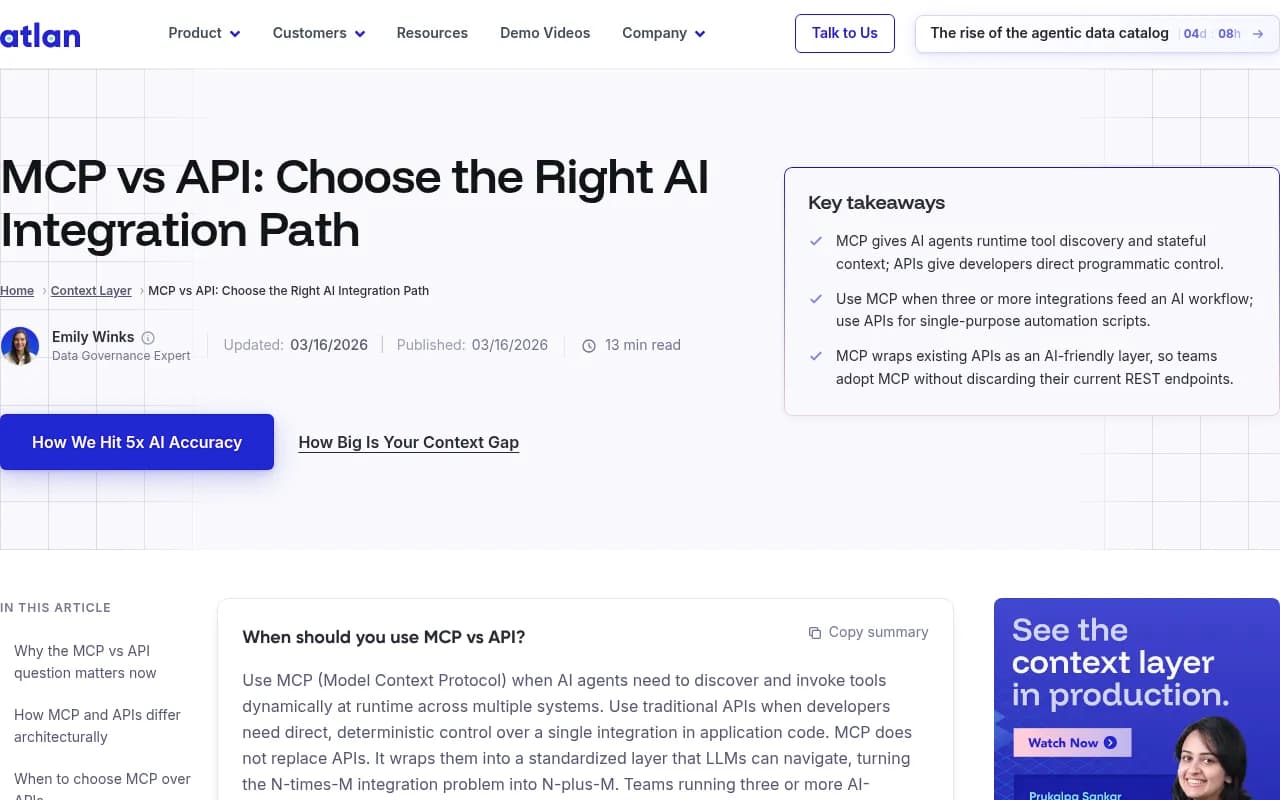
Atlan's decision framework puts it bluntly: webhook receivers, scheduled data exports, and health-check monitors belong in the "use APIs, not MCP" bucket. Anywhere the logic is fixed, the endpoint is known, and no AI reasoning is involved, direct REST calls are simpler and faster.
Concrete GEO examples:
- A nightly job that pulls all citation data into your data warehouse for trend analysis
- Syncing AI visibility metrics into Looker Studio or your BI tool
- Bulk content audits across hundreds of URLs
- Anything involving pagination, because MCP-driven agents are genuinely bad at this. An agent may not paginate through 100-record pages and you end up with incomplete data without knowing it
Use webhooks when the timing matters more than the analysis
Visibility shifts happen between dashboard checks. Promptwatch's data on the citation drop after GPT-5.3 documented average citations per ChatGPT response falling across all models around the March 2026 rollout. If your workflow is "check the dashboard every Monday," you might lose a week of traffic before you notice.
A webhook setup for AI visibility alerts typically looks like this: generate an incoming webhook URL in Slack or Teams, test it with a curl POST, then paste that destination URL into your GEO platform's integration settings alongside an API key. Then define thresholds: alert if ChatGPT citation volume drops below a floor, if a competitor's share of voice jumps, if a key prompt flips from citing you to citing someone else. Route different thresholds to different channels so the content team and the ops team each get their own signal.
The limitation is obvious once you think about it: webhooks tell you that something happened, not why. They're a tripwire, not an analyst.
Use MCP when an AI agent needs to reason across your tools
MCP earns its overhead when the consumer is an LLM doing multi-step, context-dependent work. The Atlan framework suggests three or more AI-connected integrations before MCP pays for itself. A single script calling one REST endpoint gains nothing from dynamic tool discovery.
The GEO use case where MCP genuinely shines: sitting in Claude or ChatGPT and asking questions that require chaining together visibility data, competitor comparisons, and content gaps. "Which prompts did we lose citations on this week, what pages did the engine cite instead, and what should we publish to fix it?" That's a multi-hop question. With MCP, the agent queries your visibility platform, cross-references competitor data, pulls the content gap analysis, and drafts the fix, all in one conversation.
A concrete example: how one GEO platform wires all three together
Abstract frameworks are fine, but it helps to see a real stack. Promptwatch, the GEO platform we recommend on this site, offers all three integration paths side by side, which makes it a useful reference architecture.

- REST API (v2): full programmatic access for scheduled pipelines, data warehouse syncs, and anything a developer builds deterministically. API keys live under Settings, and the platform also ships a Looker Studio connector for reporting pipelines.
- MCP server: connects ChatGPT, Claude, Cursor, and other MCP-compatible clients to visibility data directly. Setup uses Streamable HTTP transport with a Bearer token, and the same MCP server powers Promptwatch's official ChatGPT plugin and Claude connector listings. An agent can query citations across engines, analyze sources, track AI-referred traffic, compare competitors, and identify content gaps without leaving the chat.
- Push channel (Slack): the near-webhook layer. Map channels to projects and chat with the Promptwatch agent inside Slack, which covers the "tell me the moment something matters" use case without building a custom webhook receiver.
Notice the split in how data flows. Data-in integrations (Google Search Console, CDN log ingestion from Cloudflare, Vercel, Netlify, and others, the visitor analytics script) feed the platform. Tools-out integrations (MCP, REST API, Slack, CMS publishing to Webflow, Framer, and WordPress) get the insights back into your workflow. That separation is worth copying if you're architecting your own GEO stack.
The pricing reality: integration access is tier-gated
Here's something the protocol comparison guides don't cover: in the GEO tool market, your integration method is often decided by your invoice, not your architecture.
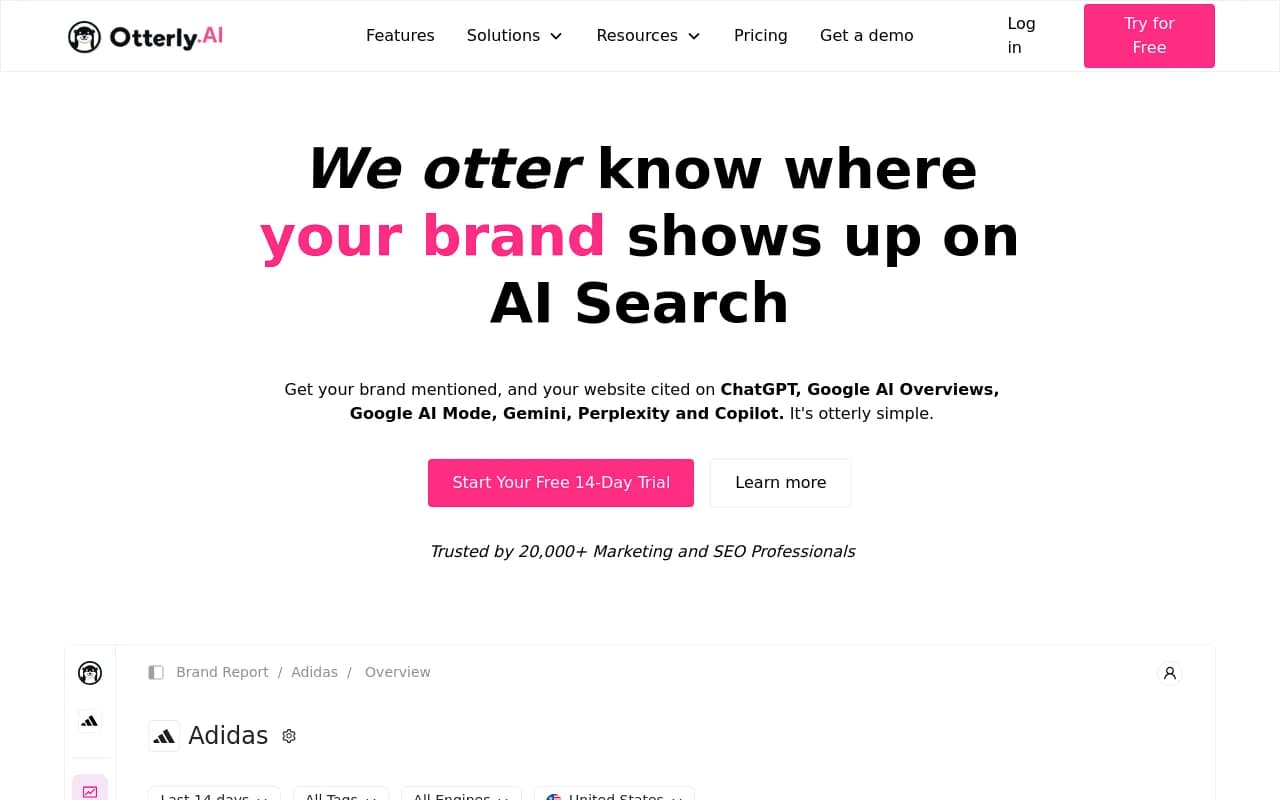
Otterly.AI, for example, gates both API and MCP access behind its Standard tier at $189/month (2,000 requests each), with Premium at $489/month bumping that to 5,000 requests. Its Lite tier at $29/month is tracking-only. Reviewers have noted that mid-tier API/MCP access is unusual, since most competitors in this category reserve it for enterprise plans. Otterly's MCP server is hosted at data.otterly.ai using OAuth 2.0.
Promptwatch includes MCP and API access starting from its Essential tier at $95/month, with the free Explore tier limited to basic ChatGPT tracking. The broader pattern across the category, per KIME's 2026 roundup, is that GEO tools are increasingly pairing "API plus MCP access on higher tiers" with an agentic execution layer that turns findings into fixes.
| Platform | Cheapest tier with API access | Cheapest tier with MCP access | Notes |
|---|---|---|---|
| Promptwatch | Essential, $95/mo | Essential, $95/mo | MCP works with ChatGPT, Claude, Cursor; official ChatGPT plugin and Claude connector |
| Otterly.AI | Standard, $189/mo | Standard, $189/mo | 2,000 requests/month each; OAuth 2.0 hosted MCP server |
| Typical competitor | Enterprise tier | Enterprise tier | Most reserve API/MCP for top-tier plans |
The practical advice: before you commit to a GEO platform, decide which integration method your workflow actually needs, then verify that method is available at the price you're willing to pay. A cheap tracking plan that locks you into manual dashboard checks can cost more in wasted hours than the tier upgrade would have.
Security: what to know before wiring MCP into production
I'd be doing you a disservice to skip this. MCP had six critical CVEs in its first year, and research found 43% of MCP servers vulnerable to command injection. The specific attack patterns matter for GEO teams because your MCP server will touch content publishing.
- Tool poisoning: malicious instructions hidden inside tool descriptions, which are visible to the LLM but not normally shown to the user. Invariant Labs demonstrated this against a WhatsApp MCP server to exfiltrate message history.
- Rug pulls: a tool approved as safe can silently mutate its own definition later, rerouting credentials, and many clients don't alert you when a previously-approved tool changes.
- Tool shadowing: with multiple MCP servers connected to one agent, a malicious server can override calls meant for a trusted one.
- Indirect prompt injection: untrusted external content (a scraped page, a document) can trigger unwanted tool calls.
The mitigations are unglamorous but effective: minimum-necessary permission grants per agent, pinning server versions, using only trusted servers, requiring schema-validated structured responses, and keeping a human in the loop for anything that publishes to your CMS. The MCP spec itself says there should always be a human able to deny tool invocations. For GEO specifically, that last one is why a review inbox before automated publishing is a feature, not friction.
If you're building custom agent workflows rather than using a platform's built-in ones, tools like n8n give you the code-level control to enforce those guardrails yourself.
A decision framework you can actually use
Ask these questions in order:
- Who or what is the consumer? A developer or a scheduled script means REST. An event-driven reaction means webhooks. An LLM reasoning across multiple tools means MCP.
- Is the logic fixed? If you can write the exact steps in advance, REST or webhooks. If the steps depend on what the data says, MCP.
- Does pagination or bulk data matter? Agents handle this poorly today. Use REST for anything that must be complete and deterministic.
- How fast do you need to know? Minutes matter for visibility drops. Webhooks. Weekly review is fine for strategy. REST pulls into a report.
- Is a human reviewing the output? MCP agents drafting content should go through a review step before publishing. Always.
For most GEO teams in 2026, the honest answer is all three: webhooks for tripwires, REST for the data backbone, MCP for the exploratory and agentic work. If you're evaluating platforms and want to compare what's out there, the GEO software directory at bestgeosoftware.com is a good starting point, and agenticseotools.com covers the agent-specific side.
The bottom line
The MCP hype is real but it's aimed at a specific problem: letting AI agents use your tools without you hand-coding every step. It doesn't replace REST, and it doesn't replace webhooks, because it doesn't try to. Your REST API does the work, your webhooks watch the clock, and your MCP server lets an agent think. A GEO workflow that uses all three, each for what it's good at, will beat one that treats the choice as either/or.