Summary
- Budget tier ($99-$249/mo): Promptwatch, Peec AI, and Otterly.AI offer core visibility tracking without breaking the bank
- Mid-market ($250-$579/mo): Profound, Scrunch AI, and AthenaHQ add advanced analytics and multi-site support
- Enterprise (custom pricing): Conductor, BrightEdge, and Searchmetrics deliver white-glove service and unlimited scale
- Free/freemium options: LLMrefs and Airefs let you test AI visibility tracking before committing
- Action-focused platforms: Promptwatch stands out by closing the loop from visibility data to content creation to traffic attribution
AI search is eating traditional SEO's lunch. When ChatGPT answers a question, nobody clicks through to Google. When Perplexity cites three sources, the other 97 sites on page one get zero traffic. This shift creates a new measurement problem: you can't optimize what you can't see.
AI visibility platforms solve this. They track which brands AI models cite, which sources they trust, and which prompts drive the most visibility. But pricing varies wildly -- from $99/month tools that track a handful of prompts to six-figure enterprise contracts with dedicated strategists.
This guide breaks down 12 platforms by price tier, showing exactly what you get at each level and which features justify the cost.
What AI visibility platforms actually measure
Before comparing prices, understand what you're paying for. AI visibility tools track four core metrics:
Brand mentions: How often your brand appears in AI responses across ChatGPT, Claude, Perplexity, Gemini, and other models. This is the baseline -- if you're not mentioned, you're invisible.
Share of voice: Your visibility percentage vs competitors for key prompts. If ChatGPT recommends five project management tools and yours is one of them, you have 20% share of voice for that prompt.
Citation sources: The exact URLs, Reddit threads, YouTube videos, and documents AI models reference when they mention you. This shows what content is working and where gaps exist.
Prompt intelligence: Volume estimates and difficulty scores for each query. High-volume, low-competition prompts are gold -- these platforms surface them so you're not guessing.
Budget tools typically cover the first two. Mid-market platforms add citation analysis. Enterprise solutions layer on prompt intelligence, content generation, and traffic attribution.
Budget tier: $99-$249/month
These platforms give you visibility data without the enterprise price tag. You'll track core metrics across major AI models, but expect limitations on prompt volume, site count, and advanced features.
Promptwatch Essential: $99/month
Promptwatch Essential is the entry point for brands that want more than monitoring. You get 50 prompts tracked across 10 AI models (ChatGPT, Perplexity, Claude, Gemini, Google AI Overviews, Meta AI, DeepSeek, Grok, Mistral, Copilot), plus the platform's standout feature: AI content generation.

Most competitors at this price stop at showing you data. Promptwatch's Answer Gap Analysis identifies which prompts competitors rank for but you don't, then its AI writing agent generates articles grounded in 880M+ citations to close those gaps. You also get 5 AI-generated articles per month included in the plan.
What you don't get: crawler logs (which AI bots hit your site), multi-site tracking (Essential covers one domain), or state/city-level geographic segmentation. For a single-site business that needs actionable insights fast, it's hard to beat.
Peec AI: $129/month
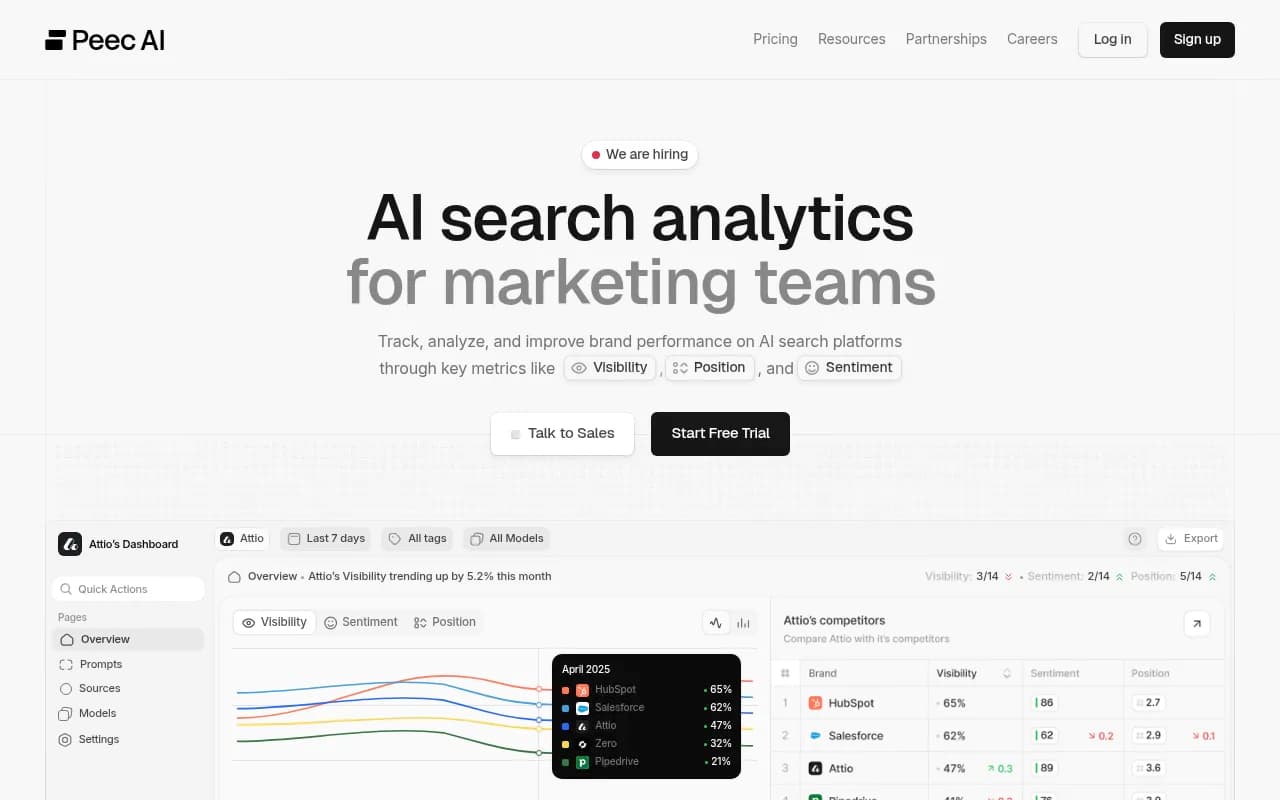
Peec AI positions itself as the budget-friendly option with multi-language support. The platform tracks your brand across ChatGPT, Perplexity, and Google AI Overviews in any language, which matters if you operate in non-English markets where most competitors have blind spots.
The interface is straightforward: prompt tracking, mention alerts, and basic competitor comparisons. You won't get citation-level analysis or content recommendations, but for brands that just need to know "are we visible or not?" across languages, Peec delivers.
Limitation: prompt volume caps are lower than Promptwatch (around 30-40 prompts depending on language), and there's no content creation tooling. It's monitoring-only.
Otterly.AI: $149/month

Otterly.AI is pure monitoring. The platform tracks brand mentions and sentiment across ChatGPT, Claude, Perplexity, and Gemini with daily updates. You get alerts when your visibility changes and basic share-of-voice metrics vs competitors.
What's missing: any optimization features. No content gap analysis, no citation tracking, no prompt volume data. Otterly shows you the scoreboard but doesn't help you improve your score. For brands that already have a content strategy and just need visibility confirmation, it works. For everyone else, the lack of actionable insights is frustrating.
Mid-market tier: $250-$579/month
This is where platforms add depth: more prompts, citation analysis, crawler logs, and multi-site support. You're paying for the data that tells you why you're visible (or not) and what to do about it.
Promptwatch Professional: $249/month
Promptwatch Professional adds the features that turn visibility tracking into optimization. You get 150 prompts (3x Essential), 2 sites, 15 AI-generated articles per month, and two critical additions: AI crawler logs and state/city tracking.
Crawler logs show which AI bots (ChatGPT, Claude, Perplexity crawlers) are hitting your site, which pages they read, and errors they encounter. Most competitors don't offer this at any price. It's the difference between knowing you're cited and understanding how AI models discover your content.
State/city tracking lets you segment visibility by geography -- crucial for local businesses or brands with regional strategies. If you're visible in New York but invisible in Austin, you need different content for each market.
The content generation scales with you: 15 articles/month is enough to systematically close visibility gaps identified by Answer Gap Analysis. This is the sweet spot for most mid-market brands.
Profound: $399/month (estimated)
Profound is the analytics powerhouse. The platform tracks mentions across 8+ AI models with granular citation breakdowns -- you see not just that you were cited, but which paragraph, which claim, and which source document the AI model referenced.
The competitor heatmaps are excellent: visual comparisons showing who wins each prompt and why. Profound also surfaces Reddit discussions and YouTube videos that influence AI recommendations, a channel most tools ignore.
Downside: no content creation features. Profound tells you what's wrong but doesn't help you fix it. You'll need a separate content team or tool to act on the insights.
Scrunch AI: $450/month (estimated)
Scrunch AI combines visibility tracking with social listening. The platform monitors AI search results and social media mentions in one dashboard, which matters because Reddit threads and Twitter discussions directly influence what AI models recommend.
You get prompt tracking across ChatGPT, Perplexity, Claude, and Gemini, plus sentiment analysis and influencer identification. The social layer adds context -- if your brand is mentioned negatively on Reddit 50 times this week, you'll see that reflected in AI visibility drops.
Trade-off: the dual focus (AI + social) means neither is as deep as single-purpose tools. Citation analysis is basic compared to Profound, and social listening isn't as robust as dedicated platforms like Brand24.
AthenaHQ: $499/month (estimated)
AthenaHQ is monitoring-focused with strong competitor benchmarking. The platform tracks 8+ AI models and provides detailed share-of-voice reports, showing exactly where you're winning and losing vs competitors.
The prompt library is curated -- AthenaHQ suggests high-value queries based on your industry instead of making you guess. This saves research time but limits customization. You can add your own prompts, but the real value is in their pre-built sets.
Missing: crawler logs, content generation, and traffic attribution. Like Profound, AthenaHQ shows you the problem but doesn't help solve it.
Promptwatch Business: $579/month
Promptwatch Business is where the platform becomes a complete optimization system. You get 350 prompts tracked, 5 sites, 30 AI-generated articles per month, and full access to crawler logs, Reddit/YouTube insights, and ChatGPT Shopping tracking.
The ChatGPT Shopping feature is unique: it monitors when your brand appears in ChatGPT's product recommendations and shopping carousels, which is increasingly important as OpenAI pushes commerce features. No other platform tracks this.
You also get Looker Studio integration and API access for custom reporting. For agencies managing multiple clients or brands with complex reporting needs, this tier delivers the flexibility to build on top of the platform.
Enterprise tier: Custom pricing
Enterprise platforms don't list prices because they're selling outcomes, not features. Expect $2,000-$10,000+ per month depending on scale, with dedicated strategists, white-glove onboarding, and unlimited customization.
Conductor: Enterprise only
Conductor is the enterprise standard for AI visibility. The platform combines traditional SEO with AI search tracking, giving you a unified view of organic and AI-driven traffic. You get unlimited prompts, unlimited sites, and a dedicated customer success manager who acts as an extension of your team.
Conductor's strength is integration: the platform connects to your CMS, analytics stack, and marketing automation tools to close the loop from visibility to revenue. You can see which AI citations drove actual conversions, not just traffic.
The trade-off is complexity. Conductor requires 3-6 months of onboarding and a team to manage it. This isn't a tool you log into once a week -- it's infrastructure.
BrightEdge: Enterprise only
BrightEdge is Conductor's main competitor, with similar enterprise positioning and pricing. The platform adds AI-powered content recommendations on top of visibility tracking, suggesting exactly what to write based on gaps in your content vs what AI models want to cite.
BrightEdge's DataCube is the differentiator -- a proprietary dataset of 5+ billion keywords and AI prompts that powers the platform's recommendations. This is overkill for most brands, but for Fortune 500 companies competing in saturated markets, the depth matters.
Searchmetrics: Enterprise only
Searchmetrics combines AI visibility with traditional search intent analysis. The platform tracks how users search on Google vs how they prompt AI models, showing where behavior diverges. This matters because optimizing for Google and optimizing for ChatGPT require different content strategies.
You get unlimited tracking, custom integrations, and quarterly business reviews with Searchmetrics strategists. The platform is built for brands with dedicated SEO teams who can act on complex insights.
Free and freemium options
Two platforms offer limited free tiers if you want to test AI visibility tracking before committing.
LLMrefs: Free tier available
LLMrefs offers a free tier that tracks 5 prompts across ChatGPT and Perplexity. It's bare-bones -- just brand mention tracking with weekly updates -- but enough to confirm whether AI visibility matters for your business.
The paid tier ($49/month) adds more prompts and daily updates. Still monitoring-only, no optimization features.
Airefs: Free tier available
Airefs provides a free tier with 10 prompts tracked across ChatGPT, Perplexity, and Google AI Overviews. You get source-level visibility (which URLs were cited) and basic competitor comparisons.
The paid tier ($99/month) increases prompt limits and adds share-of-voice tracking. Airefs also offers a Done-for-You service where their team handles content creation and community engagement based on visibility data.
Pricing comparison table
| Platform | Starting price | Prompts | Sites | AI models | Content generation | Crawler logs |
|---|---|---|---|---|---|---|
| LLMrefs | Free | 5 | 1 | 2 | No | No |
| Airefs | Free | 10 | 1 | 3 | No | No |
| Promptwatch Essential | $99/mo | 50 | 1 | 10 | 5 articles/mo | No |
| Peec AI | $129/mo | 30-40 | 1 | 3 | No | No |
| Otterly.AI | $149/mo | ~50 | 1 | 4 | No | No |
| Promptwatch Professional | $249/mo | 150 | 2 | 10 | 15 articles/mo | Yes |
| Profound | ~$399/mo | 100+ | 1 | 8+ | No | No |
| Scrunch AI | ~$450/mo | 100+ | 1 | 4 | No | No |
| AthenaHQ | ~$499/mo | 150+ | 1 | 8+ | No | No |
| Promptwatch Business | $579/mo | 350 | 5 | 10 | 30 articles/mo | Yes |
| Conductor | Custom | Unlimited | Unlimited | All major | Via services | Yes |
| BrightEdge | Custom | Unlimited | Unlimited | All major | Via services | Yes |
Which tier is right for you?
Choose budget tier if: You manage one site, need basic visibility confirmation, and have a content team that can act on insights independently. Promptwatch Essential is the best value here because it includes content generation.
Choose mid-market tier if: You need deeper analytics (citation sources, crawler logs), manage multiple sites, or want geographic segmentation. Promptwatch Professional hits the sweet spot for most brands. Profound is better if you prioritize analytics depth over content creation.
Choose enterprise tier if: You're a Fortune 500 brand, need unlimited scale, require custom integrations, or want a dedicated strategist. Conductor and BrightEdge are the safe choices, but expect 6-figure annual contracts.
Start with free tier if: You're unsure whether AI visibility matters for your business. LLMrefs and Airefs let you test the concept before spending.
The action gap most platforms ignore
Here's what most comparisons miss: visibility data is worthless if you can't act on it. Monitoring-only tools (Otterly.AI, Peec AI, AthenaHQ, Profound) show you the problem but leave you stuck. You see that competitors are visible for 50 prompts you're not, but then what?
This is where Promptwatch's approach differs. The platform closes the loop:
- Answer Gap Analysis shows which prompts competitors rank for but you don't, with specific content angles missing from your site
- AI content generation creates articles engineered to get cited by AI models, grounded in 880M+ citations analyzed
- Page-level tracking shows which new pages start getting cited and by which models
- Traffic attribution connects visibility improvements to actual revenue via code snippet, Google Search Console integration, or server log analysis
This cycle -- find gaps, generate content, track results -- is what makes it an optimization platform instead of another dashboard. Most competitors stop at step one.
Features that justify higher pricing
As you move up pricing tiers, here's what you're actually paying for:
Crawler logs ($249+ tier): Real-time logs of which AI bots hit your site, which pages they read, and errors they encounter. This is critical for understanding how AI models discover your content. Most platforms lack this entirely.
Content generation ($99+ with Promptwatch): AI writing agents that create articles based on visibility gaps. This turns insights into action without hiring a content team. Rare outside Promptwatch.
Prompt intelligence ($250+ tier): Volume estimates and difficulty scores for each prompt, plus query fan-outs showing how one prompt branches into sub-queries. Helps prioritize high-value, winnable prompts.
Multi-site support ($249+ tier): Track multiple domains in one account. Essential for agencies or brands with multiple properties.
Geographic segmentation ($249+ tier): Track visibility by state, city, or country. Matters for local businesses and regional strategies.
Reddit/YouTube tracking ($250+ tier): Surface discussions that directly influence AI recommendations. Most competitors ignore this channel entirely.
ChatGPT Shopping tracking ($579+ tier): Monitor product recommendations and shopping carousels. Only Promptwatch offers this.
White-glove service (Enterprise tier): Dedicated strategists, custom integrations, quarterly business reviews. You're paying for outcomes, not features.
Red flags to watch for
Some platforms inflate their value with features that sound impressive but don't matter:
Fixed prompt sets: Tools that only track pre-defined prompts (like Semrush's AI Visibility Toolkit) miss the queries your actual customers use. You need custom prompt tracking.
Single-model tracking: Platforms that only monitor ChatGPT or Perplexity give you an incomplete picture. Your customers use multiple AI models.
No traffic attribution: If the platform can't connect visibility to actual traffic or revenue, you're flying blind. Visibility without business impact is vanity.
Monitoring without optimization: Dashboards that show you data but don't help you improve are expensive toys. Look for platforms that close the action loop.
The 2026 landscape
AI visibility platforms are consolidating into three categories:
Monitoring-only tools (Otterly.AI, Peec AI, LLMrefs): These will become commoditized as AI search APIs mature. Expect prices to drop and features to standardize.
Optimization platforms (Promptwatch, Conductor, BrightEdge): These add content creation, traffic attribution, and strategic guidance on top of monitoring. This is where the market is moving.
Niche players (Scrunch AI for social, Profound for analytics): These serve specific use cases but struggle to compete with full-stack platforms.
The winners will be platforms that help you take action, not just see data. Promptwatch's approach -- visibility tracking + content generation + traffic attribution -- is the model others will copy.
Final recommendation by use case
Single-site brand with content team: Promptwatch Essential ($99/mo). You get visibility data and content generation to close gaps.
Agency managing 2-5 clients: Promptwatch Professional ($249/mo). Multi-site support, crawler logs, and enough article credits to serve multiple clients.
Mid-market brand (50-500 employees): Promptwatch Business ($579/mo) or Profound ($399/mo). Choose Promptwatch if you want content generation, Profound if you prioritize analytics depth.
Enterprise (500+ employees): Conductor or BrightEdge (custom pricing). You need white-glove service and unlimited scale.
Testing the concept: LLMrefs or Airefs (free tier). Confirm AI visibility matters before committing budget.
The AI search channel isn't going away. Brands that build visibility now will compound advantages as more users shift from Google to ChatGPT. The question isn't whether to invest in AI visibility -- it's which platform gives you the best return at your budget level.