Key takeaways
- AI SEO in 2026 means two things: traditional search optimization AND visibility in AI engines like ChatGPT, Perplexity, and Google AI Overviews -- small businesses need both
- The best affordable options range from $19/month (SEOZilla, Rytr) to ~$100/month (SE Ranking, Surfer SEO), with free tiers available on several tools
- Content optimization tools (Surfer SEO, Clearscope, NeuronWriter) help you rank in Google; AI visibility tools (Otterly.AI, Writesonic, Promptwatch) help you get cited by AI engines
- Most tools do one job well -- the right choice depends on whether your biggest gap is content quality, keyword research, or AI search visibility
- For small businesses just starting out: pick one content tool and one visibility tracker, not five of everything
AI search traffic jumped 527% year-over-year in 2025. That's not a trend to watch from the sidelines -- it's already changing where customers find businesses like yours. When someone asks ChatGPT "what's the best local accountant in Denver" or "which project management tool is good for a 5-person team," the AI doesn't show a list of blue links. It picks sources and recommends them directly.
If your business isn't in those answers, you're invisible to a growing chunk of your potential customers.
The good news: you don't need an enterprise budget to fix this. The AI SEO tools market is expected to hit $22.39 billion by 2026 according to Research and Markets, and a lot of that growth is being driven by affordable SaaS tools built specifically for smaller teams. There are genuinely solid options at every price point.
This guide covers 8 tools that work well for small businesses -- a mix of content optimization, keyword research, and AI visibility tracking. Some overlap; most don't. The goal is to help you figure out which combination makes sense for where you are right now.
What "AI SEO" actually means in 2026
It's worth being clear on this because the term gets used loosely.
Traditional SEO tools (keyword research, backlink analysis, on-page optimization) are still relevant. Google still processes billions of searches daily. But a second layer has emerged: Generative Engine Optimization (GEO), which is about getting your brand cited and recommended in AI-generated responses from ChatGPT, Perplexity, Claude, Google AI Overviews, and similar platforms.
The two disciplines overlap but aren't identical. A page that ranks #1 on Google doesn't automatically get cited by ChatGPT -- and vice versa. Research consistently shows that fewer than 10% of sources cited in ChatGPT responses rank in Google's top 10 for the same query.
So when you're evaluating tools, ask: does this help me rank in Google, get cited by AI engines, or both?
The 8 best AI SEO tools for small businesses in 2026
1. Surfer SEO -- best for content optimization
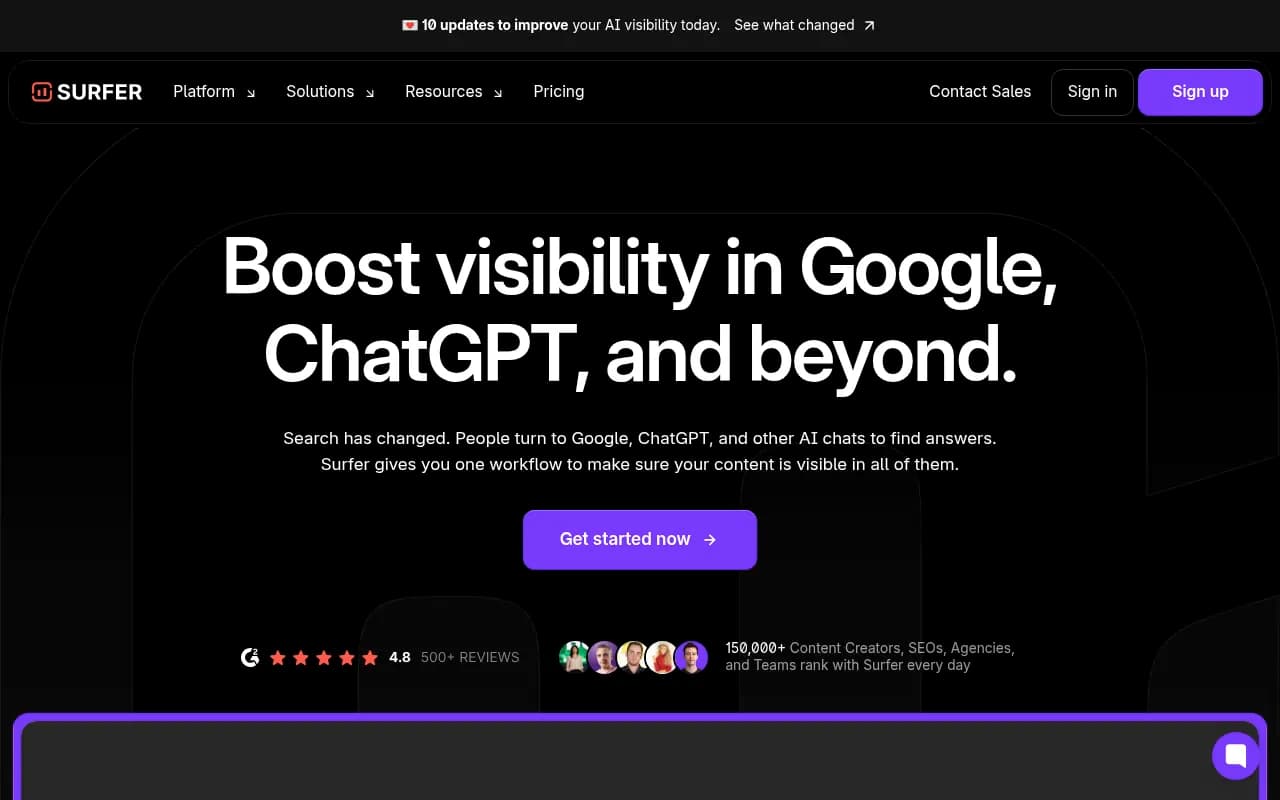
Surfer SEO is one of the most widely used content optimization tools, and for good reason. You paste in a target keyword, and it analyzes the top-ranking pages to give you a content score, recommended word count, semantic terms to include, and structural suggestions. The AI writing assistant can draft or expand content directly inside the editor.
For small businesses producing blog content, landing pages, or product descriptions, Surfer gives you a clear target to hit instead of guessing what Google wants to see.
Pricing starts around $89/month for the Essential plan. Not the cheapest option on this list, but the data quality is solid and the workflow is genuinely fast.
2. SE Ranking -- best all-in-one for budget-conscious teams
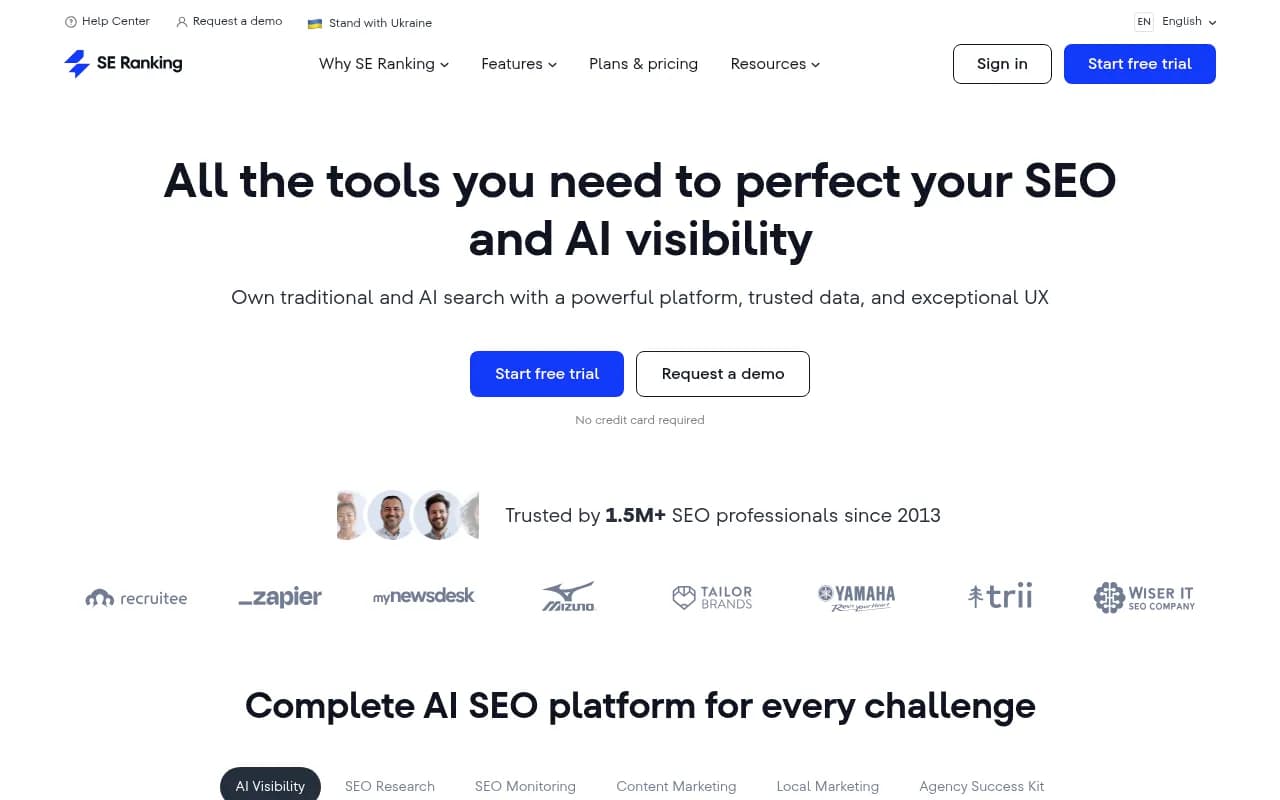
SE Ranking packs a lot into one platform: keyword research, rank tracking, site audits, backlink analysis, and -- increasingly -- AI visibility monitoring. The Essential plan starts at $65/month, which is competitive for the feature set.
What makes SE Ranking interesting for 2026 is that it's been building out AI search monitoring features alongside its traditional SEO toolkit. You get a reasonably complete picture of your search presence without juggling five separate subscriptions.
It's not the deepest tool in any single category, but for a small business that needs "good enough" across the board without a dedicated SEO team, it's hard to beat the value.
3. Clearscope -- best for content teams focused on quality
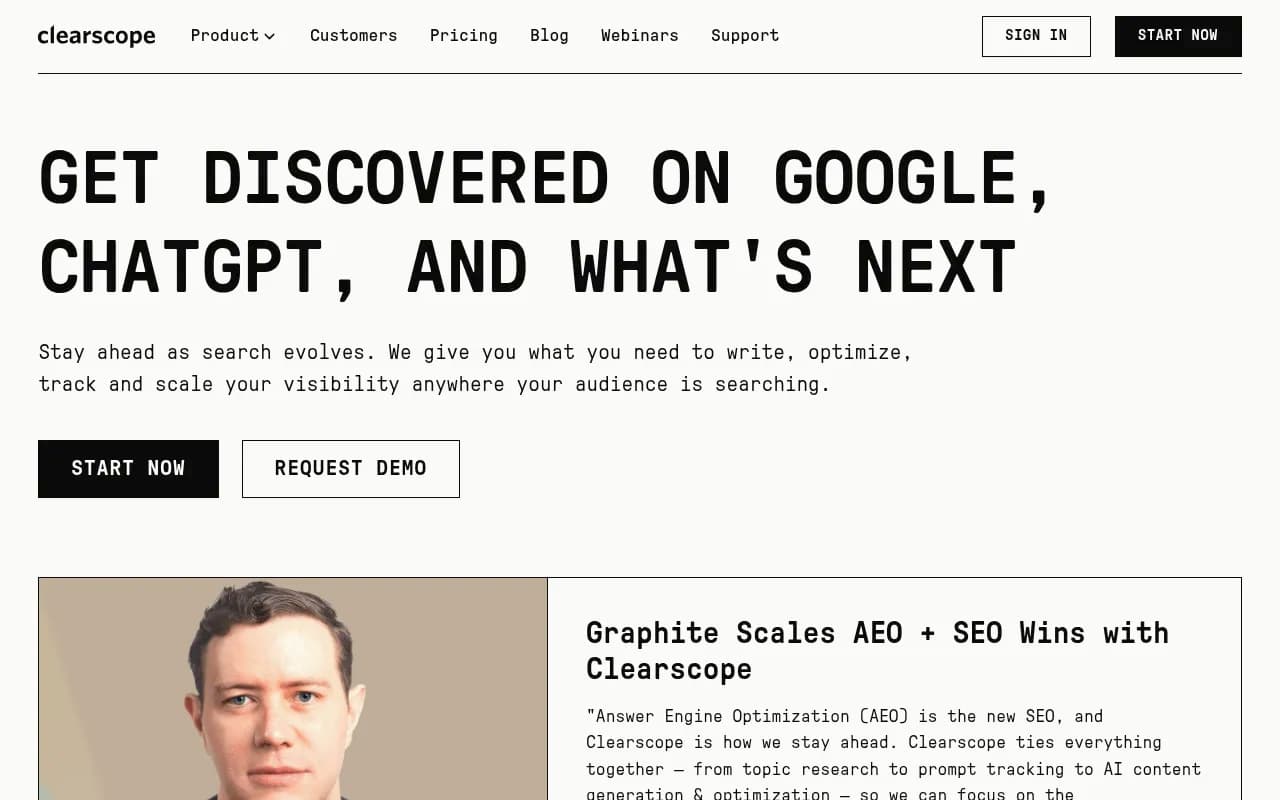
Clearscope is a content optimization tool that takes a slightly different approach than Surfer. It focuses heavily on semantic relevance -- making sure your content covers a topic thoroughly enough to satisfy both search engines and readers. The grading system (A+ through F) gives writers a clear benchmark.
It's more expensive than some alternatives (plans start around $189/month), which puts it at the upper end of "affordable" for small businesses. But if you're publishing regularly and content quality is your competitive advantage, the investment tends to pay off.
4. NeuronWriter -- best budget content optimizer
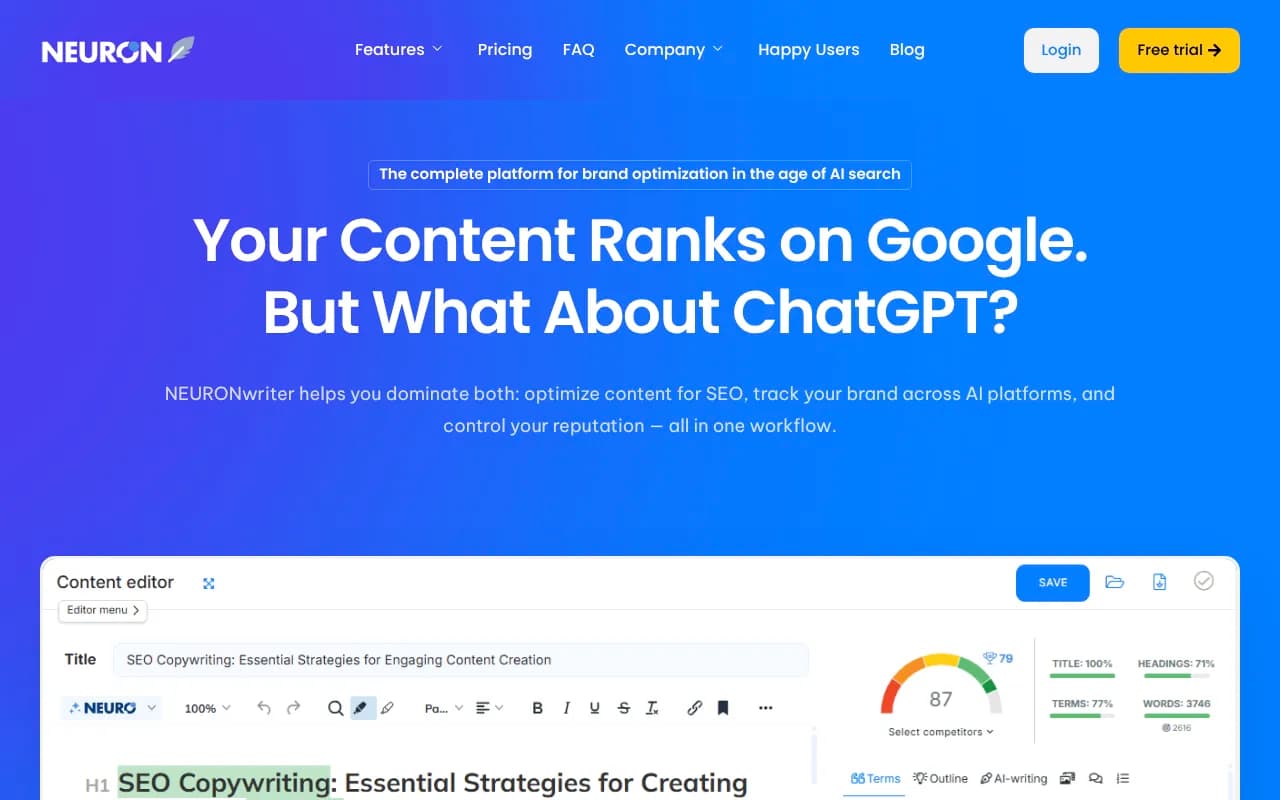
If Clearscope's price is too steep, NeuronWriter covers similar ground at a fraction of the cost. It uses NLP analysis to suggest semantic terms, competitor content comparisons, and content scoring. Plans start around $23/month, making it one of the most accessible content optimization tools available.
The interface isn't as polished as Surfer or Clearscope, but the underlying data is solid. For a small business writing its own content without a dedicated content team, NeuronWriter is a genuinely good starting point.
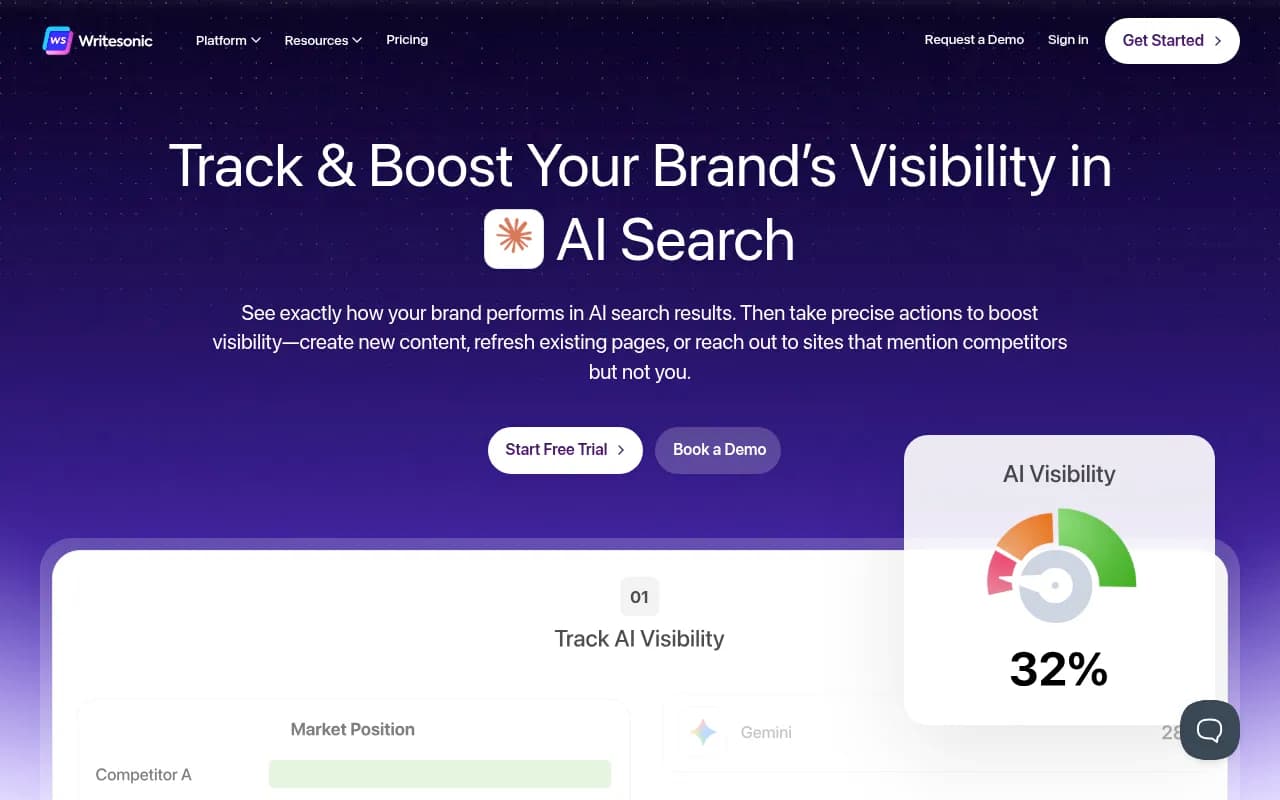
5. Writesonic -- best for combining content creation with AI visibility
Writesonic started as an AI writing tool but has evolved into something more interesting: a platform that connects content creation with AI search visibility tracking. You can generate SEO-optimized content and monitor how your brand appears in AI engine responses, which is a useful combination for teams that want to address both traditional and AI search in one place.
The pricing is accessible -- plans start around $20/month for basic use -- and the content quality has improved significantly in recent versions.
6. Otterly.AI -- best entry-level AI visibility tracker
If your main question is "does my brand show up when people ask ChatGPT about my category?" -- Otterly.AI answers that question cheaply. At $29/month, it's one of the most affordable ways to start monitoring your AI search presence across multiple LLMs.
The trade-off is that Otterly is primarily a monitoring tool. It shows you where you stand but doesn't tell you how to fix gaps or generate content to improve visibility. Think of it as a starting point: useful for understanding your baseline before you invest in more comprehensive solutions.

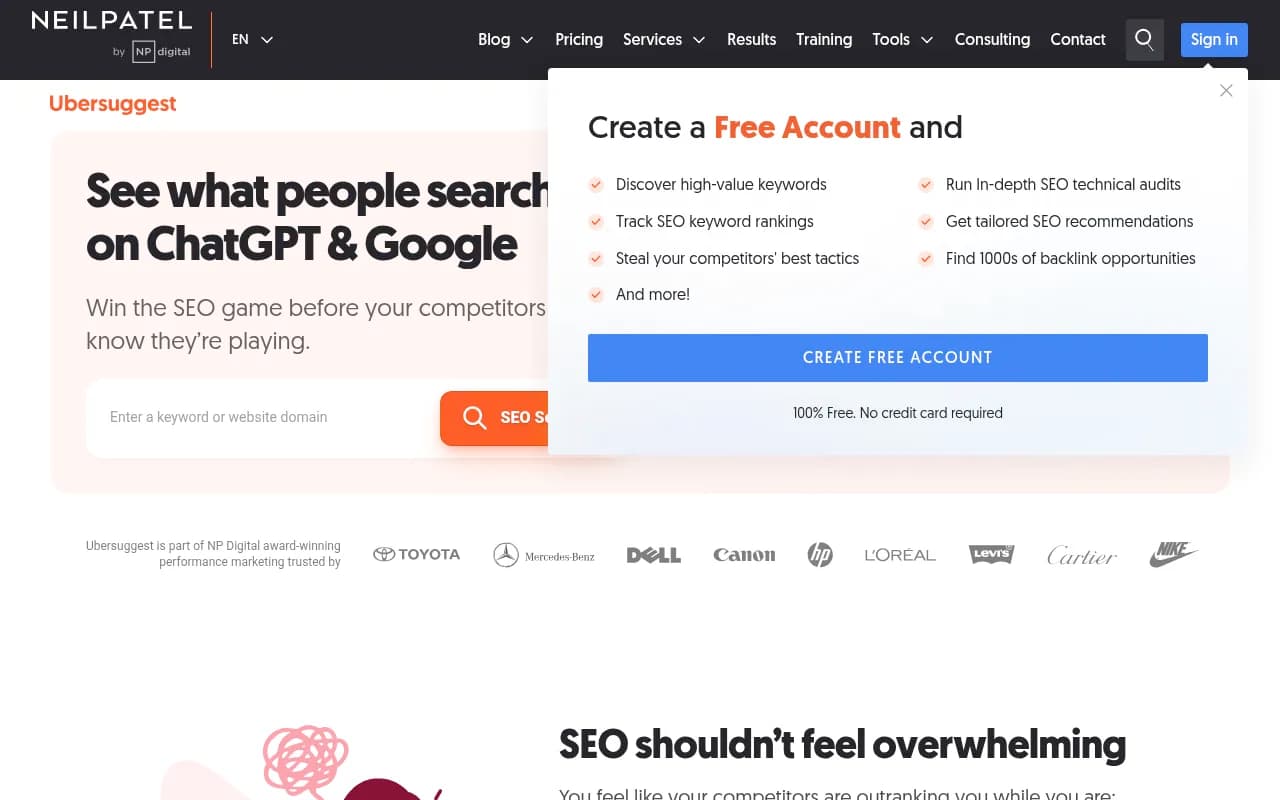
7. Ubersuggest -- best free/low-cost keyword research tool
Neil Patel's Ubersuggest has become a genuinely capable keyword research tool at a price point that's hard to argue with. The free tier covers basic keyword data, and paid plans start around $29/month. It includes keyword suggestions, content ideas, competitor analysis, and a site audit tool.
For a small business just getting started with SEO, Ubersuggest provides enough data to build a solid keyword strategy without a big upfront investment. It's not going to replace Ahrefs or Semrush for power users, but it doesn't need to.
8. Promptwatch -- best for AI search visibility and optimization
Promptwatch sits in a different category from the other tools on this list. Where most AI SEO tools focus on traditional search or basic AI monitoring, Promptwatch is built around the full cycle of AI visibility: finding where you're invisible, creating content to fix it, and tracking whether that content gets cited.
The Answer Gap Analysis shows you which prompts competitors appear in but you don't -- specific questions and topics that AI models are answering without citing your site. The built-in AI writing agent then generates content grounded in citation data from 880M+ analyzed citations, targeting the exact gaps you've identified. Page-level tracking closes the loop by showing which pages are being cited, by which AI models, and how often.
For small businesses that are serious about showing up in ChatGPT, Perplexity, Google AI Overviews, and other AI engines -- not just monitoring whether they do -- Promptwatch is the most complete affordable option. The Essential plan starts at $99/month, which covers one site, 50 prompts, and 5 AI-generated articles per month.

How these tools compare
| Tool | Starting price | Primary use | AI visibility tracking | Content generation | Best for |
|---|---|---|---|---|---|
| Surfer SEO | $89/mo | Content optimization | No | Yes (AI writer) | Ranking in Google |
| SE Ranking | $65/mo | All-in-one SEO | Basic | No | Budget all-rounder |
| Clearscope | $189/mo | Content quality | No | No | Content-focused teams |
| NeuronWriter | $23/mo | Content optimization | No | Basic | Budget content optimizer |
| Writesonic | $20/mo | Content + AI visibility | Yes (basic) | Yes | Dual-purpose teams |
| Otterly.AI | $29/mo | AI visibility monitoring | Yes | No | Monitoring on a budget |
| Ubersuggest | $29/mo | Keyword research | No | Basic | SEO beginners |
| Promptwatch | $99/mo | AI visibility + optimization | Yes (10 AI models) | Yes (citation-grounded) | Full AI search strategy |
Which tools should you actually combine?
Most small businesses don't need eight tools. Here are three practical combinations depending on where you are:
If you're starting from scratch
Start with Ubersuggest for keyword research (free or $29/month) and Otterly.AI for basic AI visibility monitoring ($29/month). Total: under $60/month. This gives you a baseline understanding of your SEO position and whether you're showing up in AI search at all.
If you're producing regular content
Add NeuronWriter ($23/month) to optimize each piece of content before publishing. If budget allows, upgrade to Surfer SEO for more robust optimization data. This combination addresses the "content quality" gap that prevents many small business sites from ranking.
If AI search visibility is a priority
Promptwatch at $99/month covers the full loop: gap analysis, content creation, and tracking. Pair it with SE Ranking ($65/month) for traditional SEO monitoring and you have a comprehensive setup for around $165/month -- reasonable for a business that takes search seriously.
A note on AI visibility vs. traditional SEO
It's tempting to think these are two separate problems requiring two separate strategies. They're not, really. The content that gets cited by AI engines tends to be thorough, well-structured, and authoritative -- the same qualities that help pages rank in Google. The difference is that AI engines also care about whether you're being discussed across the web: in Reddit threads, YouTube videos, industry publications, and other sources they use to form their understanding of a topic.
This is why tools that only track AI citations without helping you understand why you're being cited (or not) have limited value. The more useful question is: what content does my site need to become the kind of source AI engines want to cite?
That's a harder question to answer, but it's the right one to be asking.
What to look for when choosing
A few practical criteria worth applying to any AI SEO tool before you pay for it:
Does it show you what to do, not just what's happening? Dashboards that show you're invisible in ChatGPT are mildly interesting. Tools that show you which specific content gaps are causing that invisibility are actually useful.
Does it cover the AI engines your customers use? ChatGPT gets the most attention, but Perplexity, Google AI Overviews, and Claude are all driving meaningful traffic. A tool that only monitors one or two platforms gives you an incomplete picture.
Is the pricing model sustainable for your business? Some tools charge per report or per keyword query, which can get expensive fast. Flat monthly pricing with clear limits is easier to budget around.
Does it integrate with your existing workflow? If you're already using WordPress, Google Search Console, or a specific CMS, tools that connect directly to those save meaningful time.
The bottom line
The AI SEO tools market has matured enough that small businesses have real options at every price point. You don't need to spend $500/month to get useful data and actionable recommendations.
The honest advice: start with one tool that addresses your biggest current gap. If you're not ranking in Google at all, start with keyword research and content optimization. If you're ranking but not appearing in AI search results, start with an AI visibility tracker. Once you understand your baseline, you can layer in additional tools as your needs grow.
The businesses that will win in AI search over the next few years aren't necessarily the ones with the biggest budgets -- they're the ones that understand what AI engines are looking for and consistently produce content that answers those questions better than anyone else.