Key takeaways
- For AI search visibility + content optimization combined: Promptwatch is the strongest pick -- it tracks your brand across 10+ AI models, identifies content gaps, and generates content engineered to get cited. Starts at $99/mo.
- For traditional SEO content writing with some AI tracking: Surfer SEO ($99/mo) and Frase ($39/mo) are the most affordable options with solid on-page optimization workflows.
- For content strategy and topical authority: Clearscope ($189/mo) and MarketMuse ($150/mo) go deeper on topic modeling and search intent than Rankability does.
- For agencies wanting automation: SearchAtlas ($99/mo) and its OTTO AI agent can actually deploy fixes -- not just flag them.
- For budget-conscious teams: NeuronWriter starts at $19/mo and punches well above its price point for semantic SEO optimization.
Rankability is a capable platform, especially for SEO agencies that want a single workflow covering research, content writing, optimization, and rank tracking. The pitch is clean: stop juggling five tools and run everything through one repeatable system. For agencies producing content at scale, that's genuinely appealing.
But there are real reasons people look elsewhere. Pricing isn't publicly listed, which is a friction point when you're comparing options. The platform is explicitly built for agencies, so solo operators or in-house teams often find it over-engineered for their needs. And while Rankability has added AEO (AI search) tracking, it's not the primary focus -- teams that want deep AI visibility data tend to outgrow what it offers on that front pretty quickly.
There's also the question of what you actually need. If your main problem is Google rankings, you probably don't need Rankability's full agency workflow. If your main problem is AI search visibility, you need something purpose-built for that. And if you need both, the options below cover the full range.
Promptwatch

Promptwatch is the most complete option on this list if AI search visibility is your priority. Where Rankability treats AI tracking as one feature among many, Promptwatch is built entirely around it -- tracking your brand across ChatGPT, Claude, Gemini, Perplexity, Grok, DeepSeek, Copilot, Mistral, Meta AI, and Google AI Overviews.
The core difference from most tools in this space is that Promptwatch doesn't stop at monitoring. The Answer Gap Analysis shows you exactly which prompts your competitors appear in but you don't -- and then the built-in AI writing agent generates content designed to close those gaps. That content is grounded in real citation data (880M+ citations analyzed), so it's not generic filler. It's written to get cited by AI models specifically.
A few things Rankability doesn't have that Promptwatch does: AI Crawler Logs (real-time logs of ChatGPT, Claude, Perplexity, and other AI crawlers hitting your site), Reddit and YouTube citation tracking (which directly influences what AI models recommend), ChatGPT Shopping tracking, and query fan-outs that show how a single prompt branches into sub-queries.
The page-level tracking is also more granular than what Rankability offers on the AI side -- you can see exactly which pages are being cited, by which models, and how often. And the traffic attribution (via code snippet, GSC integration, or server log analysis) connects AI visibility to actual revenue, which is the number most clients actually care about.
Pricing is transparent: $99/mo for the Essential plan (1 site, 50 prompts, 5 articles), $249/mo for Professional (2 sites, 150 prompts, 15 articles, crawler logs), and $579/mo for Business (5 sites, 350 prompts, 30 articles). There's a 7-day free trial.
Compared to Rankability, Promptwatch is narrower in scope -- it's not trying to replace your entire SEO content workflow. But for teams where AI search visibility is the actual business problem, it's the more focused and more actionable tool.
Best for: Marketing teams, SEO agencies, and brands that need to understand and improve how they appear in AI search results -- not just track it.
Semrush
Semrush is the obvious choice if you want one platform that covers traditional SEO, PPC, social, content, and AI visibility without stitching together separate tools. The AI Visibility Toolkit (available as a $99/mo add-on) tracks brand mentions across AI search engines and provides some competitive benchmarking.
The honest trade-off: Semrush's AI tracking uses fixed prompts, which limits how granular you can get. You can't define custom prompts that match how your actual customers search, and there's no AI traffic attribution to connect visibility data to revenue. For teams that are primarily SEO-focused and want AI tracking as a secondary feature, that's probably fine. For teams where AI search is the main concern, it feels like a bolt-on.
Where Semrush genuinely wins is breadth. Keyword research, backlink analysis, site audits, competitor traffic data, local SEO, social scheduling -- it's all there. If you're replacing Rankability because you want more traditional SEO horsepower, Semrush is the natural upgrade.
Pricing: Starts at $165.17/mo (Starter), with Pro+ at $249/mo and Business+ at $499/mo. Add the AI Visibility add-on for $99/mo on top. 7-day free trial.
Best for: Teams that need a full-stack digital marketing platform and want AI tracking as one piece of a larger toolset.
Surfer SEO
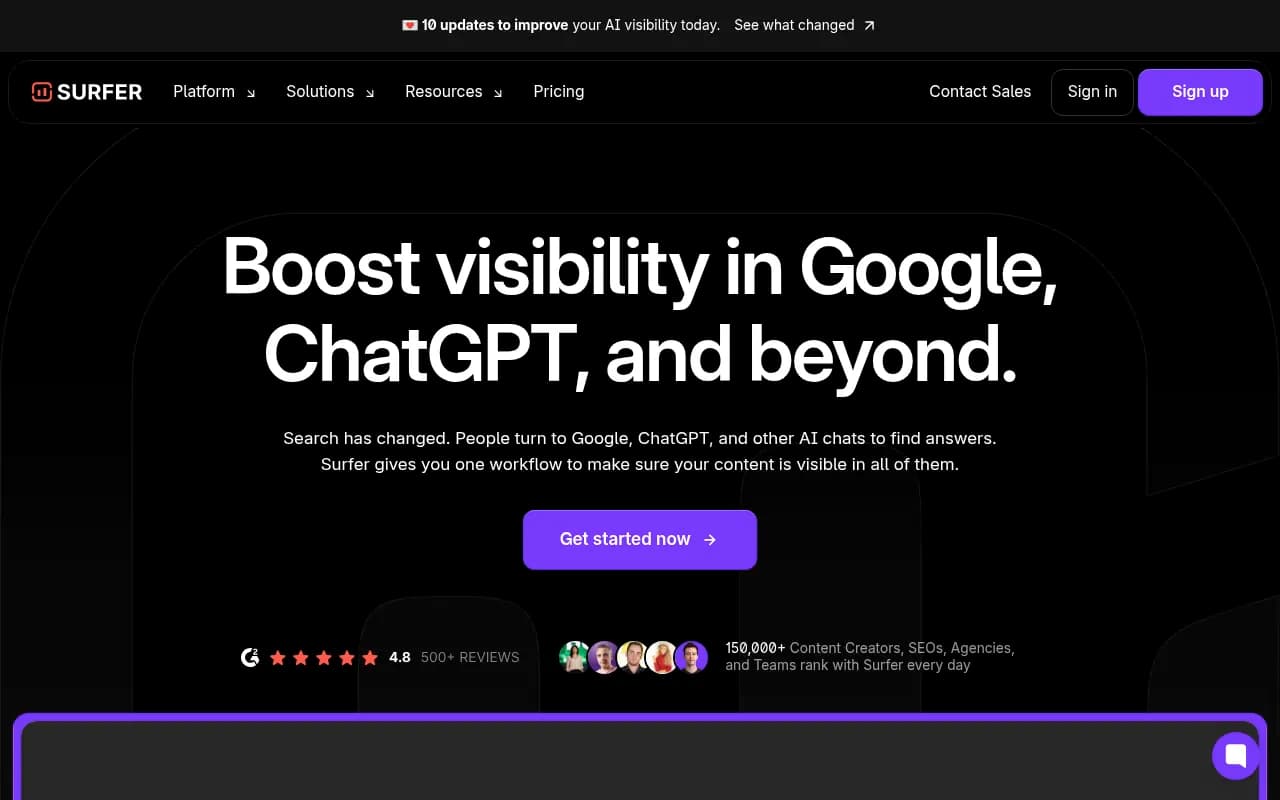
Surfer is probably the closest direct competitor to Rankability's content optimization workflow. You put in a keyword, it analyzes the top-ranking pages, and gives you a real-time content score with specific recommendations -- word count targets, NLP terms to include, heading structure, internal linking suggestions. The editor is clean and the feedback loop is fast.
Surfer has also been adding AI search optimization features, positioning itself as a tool for visibility in both Google and AI platforms. The content guidelines it generates are increasingly informed by what AI models tend to cite, not just what ranks in traditional search.
Where Surfer falls short compared to Rankability is the agency workflow side. There's no client-specific advisor, no built-in knowledge base for grounding drafts in client context, and the research phase (finding opportunities from Reddit, YouTube, trending topics) is less developed. Surfer is excellent at the "optimize this piece of content" step but doesn't do as much to help you figure out what to write in the first place.
Pricing: $99/mo (Essential: 30 articles, 1 user), up to $399/mo (Max: 300 articles, 10 users). Annual billing saves 20%. 7-day money-back guarantee.
Best for: Content writers and SEO teams who want fast, data-driven on-page optimization guidance without a complex agency workflow.
Clearscope
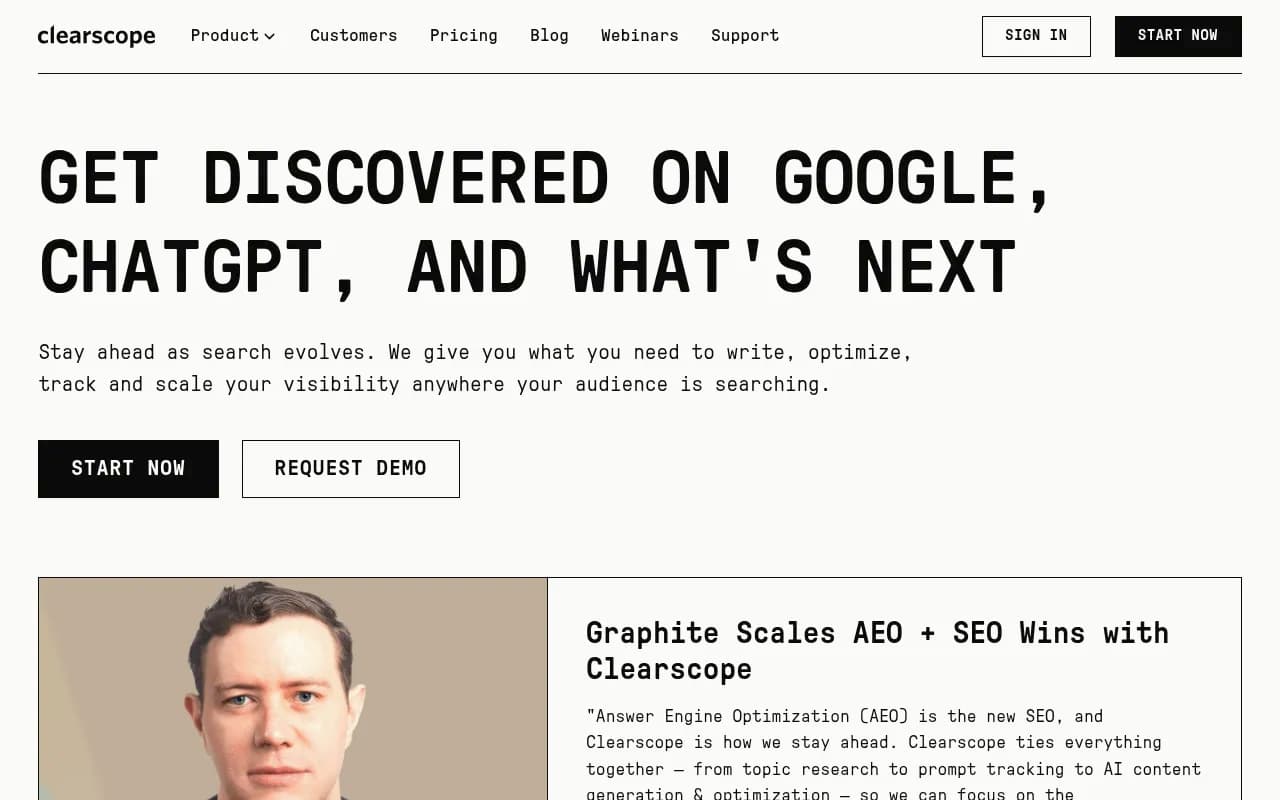
Clearscope has always been the premium content optimization option -- cleaner interface, more reliable grading, and a stronger focus on search intent than most competitors. It's expanded into AI search tracking, with visibility monitoring across Google and AI platforms like ChatGPT and Gemini, plus topic exploration tools for building content clusters.
The content editor is genuinely excellent. The keyword grading is more nuanced than Surfer's, and the intent analysis goes deeper into the "why" behind searches rather than just the "what." For teams producing high-quality editorial content (as opposed to volume-driven SEO content), Clearscope tends to produce better results.
The downside is price. At $189/mo for the Essentials plan, it's more expensive than Surfer for similar core functionality. And compared to Rankability's full agency workflow, it's missing the research and briefing phases -- you still need to figure out what to write before Clearscope can help you write it well.
Pricing: $189/mo (Essentials), $399/mo (Business), custom Enterprise pricing.
Best for: Content teams that prioritize quality over volume and want the best-in-class content editor with solid AI visibility tracking.
Frase
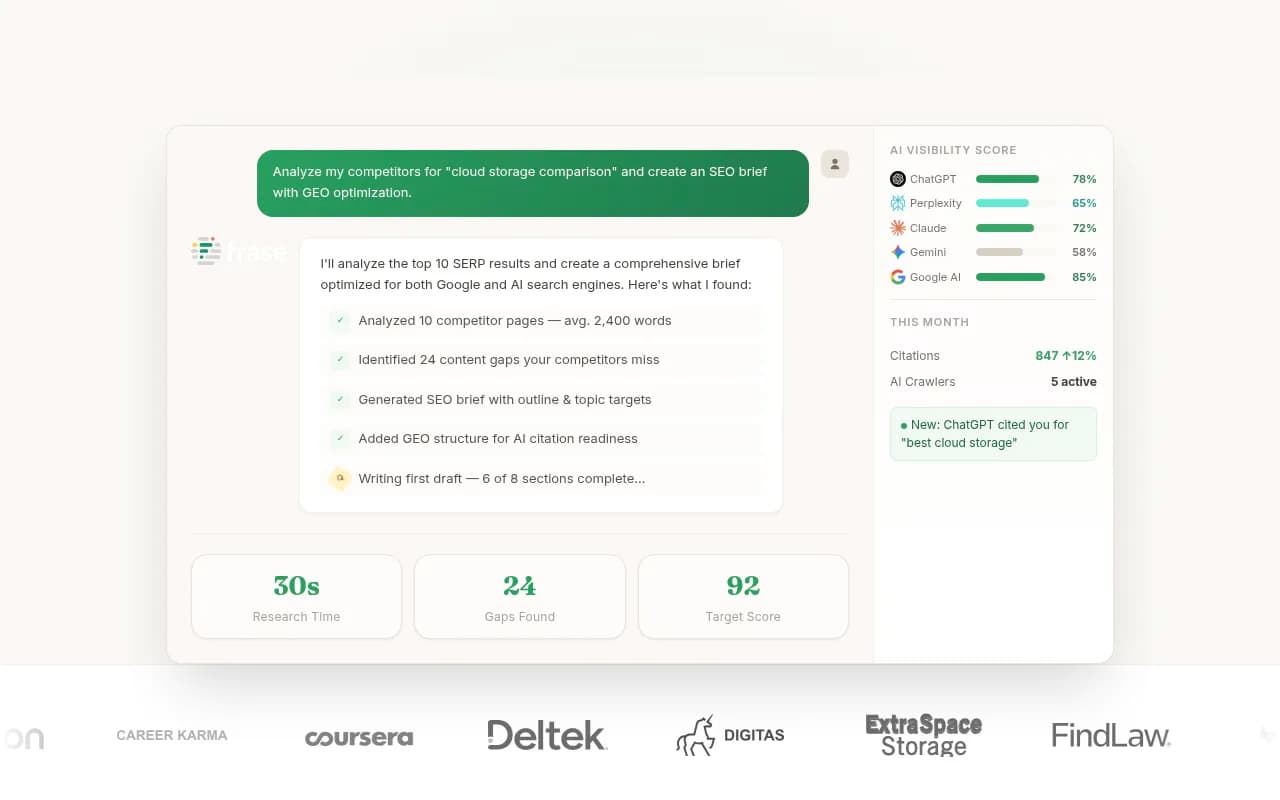
Frase has repositioned itself as an "agentic SEO & GEO platform" -- the pitch is that one AI agent handles research, content creation, optimization, and visibility tracking across Google, ChatGPT, and Perplexity. That's ambitious, and the execution is genuinely solid for the price.
The research workflow is fast. You give Frase a keyword, it pulls the top SERP results, identifies content gaps, and generates a brief with an outline. The AI writing is decent, and the optimization scoring is comparable to Surfer and Clearscope at a lower price point. The GEO features (optimizing for AI citation readiness) are newer but developing quickly.
Where Frase lags behind Rankability is depth. The agency-specific features -- client knowledge bases, white-label reporting, multi-client management -- aren't really there. And the AI visibility tracking is more limited than dedicated tools like Promptwatch. But for the price, it's hard to beat as a starting point.
Pricing: $39/mo (Solo: 1 user, 10 articles/mo), $114/mo (Basic: 3 users, 30 articles/mo), $214/mo (Team: unlimited users, 100 articles/mo). 7-day free trial, no credit card required.
Best for: Solo operators and small teams who want an affordable all-in-one content research and optimization tool with basic GEO features.
SearchAtlas LLM visibility

SearchAtlas takes a different approach from most tools on this list. The OTTO AI agent doesn't just suggest fixes -- it deploys them. Technical SEO issues, content optimizations, meta tags, internal linking -- OTTO can implement changes directly on your site, which is a meaningful time saver for agencies managing multiple clients.
The platform covers 60+ tools in one dashboard: LLM visibility tracking, GBP management, white-label dashboards, site audits, content generation, and more. The Atlas Brain AI agent can run competitor analysis, generate topical maps, and identify technical issues through a conversational interface.
Compared to Rankability, SearchAtlas is broader but also more complex. The sheer number of features can be overwhelming, and the interface takes time to learn. The LLM visibility tracking is solid but not as deep as Promptwatch's -- you get monitoring without the same level of citation analysis or content gap identification.
Pricing: $99/mo (Starter), $199/mo (Growth), $399/mo (Pro). 7-day free trial. Unlimited clients on all plans.
Best for: Agencies that want automation beyond just recommendations -- teams where the bottleneck is implementation, not strategy.
MarketMuse
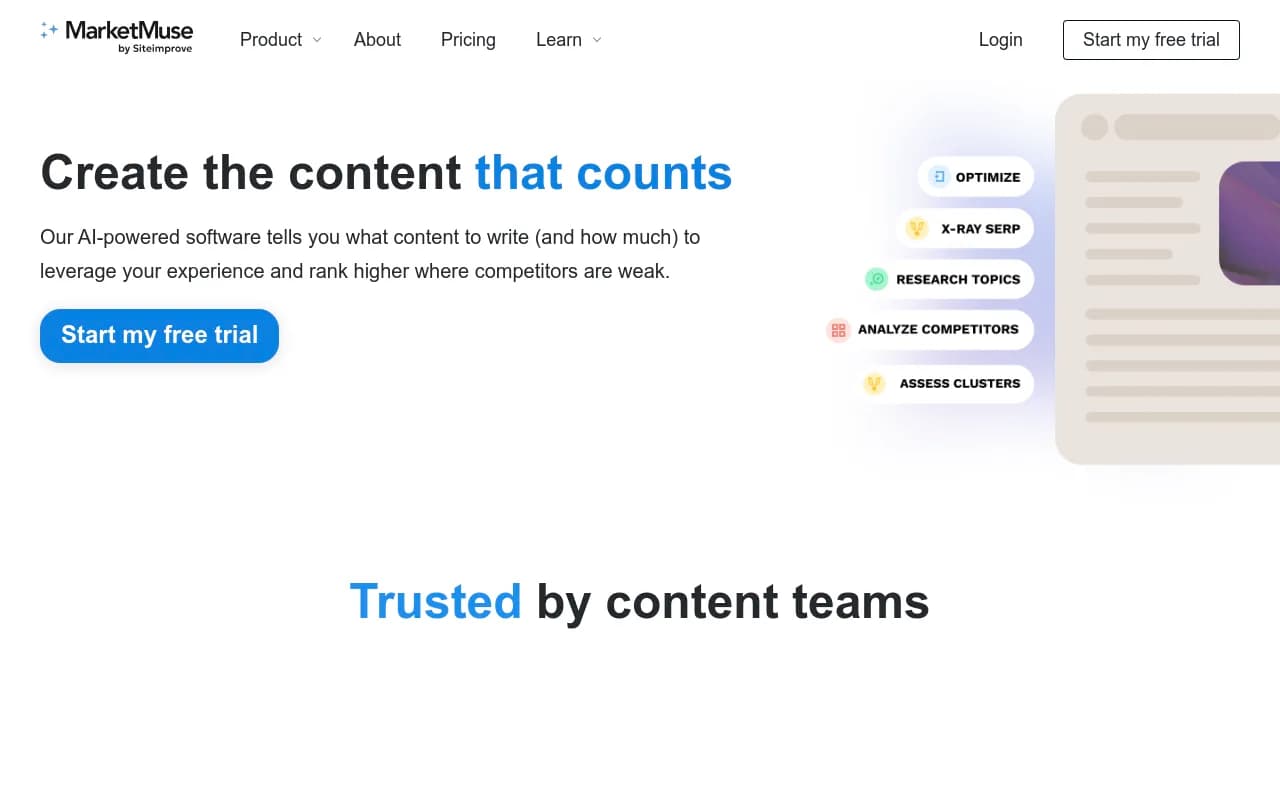
MarketMuse is the most sophisticated content strategy tool on this list. The patented AI analyzes your entire content inventory, maps your existing topical authority, and generates personalized content plans that account for what you already rank for. The "personalized difficulty" scoring is genuinely useful -- it tells you how hard a topic is to rank for given your specific site's authority, not just a generic competition score.
This is where MarketMuse beats Rankability: strategic depth. If you're trying to build topical authority across a large content library, MarketMuse's inventory analysis and cluster mapping is more sophisticated than what Rankability offers. It's also better at identifying which existing pages to update versus which new pages to create.
The downside is that MarketMuse is primarily a strategy and planning tool. The content editor exists, but it's not as polished as Surfer or Clearscope. And there's no meaningful AI search visibility tracking -- it's focused entirely on Google.
Pricing: Free tier (10 queries/month). Paid plans from $150/mo (Standard). Premium pricing on request.
Best for: SEO strategists and content teams managing large content libraries who need data-driven decisions on what to create, update, or cut.
NeuronWriter
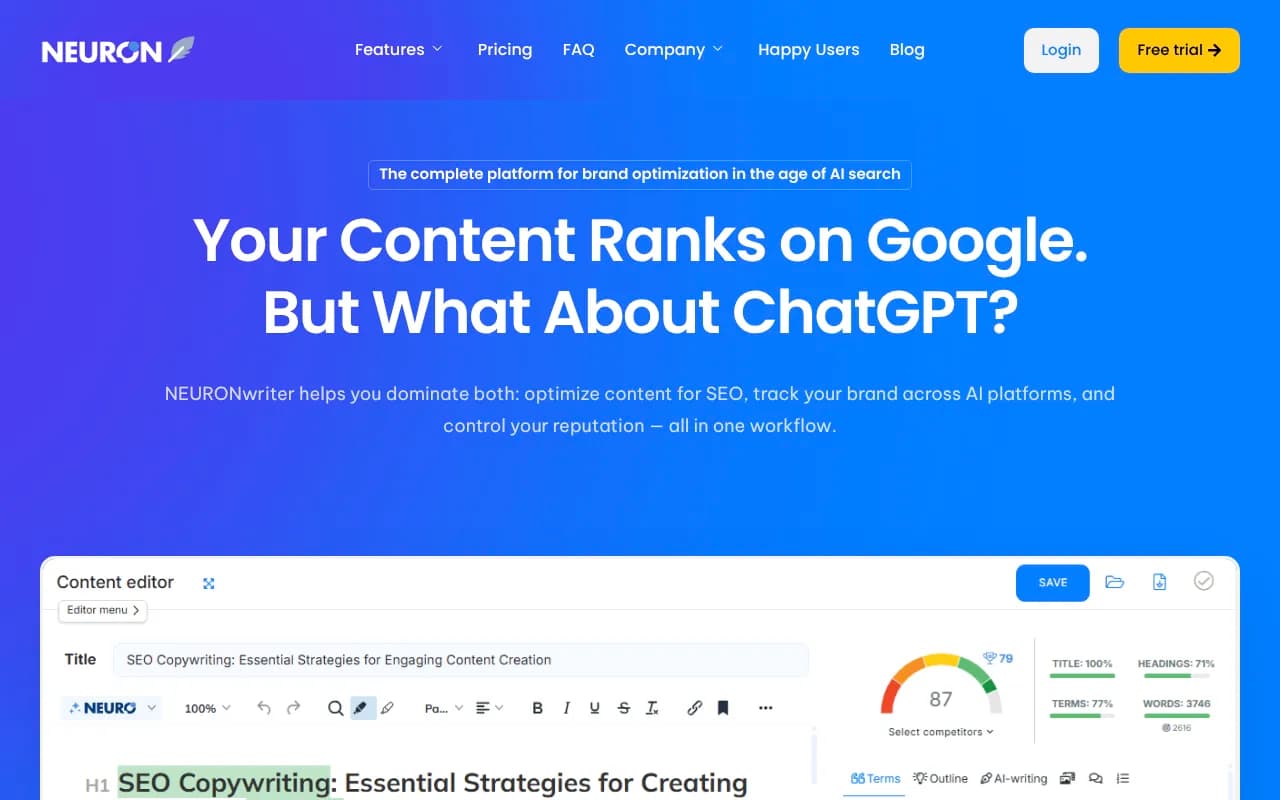
NeuronWriter is the budget pick that doesn't feel like a budget pick. The semantic SEO analysis is solid -- it uses NLP models to analyze top-ranking pages and suggest relevant terms, similar to what Surfer and Clearscope do, but at a fraction of the price. The content editor is clean, the scoring is reliable, and the competitor analysis covers the basics well.
It's also added AI brand monitoring features, letting you track your brand across AI platforms. This is newer and less developed than dedicated tools, but for teams that primarily need content optimization and want basic AI tracking included, it's a reasonable package.
Where NeuronWriter falls short is scale and depth. The agency workflow features are minimal compared to Rankability. The AI visibility tracking is surface-level. And the article limits on lower plans can be restrictive for high-volume teams.
Pricing: $19/mo (Bronze, annual billing) up to $97/mo (Diamond). Monthly billing runs about 20% higher. 7-day free trial.
Best for: Freelancers, small agencies, and budget-conscious teams who want solid semantic SEO optimization without paying Surfer or Clearscope prices.
Outranking
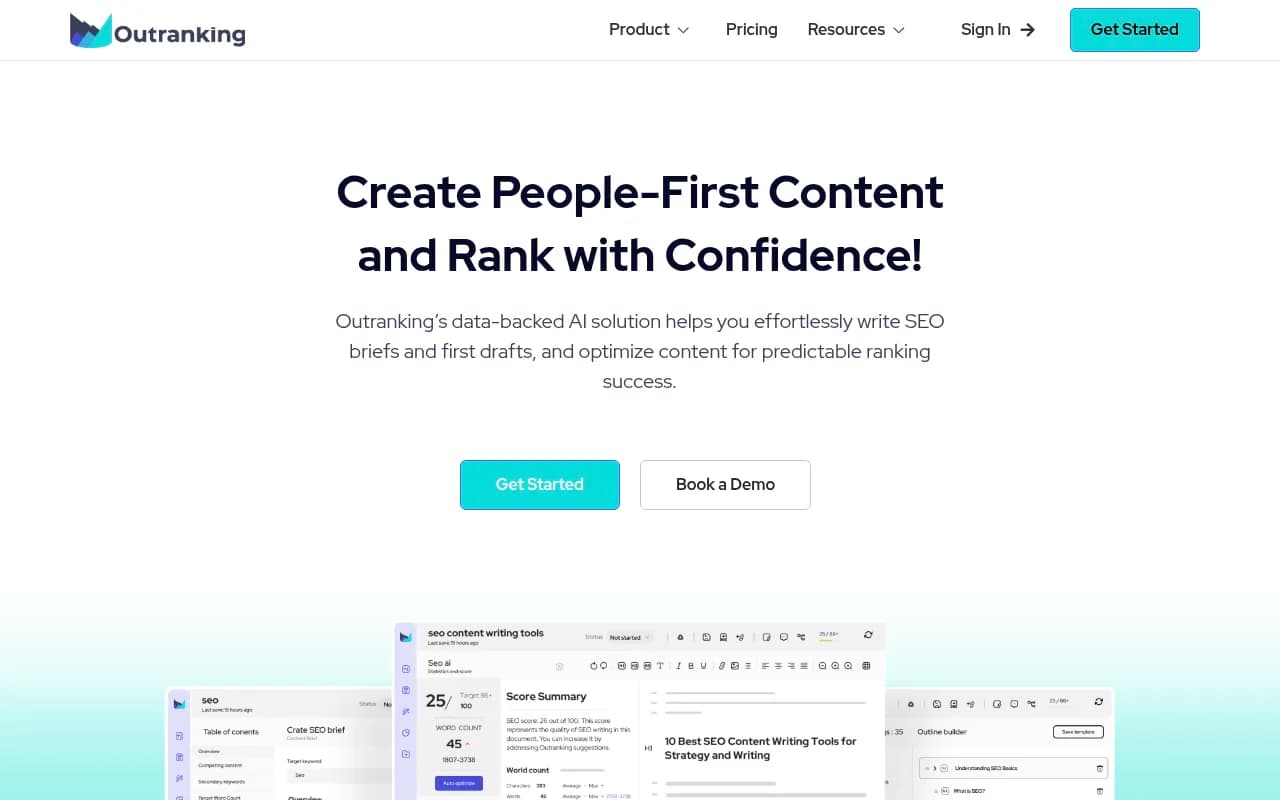
Outranking combines GPT-4, NLP analysis, and real-time SERP data to generate content briefs and first drafts. The E-E-A-T alignment features are a genuine differentiator -- the platform actively suggests ways to add experience, expertise, authority, and trustworthiness signals to your content, which matters more than ever for Google rankings.
The automatic optimization is useful: you can run a content score check and have Outranking automatically insert missing keywords and fix structural issues. For teams that produce a lot of content and want to reduce manual editing time, that's a real time saver.
Compared to Rankability, Outranking is more affordable and more focused on the writing and optimization steps. It doesn't have the full agency workflow (research, briefing, client management, reporting) that Rankability offers. And there's no meaningful AI search visibility tracking.
Pricing: Free trial available. Paid plans from $19/mo (Starter), $79/mo (SEO Writer), $159/mo (SEO Wizard).
Best for: Content writers and small SEO teams who want affordable AI-assisted writing with strong on-page optimization and E-E-A-T guidance.
Which alternative should you pick?
The right choice depends on what's actually frustrating you about Rankability -- or what you need that it doesn't cover.
If your main gap is AI search visibility -- understanding where you appear in ChatGPT, Claude, Perplexity, and other AI engines, and what to do about it -- Promptwatch is the most complete option. It's the only tool here that combines monitoring, gap analysis, content generation, and traffic attribution in one place.
If you need a full-stack SEO platform with AI tracking as one feature among many, Semrush is the natural choice. More expensive, but the breadth is unmatched.
If you want Rankability's content optimization workflow at a lower price, Surfer SEO ($99/mo) or Frase ($39/mo) cover the core use case without the agency overhead.
For content strategy and topical authority planning, MarketMuse is more sophisticated than anything else on this list -- but it's Google-only and doesn't help with AI search.
For agency automation where you need fixes deployed, not just flagged, SearchAtlas and its OTTO agent is worth a serious look.
And if budget is the primary constraint, NeuronWriter at $19/mo delivers genuine value for semantic SEO optimization that most tools charge 5-10x more for.
The honest summary: Rankability is a solid agency workflow tool, but it's trying to be everything at once. Most of the alternatives here do one or two things better -- the question is which one or two things matter most to your team right now.