Key takeaways
- All three platforms track brand mentions across AI engines, but the depth of monitoring varies significantly -- from basic mention counting to full citation-level analysis.
- Searchable and Brandlight.ai are primarily monitoring tools: they show you where you appear (or don't), but stop there.
- Promptwatch goes further with crawler logs, content gap analysis, a built-in AI writing agent, and traffic attribution -- making it the only one of the three that closes the loop from insight to action.
- If you're an agency or a brand that wants to move beyond dashboards and actually improve AI visibility, the platform you choose matters a lot.
- Pricing differs substantially: Brandlight.ai and Searchable are positioned as lighter-weight options, while Promptwatch's entry plan starts at $99/mo with a free tier available.
The AI search monitoring space has gotten crowded fast. Two years ago, barely anyone was tracking how ChatGPT or Perplexity mentioned their brand. Now there are dozens of tools claiming to do it, and the differences between them aren't always obvious from a feature page.
This guide focuses on three platforms that often come up together in buyer research: Searchable, Brandlight.ai, and Promptwatch. All three monitor brand visibility across AI engines. But what they actually track, how deep they go, and what you can do with the data are very different stories.
What "brand monitoring depth" actually means in AI search
Before comparing the tools, it's worth being precise about what we mean by "depth." In traditional SEO, brand monitoring meant tracking mentions across news sites and social media. In AI search, it's more layered:
- Does the AI mention your brand at all when asked a relevant question?
- What position is your brand mentioned in (first, third, buried)?
- Which specific pages on your site is the AI citing?
- What sources is the AI pulling from instead of your site?
- Is the AI crawling your site at all, and which pages is it reading?
- When you're not mentioned, what's missing from your content?
A "monitoring" tool typically answers the first two questions. A deeper platform answers all of them -- and ideally helps you fix the gaps it finds.
Searchable: lightweight tracking for smaller teams
Searchable sits at the lighter end of the spectrum. It tracks brand mentions across a handful of AI engines and gives you a visibility score over time. The interface is clean and the setup is quick -- you can be tracking prompts within minutes.
Where it falls short is depth. Searchable doesn't offer crawler log analysis, so you can't see whether AI engines are actually reading your pages. There's no content gap analysis, no Reddit or YouTube tracking, and no built-in way to act on what you find. It's a monitoring dashboard, and a fairly basic one.
That said, for a small business or a solo marketer who just wants to know "am I showing up in ChatGPT when someone asks about [my category]?", Searchable does the job without much complexity.

Brandlight.ai: more polish, similar limitations
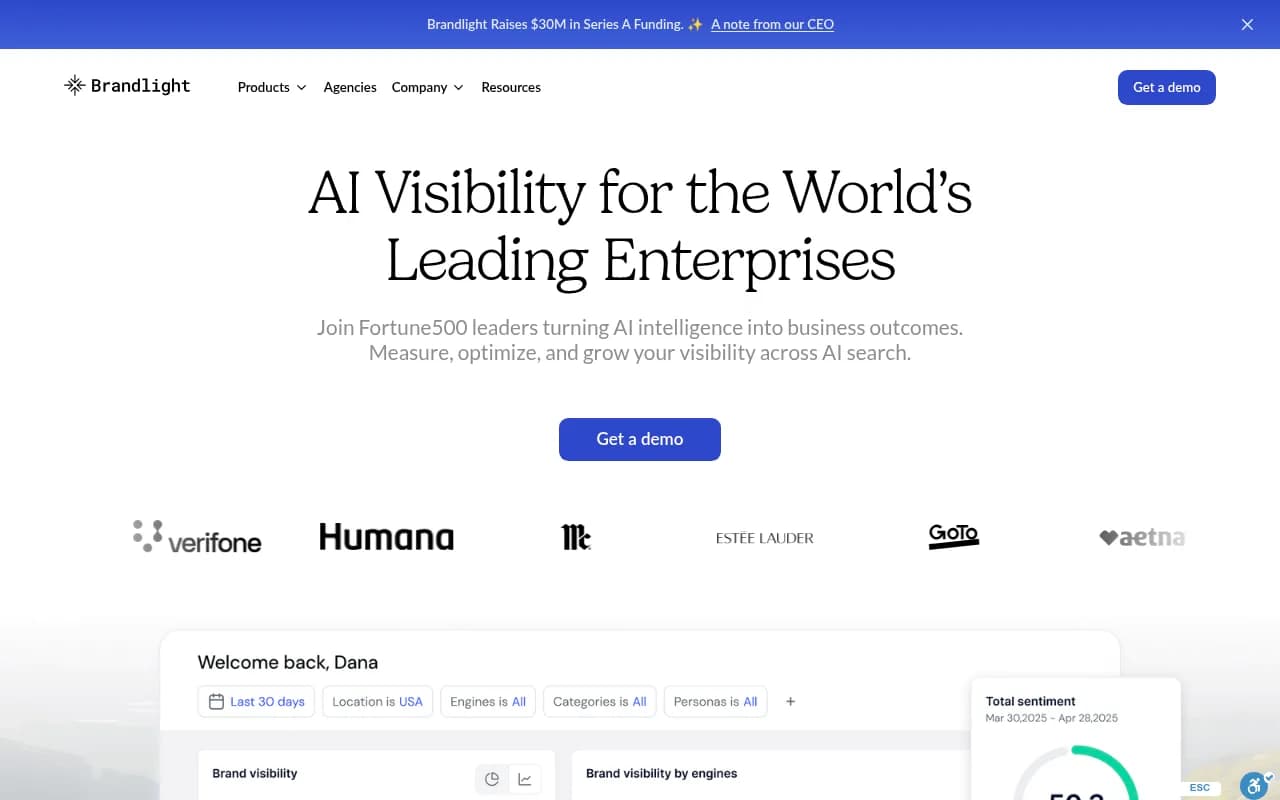
Brandlight.ai has a more polished product than Searchable and covers more AI engines. It tracks sentiment alongside mentions, which is genuinely useful -- knowing that ChatGPT mentions your brand but frames it negatively is different from not being mentioned at all.
The platform also offers competitor comparison, so you can see how your visibility stacks up against specific rivals across different AI models. That's a meaningful feature, especially for brands in competitive categories.
But Brandlight.ai still sits in the "monitoring-only" camp. There's no crawler log data, no content generation, no prompt volume intelligence, and no attribution layer connecting AI visibility to actual website traffic. You can see the problem; you can't fix it from within the platform.
Promptwatch: monitoring plus the full optimization loop
Promptwatch covers the same monitoring ground as the other two -- brand mentions, visibility scores, competitor comparisons across 10+ AI engines -- but it doesn't stop there.
The core difference is what happens after you see a gap. Promptwatch's Answer Gap Analysis shows you the specific prompts where competitors are visible but you're not. It then shows you what content is missing from your site that would help AI models answer those prompts using your pages. The built-in AI writing agent can generate articles, listicles, and comparison pieces grounded in real citation data from over 880 million analyzed citations.
That cycle -- find the gap, create the content, track whether it gets cited -- is what separates Promptwatch from a monitoring dashboard.
A few other things worth noting:
- AI Crawler Logs show you in real time which AI crawlers (ChatGPT, Claude, Perplexity, etc.) are hitting your site, which pages they read, and any errors they encounter. Most competitors don't have this at all.
- Prompt Intelligence gives you volume estimates and difficulty scores for each prompt, so you can prioritize the ones worth going after.
- Reddit and YouTube tracking surfaces the discussions that actually influence AI recommendations -- a channel both Searchable and Brandlight.ai ignore.
- Traffic attribution connects AI visibility to real visits and conversions via a code snippet, GSC integration, or server log analysis.
Feature comparison: what each platform actually tracks
| Feature | Searchable | Brandlight.ai | Promptwatch |
|---|---|---|---|
| Brand mention tracking | Yes | Yes | Yes |
| Sentiment analysis | Limited | Yes | Yes |
| Competitor visibility comparison | Basic | Yes | Yes (heatmaps) |
| Number of AI engines monitored | ~5 | ~6 | 10+ |
| Prompt volume & difficulty scoring | No | No | Yes |
| Query fan-out analysis | No | No | Yes |
| AI crawler logs | No | No | Yes |
| Citation-level page tracking | No | No | Yes |
| Reddit & YouTube tracking | No | No | Yes |
| ChatGPT Shopping tracking | No | No | Yes |
| Content gap analysis | No | No | Yes |
| Built-in AI content generation | No | No | Yes |
| Traffic attribution | No | No | Yes |
| Multi-language / multi-region | Limited | Limited | Yes |
| Free tier | No | No | Yes (10 prompts) |
| Starting price | ~$49/mo | ~$79/mo | $99/mo |
A few caveats: pricing for Searchable and Brandlight.ai can shift, and their feature sets continue to evolve. The table above reflects the state of each platform in mid-2026. The gap in the "action" features (content generation, crawler logs, attribution) is the most structurally significant difference.
Monitoring depth: a closer look at what each platform sees
Prompt coverage
All three platforms let you set up prompts to track -- questions like "what's the best project management tool for remote teams?" or "which CRM should a B2B startup use?" Promptwatch adds volume estimates and difficulty scores to each prompt, which matters a lot in practice. Knowing that a prompt gets 40,000 monthly queries vs. 400 changes how you prioritize.
Citation-level vs. brand-level tracking
Searchable and Brandlight.ai tell you whether your brand was mentioned. Promptwatch tells you which specific page on your site was cited, how often, by which AI model, and whether that's changing over time. That page-level granularity is what makes optimization possible -- you can't improve what you can't measure at the right level of detail.
The crawler logs question
This is probably the most underappreciated feature in the whole category. AI models don't just make up their responses -- they crawl the web and index content, much like traditional search engines. If Perplexity's crawler is hitting your homepage but never reading your product comparison pages, that's a fixable technical problem. Without crawler logs, you'd never know.
Promptwatch's AI Crawler Logs show exactly this: which bots visited, which pages they read, how often they return, and whether they encountered errors. Neither Searchable nor Brandlight.ai offers anything comparable.
Offsite signals: Reddit, YouTube, and beyond
AI models frequently pull from Reddit threads, YouTube videos, and third-party review sites when forming recommendations. If a Reddit thread from 2023 is influencing how Claude describes your category, you want to know about it -- and potentially respond to it or create content that counters it.
Promptwatch tracks these offsite signals. The other two don't.
Who should use which platform
The honest answer depends on what you're trying to accomplish.
If you're a small business owner who just wants a simple answer to "is my brand showing up in AI search?", Searchable is fine. It's lightweight and doesn't require much setup or ongoing management.
If you want slightly more depth -- sentiment tracking, cleaner competitor comparisons, a more polished interface -- Brandlight.ai is a step up. It's still a monitoring tool, but a better one.
If you're a marketing team, SEO team, or agency that wants to actually move the needle on AI visibility -- not just watch the numbers -- Promptwatch is the only one of the three that gives you the tools to do that. The content gap analysis and AI writing agent alone justify the difference in price for most teams that are serious about AI search.
Pricing in context
| Platform | Entry price | Free tier | Key limitation at entry level |
|---|---|---|---|
| Searchable | ~$49/mo | No | Limited AI engines, basic reporting |
| Brandlight.ai | ~$79/mo | No | No content tools, no crawler data |
| Promptwatch Essential | $99/mo | Yes (10 prompts) | 1 site, 50 prompts, 5 articles/mo |
| Promptwatch Professional | $249/mo | -- | 2 sites, 150 prompts, crawler logs |
| Promptwatch Business | $579/mo | -- | 5 sites, 350 prompts, 30 articles/mo |
The price gap between Searchable and Promptwatch's entry plan is $50/month. For a team that's actively trying to improve AI visibility, the difference in capability is far larger than the difference in cost. The free tier on Promptwatch is also worth noting -- you can track 10 prompts with ChatGPT without paying anything, which is a reasonable way to test whether the platform is worth it before committing.
The monitoring-only trap
There's a pattern worth naming here. A lot of teams buy a monitoring tool, set up their prompts, watch their visibility score for a few weeks, and then... don't know what to do next. The dashboard shows them they're invisible for certain queries. It doesn't tell them why, or what to do about it.
This is the monitoring-only trap. It's not a criticism of any specific tool -- it's a structural limitation of platforms that were built to observe rather than to act. Searchable and Brandlight.ai both fall into this category. They're useful for awareness, but they don't help you close the gap.
The platforms that are actually moving the needle for brands in 2026 are the ones that connect monitoring to optimization -- showing you what content to create, helping you create it, and then tracking whether it worked.
Final take
Searchable, Brandlight.ai, and Promptwatch all answer the basic question: "is my brand visible in AI search?" But that's roughly where the similarity ends.
Searchable is the simplest option, best for teams that want basic awareness without much overhead. Brandlight.ai adds sentiment and slightly better competitor tracking, but stays in the monitoring lane. Promptwatch is the only one of the three that treats AI visibility as something you can actively improve -- with crawler logs, content gap analysis, AI-generated content, and attribution that connects visibility to revenue.
If you're evaluating these platforms, the right question isn't just "what does it track?" It's "what can I do with what it finds?" On that question, the gap between the three is significant.