Key takeaways
- Scrunch sold to Sitecore in June 2026, in a deal Bloomberg reported at around $225 million. It is now the enterprise option, and its $250/mo Core plan still tracks only four engines, with Claude, Gemini, Grok, and Meta AI locked behind a custom-quoted Enterprise tier.
- Otterly.AI refuses outside funding on principle. It has the cheapest genuine entry point at $29/mo, but engine add-ons can push a $189 Standard plan to roughly $357/mo once you add Claude and Gemini.
- Promptwatch took the venture route and it is working: €2M ARR within twelve months of launch, a €6M seed round in July 2026, and it is the only one of the three that pairs monitoring with agents that write and publish the fixes.
- The engines behave very differently from each other. ChatGPT cites about five sources per answer while Google AI Overviews and Perplexity cite around ten, so single-engine tracking gives you a distorted picture.
- The right pick depends on your situation: Sitecore shops and governance-heavy enterprises should shortlist Scrunch, lean teams that only need monitoring should shortlist Otterly, and teams that need to close visibility gaps rather than just measure them should shortlist Promptwatch.
Three companies, three very different bets
Two years ago, tracking how AI assistants talked about your brand meant typing your company name into ChatGPT and keeping a spreadsheet. Now it is a real category, with venture rounds, an acquisition, and more comparison articles than any one person can read. Scrunch, Otterly.AI, and Promptwatch entered it within about two years of each other, sell to the same buyers, and watch overlapping sets of engines.
What separates them in 2026 is not the feature checklist. It is the business model each one chose, because that decision now drives their pricing, their roadmaps, and the risk you take on when you sign a contract.
Scrunch bet on enterprise gravity and sold itself. Otterly bet that discipline outlasts hype. Promptwatch bet that the winner would not be the best dashboard but the platform that closes the gap between seeing a visibility problem and fixing it, and raised money to build exactly that.
None of these bets has fully played out. But each looks different enough that choosing among them is really a choice about which trajectory you want to ride.
Scrunch: sell to the enterprise
Scrunch moved fast from the start: a $4.95M seed led by Mayfield in March 2025, a $15M Series A four months later, and then, on June 3, 2026, the ending most startups never get. Sitecore acquired the company. Bloomberg reported the price at around $225 million. Neither side confirmed the number, but Scrunch's own FAQ confirms the $26M it had raised beforehand from Mayfield, Decibel, Homebrew, and GTM Capital, and Sitecore brings $1.23B in raised capital and more than $500M in ARR to the marriage.
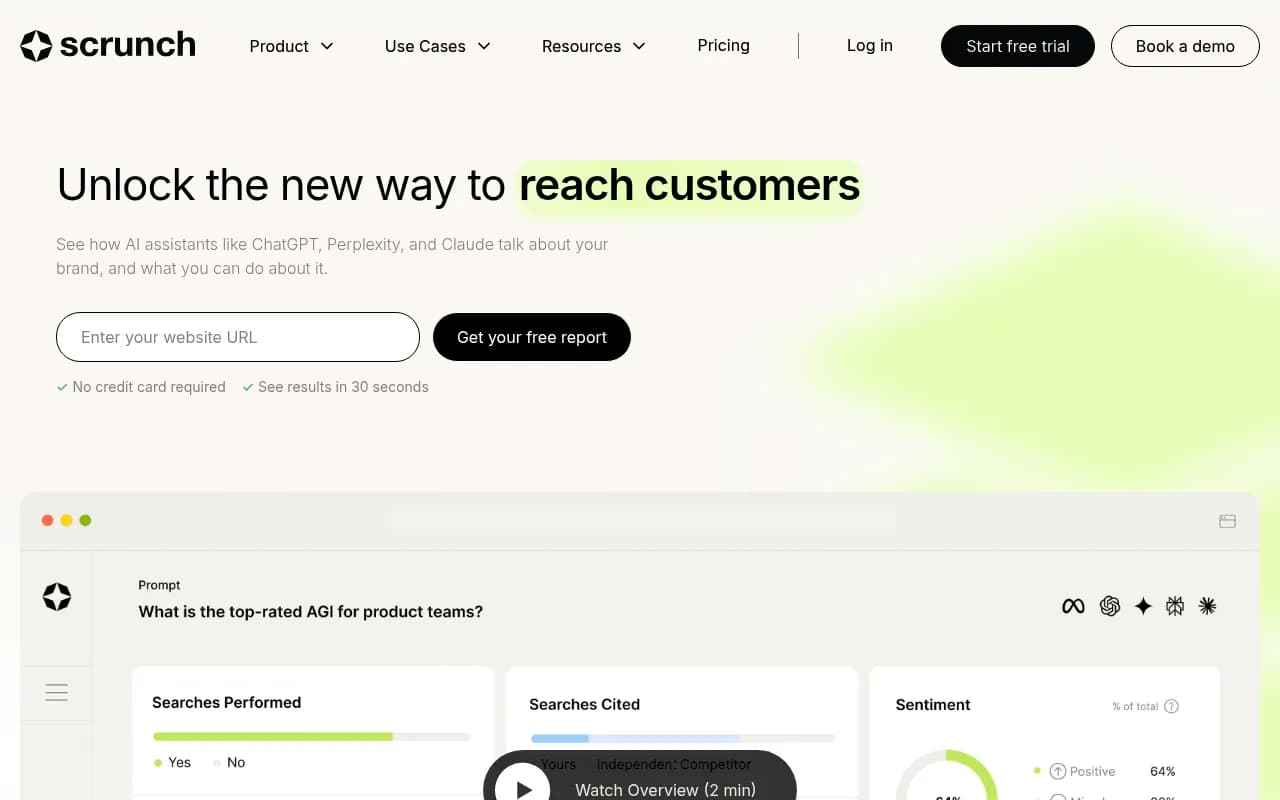
At acquisition, Scrunch was serving 500-plus brands and agencies, including Akamai, Lenovo, ADP, Publicis, and Seer Interactive. Sitecore's press release leaned on customer numbers that explain the price tag: Akamai saw a 364% increase in brand presence on non-branded prompts and a 218% increase in citations on pages built with Scrunch's Agent Experience Platform, and Runpod credited its AI search work with a 400% increase in paying customers. CEO Chris Andrew's message since the deal is that Scrunch keeps operating as a standalone platform, only faster.
I would take that promise at face value for now, with one caveat. Acquisitions like this can go two ways. The good version is the one Sitecore describes: an AI visibility product with enterprise backing, SOC 2 Type II compliance, and a digital experience integration story no standalone startup can match. The bad version is the one every marketer has lived through, where the standalone roadmap slows to the pace of the acquirer's release train and the product you bought quietly becomes a feature. Three months in, there is no evidence of the bad version. There is also no evidence of the good version beyond the press release.
What has not changed is the pricing structure, and this is where buyers should pay attention. The Core plan costs $250/mo and tracks 125 prompts across four engines: ChatGPT, Perplexity, Google AI Overviews, and Copilot. One country, three personas, five competitors, one page optimization per month, and no API, MCP, or Looker Studio access. Claude, Gemini, Meta AI, Google AI Mode, and Grok all live on the custom-quoted Enterprise tier, along with SSO, full query fan-out, and the Agent Experience Platform. If you need Claude or Gemini without an enterprise contract, Scrunch is still the wrong tool, acquisition or not.
Otterly: stay small, stay independent
Otterly is the most ideologically interesting of the three. Founded in 2023, it got TechCrunch coverage in late 2024 and used the moment to say it would not seek external funding, with the stated ambition of becoming what Semrush or Ahrefs are for SEO, but for AI search. That is either rare discipline or a self-imposed limitation, depending on the quarter.

The numbers describe a small, deliberate company. GetLatka estimates Otterly's revenue at roughly $770K ARR, while Otterly itself claims more than 40,000 marketing professionals use the product. Both can be true at once, and the gap between them is the whole business model: cheap plans, lots of small accounts, profitability over growth. For what it is worth, the people who use it like it. Otterly holds a 4.7/5 rating on G2 across 54 reviews, with support quality at 9.5 and product direction at 9.7, plus a Gartner Cool Vendor 2025 nod. Those are strong scores for a company this size.
Pricing is where Otterly wins friends. Lite costs $29/mo and includes 15 prompts across four core engines (ChatGPT, Google AI Overviews, Perplexity, and Copilot), unlimited team members, and 1,000 GEO audits per month. Standard at $189/mo adds 100 prompts, unlimited workspaces, API and MCP access, Agent Analytics, and a Looker Studio connector. Premium at $489/mo goes to 400 prompts, and Enterprise starts at $1,000/mo.
The catch is the add-on sheet. Claude costs $29, $109, or $439 per month depending on your tier. Gemini and Google AI Mode cost $9, $59, or $149. A Standard plan with Claude and Gemini added works out to roughly $357/mo, nearly double the sticker price. If you mainly care about ChatGPT and AI Overviews, Otterly is genuinely cheap. The moment you want Claude too, it is not.
What the bootstrap means for you as a customer: no acquisition risk, no investor-driven pivot, and prices that stay sane. The tradeoff is pace. Crawler-level analytics, content execution, and the agentic features the funded players ship every quarter arrive slower, or not at all. Otterly audits your content and crawlability, but it does not write or publish anything, so the "now what?" after a bad visibility report is still your problem.
Promptwatch: raise money, ship agents
Promptwatch is running the classic venture playbook, except it is actually working. The Amsterdam company, founded by Gijs de Groot and Klaas Foppen, launched on April 1, 2025, took a €1.2M pre-seed from Arches Capital that September, passed €2M in ARR by May 2026, and closed a €6M seed in July 2026 led by Seed + Speed Ventures, with Blum Ventures and Arches Capital doubling down. Along the way it picked up more than 1,840 brands and agencies, adding 150-plus new customers every month, with a 4.7/5 rating on G2. The customer list includes Duolingo, Yelp, Typeform, Shutterstock, Rabobank, ABN AMRO, and agencies like Monks and WPP.

The positioning is the part worth understanding, because it is the clearest strategic bet of the three. Promptwatch's argument is that monitoring is only half the product. Its crawler logs, fed by direct CDN integrations with Cloudflare, Fastly, Vercel, and others, show when bots like ChatGPTBot and ClaudeBot hit your pages, what they read, and whether they hit errors. Content gap analysis scores your existing pages against the prompts your buyers actually ask. Then Content Agents write GEO-optimized articles and publish them straight to Webflow, Framer, or WordPress, on a schedule you control, with an approval inbox if you want one. Unified Actions turns the visibility data into a prioritized to-do list, and Agent Chat lets you interrogate the data conversationally. Reddit and YouTube citation tracking, offsite mention monitoring, shopping insights, and an Ads Radar for sponsored placements in AI answers round out the stack.
The pricing philosophy is the opposite of Scrunch's. All 11 tracked AI surfaces, including ChatGPT, Claude, Gemini, Perplexity, Grok, DeepSeek, Meta Llama, Google AI Overviews, Google AI Mode, and the coding assistants Claude Code and OpenCode, are available on every paid plan; you track four per project at a time and can swap them freely. Essential costs $95/mo and includes 50 prompts, 6,000 tracked responses, five AEO articles, and full API and MCP access. Professional at $245/mo adds crawler logs, state and city-level tracking, automated content generation, and shopping insights. Business at $579/mo adds the Ads Radar and dedicated support. Agency plans start at $199/mo with unlimited projects and prompts. There is also a free plan that tracks 10 prompts in ChatGPT if you want to poke at it first.
The honest risk with any funded rocket is that the roadmap serves the next raise as much as it serves you, and "agents that publish content" is exactly the story investors wanted to hear in 2026. But the shipping backs the story: the crawler logs, the CMS publishing, and the agentic stack exist today, and the €2M ARR arrived before the seed money, which means the product was selling before the narrative got hot. The thing to watch is whether the pricing holds as the New York office opens and headcount grows.
What each trajectory means for you
Scrunch's acquisition is a net positive if you are the buyer it now wants: an enterprise that needs SOC 2, multi-brand governance, and AI visibility tied into a broader digital experience stack. It is a question mark if you are a mid-market team that liked buying from a hungry startup. Watch the pricing page over the next year. If the four-engine Core plan survives and the Enterprise gate stays, the deal changed the company's ownership and nothing else.
Otterly's independence is an asset in a hype cycle. Nobody can buy the company out from under you, and the team's incentives point straight at keeping customers happy rather than keeping investors impressed. The cost is that a company this size has to pick its battles, and crawler logs, content agents, and shopping radars are expensive battles.
Promptwatch's funding buys speed, and speed shows: the platform went from launch to a full optimization stack in about fifteen months. The cost is the standard one. Priorities can shift with the funding cycle, and if a Series A arrives, enterprise governance and enterprise pricing usually arrive with it. For now the value math is unusually favorable, because the entry plan includes things Scrunch and Otterly reserve for their top tiers.
The 2026 scorecard
Here is where the three stand side by side in September 2026.
| Scrunch (a Sitecore company) | Otterly.AI | Promptwatch | |
|---|---|---|---|
| Business model | Acquired by Sitecore, June 2026 | Bootstrapped, no outside funding | VC-backed, €7.2M raised |
| Entry price | $250/mo (Core) | $29/mo (Lite) | $95/mo (Essential) |
| Prompts at entry | 125 | 15 | 50 (6,000 tracked responses) |
| Engines at entry | 4: ChatGPT, Perplexity, AI Overviews, Copilot | 4 core; Claude, Gemini, AI Mode are paid add-ons | All 11 available; 4 tracked per project at a time, swappable |
| Full engine access | Enterprise, custom quote | ~$357/mo at Standard with Claude + Gemini add-ons | Included from $95/mo |
| Content execution | 1 page optimization/mo on Core; AXP on Enterprise | GEO audits only, no content generation | Content Agents with CMS publishing; 5 AEO articles/mo from entry |
| Crawler analytics | AI bot traffic attribution via GA4 | Agent Analytics from Standard (200K events/mo) | Crawler logs from Professional ($245/mo), 400+ bots tracked |
| API / MCP | Enterprise only | From Standard ($189/mo) | Every plan, including the $95 tier |
| Reported scale | 500+ brands at acquisition | 40,000+ claimed users, ~$770K estimated ARR | 1,840+ customers, +150/month |
| G2 rating | 4.5/5 (1,129 reviews) | 4.7/5 (54 reviews) | 4.7/5 |
The wider field
These three are not the whole market. Profound has raised roughly $155M at a $1B valuation and counts Walmart and Figma among its customers, which makes it the enterprise heavyweight of the category. The traditional SEO suites have bolted on AI tracking too: Ahrefs Brand Radar monitors six AI platforms using prompts derived from real People Also Ask data, and Semrush sells its AI Visibility Toolkit as a $99/mo per-domain add-on.
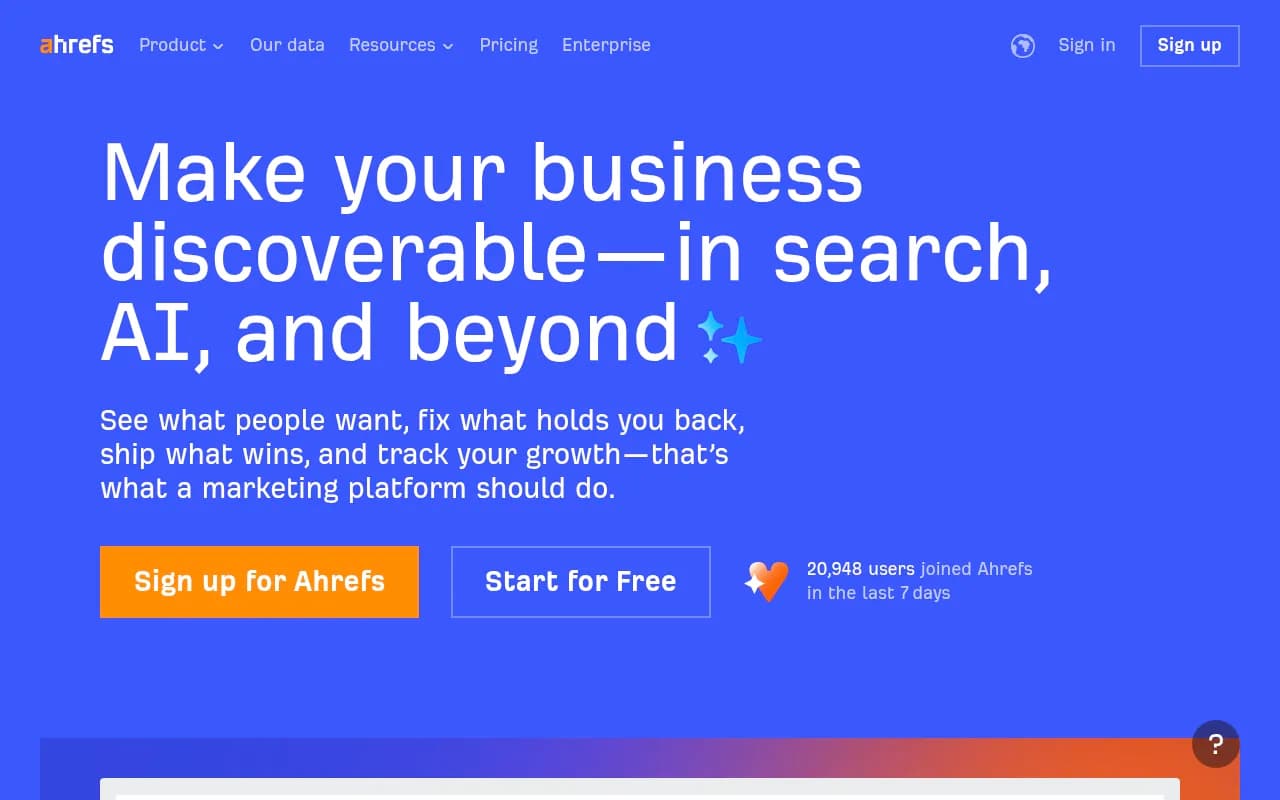
Even the vendors review each other. Promptwatch's blog runs a seven-tool Scrunch alternatives comparison, and Ahrefs' Tim Soulo runs one with fourteen tools, which tells you something about how crowded this field got. If you want to go wider than this article, the AI rank tracking tools directory is the place to start.

Why the ground keeps moving under all three
Whichever tool you pick, the thing you are measuring refuses to stand still. Three findings from Promptwatch's citation data explain why engine coverage and fast tracking matter more than any feature list.
Engines behave differently from each other. ChatGPT answers cite about five sources on average, while Google AI Overviews and Perplexity both hover near ten, with Perplexity almost eerily consistent day to day (Promptwatch's average sources per response data). A brand can look well-cited in ChatGPT and nearly invisible in AI Overviews on the same afternoon. Tools that gate engines or charge per engine make it expensive to see the whole picture, which is the strongest argument for Promptwatch's all-models-from-$95 approach and the biggest knock on Scrunch's Enterprise gate.
Citation sources shift without warning. Reddit's share of ChatGPT Search citations collapsed from roughly 4% to half a percent on August 14, 2026, per Promptwatch's Reddit citation tracking. Any brand whose AI strategy leaned on Reddit mentions woke up to a different world that week. Shifts like this do not announce themselves, which is the argument for daily tracking and crawler logs over monthly PDF reports.
The content formats that win citations keep changing too. Product pages became the single most-cited format in ChatGPT during July 2026, at roughly a third of daily citations, nearly double their share in March, per Promptwatch's July 2026 citation type data. When the format that wins is a well-built product or comparison page, monitoring tells you that you are losing, and execution is how you win it back. That is the specific gap Promptwatch's Content Agents were built to close, and the specific gap Scrunch and Otterly leave to you and your writers.
Who should pick which
| Your situation | Best fit | The honest reason |
|---|---|---|
| Sitecore customer, or an enterprise that needs SOC 2 and multi-brand governance | Scrunch | DXP integration, journey mapping, enterprise security; budget for the Enterprise tier if you need Claude or Gemini |
| Small team that needs monitoring only, focused on ChatGPT and AI Overviews | Otterly | $29/mo entry, excellent support scores, 50+ countries and languages; price the engine add-ons before committing |
| Team that needs to fix visibility gaps, not just measure them | Promptwatch | Content Agents that publish to your CMS, crawler logs, all 11 engines from $95, API and MCP on every plan |
| Agency managing many client workspaces | Promptwatch or Otterly | Promptwatch's $199 agency tier includes unlimited projects and prompts; Otterly adds white-label reporting and pitch workspaces |
If I had to pick one for a mid-market team in September 2026, it would be Promptwatch, and the reasoning is boring: it is the only one of the three whose product answers the question that follows every bad visibility report, which is "what do we do about it?" It also happens to be the only one that does not charge extra for the engines that matter. But that pick comes with honest caveats. If you live in a Sitecore world, Scrunch is the rational choice, and the acquisition made it safer rather than riskier. If your budget is $50 a month, Otterly is not a compromise, it is the correct answer, and its support team will treat you better than most enterprise vendors treat their biggest accounts.
What to watch over the next twelve months
Watch Scrunch's Core plan. If the four-engine limit loosens or the Enterprise gate drops, the acquirer is investing in the standalone product. If prices rise and features start bundling into the DXP, the standalone era is ending. The pricing page will tell you before the press release does.
Watch whether Otterly can keep pace as agentic execution becomes table stakes. Its product direction score of 9.7 on G2 says customers believe it can. Its estimated revenue says the margin for error is thin.
Watch whether Promptwatch holds its pricing while it scales. The €6M seed and the planned New York office put growth pressure on the friendliest pricing in this comparison. The free plan and the $95 entry tier are the canaries.
Watch the category, not just these three. Profound's $1B valuation means more exits are coming. This market had dozens of trackers in 2025 and will have a handful of platforms by 2028, and each of these three companies has already chosen which side of that divide it wants to be on.
The bottom line
Three trajectories, one lesson: in a market this young, the vendor's business model is part of the product you are buying. Scrunch sold its future to an enterprise acquirer and became the governed, expensive, integration-friendly path. Otterly is betting that discipline outlasts hype, and for teams with thin budgets that bet currently pays off in the cheapest credible monitoring on the market. Promptwatch is betting that the platforms which fix visibility, rather than merely report it, take the category, and it has fifteen months of shipping and €2M of pre-funding revenue behind that bet. Pick the trajectory you can afford to be wrong about.