Key takeaways
- Most AI visibility platforms are monitoring dashboards. They show you where you're invisible but don't help you fix it.
- Promptwatch is the only platform in this comparison that closes the full loop: find gaps, generate content, track results.
- Profound is the strongest pure-monitoring competitor, with deep enterprise analytics starting at $499/month.
- Peec AI is a solid mid-market option with good multi-language support, starting around €89/month.
- Otterly.AI is the cheapest entry point at $29/month, but feature depth is limited.
- If you're serious about actually improving your AI search visibility (not just measuring it), the platform you choose matters a lot.
The AI search landscape shifted fast. Gartner estimates search engine volume will decline 25% by 2026 as users move to AI chatbots for answers. Meanwhile, 66% of UK senior decision-makers now use tools like ChatGPT, Copilot, and Perplexity to research suppliers before buying. Your Google Analytics dashboard has no idea any of this is happening.
So you're looking at AI visibility platforms. Good. But the market is crowded, the pricing varies wildly, and the feature sets are genuinely hard to compare because every vendor uses slightly different terminology for the same concepts.
This guide cuts through that. We compare four platforms head-to-head: Promptwatch, Profound, Peec AI, and Otterly.AI. We'll cover what each one actually does, where it falls short, who it's best for, and how the pricing stacks up.
What these platforms actually do (and what they don't)
Before diving into the comparison, it's worth being clear about what "AI visibility" means in practice.
When someone asks ChatGPT "what's the best project management tool for remote teams?" or Perplexity "which CRM should a 50-person B2B company use?", AI models pull from their training data and real-time web retrieval to generate an answer. They cite specific sources. They recommend specific brands. If your brand isn't in those answers, you're invisible to a growing chunk of your potential buyers.
AI visibility platforms track this. They run prompts across AI engines, record which brands appear, which sources get cited, and how often. That's the core function.
The difference between platforms is what happens next. Some stop at the data. Others help you act on it.
The four platforms at a glance

Feature-by-feature comparison
| Feature | Promptwatch | Profound | Peec AI | Otterly.AI |
|---|---|---|---|---|
| AI engines monitored | 10+ (ChatGPT, Claude, Gemini, Perplexity, Grok, DeepSeek, Copilot, Mistral, Meta AI, Google AI Overviews) | 10+ | 6-8 | 4-6 |
| Prompt volume estimates | Yes | Yes | Limited | No |
| Answer gap analysis | Yes | Partial | No | No |
| AI content generation | Yes (built-in writing agent) | Limited | No | No |
| AI crawler logs | Yes | No | No | No |
| Citation & source analysis | Yes (880M+ citations) | Yes | Partial | Basic |
| Reddit & YouTube tracking | Yes | No | No | No |
| ChatGPT Shopping tracking | Yes | Yes | No | No |
| Competitor heatmaps | Yes | Yes | Yes | Basic |
| Multi-language/region | Yes | Yes | Yes | Limited |
| Traffic attribution | Yes (GSC, code snippet, server logs) | No | No | No |
| Looker Studio / API | Yes | Yes | No | No |
| Starting price | $99/month | $499/month | €89/month | $29/month |
| Free trial | Yes | Demo only | Yes | Yes |
Promptwatch: the platform that actually helps you fix the problem
Most AI visibility tools are dashboards. They show you a score, a chart, a list of prompts where competitors appear and you don't. Then they leave you to figure out what to do about it.
Promptwatch is built differently. The core idea is a loop: find the gaps, create content to fill them, track whether it worked.
The Answer Gap Analysis shows you exactly which prompts your competitors rank for in AI search that you don't. Not just "you're missing coverage here" -- it shows the specific questions, the specific angles, and the specific content types AI models want to see. That's genuinely useful intelligence.
Then there's the built-in AI writing agent. It generates articles, listicles, and comparisons grounded in real citation data -- not generic SEO filler, but content engineered to get cited by ChatGPT, Claude, Perplexity, and others. The agent uses prompt volume data, competitor analysis, and persona targeting to produce content that has a real shot at appearing in AI answers.
The crawler logs are another differentiator. Promptwatch shows you in real time which AI crawlers (ChatGPT, Claude, Perplexity) are hitting your site, which pages they're reading, and what errors they're encountering. Most competitors don't offer this at all. If an AI model can't crawl your content, it can't cite it -- and you'd never know without this data.
Traffic attribution rounds it out. You can connect AI visibility to actual revenue via a code snippet, Google Search Console integration, or server log analysis. That's the kind of data marketing teams need to justify investment.
Pricing starts at $99/month for the Essential plan (1 site, 50 prompts, 5 articles). The Professional plan at $249/month adds crawler logs, state/city tracking, and 15 articles per month. Business is $579/month for 5 sites and 30 articles. Agency and enterprise pricing is available on request.
The honest caveat: Promptwatch is a newer platform compared to Profound, and some users may find the breadth of features requires a learning curve. But for teams that want to actually move the needle on AI visibility -- not just measure it -- it's the most complete option available.
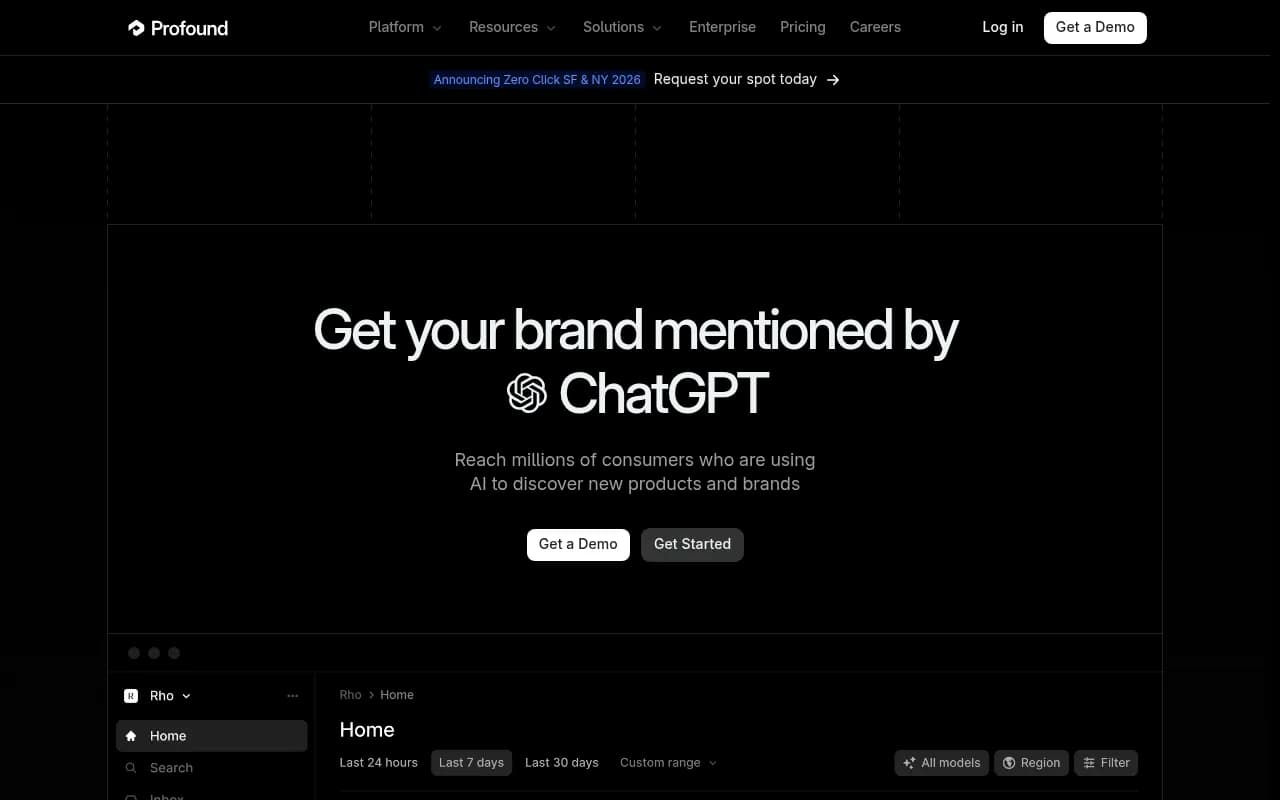
Profound: the enterprise monitoring benchmark
Profound is the most established pure-monitoring platform in this comparison, and it's genuinely impressive at what it does.
The platform covers 10+ AI engines, has deep analytics on prompt volumes and answer engine behavior, and offers an agency mode with brand configurations and pitch environments. If you're a large marketing agency managing multiple enterprise clients, Profound's reporting depth is hard to match.
The research data from ContentMonk notes that "Profound leads on pure AI visibility depth, with 10+ engine coverage that no competitor matches at the Growth tier or above." That's a fair assessment.
Where Profound falls short is the action side. There's no built-in content generation. No crawler logs. No Reddit or YouTube tracking. No traffic attribution connecting AI visibility to revenue. You get excellent data, then you're on your own to act on it.
The price reflects the enterprise positioning: $499/month is the entry point, which puts it out of reach for most small and mid-market teams. For large brands with dedicated SEO teams who can execute on the insights, Profound is a strong choice. For everyone else, you're paying a lot for a dashboard.
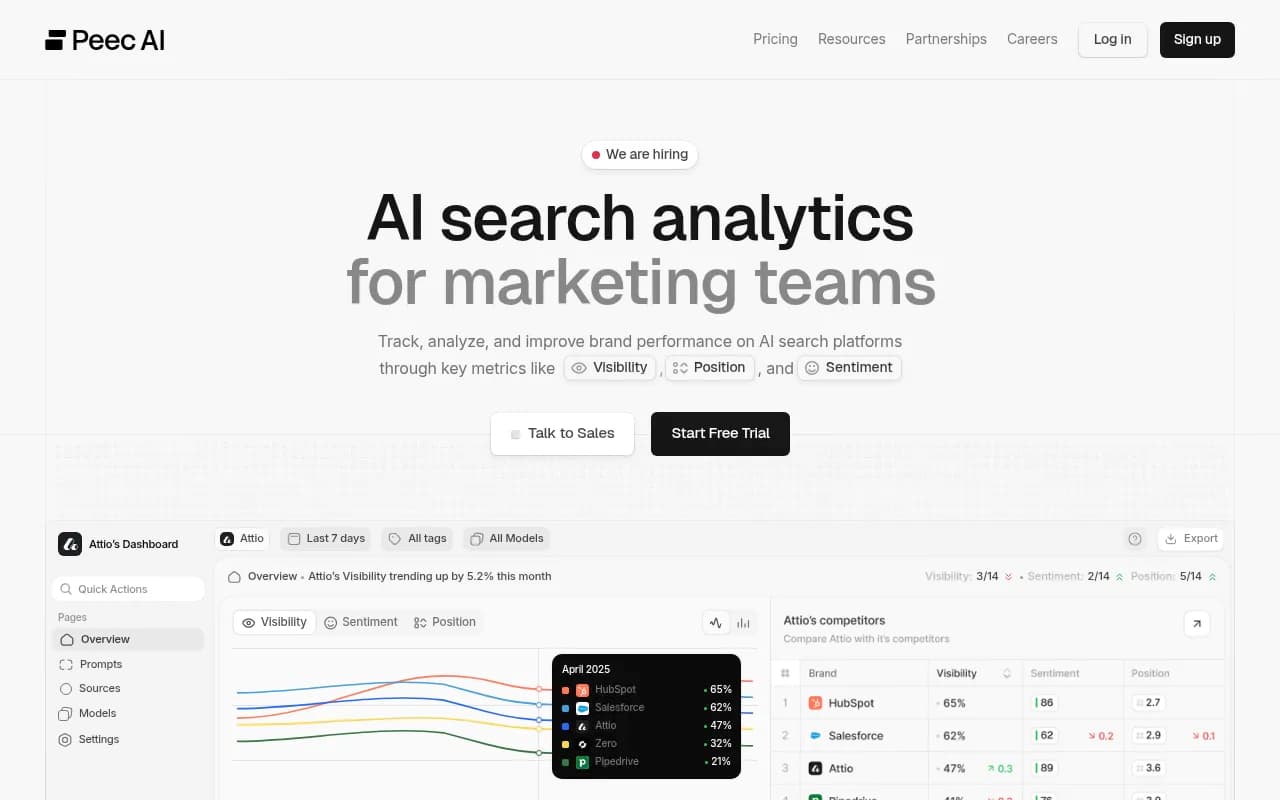
Peec AI: solid mid-market option with good language coverage
Peec AI sits in an interesting middle ground. It's faster to set up than Profound, more affordable (starting around €89/month), and has notably good multi-language and multi-region support -- which matters if you're operating across European or global markets.
The platform covers 6-8 AI engines, offers competitor visibility comparisons, and has a clean interface that's easier to navigate than some enterprise tools. For mid-market teams that need basic AI visibility tracking without the complexity of an enterprise platform, it's a reasonable choice.
The gaps are real though. No content generation. No crawler logs. No prompt volume estimates at the level Profound or Promptwatch offer. No Reddit or YouTube tracking. No traffic attribution. Peec AI is a monitoring tool, and a decent one, but it doesn't help you improve what you're monitoring.
For teams that primarily need multi-language coverage and want a simpler setup, Peec AI is worth evaluating. For teams that want to actually optimize their AI visibility, it's a starting point at best.
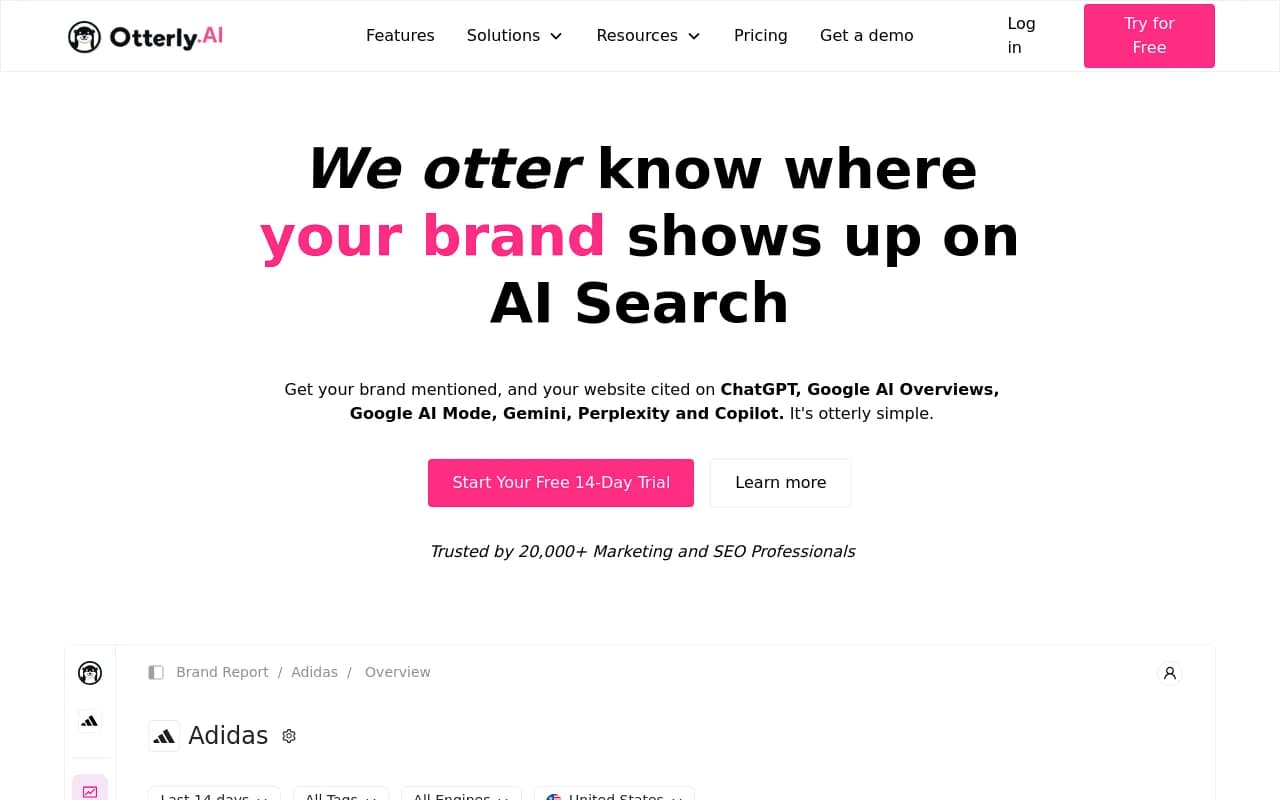
Otterly.AI: the budget entry point
Otterly.AI is the most affordable option here at $29/month, and that price point makes it genuinely useful for freelancers, small businesses, or teams that just want to dip their toes into AI visibility tracking before committing to a larger platform.
The GEO audit feature is a nice touch -- it gives you a structured assessment of where your site stands in AI search. For the price, that's solid.
But the feature set is limited. Coverage is narrower than the other platforms. Analytics are basic. There's no content generation, no crawler logs, no prompt volume data, no traffic attribution. Otterly.AI tells you roughly where you stand, but not much more.
If you're just starting to think about AI visibility and want to understand the basics without spending much, Otterly.AI is fine. If you're serious about competing in AI search, you'll outgrow it quickly.
Who should use what
The right platform depends heavily on what you're actually trying to accomplish.
If you want to measure AI visibility and have a team that can execute on the insights, Profound is the strongest monitoring platform -- but budget for the $499/month entry point and the internal resources to act on the data.
If you need multi-language coverage and want something simpler and cheaper than Profound, Peec AI is worth a look, particularly for European markets.
If you're just getting started and want to understand the basics cheaply, Otterly.AI gets you in the door.
If you want to actually improve your AI visibility -- find the gaps, create content that gets cited, track the results, and connect it to revenue -- Promptwatch is the only platform in this comparison that does all of that. The action loop (gap analysis, content generation, tracking) is what separates it from the monitoring-only tools.
For marketing teams and agencies that need to show results, not just reports, that distinction matters a lot.
Pricing comparison
| Platform | Entry price | Mid tier | Enterprise |
|---|---|---|---|
| Promptwatch | $99/month (Essential) | $249/month (Professional) | $579/month (Business) / Custom |
| Profound | $499/month | Custom | Custom |
| Peec AI | ~€89/month | ~€199/month | Custom |
| Otterly.AI | $29/month | ~$79/month | Custom |
Promptwatch offers the best value across the range. Profound is the most expensive entry point by a significant margin. Otterly.AI is cheapest but also the most limited.
The monitoring-only problem
Here's the thing that's easy to miss when evaluating these platforms: knowing you're invisible in AI search is only useful if you can do something about it.
Most platforms in this space -- including Profound, Peec AI, and Otterly.AI -- are built around measurement. They show you data. They tell you where competitors are winning. They don't help you close the gap.
That's not a criticism of the data quality. Profound's analytics are genuinely deep. But if your team doesn't have the bandwidth to translate visibility data into content strategy, content production, and technical optimization, you're paying for a dashboard that tells you bad news without a path forward.
Promptwatch's approach -- building the content creation and optimization tools directly into the platform -- is a more complete answer to the actual problem. You can see which prompts you're missing, generate content designed to capture those prompts, and track whether it worked. That's a workflow, not just a report.
Bottom line
The AI visibility platform market is maturing fast, and the differences between tools are becoming clearer. Profound is the best pure monitoring platform if budget isn't a constraint. Peec AI is a reasonable mid-market option with good language support. Otterly.AI is fine for getting started cheaply.
But if you're looking for a platform that helps you actually compete in AI search -- not just measure how badly you're losing -- Promptwatch is the one to evaluate first. The combination of gap analysis, AI content generation, crawler logs, and traffic attribution makes it the only end-to-end option in this comparison.
Start with the free trial and run your own prompts. The data will tell you more than any comparison article can.