Key takeaways
- Otterly.AI is the most affordable entry point ($29/mo) and works well for basic brand mention tracking, but stops at monitoring.
- Peec AI has strong multi-language support and smart suggestions, making it a good fit for international brands that need more than English-only tracking.
- Promptwatch is the only one of the three that closes the full loop: find gaps, generate content, track results. It's built for teams that want to actually improve their AI visibility, not just measure it.
- If your goal is to appear more often in ChatGPT, Perplexity, or Google AI Overviews, monitoring alone won't get you there. You need a tool that tells you what to fix and helps you fix it.
There's a version of this comparison that goes: "Otterly is cheap, Peec is smart, Promptwatch is powerful -- pick your budget." That's not wrong, but it misses the more important question: what do you actually need from an AI visibility tool?
Most teams buying into this category think they need monitoring. They want to know when ChatGPT mentions their brand, how often they show up in Perplexity, whether they're beating competitors in AI-generated answers. That's all reasonable. But monitoring is the beginning of the job, not the end. Knowing you're invisible doesn't make you visible.
This guide is about figuring out which tool is actually worth the money for your situation -- not just which one has the most features on a spec sheet.
What these tools are actually trying to do
Before getting into the comparison, it's worth being clear about the category. AI visibility tools track how brands appear in responses from large language models like ChatGPT, Claude, Perplexity, Gemini, and others. When someone asks "what's the best project management tool for remote teams?" -- does your product get mentioned? With what sentiment? Are competitors getting cited more often?
That's the core problem. But the tools in this space have taken very different approaches to solving it.
Some are pure monitors: they run prompts, count mentions, report scores. Others try to go further -- flagging inaccuracies in AI responses, suggesting content changes, or actually generating content designed to improve your visibility.
Peec AI, Otterly.AI, and Promptwatch all sit in this space, but they're not doing the same thing.
Otterly.AI: the affordable starting point

Otterly.AI is the most accessible tool in this comparison. At $29/month for the entry tier, it's genuinely cheap for what it does. You can track brand mentions across ChatGPT, Perplexity, and a handful of other models, get visibility scores, and monitor sentiment over time.
The GEO Audit feature is a nice touch -- it gives you a structured review of how well your content is positioned for AI search, which is more than most tools at this price point offer. For a small business or solo marketer just getting started with AI visibility, Otterly covers the basics without a painful commitment.
Where it runs into trouble is the ceiling. Otterly is a monitoring dashboard. It shows you data. It doesn't tell you why your visibility is low, what content you're missing, or how to fix the gap. If you're already comfortable with AI search concepts and just need a lightweight tracker, that might be fine. But if you're trying to actually improve your numbers, you'll quickly find yourself staring at a score with no clear next step.
The other limitation worth knowing: Otterly's prompt library is relatively small, and the platform doesn't support the deeper prompt intelligence features (volume estimates, difficulty scores, query fan-outs) that help you prioritize which prompts are actually worth targeting.
Peec AI: smarter suggestions, strong international coverage

Peec AI sits a step above Otterly in terms of sophistication. The platform covers more AI models, offers prompt performance analytics, and -- this is the standout feature -- supports over 115 languages. For any brand operating across multiple markets, that's a real differentiator. Most tools in this space are effectively English-only, which makes them close to useless if your customers are asking questions in French, German, Spanish, or Japanese.
Peec also does a better job of surfacing suggestions. It won't just tell you that your visibility dropped -- it'll point toward the types of prompts where competitors are outperforming you and flag areas where your content coverage is thin. That's more actionable than a raw score.
That said, Peec is still primarily a monitoring and analytics tool. The suggestions are useful, but the platform doesn't generate content for you or walk you through a structured process for improving your visibility. You get the diagnosis; the treatment is up to you.
Pricing sits in the mid-range. It's more expensive than Otterly but cheaper than enterprise-tier platforms. For international brands that need reliable multi-language tracking and some directional guidance, Peec is a solid choice.
Promptwatch: the full loop
Promptwatch takes a different approach to the problem. Where Otterly and Peec are fundamentally monitoring tools, Promptwatch is built around what it calls the action loop: find the gaps, create content that ranks in AI, track the results.

The gap analysis is where it starts. Promptwatch's Answer Gap Analysis shows you exactly which prompts your competitors are visible for that you're not -- not as a vague "you're missing coverage here" signal, but as specific prompts with volume estimates and difficulty scores. You can see what ChatGPT or Perplexity is saying in response to those prompts, which sources they're citing, and what your content is missing.
From there, the built-in AI writing agent generates articles, listicles, and comparison pages grounded in citation data from over 880 million citations analyzed. This isn't generic content -- it's engineered around the specific prompts and topics where AI models are already looking for answers but not finding them on your site.
Then you track whether it worked. Page-level tracking shows which of your pages are being cited, how often, and by which models. Traffic attribution (via a code snippet, Google Search Console integration, or server log analysis) connects visibility to actual revenue.
That full cycle is what separates Promptwatch from the other two. Otterly and Peec can tell you there's a problem. Promptwatch helps you fix it and then confirms the fix worked.
A few other capabilities worth mentioning: AI Crawler Logs show you in real time which AI crawlers are visiting your site, which pages they're reading, and what errors they're hitting. This is genuinely rare -- most competitors don't have this at all. Reddit and YouTube tracking surfaces discussions that influence AI recommendations, which is a channel most tools ignore entirely. And ChatGPT Shopping tracking monitors when your brand appears in product recommendation carousels, which matters a lot for e-commerce brands.
Pricing runs from $99/month (Essential: 1 site, 50 prompts, 5 articles) to $249/month (Professional: 2 sites, 150 prompts, 15 articles, crawler logs) to $579/month (Business: 5 sites, 350 prompts, 30 articles). There's a free trial, and annual billing brings the cost down.
Side-by-side comparison
| Feature | Otterly.AI | Peec AI | Promptwatch |
|---|---|---|---|
| Starting price | $29/mo | Mid-range | $99/mo |
| AI models tracked | ChatGPT, Perplexity, others | 10+ models | 10+ models (ChatGPT, Claude, Gemini, Perplexity, Grok, DeepSeek, Copilot, Mistral, Meta AI, Google AI Overviews) |
| Multi-language support | Limited | 115+ languages | Multi-language, multi-region |
| Brand mention tracking | Yes | Yes | Yes |
| Sentiment analysis | Yes | Yes | Yes |
| Competitor visibility | Basic | Yes | Yes, with heatmaps |
| Answer gap analysis | No | Partial | Yes, with prompt volumes and difficulty scores |
| Content generation | No | No | Yes (AI writing agent) |
| AI crawler logs | No | No | Yes |
| Reddit/YouTube tracking | No | No | Yes |
| ChatGPT Shopping tracking | No | No | Yes |
| Traffic attribution | No | No | Yes (snippet, GSC, server logs) |
| Page-level citation tracking | No | No | Yes |
| GEO audit | Yes | No | Built into gap analysis |
| Free trial | Yes | Yes | Yes |
| Best for | Budget-conscious teams, beginners | International brands, mid-market | Teams that want to improve visibility, not just measure it |
The accuracy problem nobody talks about enough
One thing worth raising: monitoring tools can give you a false sense of security. A tool can report healthy mention counts and positive sentiment while ChatGPT is simultaneously telling your prospects the wrong price, attributing a competitor's feature to you, or describing a product you discontinued two years ago.
This isn't a hypothetical. The LLMClicks.ai comparison cited in research for this piece describes exactly this scenario -- a platform showing 18 brand mentions and zero alerts while ChatGPT was quoting incorrect pricing to prospects. The tool was working as designed. The design just didn't include accuracy checking.
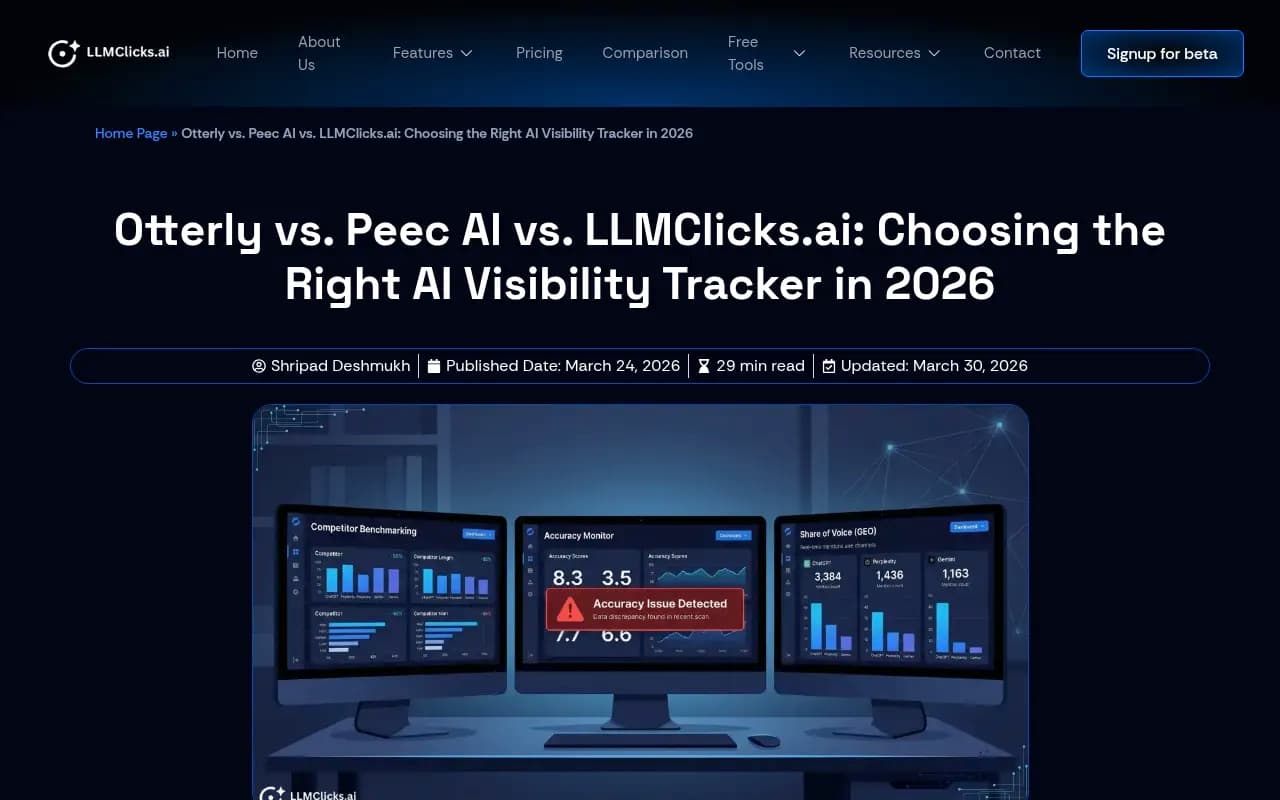
This is a real gap in the monitoring-only approach. Promptwatch's citation analysis and page-level tracking give you more visibility into what AI models are actually saying about you, but if hallucination detection is your primary concern, it's worth evaluating tools specifically built around that problem.
Who should use which tool
The honest answer is that the right tool depends on what you're actually trying to accomplish.
If you're just starting out and want to understand whether AI models mention your brand at all, Otterly.AI is a reasonable first step. It's cheap, it's easy to set up, and it'll give you a baseline. Don't expect it to tell you what to do with that baseline.
If you're an international brand and need reliable tracking across languages, Peec AI is the strongest option in this comparison for that specific use case. The 115+ language support is a real capability gap that neither Otterly nor most other tools in the market fill.
If you're a marketing or SEO team that wants to actually move the needle -- improve your visibility scores, show up more often in ChatGPT and Perplexity, connect that visibility to traffic and revenue -- Promptwatch is the tool built for that job. The gap analysis, content generation, and attribution features are what turn AI visibility from a vanity metric into something you can actually optimize.
The pattern across the market right now is that most tools stop at monitoring. They show you a score. They tell you competitors are outranking you. Then they leave you to figure out what to do about it. Promptwatch is one of the few platforms that takes the next step -- and for teams that are serious about AI search, that next step is the whole point.
A note on the broader market
These three tools don't exist in a vacuum. The AI visibility space has exploded in the past 18 months, and there are now dozens of platforms claiming to solve this problem. Some worth knowing about:
For enterprise teams with larger budgets, Profound offers deep analytics and is well-regarded for all-in-one enterprise needs.
For agencies managing multiple clients, Search Party has a strong agency-oriented workflow.
Search Party
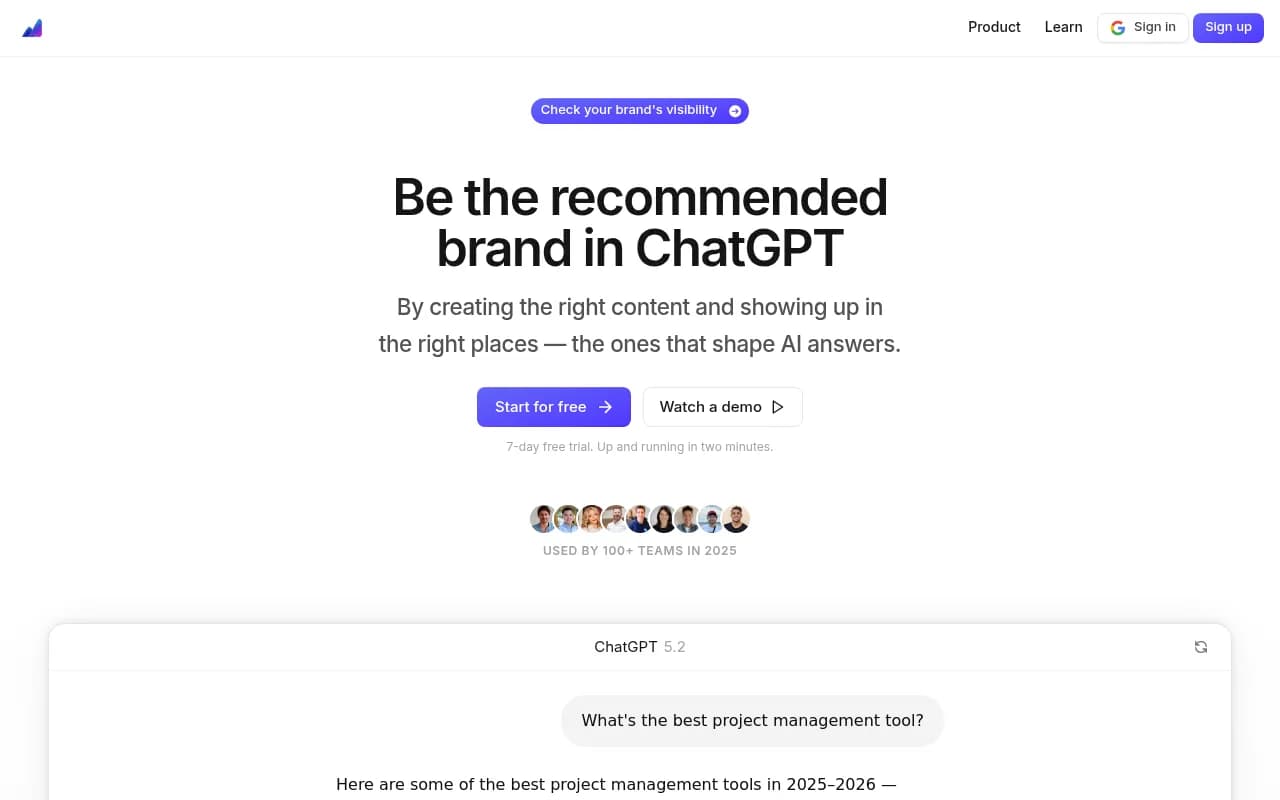
For teams that want a monitoring-focused tool with a clean interface, Airefs is a budget-friendly option worth considering.
But across the board, the distinction that matters most in 2026 is the same one that separates Promptwatch from Otterly and Peec: are you just watching your visibility, or are you doing something about it?
Bottom line
Otterly.AI is fine for what it is. Peec AI is genuinely good if you need multi-language coverage. But if you're asking which tool is "worth it" in the sense of delivering real business value -- improving how often your brand appears in AI-generated answers, connecting that to revenue, and giving you a clear path to getting better -- Promptwatch is the only one of these three that's built to do that.
Monitoring tells you where you stand. Optimization changes where you stand. Those are different products, and it's worth being clear about which one you're buying.