Key takeaways
- Most GEO platforms in 2026 are monitoring dashboards: they show you visibility data but don't help you act on it.
- Meteoria.ai focuses on brand monitoring and sentiment tracking across AI engines, with limited optimization features.
- Relixir offers AI content generation alongside monitoring, making it a step up from pure trackers.
- Promptwatch is the only platform in this comparison with a complete action loop: gap analysis, AI content generation, crawler logs, and traffic attribution in one place.
- If your goal is to understand and improve AI search visibility (not just watch it), the platform you choose matters a lot.
The GEO tool market has exploded. Two years ago, tracking your brand in ChatGPT responses was a novelty. Now there are dozens of platforms competing for the same budget line, and most of them look similar on a feature checklist.
The real divide isn't between tools with more prompts or fewer prompts. It's between platforms that monitor and platforms that optimize. That distinction sounds obvious, but it's easy to miss when every vendor uses the same language: "AI visibility," "brand monitoring," "citation tracking." The question worth asking is: after you see the data, what can the tool actually help you do about it?
This guide puts three platforms under that lens: Meteoria.ai, Relixir, and Promptwatch. They represent three different philosophies about what a GEO platform should be.
What we're actually comparing
Before getting into the tools, it helps to define what a complete GEO platform needs to do. There are roughly four layers:
- Monitoring: track when and where your brand appears in AI-generated responses across ChatGPT, Perplexity, Gemini, Claude, etc.
- Analysis: understand why you appear (or don't) -- which pages get cited, which competitors are winning, which prompts you're missing.
- Optimization: identify the specific content gaps and fix them, either by generating new content or improving existing pages.
- Attribution: connect AI visibility to actual traffic and revenue, so you can prove the work is worth doing.
Most tools do layer one reasonably well. Fewer do layer two with any depth. Almost none do layers three and four. That's the gap this comparison is designed to surface.
Meteoria.ai
Meteoria.ai positions itself as a brand monitoring platform for the AI search era. The core product tracks how your brand appears across major LLMs, measures sentiment in those responses, and shows you how competitors are mentioned alongside (or instead of) you.
The interface is clean and the data is presented well. If you're a marketing director who needs to show a slide deck on "how we appear in AI search," Meteoria gives you the charts to do that. Sentiment scores, mention frequency, share of voice across models -- it's all there.
Where it runs into limits is the "now what?" question. Meteoria shows you the gap between your visibility and a competitor's. It doesn't tell you which specific content is missing from your site that would close that gap. There's no content generation, no crawler log access, no page-level attribution. You get a clear picture of the problem, then you're on your own to solve it.
That's not a fatal flaw if you have a content team that can take monitoring data and run with it. But for most marketing teams, the bottleneck isn't knowing they have a visibility problem -- it's knowing exactly what to write and being able to produce it quickly.
Meteoria is a reasonable choice for teams that primarily need reporting and stakeholder-facing dashboards, and who have separate tools or workflows for content production.
Relixir
Relixir sits a step further along the spectrum. It combines AI search monitoring with content generation, which puts it in a different category from pure trackers like Meteoria.
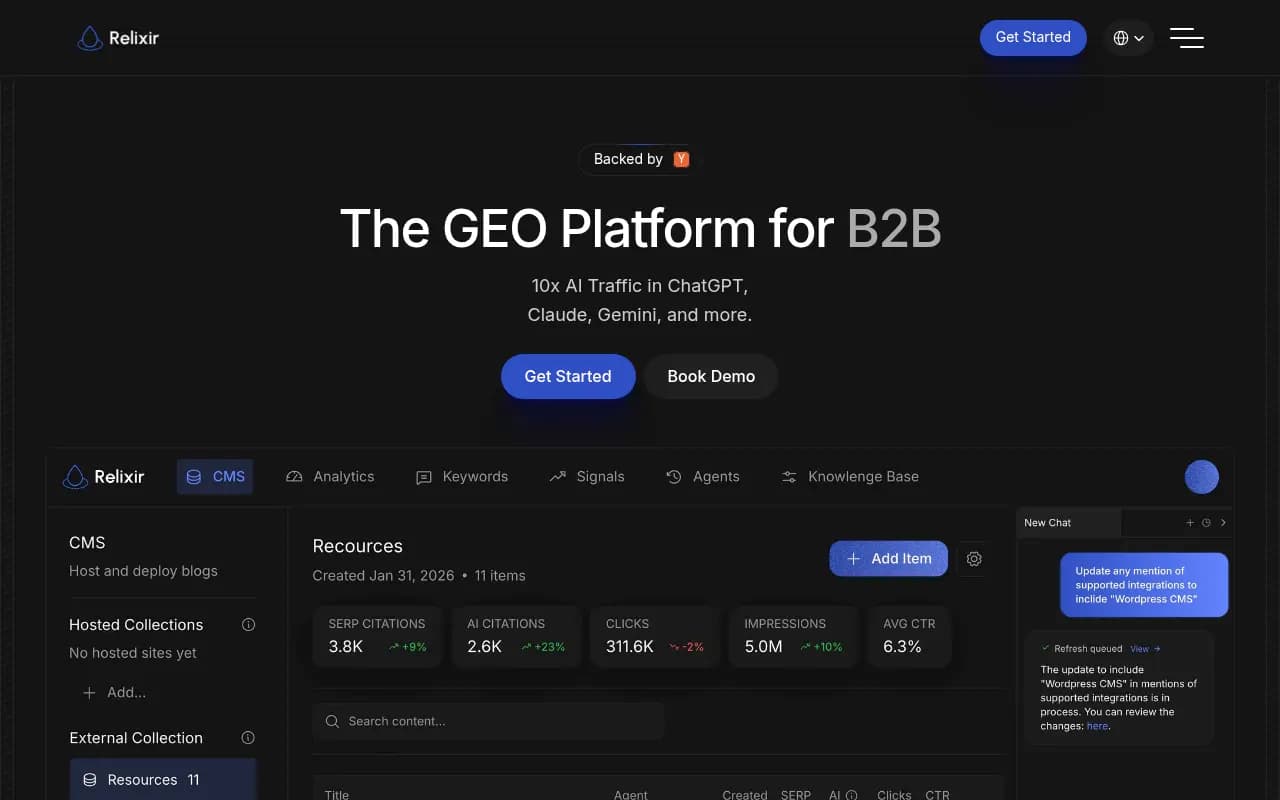
The monitoring side covers the major AI engines and gives you competitive visibility data. The more interesting part is the content workflow: Relixir can generate articles and content pieces aimed at improving your AI citation rate. That's a meaningful capability that most monitoring-only tools don't offer.
The limitations are mostly about depth. Relixir's content generation is useful, but it's not grounded in the same volume of citation data that more established platforms have accumulated. The gap analysis -- identifying which specific prompts competitors rank for that you don't -- is present but less granular than what you'd get from a platform built around that workflow from the start.
There's also no AI crawler log access. Knowing that ChatGPT is (or isn't) crawling your pages, which pages it reads, and whether it's hitting errors is genuinely useful diagnostic information. Without it, you're optimizing somewhat blind.
Relixir is a good fit for teams that want monitoring plus content generation in one tool, and don't need deep technical diagnostics or enterprise-level attribution.
Promptwatch
Promptwatch is built around a different premise: that monitoring is only valuable if it leads to action. The platform is structured as a closed loop -- find gaps, create content, track results -- and each step is built into the product rather than handed off to another tool.

The gap analysis is the starting point. Answer Gap Analysis shows you the specific prompts where competitors appear in AI responses and you don't. Not just "you have lower visibility than Competitor X" -- but the actual questions, the actual topics, the actual angles that AI models are answering with your competitors' content and not yours. That's a different level of specificity.
From there, the built-in AI writing agent generates content grounded in 880M+ citations analyzed across 10 AI models. The articles it produces aren't generic SEO filler -- they're built around the prompts and citation patterns that actually drive AI visibility. You can target specific personas, specific regions, and specific competitors.
The crawler logs are a feature most GEO platforms don't have at all. Promptwatch shows you real-time logs of AI crawlers (ChatGPT, Claude, Perplexity, and others) hitting your website -- which pages they read, how often they return, and what errors they encounter. If ChatGPT is ignoring your most important product page, you'll see it here.
On the attribution side, Promptwatch connects AI visibility to actual traffic through a code snippet, Google Search Console integration, or server log analysis. That closes the loop in a way that's hard to replicate with monitoring-only tools.
The platform monitors 10 AI models: ChatGPT, Perplexity, Google AI Overviews, Google AI Mode, Claude, Gemini, Meta/Llama, DeepSeek, Grok, and Mistral. It also tracks Reddit and YouTube as citation sources -- channels that directly influence AI recommendations but that most competitors ignore entirely.
Pricing runs from $99/month (Essential: 1 site, 50 prompts, 5 articles) to $579/month (Business: 5 sites, 350 prompts, 30 articles), with agency and enterprise tiers available. There's a free trial.
Side-by-side comparison
| Feature | Meteoria.ai | Relixir | Promptwatch |
|---|---|---|---|
| AI model coverage | Multiple LLMs | Multiple LLMs | 10 LLMs (ChatGPT, Claude, Gemini, Perplexity, Grok, DeepSeek, Mistral, Copilot, Meta AI, Google AI Overviews) |
| Brand mention tracking | Yes | Yes | Yes |
| Competitor visibility analysis | Yes | Yes | Yes (with heatmaps) |
| Prompt/query volume data | Limited | Limited | Yes (with difficulty scores) |
| Answer gap analysis | No | Partial | Yes (specific missing prompts) |
| AI content generation | No | Yes | Yes (grounded in citation data) |
| AI crawler logs | No | No | Yes (real-time, per-page) |
| Page-level citation tracking | No | Limited | Yes |
| Reddit/YouTube citation tracking | No | No | Yes |
| ChatGPT Shopping tracking | No | No | Yes |
| Traffic attribution | No | No | Yes (snippet, GSC, server logs) |
| Multi-language/region | Limited | Limited | Yes |
| Free trial | Check site | Check site | Yes |
| Starting price | Check site | Check site | $99/month |
The monitoring-only trap
Here's the practical problem with monitoring-only platforms: they create a reporting habit without a fixing habit.
Your team checks the dashboard, sees that a competitor is appearing in 40% of relevant AI responses and you're in 12%, notes it in a report, and moves on. The next month, the numbers are similar. The month after, maybe slightly worse. The data is accurate. Nothing changes.
This isn't a criticism of the people using those tools -- it's a structural problem. When the tool's job ends at "show you the data," the next steps (figure out what content to create, write it, publish it, track whether it worked) require separate tools, separate workflows, and significant time. Most teams don't have that bandwidth.
The platforms that are actually moving the needle for brands in 2026 are the ones that compress that cycle. Find the gap, generate the content, track the result -- ideally without leaving the platform.
Who should use what
The right tool depends on what your team actually needs to do with the data.
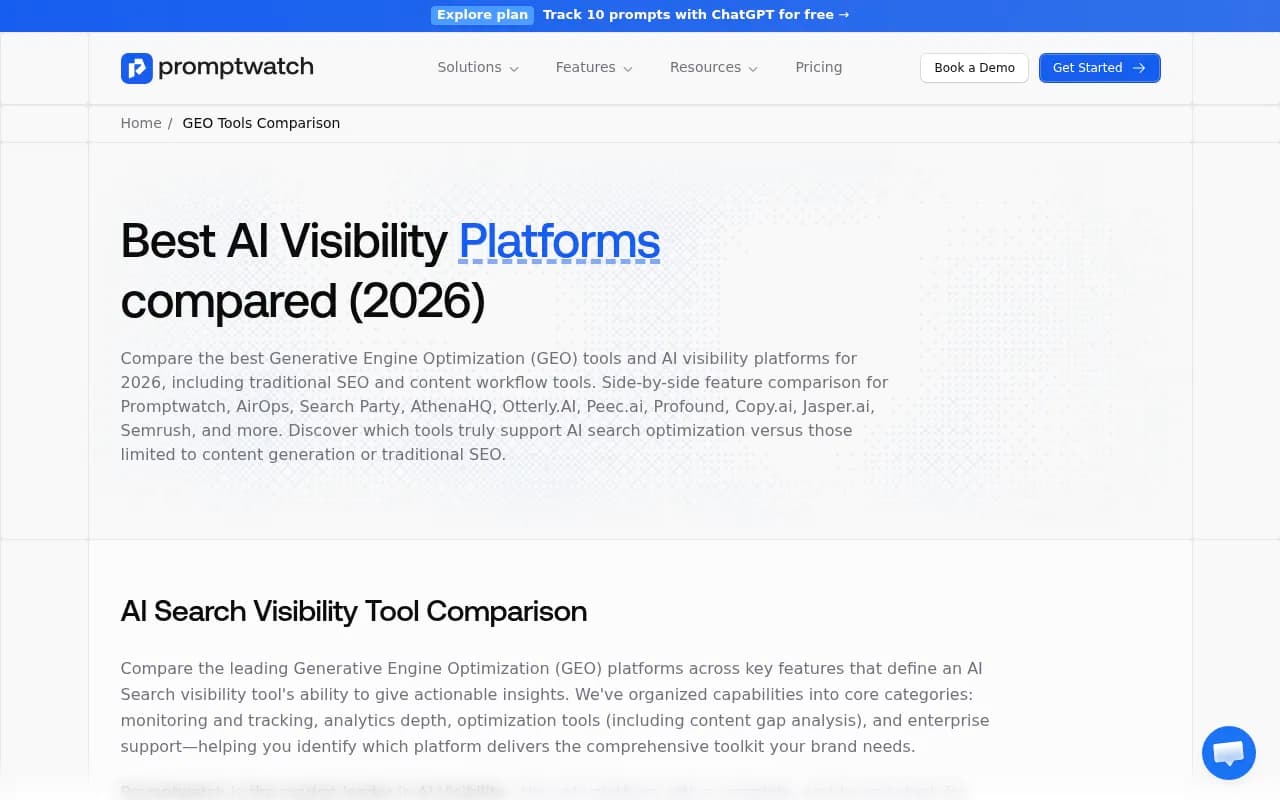
If you're primarily building executive reporting and stakeholder dashboards, and your content team is already well-resourced, a monitoring-focused tool might be enough. You get the visibility data, your writers handle the content strategy separately.
If you want monitoring plus content generation without needing deep technical diagnostics, Relixir is a reasonable middle ground. It's more capable than a pure tracker, and the content workflow is a genuine differentiator.
If you need to actually move your AI visibility metrics -- not just report on them -- Promptwatch is the more complete option. The combination of gap analysis, content generation grounded in real citation data, crawler logs, and traffic attribution is hard to replicate by stitching together separate tools. It's also the only platform in this comparison that's been rated a "Leader" across all categories in a 2026 comparison of 12 GEO platforms.
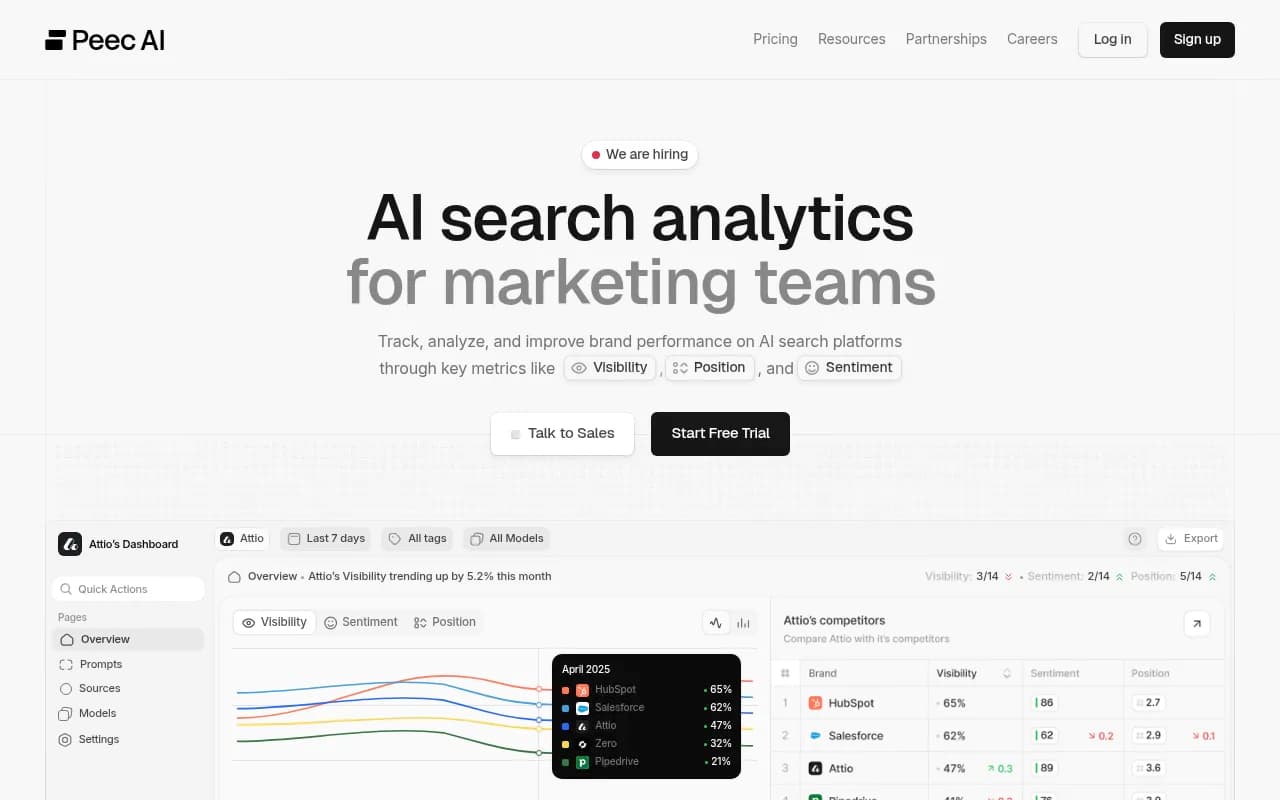
For teams that are just starting out and want to understand the space before committing to a full platform, tools like Otterly.AI or Peec AI offer lower-cost entry points for basic monitoring.

A note on prompt volume and difficulty
One capability that separates more mature platforms from early-stage ones is prompt intelligence. Not all prompts are equally valuable to rank for. Some have high volume and low competition -- those are the ones worth prioritizing. Others are highly competitive and low-volume -- probably not worth the effort.
Promptwatch includes volume estimates and difficulty scores for each prompt, plus query fan-outs that show how one prompt branches into related sub-queries. That kind of prioritization data changes how you allocate content resources. Instead of guessing which topics to cover, you're working from actual signal.
Neither Meteoria nor Relixir offers this at the same depth, which means teams using those platforms are making content decisions with less information.
Bottom line
The GEO platform market in 2026 has a clear split: tools that show you the problem, and tools that help you fix it.
Meteoria.ai is a solid monitoring platform for teams that need visibility reporting and have separate workflows for content. Relixir adds content generation to the mix, which makes it more actionable. Promptwatch is the most complete option if your goal is to actually improve your AI search presence, not just document it.
The question to ask before choosing any GEO platform: "After I see the data, what does this tool help me do next?" The answer tells you everything about whether it's worth the investment.