Key takeaways
- Promptwatch and Wincher are not really direct competitors -- they track visibility in completely different search environments. Promptwatch covers AI engines (ChatGPT, Claude, Gemini, Perplexity); Wincher covers Google.
- If your goal is to rank higher on Google, Wincher is the right tool. If you want to appear in AI-generated answers, Promptwatch is the right tool. Most forward-thinking teams will eventually need both.
- Wincher is cheaper to start (€49/mo with a free tier) and significantly simpler to use. Promptwatch starts at $99/mo and has more moving parts, but the depth is justified by what it does.
- Promptwatch goes beyond monitoring -- it includes content gap analysis, an AI writing agent, crawler logs, and citation tracking. Wincher is a monitoring and research tool; it doesn't generate content or suggest fixes beyond on-page SEO recommendations.
- Wincher has a larger user base (700,000+ marketers) and longer track record in traditional SEO. Promptwatch is newer but purpose-built for the AI search era that Wincher doesn't address.
- Neither tool replaces the other. The real question is which problem you're trying to solve right now -- and increasingly, the answer is both.
Overview
Promptwatch

Promptwatch is an AI search visibility platform built specifically for the era where ChatGPT, Perplexity, and Gemini are becoming primary research tools. It tracks how your brand appears across 10 AI models, shows you which prompts competitors rank for that you don't, and then helps you close those gaps with an AI writing agent trained on real citation data. Used by 8,400+ brands including Duolingo, Typeform, and Yelp, it's rated 4.7/5 on G2.
The core loop is: find where you're invisible, create content to fix it, track whether it worked. Most AI visibility tools stop at step one. Promptwatch is one of the few that takes you through all three.
Wincher
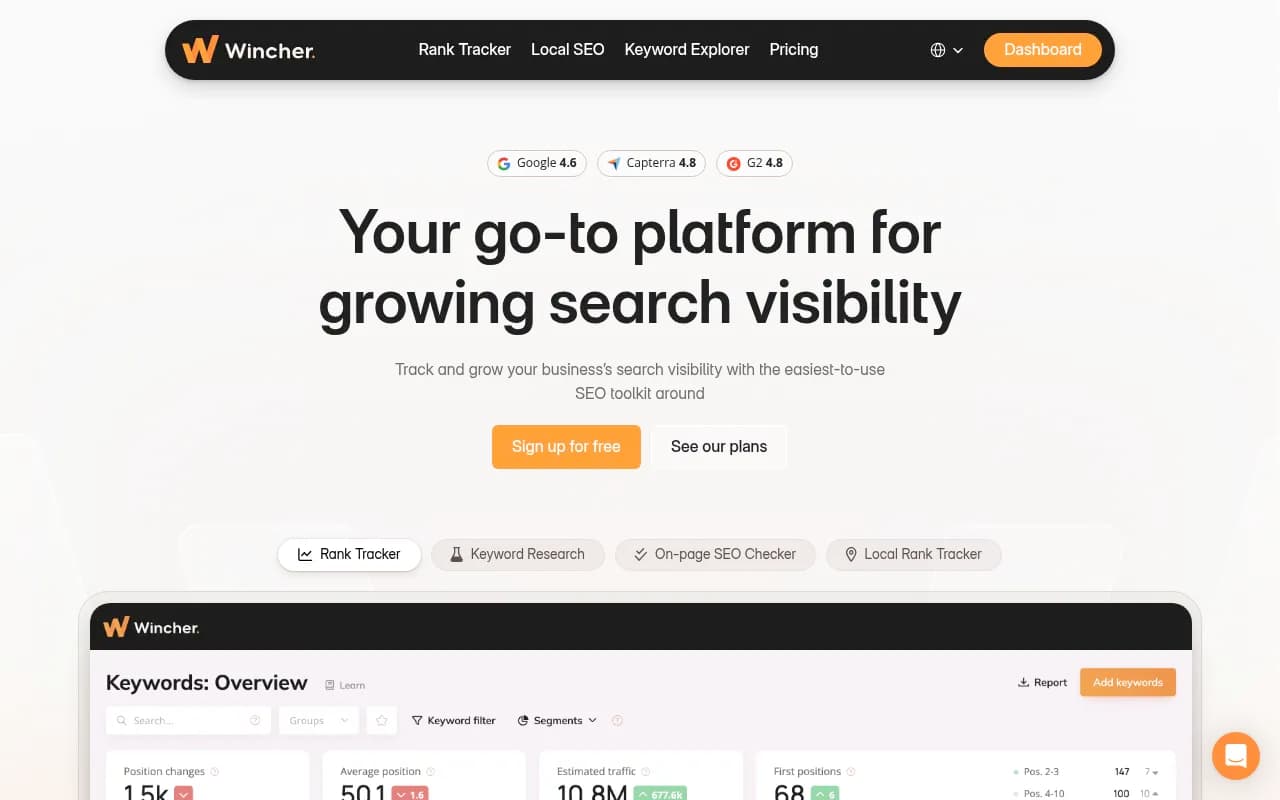
Wincher is a Google-focused search visibility platform used by 700,000+ marketers. It does rank tracking, keyword research, on-page SEO analysis, local tracking, and white-label reporting -- all with a clean interface that doesn't require an SEO background to navigate. Rated 4.8/5 on both G2 and Capterra, it's particularly popular with SMBs and agencies who want reliable Google data without the complexity or price tag of tools like Semrush or Ahrefs.
What Wincher does, it does well. What it doesn't do is anything related to AI search engines.
Side-by-side comparison
| Feature | Promptwatch | Wincher |
|---|---|---|
| Primary focus | AI search visibility (ChatGPT, Claude, Gemini, etc.) | Google keyword rank tracking |
| Google rank tracking | No | Yes, daily updates |
| AI model monitoring | 10 models (ChatGPT, Claude, Perplexity, Gemini, Grok, DeepSeek, Copilot, Meta AI, Mistral, Google AI Overviews) | None |
| Keyword research | No | Yes |
| Content generation | Yes (AI writing agent) | No |
| On-page SEO checker | No | Yes |
| Local tracking | No | Yes |
| Competitor analysis | AI visibility heatmaps, answer gap analysis | Competitor rank comparisons |
| Citation/source tracking | Yes (880M+ citations analyzed) | No |
| AI crawler logs | Yes (real-time) | No |
| White-label reporting | Yes (agency plans) | Yes |
| Free tier | No (7-day trial) | Yes |
| Starting price | $99/mo | €49/mo |
| User base | 8,400+ brands | 700,000+ marketers |
| G2 rating | 4.7/5 | 4.8/5 |
| Best for | Brands optimizing for AI search | SMBs/agencies optimizing for Google |
Head-to-head feature deep-dive
What each tool actually tracks
This is the most important distinction and it's worth being direct about: these tools don't compete on the same terrain.
Wincher tracks where your pages rank on Google for specific keywords. You add keywords, it checks Google daily, and you see position changes over time. That's the core of what it does, and it does it cleanly.
Promptwatch tracks whether AI models mention your brand when users ask relevant questions. You add prompts (like "what's the best CRM for startups?"), it queries multiple AI engines, and you see whether your brand appears, how prominently, and what competitors are mentioned instead.
These are genuinely different signals. A page can rank #1 on Google and never appear in a ChatGPT response. A brand can dominate AI answers without ranking particularly well on Google. Both matter, and neither tool covers both.
Verdict: No winner here -- they track different things. Pick based on which channel matters more to your business right now.
Content and optimization capabilities
Wincher's on-page SEO checker analyzes your pages against target keywords and gives you actionable recommendations: missing meta tags, thin content, internal linking gaps. It's practical and useful for traditional SEO work.
Promptwatch's content capabilities go further in a different direction. The Answer Gap Analysis shows you exactly which prompts competitors appear for that you don't -- and then the built-in AI writing agent can generate articles, listicles, and comparison pages designed to get cited by AI models. The agent uses real citation data (which content formats AI models actually cite, which topics they reference) rather than generic SEO logic.
Wincher tells you how to improve existing pages for Google. Promptwatch tells you what new content to create to appear in AI answers.
Verdict: Promptwatch wins on content generation and AI-specific optimization. Wincher wins on traditional on-page SEO guidance.
Competitor analysis
Wincher lets you track competitor keyword rankings alongside your own. You can see where a competitor ranks for a keyword you're targeting, track their position changes over time, and identify keywords they rank for that you don't. It's straightforward and useful.
Promptwatch's competitor analysis is built around AI visibility. The competitor heatmaps show you which brands appear for which prompts across which AI models. The Answer Gap Analysis surfaces specific prompts where a competitor gets cited and you don't. You can see not just that a competitor is winning, but what content they have that you're missing.
| Competitor feature | Promptwatch | Wincher |
|---|---|---|
| Track competitor Google rankings | No | Yes |
| Track competitor AI visibility | Yes | No |
| Identify competitor content gaps | Yes (Answer Gap Analysis) | Keyword gap analysis |
| Competitor heatmaps | Yes (by AI model) | No |
| Prompt-level competitor data | Yes | N/A |
Verdict: Different tools for different competitive intelligence. Wincher for Google positioning, Promptwatch for AI search positioning.
Reporting and integrations
Wincher has clean, exportable reports and white-label options that agencies use to send branded ranking reports to clients. It integrates with Google Search Console and Google Analytics, which covers most of what traditional SEO teams need.
Promptwatch has a Looker Studio integration, an API for custom workflows, and supports white-label reporting on agency plans. It also integrates with Cloudflare, Vercel, and Fastly for real-time AI crawler tracking -- something Wincher has no equivalent for.
Verdict: Roughly comparable for reporting. Promptwatch has more integration depth for teams building custom workflows.
Ease of use
Wincher is genuinely easy. The interface is clean, the concepts are familiar (keyword, ranking, position), and you don't need to understand anything new to get value from it. That's a real advantage for small business owners or marketers who aren't deep into SEO.
Promptwatch has more complexity because the underlying concepts are newer. Understanding prompt tracking, citation analysis, and answer gaps takes a bit more onboarding. That said, the dashboards are well-organized and most teams report getting comfortable within a week or two.
Verdict: Wincher is simpler. Promptwatch has a steeper learning curve but the complexity reflects the depth of what it's doing.
AI crawler logs (Promptwatch only)
This is a feature Wincher simply doesn't have, and it's worth calling out because it's genuinely useful. Promptwatch's AI crawler logs show you in real time when bots from ChatGPT, Claude, Perplexity, and other AI engines crawl your pages -- which URLs they visit, how often, whether they encounter errors.
This matters because AI models can only cite content they've actually read. If a crawler is hitting your site and bouncing on errors, or never visiting your most important pages, you have a visibility problem that no amount of content creation will fix. Knowing this is the first step to fixing it.
No traditional SEO tool tracks this. It's a Promptwatch-specific capability.
Pricing comparison
| Plan | Promptwatch | Wincher |
|---|---|---|
| Free tier | No (7-day trial) | Yes (limited) |
| Entry plan | $99/mo (1 site, 50 prompts, 5 articles) | €49/mo |
| Mid-tier | $249/mo (2 sites, 150 prompts, 15 articles, crawler logs) | ~€89/mo |
| Higher tier | $579/mo (5 sites, 350 prompts, 30 articles) | ~€149/mo |
| Agency/Enterprise | Custom pricing | Custom pricing |
| Annual discount | Yes | Yes |
| Free trial | 7 days | 7 days |
Wincher is cheaper at every tier. For a small business that just wants to track Google rankings, €49/month is a reasonable price. Promptwatch's $99/month entry tier is also competitive compared to other AI visibility platforms (many of which charge $200+ for similar functionality), but it's a higher bar for teams just getting started with AI search.
Pros and cons
Promptwatch
Pros:
- Covers 10 AI models in one platform, including ChatGPT, Claude, Gemini, Perplexity, Grok, and DeepSeek
- Goes beyond monitoring -- content gap analysis and AI writing agent help you actually fix visibility problems
- Real-time AI crawler logs show how AI engines interact with your site
- Citation tracking (880M+ citations analyzed) gives you data on what content AI models actually reference
- Reddit and YouTube insights surface off-site content that influences AI recommendations
- ChatGPT Shopping tracking for e-commerce brands
- Prompt volume and difficulty scoring helps prioritize which prompts to target
Cons:
- No Google rank tracking -- doesn't replace traditional SEO tools
- Higher starting price than Wincher
- More complex to onboard, especially for teams new to AI search concepts
- No permanent free tier (7-day trial only)
- Newer platform with a shorter track record than established SEO tools
Wincher
Pros:
- Clean, intuitive interface that non-technical users can navigate without training
- Daily Google rank tracking with historical data
- Keyword research with search volume, intent, and difficulty data
- Local rank tracking for businesses targeting specific cities or regions
- White-label reporting built in -- useful for agencies
- Free tier available, very low entry price
- 700,000+ user base means a well-tested, stable product
- Strong ratings across G2 and Capterra
Cons:
- Zero AI search visibility coverage -- no ChatGPT, Claude, Perplexity, or Gemini tracking
- No content generation capabilities
- No AI crawler logs or citation analysis
- Competitor analysis is limited to Google keyword positions
- Won't help you understand or improve how AI models perceive your brand
Who should pick which tool
Pick Promptwatch if:
- Your marketing team is asking "why aren't we showing up in ChatGPT answers?" and you need data to answer that
- You're in a competitive category where AI-generated recommendations drive purchase decisions (SaaS, travel, finance, e-commerce)
- You want to do more than monitor -- you want to create content that actually gets cited by AI models
- You're an agency managing AI visibility for multiple clients
- You need to track AI crawler activity on your site and understand how AI engines discover your content
Pick Wincher if:
- Google organic traffic is your primary acquisition channel and you need solid rank tracking
- You're a small business or solo marketer who wants clean, affordable SEO tools without complexity
- You need local rank tracking for a business with physical locations
- You're running an agency and need white-label Google ranking reports for clients
- You're just getting started with SEO and want something approachable
Pick both if:
- You're a mid-size or larger brand that cares about both Google rankings and AI search visibility (which is increasingly most brands)
- You have separate SEO and content teams -- Wincher for the SEO team, Promptwatch for the content/brand team
- You want a complete picture of your search presence across both traditional and AI-powered channels
Final verdict
Promptwatch and Wincher are solving different problems in 2026. Wincher is a mature, well-priced Google rank tracker that does its job cleanly. Promptwatch is an AI search visibility platform that not only shows you where you're invisible in AI answers but helps you fix it.
If you're choosing between them, the real question is: which search channel matters more to your business right now? For most teams, the honest answer is "both" -- Google isn't going away, but AI-generated answers are eating an increasing share of informational queries. Wincher handles one side of that equation well. Promptwatch handles the other side, and goes deeper with content generation and optimization that Wincher doesn't attempt.
For teams that can only pick one: if your traffic is almost entirely Google-dependent and you're not yet thinking about AI search, start with Wincher. If AI search visibility is already on your radar or your category is one where ChatGPT and Perplexity recommendations drive decisions, Promptwatch is the more forward-looking investment.