Serpstat Review 2026
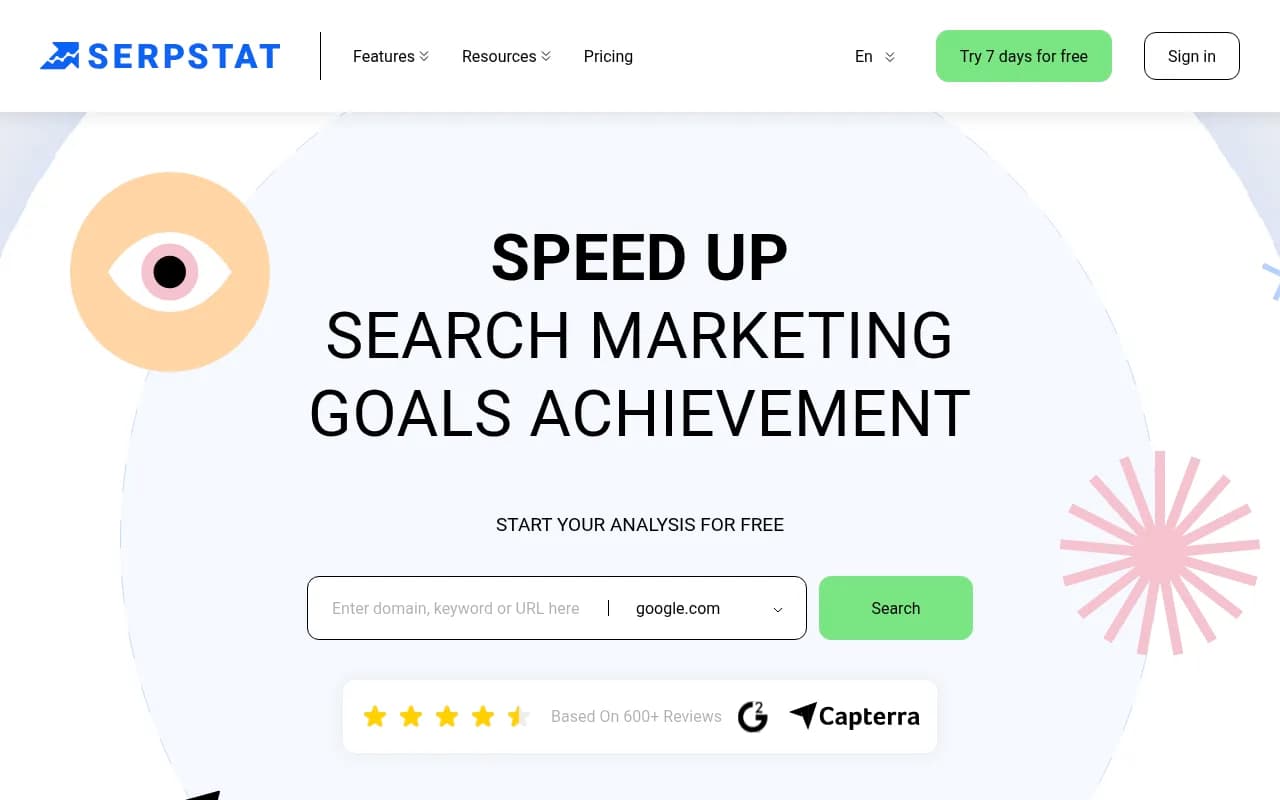
Serpstat is a comprehensive SEO platform covering keyword research, rank tracking, site audit, backlink analysis, and competitor intelligence across 230 countries. Trusted by 1.1M+ users including Visa, Uber, and Shopify. Plans from $69/mo.
Key takeaways
- Serpstat is a full-featured SEO platform with keyword research, rank tracking, site audit, backlink analysis, and competitor intelligence in one tool
- Covers 230 countries and supports both Google and Bing, with a database of 8.62 billion keywords and 529 billion backlinks
- Pricing runs from $69/mo to $499/mo, making it more affordable than Semrush or Ahrefs at comparable feature depth
- The site audit and competitor analysis modules are consistently the most praised features among users
- No meaningful AI search visibility or LLM monitoring capabilities -- teams that need to track brand presence in ChatGPT, Perplexity, or other AI engines will need a separate tool for that
Serpstat is a Ukrainian-built all-in-one SEO platform that has been around since 2013, originally launched as a keyword research tool before expanding into a full suite covering technical SEO, rank tracking, backlink analysis, and competitor intelligence. The company has grown to serve over 1.1 million users globally, with enterprise clients including Visa, Uber, Shopify, Rakuten, Deloitte, and Samsung. That's not a small user base for a tool that often flies under the radar compared to Semrush or Ahrefs.
The core pitch is straightforward: one platform for the main SEO workflows, at a price point that doesn't require a large agency budget. Where Semrush's comparable plans start at $139/mo and Ahrefs at $129/mo, Serpstat's entry plan sits at $69/mo. That gap matters a lot for freelancers, small agencies, and in-house teams at mid-sized companies who need real data without paying enterprise prices.
The platform has been particularly popular in Eastern European markets, which makes sense given its origins, but it has built a genuinely global user base. The database covers 230 countries for both keyword research and rank tracking, which is competitive with the biggest players in the space.
Key features
Keyword research
Serpstat's keyword research module pulls from a database of 8.62 billion keywords across 230 countries. For any seed keyword, you get search volume, keyword difficulty, CPC, competition level, and related keyword suggestions. The tool also surfaces questions, related searches, and top pages ranking for the keyword -- useful for content planning without needing a separate tool.
- Keyword difficulty scores are calculated based on the top 10 results, factoring in domain authority and page-level metrics
- The "Search Suggestions" feature pulls autocomplete data from Google, giving you long-tail variations that pure database tools sometimes miss
- PPC metrics are included alongside organic data, so you can evaluate keywords for both channels in one view
- Bulk keyword analysis lets you upload lists and get metrics in batch, which saves significant time for agencies doing client research
Competitor analysis
This is one of Serpstat's strongest modules. Enter any domain and you get a full breakdown of their organic and paid keyword rankings, estimated traffic, visibility score, top pages, and backlink profile. The "Competitor Graph" feature visualizes which domains share keyword overlap with your target, helping you identify competitors you might not have considered.
- "Missing keywords" analysis shows keywords your competitors rank for that you don't -- a practical gap analysis for content planning
- Ad intelligence shows competitors' active PPC campaigns, ad copy, and landing pages, which is genuinely useful for PPC teams
- Historical data lets you track competitor visibility over time, not just a snapshot
- Multi-competitor comparison lets you stack up to 3 domains side by side
Site audit
The site audit tool crawls your website and categorizes technical issues by severity. It covers the standard checklist: broken links, duplicate content, missing meta tags, slow pages, redirect chains, canonical issues, and more. What makes it practical is the prioritization -- issues are sorted by impact, so you're not wading through 200 low-priority warnings to find the things that actually matter.
- Scheduled audits run automatically and track whether your issue count is going up or down over time
- The "optimization score" gives you a single number to track progress, which is useful for client reporting
- White-label reports can be generated directly from the audit module
- Crawl settings let you adjust depth, speed, and which pages to include or exclude
Rank tracker
Serpstat's rank tracker monitors keyword positions on both desktop and mobile, across Google and Bing, in any of the 230 supported countries. You can track your own domain alongside competitors, which gives you a relative view of performance rather than just absolute positions.
- Flexible scheduling: daily, weekly, or custom tracking intervals
- SERP feature tracking shows when your pages appear in featured snippets, local packs, or other rich results
- Tag-based keyword grouping lets you organize tracked keywords by topic, page, or campaign
- Project migration from other tools (Semrush, Ahrefs, etc.) is supported at no cost, which lowers the switching barrier
Backlink analysis
With 529 billion backlinks in the index, Serpstat's backlink database is large enough to be useful for most link building and audit workflows. You can analyze any domain's backlink profile, filter by anchor text, referring domain authority, link type (dofollow/nofollow), and more.
- Backlink monitoring alerts you when new links are gained or lost
- Toxic link detection flags potentially harmful backlinks for disavow consideration
- Competitor backlink comparison shows where competitors are getting links that you're not
- The index update frequency is less aggressive than Ahrefs, which updates its index more frequently -- worth noting if you're doing active link building campaigns
API and data solutions
Serpstat has a well-documented API that covers most of the platform's data: keyword metrics, domain analytics, backlink data, and SERP data. The company explicitly welcomes data reselling, which makes it attractive for agencies building custom tools or dashboards for clients.
- REST API with JSON responses
- Dedicated integration and solutions team for enterprise API customers
- Transparent documentation with clear endpoint descriptions and rate limit information
- Cost-effective compared to Semrush's API pricing, which is a meaningful differentiator for data-heavy use cases
AI content tools
Serpstat has added AI-assisted content features in recent years, including content brief generation and text optimization suggestions. These are useful for content teams working on SEO-focused articles, though they're more of a supporting feature than a core differentiator.
Who is it for
Serpstat fits best for in-house SEO teams at mid-sized companies and small-to-medium digital agencies. Think a 5-15 person marketing team at a SaaS company tracking 200-500 keywords, or a boutique SEO agency managing 10-30 client sites. The pricing is accessible enough that it doesn't require a dedicated budget line item, and the feature set covers the full SEO workflow without needing to stitch together multiple tools.
Freelance SEO consultants are another strong fit, particularly those who need to produce client-ready reports without paying Semrush prices. The white-label reporting and multi-project support make it workable for managing several clients under one account. The competitor analysis module is especially useful for client pitches -- showing a prospect where their competitors are outranking them is a reliable way to win work.
The 230-country coverage makes Serpstat a reasonable choice for teams working in non-English markets. Eastern European, Latin American, and Southeast Asian markets are well-represented in the database, which isn't always true of tools that are primarily built around US and UK data.
Who should probably look elsewhere: large enterprise SEO teams with complex technical requirements and big budgets will likely find Semrush or Ahrefs more capable, particularly for link building workflows and content gap analysis at scale. Teams that primarily need AI search visibility monitoring -- tracking how their brand appears in ChatGPT, Perplexity, or Google AI Overviews -- won't find that capability here at all. Serpstat is a traditional SEO tool, and it doesn't pretend to be anything else.
Integrations and ecosystem
Serpstat's integration story is fairly standard for an SEO platform. The most important connection is Google Search Console, which you can link to pull real click and impression data alongside Serpstat's estimated metrics. This combination of GSC data and Serpstat's competitive intelligence gives you a more complete picture than either source alone.
- Google Search Console: Direct integration for organic performance data
- Google Analytics: Connect for traffic correlation with ranking data
- Google Data Studio / Looker Studio: Export data for custom dashboards
- Zapier: Available for workflow automation, though the native Zapier integration is limited compared to what the API can do
- REST API: Full programmatic access to keyword, domain, backlink, and SERP data -- well-documented and actively maintained
- Browser extension: A Chrome extension provides quick SEO metrics for any page you're browsing, including domain authority, keyword rankings, and backlink counts
There's no native Slack integration for alerts, which is a minor gap. Rank change alerts and audit notifications are delivered by email. The mobile experience is functional but the platform is clearly designed for desktop use -- most of the analytical workflows require a full browser.
Pricing and value
Serpstat's pricing runs across four main tiers:
- Individual: $69/mo -- covers basic keyword research, rank tracking, and site audit for a single user
- Team: $149/mo -- adds more projects, higher limits, and multi-user access
- Agency: $299/mo -- higher limits across all modules, white-label reporting, API access
- Enterprise/Custom: $499/mo and up -- custom limits, dedicated support, data solutions
Annual billing brings a meaningful discount (typically around 20-30% off monthly rates). A 7-day free trial gives you access to all paid features, which is enough time to evaluate whether the data quality and workflow fit your needs.
Compared to the main alternatives: Semrush's Pro plan starts at $139/mo with tighter limits, and Ahrefs starts at $129/mo. Serpstat's $69 entry point is genuinely lower, and the Team plan at $149 competes directly with Semrush Pro on features while offering broader geographic coverage. For agencies specifically, the $299 Agency plan undercuts Semrush's Agency plans significantly.
The value proposition is clearest for teams that need solid keyword research and competitor analysis without the premium price tag. If you're primarily a link builder who lives in Ahrefs' link database, Serpstat probably isn't the right switch. But for the broader SEO workflow, the price-to-capability ratio is strong.
Strengths and limitations
Where Serpstat does well:
- Geographic coverage: 230 countries with localized data is genuinely broad, and the non-English market coverage is better than many competitors
- Price-to-feature ratio: Getting keyword research, rank tracking, site audit, backlink analysis, and competitor intelligence under $150/mo is hard to beat
- Site audit quality: The audit module is consistently praised by users for its clarity and actionable prioritization -- it's one of the better technical SEO audit tools in this price range
- API accessibility: The API is well-documented, cost-effective, and explicitly supports data reselling, which is unusual and valuable for agencies building custom solutions
- Competitor intelligence: The missing keywords and competitor overlap features are practical and well-implemented
Honest limitations:
- Backlink index freshness: Ahrefs updates its backlink index more frequently. For active link building campaigns where you need near-real-time data on new links, this matters.
- No AI search visibility: Serpstat has no capability to monitor how your brand appears in ChatGPT, Perplexity, Claude, Google AI Overviews, or any other AI engine. As AI search becomes a larger share of how people find information, this is a real gap. Teams that need that coverage will need a dedicated tool -- Serpstat simply doesn't play in that space.
- UI complexity at scale: The platform covers a lot of ground, and navigating between modules for large projects can feel disjointed. Semrush's workflow integration between modules is smoother.
- Limited content optimization depth: The AI content features are functional but not as developed as dedicated content optimization tools like Clearscope or Surfer SEO.
Bottom line
Serpstat is a solid, well-priced SEO platform that covers the core workflows -- keyword research, rank tracking, technical audit, backlinks, and competitor analysis -- without the premium price tag of Semrush or Ahrefs. It's the right choice for freelancers, small agencies, and in-house teams at mid-sized companies who need real SEO data and can't justify $300-500/mo for a tool they'll use for the same core tasks.
The best use case in one sentence: an SEO agency managing 10-25 client sites that needs reliable keyword and competitor data, white-label reporting, and API access at a price that keeps margins healthy.
Tags:
Frequently asked questions
Similar and alternative tools to Serpstat