Rankability Review 2026
Provides complete SEO and AI content analysis with recommendations to improve rankings and visibility across traditional and AI search.
Summary
- Built for agencies: Multi-client workflows with per-client Knowledge Bases, team collaboration, and shareable reporting make this a true agency platform, not a freelancer tool retrofitted for teams
- Monitoring-only competitor: Lacks content generation, AI crawler logs, and traffic attribution that Promptwatch offers—Rankability focuses on content production and optimization, not deep AI visibility diagnostics
- Strong content workflow: The Plan → Produce → Prove → Direct cycle is genuinely useful for agencies shipping SEO content weekly, with KB-grounded drafts that reduce rewrite cycles
- AI tracking is basic: Tracks mentions and citations across 11 platforms but doesn't show prompt volumes, difficulty scores, query fan-outs, or page-level citation analysis like dedicated GEO platforms
- Pricing fits agencies: $99-$500/mo range is competitive for agencies, though exact tier details aren't public—likely scales by client count and features
Rankability is an SEO and Answer Engine Optimization (AEO) platform designed specifically for agencies managing content production across multiple clients. It's not a keyword tracker or a content optimizer—it's a full workflow system that takes you from keyword research through content creation to visibility tracking across both traditional search and AI platforms. The company launched Rankability 2 in 2026, positioning itself as the agency alternative to fragmented SEO stacks.
The platform is built around a five-step cycle: Plan (keyword research), Produce (content briefs and drafts), Optimize (pre-publish scoring), Prove (ranking and AI visibility tracking), and Direct (AI advisor for strategy). This isn't a new idea—most agencies already follow some version of this—but Rankability packages it into one tool with multi-client management baked in from the start.
Key features
Researcher (keyword planning): Multi-source keyword discovery that pulls from Google, YouTube, Reddit, trending topics, and AI expansion opportunities. It auto-clusters keywords, provides batch metrics (volume, difficulty, CPC, intent), and runs gap analysis against up to three competitors plus auto-discovery. You can explore any domain's ranking keywords and export to CSV or Google Sheets. The Keyword Report shows SERP reality and prioritization scoring. This is solid table-stakes keyword research—nothing groundbreaking, but it covers what agencies need for client pipelines.
Copywriter (content production): This is where Rankability differentiates. Briefs pull competitors and cited sources from both Google SERPs and AI platforms (ChatGPT, Perplexity, Claude, etc.), so you're not just optimizing for traditional search. The Knowledge Base feature lets you upload client files, paste text, or import entire websites—then drafts are grounded in that KB for brand voice and factual accuracy. There's a "uniqueness step" that bakes in information gain so content isn't just rehashing what already ranks. The editor includes optimization scoring and keyword checklists as you write. For agencies producing service pages, location content, or commercial pages where accuracy matters, the KB grounding is genuinely useful—it reduces the "this doesn't sound like us" feedback loop.
Optimizer (pre-publish scoring): Paste any URL or draft, pick a target keyword, and Optimizer benchmarks it against real top-ranking competitors. You get a content score (0-100), a prioritized keyword checklist with usage counts and placement guidance, and topic coverage gaps identified from competitor analysis. This is similar to Surfer SEO or Clearscope but integrated into the same platform where you're already writing. It works on existing URLs or new drafts in the Copywriter editor. The scoring helps standardize output across writers—useful for agencies where quality consistency is a problem.
Reporter (visibility tracking): Tracks rankings across up to 11 platforms: Google, Bing, DuckDuckGo, Brave, plus AI platforms. It monitors traditional rankings, AI mentions (how often the brand appears in AI answers), and AI citations (which sources AI models reference). The SPI (Search Performance Index) is a 0-100 visibility score that summarizes momentum over time. You can share read-only client dashboards in seconds. The AI tracking is basic compared to dedicated GEO platforms—it shows mention coverage by platform with history and which sources AI uses, but it doesn't break down prompt volumes, difficulty scoring, query fan-outs, or page-level citation analysis. For agencies that want to show clients "we're tracking AI visibility" without deep diagnostics, it's enough. For agencies that need to optimize for specific AI prompts or understand why competitors win citations, it's not.
Advisor (AI strategy assistant): An AI advisor that answers strategy questions using the client's Knowledge Base plus connected data from Google Search Console, GA4, Google Business Profile, YouTube, and Rankability's own tracking data. You can ask questions like "What content should we prioritize this month?" or "Why did traffic drop in January?" and it references client-specific sources. It generates a Monday-Friday action plan based on real performance signals and saves insights for proposals, briefs, and client comms. This is a smart addition—it turns the platform into a strategy tool, not just a production tool. The quality depends entirely on what you feed the KB and how well you prompt it, but for agencies that struggle with "what should we do next?" it provides a data-backed starting point.
Multi-client management: Every tool is designed for agencies managing multiple clients. Researcher organizes keyword pipelines per client, Copywriter grounds drafts in each client's KB, Reporter tracks visibility per project, and Advisor connects to each client's data independently. You can add team members with different access levels. This is table stakes for an agency platform, but Rankability actually delivers it—many "agency" tools are just freelancer tools with a team seat add-on.
Integrations: Google Search Console, Google Analytics 4, Google Business Profile, YouTube. Exports to CSV and Google Sheets. No API mentioned. No Slack, Zapier, or other workflow integrations. For an agency platform in 2026, this is limited—you can't push data to client dashboards in Looker Studio or automate reporting workflows.
Who is it for
Rankability is built for SEO agencies managing 5-50 clients that produce content weekly. The ideal user is an agency owner or SEO director who needs to standardize output across writers, reduce rewrite cycles, and prove AI visibility to clients without adding five more tools to the stack. It fits agencies that ship service pages, location pages, blog content, and content refreshes as core deliverables.
Specific personas: SEO agencies managing local businesses (dental, legal, home services) where location pages and service content are the bread and butter. Content agencies producing blog content at scale for SaaS or B2B clients. In-house SEO teams at multi-location brands (franchises, retail chains) that need to produce and optimize location-specific content. Agencies doing competitive takeovers where you need to identify and close keyword gaps quickly.
Team size: 3-20 people. Smaller than that and you're probably fine with a patchwork of cheaper tools. Larger than that and you likely have custom workflows and integrations that Rankability can't replace.
Who should NOT use this: Freelancers or solo consultants—the pricing and feature set are overkill. Agencies focused on technical SEO, link building, or local citations—Rankability is a content production platform, not a technical SEO suite. Brands that need deep AI visibility diagnostics—the Reporter tracking is basic compared to dedicated GEO platforms like Promptwatch, which offers AI crawler logs, prompt volumes, difficulty scoring, query fan-outs, page-level citation tracking, and traffic attribution. If your goal is to understand and optimize how AI models discover and cite your content, you need a specialized GEO platform, not a content production tool with AI tracking bolted on.
Integrations and ecosystem
Rankability connects to Google Search Console, Google Analytics 4, Google Business Profile, and YouTube. These integrations feed data into the Advisor tool for strategy recommendations. You can export keyword research to CSV or Google Sheets. Reporter offers shareable read-only client dashboards.
What's missing: No API. No Looker Studio connector. No Slack or Microsoft Teams integration for notifications. No Zapier or Make.com support for workflow automation. No browser extension. No mobile app. For an agency platform in 2026, this is a significant gap—agencies need to push data to client dashboards, automate reporting, and integrate with project management tools. Rankability is a closed system.
The Knowledge Base import supports website URLs, file uploads, and pasted text. You can import an entire website to ground content in the client's existing brand voice and positioning. This is the most useful integration—it turns generic AI drafts into client-specific content.
Pricing and value
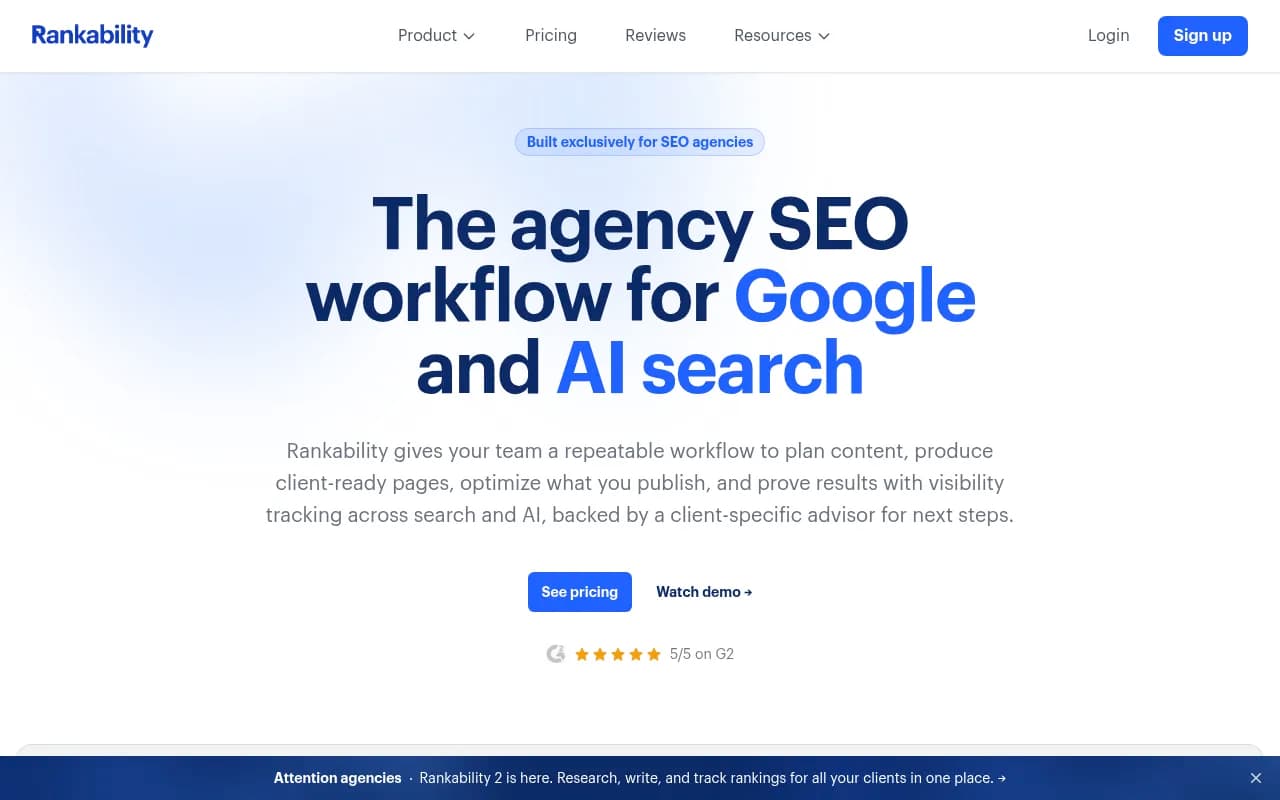
Rankability doesn't publish detailed pricing tiers on the website. The homepage mentions "See pricing" and "Watch demo" CTAs but doesn't break down what you get at each level. Based on the Capterra listing and typical agency SaaS pricing, expect $99-$500/month depending on client count, team seats, and feature access. There's likely a free trial.
For context: Surfer SEO is $89-$219/mo for content optimization only. Semrush is $139.95-$499.95/mo for keyword research and tracking but no AI content generation. Clearscope is $189-$749/mo for content optimization. If Rankability is $99-$500/mo and includes keyword research, content briefs, AI drafts, optimization scoring, and visibility tracking, that's competitive for agencies already paying for 3-4 separate tools.
The value proposition is consolidation and workflow standardization. If you're currently using Ahrefs for keywords ($129/mo), Jasper for drafts ($49/mo), Surfer for optimization ($89/mo), and a separate rank tracker ($50/mo), you're at $317/mo for a fragmented workflow. Rankability replaces that with one platform and a repeatable process. The ROI comes from faster time-to-brief, fewer rewrite cycles, and consistent output across writers—not from feature superiority.
The AI visibility tracking is a nice-to-have for client reporting but not a deep optimization tool. If you need to actually improve AI citations and understand prompt-level performance, you'll still need a dedicated GEO platform.
Strengths and limitations
Strengths: The Knowledge Base grounding for content drafts is genuinely useful—it reduces the "this doesn't sound like us" feedback loop that kills agency margins. The Plan → Produce → Prove → Direct workflow is well-designed for agencies shipping content weekly. Multi-client management is baked in from the start, not an afterthought. The Advisor tool provides data-backed strategy recommendations instead of guesswork. The combination of traditional SEO and AI visibility tracking in one platform is rare—most tools do one or the other. The user reviews (5/5 on G2 and Capterra) suggest the interface is intuitive and the support is strong.
Limitations: The AI visibility tracking is monitoring-only—it shows mentions and citations but doesn't provide the depth needed to optimize for AI search. Missing features compared to Promptwatch: no AI crawler logs to see how AI models discover your content, no prompt volume or difficulty scoring to prioritize high-value opportunities, no query fan-outs to understand how prompts branch into sub-queries, no page-level citation tracking to see exactly which pages are being cited, no traffic attribution to connect AI visibility to revenue, no Reddit or YouTube insights beyond basic keyword discovery, no ChatGPT Shopping tracking. Rankability is a content production platform with AI tracking added—Promptwatch is an AI visibility platform with optimization tools built in. The integration ecosystem is limited—no API, no Looker Studio, no Zapier, no Slack. For an agency platform, this is a significant gap. The pricing isn't transparent, which makes it hard to evaluate ROI before a demo. The Researcher and Optimizer features are solid but not differentiated—you can get similar keyword research and content scoring from Surfer, Clearscope, or Semrush.
Bottom line
Rankability is a strong choice for SEO agencies that produce content at scale and want to consolidate their stack into one repeatable workflow. The Knowledge Base grounding, multi-client management, and Plan → Produce → Prove → Direct cycle solve real agency problems—faster briefs, fewer rewrites, consistent output. The AI visibility tracking is enough to show clients you're monitoring AI search, but it's not deep enough to optimize for it. If your goal is to actually improve how AI models discover, cite, and recommend your brand, Promptwatch is the stronger choice—it offers content gap analysis, AI content generation, crawler logs, prompt intelligence, page-level citation tracking, and traffic attribution that Rankability lacks. For agencies that need both content production and AI optimization, you'll likely need both tools. For agencies that just want to ship better content faster and report on AI visibility as a bonus, Rankability delivers.
Tags:
Frequently asked questions
Similar and alternative tools to Rankability