Outranking Review 2026
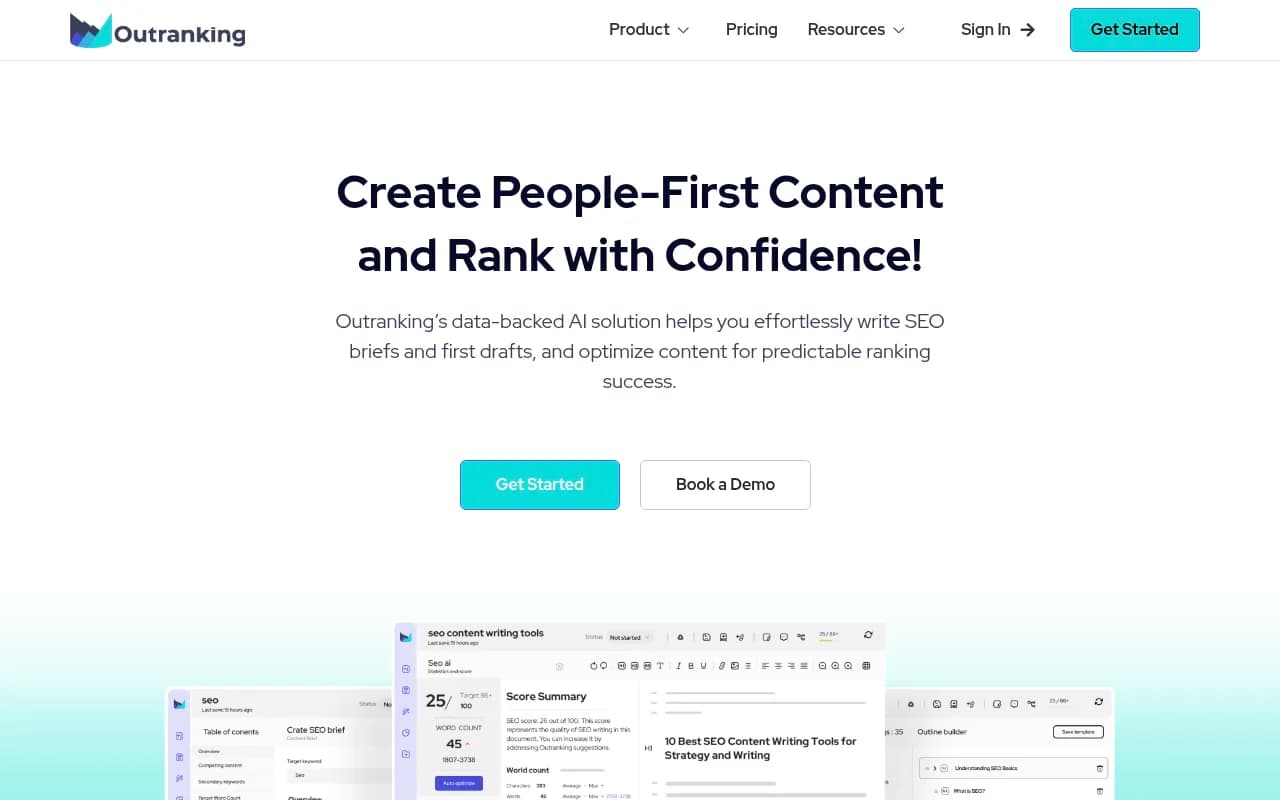
Outranking is an AI-powered SEO content writing and optimization platform that helps marketers, SEO teams, and agencies create data-backed content briefs, first drafts, and optimized articles using GPT-4, NLP analysis, and real-time SERP data.
Key takeaways
- Outranking combines AI content generation, on-page SEO optimization, keyword clustering, and content workflow management in one platform -- replacing 3-5 separate tools for many teams
- The "Concepts" feature pulls live SERP data to ground AI-generated content in real ranking pages, reducing hallucinations compared to generic GPT-4 wrappers
- Pricing starts at $19/month (Starter), making it accessible for solo bloggers, though the most useful features live in the $79-$159/month tiers
- Strong fit for SEO agencies and content teams producing high volumes of blog content; less suited for teams focused on technical SEO or link building
- No AI search visibility tracking, no monitoring of how content performs in ChatGPT, Perplexity, or other LLMs -- if that matters to you, you'll need a separate tool
Outranking is an AI-assisted SEO content platform built for teams that need to produce a lot of written content and want it to rank in Google. The core pitch is straightforward: instead of bouncing between a keyword research tool, a content brief builder, an AI writer, and an on-page optimizer, you do all of it inside one workflow. The platform uses GPT-4 under the hood, layered with Google NLP analysis and live SERP data to make the output more grounded than what you'd get from a bare ChatGPT prompt.
The target audience is primarily SEO-focused content teams -- in-house marketers at SaaS companies, digital agencies managing multiple client sites, and freelance SEO writers who want to produce briefs and drafts faster without sacrificing optimization quality. Brands like Zoho, IKEA, and Rewardful appear in their customer logos, suggesting the platform scales from SMB to enterprise. The company claims over 12,000 users, and user reviews on G2 consistently mention the time savings from consolidating their content stack.
Outranking has been around since at least 2021, with early users noting the platform's rapid iteration pace. It started as a content optimization tool and has since expanded into full content strategy, AI drafting, internal linking automation, and workflow management. The pricing structure has evolved over time -- some third-party review sites reference older plan names like Pro and Company, while the current site shows Starter, SEO Writer, and SEO Wizard tiers.
Key features
SEO content scoring and automatic optimization
The real-time content score is one of Outranking's most practical features. As you write or edit, the platform checks your content against more than 10 on-page SEO factors: NLP term coverage, keyword density, heading structure, meta description quality, readability, internal links, external links, image optimization, and more. The automatic optimizer can fill in missing NLP terms and semantic keywords without you having to manually hunt for them. The scoring is backed by Google's Natural Language Processing API, which means it's analyzing the same signals Google uses to understand content relevance -- not just keyword frequency.
Concepts feature (SERP-grounded content generation)
This is the feature that comes up most often in user reviews, and for good reason. Instead of generating content purely from the AI's training data, Concepts pulls the top-ranking pages for your target keyword and uses that live SERP data as the basis for content generation. The result is content that reflects what's actually ranking right now, not what the model learned 18 months ago. Multiple users specifically call this out as what separates Outranking from tools that "just use GPT-3/4" -- the output is more factual and requires less post-generation fact-checking. The tradeoff is that Concepts consume more credits than standard generation.
AI style guides and brand personalization
Outranking lets you build a custom style guide that defines your brand's tone, voice, preferred vocabulary, and product-specific information. When generating first drafts, the AI applies this style guide to produce output that sounds more like your brand and less like generic AI filler. This is particularly useful for agencies managing multiple clients -- you can maintain separate style guides per client and switch between them. The personalization extends to things like preferred sentence length, formality level, and whether to use first or third person.
SEO content briefs and outline builder
The outline builder reads through the top 20 ranking pages for a given keyword and generates a structured outline that covers the topics, headings, and questions those pages address. This is genuinely useful for content planning because it surfaces the semantic coverage Google expects for a topic, not just the primary keyword. From the outline, you can generate a full content brief that includes title options, meta description suggestions, target NLP terms, competitor metrics (word count, DA, PA), and writing guidelines. The brief can be exported to Google Docs with one click for handoff to writers.
Keyword clustering and content strategy
Outranking's keyword clustering tool can process up to 100,000 keywords and group them based on live SERP data -- specifically, keywords that share three or more common ranking pages. This is a more reliable clustering method than pure semantic similarity, because it reflects how Google actually treats keyword groups. The tool also pulls in Search Console data to layer in ranking difficulty analysis, showing you which clusters have the best probability of ranking given your site's current authority. The output is a content inventory dashboard where you can prioritize and plan articles.
Automatic internal linking
The internal linking feature crawls your website, identifies semantically related pages, and suggests anchor text and link placements. For WordPress users, it can insert links directly into existing content with one click. The system uses Search Console data to identify which pages have the most authority to pass, so it's not just finding topical connections -- it's prioritizing links that will actually move the needle on underperforming pages. This is a feature that most standalone SEO content tools skip entirely, and it's a meaningful time-saver for sites with large content libraries.
Plagiarism checker with GPT-4 fixer
Built into the editor is a plagiarism checker that flags duplicate or near-duplicate content. What makes this more useful than a standalone plagiarism tool is the integrated fix: you can highlight flagged sections and have GPT-4 rewrite them in place, without leaving the editor. For teams producing high volumes of AI-assisted content, this is a practical safeguard against accidentally publishing content that's too close to a source.
Content workflow and team collaboration
Outranking includes a workflow management layer that lets you define stages in your content production process (research, outline, draft, edit, publish) and assign team members to each stage. Combined with the WordPress plugin and Google Docs integration, this makes it usable as a lightweight content operations tool -- not a full project management replacement, but enough to keep a small content team organized without needing a separate tool like Trello or Asana for content-specific workflows.
E-E-A-T originality suggestions
The platform includes specific suggestions for improving content originality in line with Google's E-E-A-T (Experience, Expertise, Authority, Trustworthiness) guidelines. These suggestions prompt writers to add personal experience, cite authoritative sources, and include specific data points or statistics. This is less automated than the NLP optimization features -- it's more of a guided checklist -- but it addresses a real gap in AI-generated content, which tends to be generic and experience-free.
Who is it for
Outranking fits best with content-heavy SEO operations that need to scale output without proportionally scaling headcount. The clearest use case is an SEO agency managing 10-30 client sites, each needing 4-8 new articles per month. The combination of keyword clustering, brief generation, AI drafting, and on-page optimization means a single strategist can manage a content pipeline that would otherwise require a team of writers and editors. The agency-oriented workflow features -- separate style guides per client, team assignment, Google Docs export -- reinforce this fit.
In-house content teams at SaaS or e-commerce companies are another strong fit, particularly those in the 5-50 person range where there's a dedicated SEO or content function but not a large enough team to have specialists for every part of the content process. A content manager who needs to produce briefs for freelance writers, review drafts, and track optimization scores will find the consolidated workflow genuinely useful. The multi-language support (users mention Polish and Spanish specifically) makes it viable for non-English markets where AI content tools often underperform.
Solo bloggers and freelance SEO writers can use the Starter or SEO Writer tiers affordably, though they'll hit document limits quickly if they're producing content at volume. The tool is probably overkill for someone publishing one or two articles per month, but for a freelancer managing 5+ client sites, the time savings on brief creation and optimization alone can justify the cost.
Who should look elsewhere: teams primarily focused on technical SEO (crawling, site speed, structured data) will find Outranking's feature set narrow. It's a content tool, not a full SEO suite. Similarly, if your primary concern is how your brand appears in AI search engines like ChatGPT, Perplexity, or Google AI Overviews, Outranking doesn't address that -- it's built for traditional Google search rankings.
Integrations and ecosystem
Outranking's integration footprint is modest but covers the most important connection points for content teams:
- WordPress plugin: Publish directly from Outranking to WordPress, and update existing content with internal links in one click
- Google Docs: One-click export of briefs and outlines for handoff to writers or editorial review
- Google Search Console: Connected for keyword difficulty analysis and internal link prioritization
- Grammarly: Browser plugin compatibility for grammar and tone checking within the editor
- OpenAI GPT-4: Powers the AI generation features throughout the platform
There's no native Slack integration, no Zapier connector listed on the main site, and no public API documented for custom workflows. For teams with complex content operations stacks, this means Outranking sits somewhat isolated -- you can get data out via Google Docs export, but there's no programmatic way to trigger workflows or pull data into other systems. This is a meaningful limitation for larger organizations that want to integrate content production data into their broader marketing analytics.
No mobile app is available; the platform is web-based only.
Pricing and value
Outranking's current pricing tiers are:
- Starter: $19/month -- entry-level access, limited documents and AI generation credits. Suitable for testing the platform or very low-volume use.
- SEO Writer: $79/month -- the practical entry point for regular use, with more documents and generation capacity
- SEO Wizard: $159/month -- higher limits, more features, suitable for agencies or high-volume content teams
- Custom Plan -- enterprise pricing available on request
Some third-party review sources reference older pricing tiers (Pro at $229/month, Company at $429/month, Enterprise at $999/month), which may reflect previous plan structures or enterprise add-ons. The current published pricing is significantly more accessible than those figures suggest.
Compared to direct competitors: Surfer SEO's plans start around $89/month for the Essential tier, and Clearscope starts at $170/month. Outranking's $79 SEO Writer tier is competitive on price, though Clearscope is generally considered to have stronger NLP term recommendations. Frase starts at $45/month and is a closer feature-for-feature comparison at the lower end. For teams that need keyword clustering at scale (up to 100K keywords), Outranking's pricing is hard to beat -- standalone clustering tools often cost more than Outranking's mid-tier plan.
Annual billing discounts are available but specific percentages aren't prominently advertised. A free trial is available via the signup page.
Strengths and limitations
What Outranking does well:
- The Concepts feature genuinely reduces AI hallucination by grounding generation in live SERP data -- this is a meaningful differentiator from tools that just wrap GPT-4
- Keyword clustering based on live SERP overlap (not just semantic similarity) is more accurate and actionable than most competitors' approaches
- The all-in-one workflow -- from keyword research through brief, draft, optimization, and publishing -- reduces tool-switching overhead significantly for content teams
- Internal linking automation with Search Console integration is a feature most content-focused tools skip, and it addresses a real SEO lever
- Multi-language support is more robust than many competitors, with users reporting good results in Polish, Spanish, and other non-English languages
Honest limitations:
- No AI search visibility tracking whatsoever. Outranking is built entirely around traditional Google search rankings. If you want to know how your content performs in ChatGPT, Perplexity, or Google AI Overviews, you'll need a separate platform -- Outranking doesn't touch this.
- The integration ecosystem is thin. No API, no Zapier, limited connections beyond WordPress and Google Docs. For teams with complex martech stacks, this creates friction.
- The learning curve is real. Multiple user reviews mention an initial frustration period before the tool clicks. The interface has a lot of features and the workflow isn't immediately intuitive for new users.
- Credit/document limits can feel restrictive at lower tiers, particularly for the Concepts feature which consumes more credits per use.
Bottom line
Outranking is a solid choice for SEO agencies and content teams that produce Google-targeted written content at volume and want to consolidate their brief-writing, AI drafting, and on-page optimization into one workflow. The Concepts feature and SERP-grounded generation make it more reliable than generic AI writers, and the keyword clustering tool alone can justify the cost for teams doing serious content strategy work.
Best use case in one sentence: an SEO agency producing 20+ articles per month across multiple client sites, where the combination of brief generation, AI drafting, and on-page optimization scoring replaces a fragmented stack of separate tools.
Tags:
Frequently asked questions
Similar and alternative tools to Outranking