Meridian Review 2026
Tracks brand visibility in AI search engines with category-level AI tracking, sentiment insights, citation tracking, and competitive benchmarking to help companies win qualified leads.
Key takeaways
- Meridian positions itself as a "done-with-you" GEO platform, pairing software monitoring with forward-deployed human experts who execute the work -- a meaningful differentiator from pure-software competitors
- Lacks several self-serve optimization features found in Promptwatch, including AI crawler logs, prompt volume/difficulty scoring, query fan-outs, Reddit and YouTube citation tracking, and page-level citation tracking -- Meridian's approach leans on managed services rather than giving teams direct access to these data layers
- Multi-model coverage spans ChatGPT, Perplexity, Gemini, Google AI, Claude, Meta AI, Grok, DeepSeek, Copilot, and Google AI Overviews
- Strong fit for brands that want an agency-style partner rather than a self-serve analytics tool
- Pricing is not publicly listed; requires a demo call, which makes it harder to evaluate for budget-conscious buyers
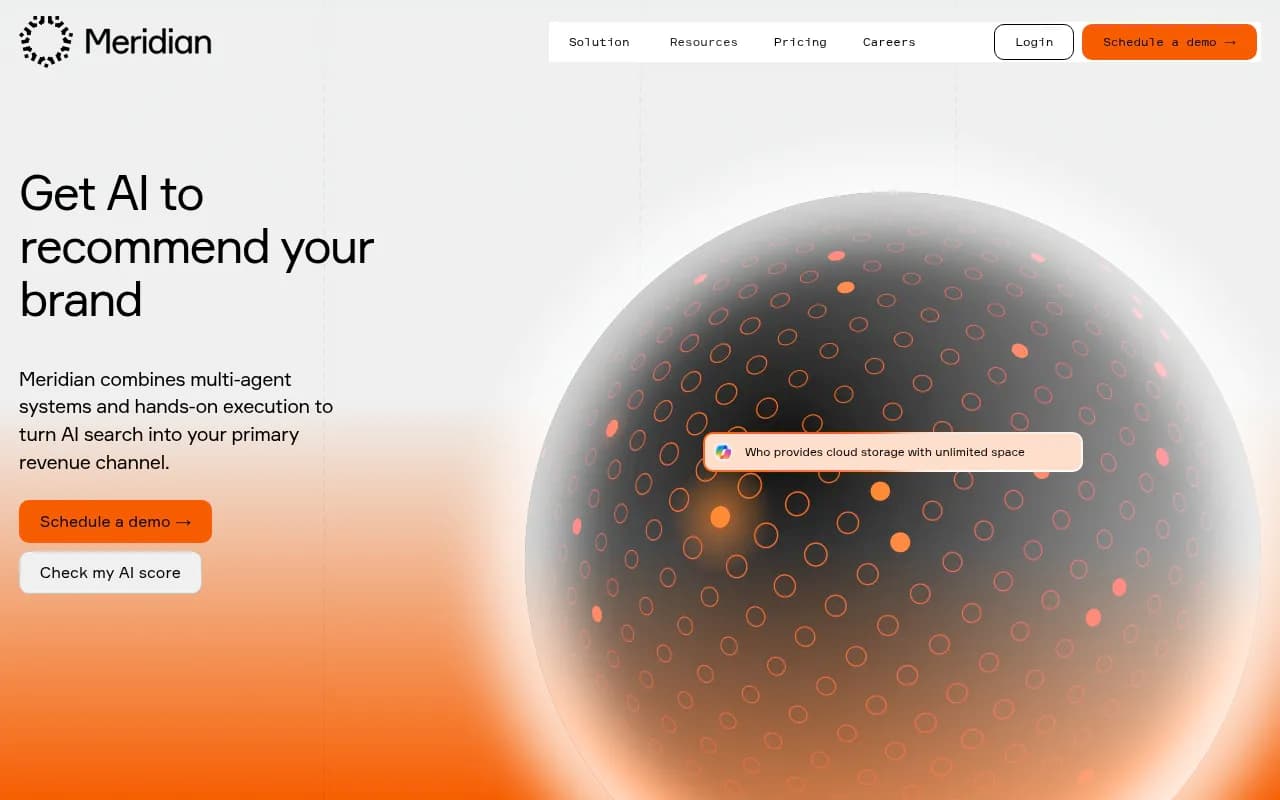
Meridian (trymeridian.com) is a generative engine optimization platform that takes an unusual angle in a crowded space: it doesn't just give you a dashboard and leave you to figure out what to do with it. The pitch is "expert-led, agent-powered" -- meaning you get both a software layer that monitors your AI search visibility and a team of human specialists who actually execute the strategy. That combination is genuinely rare. Most GEO tools are pure SaaS; Meridian is closer to a managed service with software baked in.
The platform targets brands that want to show up when people ask ChatGPT, Perplexity, or Google AI questions like "best payment processors for startups" or "most popular gyms in London." It tracks visibility scores, sentiment, and competitive position across those queries, then helps teams close the gaps through content creation, technical fixes, and AI shopping optimization. The customer list includes a mix of DTC brands (APL, Hanacure, Toniiq), SaaS companies (Intelligems), and agencies -- suggesting it works across verticals rather than being narrowly specialized.
Meridian appears to be a relatively young company; the website domain and content structure suggest it launched sometime in 2024-2025. There's no public funding information available, and pricing is gated behind a demo request, which is typical of managed-service-oriented platforms targeting mid-market and enterprise buyers.
Key features
Multi-model AI visibility monitoring Meridian tracks brand mentions and recommendations across nine AI platforms: ChatGPT, Perplexity, Google Gemini, Google AI Overviews, Claude, Meta AI, Grok, DeepSeek, and Microsoft Copilot. For each tracked prompt, you see a visibility score (0-100), sentiment score, and competitive position ranking. The demo UI shows prompts in multiple languages -- Japanese, Arabic, Spanish, German -- which suggests genuine multi-language support rather than English-only monitoring.
Sentiment analysis Each prompt response gets a sentiment score alongside the visibility metric. This matters because being mentioned isn't the same as being recommended positively. A brand could appear in an AI response as a cautionary example or a lower-ranked option. Meridian surfaces this distinction, though the depth of sentiment breakdown (e.g., which specific attributes drive positive vs. negative framing) isn't fully detailed in public materials.
Competitive benchmarking The platform shows your brand's position relative to competitors for each tracked prompt. The demo examples show position rankings like "#1", "#2", "#12" alongside delta indicators showing movement over time. This gives teams a clear picture of where they're winning and where competitors are outranking them in AI responses.
Opportunity identification with multi-agent discovery Meridian uses what it calls "multi-agent discovery" to find visibility gaps -- prompts and topics where competitors appear but your brand doesn't. This is similar in concept to answer gap analysis, but the execution here leans on the expert team to turn those findings into a prioritized action plan rather than surfacing raw data for users to interpret themselves.
Content creation pipeline One of Meridian's more concrete differentiators is that it doesn't just identify content gaps -- it produces the content. The platform combines "experts + agentic workflows" to build content pipelines targeting the specific prompts where visibility is low. Case studies on the site reference outcomes like "4x revenue growth from ChatGPT leads" and moving a travel brand "from never mentioned to the default recommendation in AI travel planning." The content creation is positioned as an ongoing production system, not a one-time audit.
AI shopping tracking and optimization Meridian tracks which product SKUs appear in ChatGPT's shopping recommendations and AI product carousels. When products are missing, the team deploys agents to fix the underlying issues: PDP (product detail page) upgrades, feed and schema fixes, and "best-of" placements. This is a specific capability that matters a lot for e-commerce brands -- and it's reflected in the customer list, which includes several DTC and Shopify merchants.
Forward-deployed expert team This is the feature that most distinguishes Meridian from pure-software GEO tools. Rather than giving you a dashboard and a knowledge base, Meridian assigns human experts who work directly with your team. The described workflow involves weekly execution: publishing content, improving authority signals, tracking ranking lifts, and continuously testing new growth loops. For teams without in-house GEO expertise, this is genuinely valuable. For teams that want full control and transparency over the process, it may feel like a black box.
ROI reporting Meridian ties its work to business outcomes rather than just visibility metrics. The reporting layer connects AI mentions, referral traffic, and product placements to revenue influence. The UI shown on the site tracks metrics like "AI Mentions +56%", "Referrals +34%", and "Product Placements 8.7/10" -- suggesting an attempt to bridge the gap between AI visibility and actual pipeline impact.
Who is it for
Meridian's sweet spot is mid-market brands with real revenue at stake from AI search but without a dedicated in-house GEO team. Think a DTC health and wellness brand doing $5-50M in revenue that's starting to see ChatGPT drive meaningful referral traffic and wants to systematically capture more of it. Or a SaaS company with 20-100 employees that competes in a crowded category where AI recommendations are increasingly influencing trial signups. The managed-service model means you don't need to hire an AI search specialist -- Meridian's team fills that role.
The platform also makes sense for digital agencies that want to offer GEO as a service to clients. The case study featuring a 20-person agency achieving "4x revenue growth from ChatGPT leads" suggests Meridian has thought about the agency use case, though it's not as explicitly positioned as an agency platform compared to some competitors.
Who should probably look elsewhere: teams that want full self-serve access to raw data, prompt-level analytics, and the ability to run their own experiments without waiting on a managed service cadence. Developers or data-heavy marketing teams who want API access, custom dashboards, or deep integration with their own analytics stack will likely find Meridian's approach too opaque. Similarly, very early-stage startups with tight budgets will struggle with the lack of transparent pricing and the likely cost of a managed service model.
Integrations and ecosystem
Meridian's public materials don't detail a specific integration catalog, which is a gap worth noting. There's no mention of Google Search Console integration, Looker Studio connectors, Zapier support, or API access in the scraped content. Given the managed-service orientation, it's possible that reporting is delivered through custom dashboards or regular reports rather than native integrations.
The platform does appear to support multi-language and multi-region monitoring based on the demo UI, which shows prompts in Japanese, Arabic, Spanish, and German alongside English. This is practically useful for brands operating across multiple markets.
No browser extension or mobile app is mentioned. The product appears to be entirely web-based, accessed through a dashboard that the expert team also uses to manage client work.
Pricing and value
Meridian does not publish pricing on its website. Access requires scheduling a demo, which is a common pattern for managed-service platforms targeting mid-market and enterprise buyers. The Terms and Conditions page references "then-current standard rates" for renewals, confirming it's a subscription model, but no tier names or price points are publicly available.
This opacity is a real friction point for buyers doing initial research. Without knowing whether Meridian starts at $500/month or $5,000/month, it's impossible to assess value relative to alternatives. For comparison, Promptwatch publishes clear pricing starting at $99/month for self-serve access, which makes the evaluation process much faster for budget-conscious teams.
The managed-service component likely means Meridian's effective cost is higher than pure-software GEO tools -- you're paying for both the platform and the expert time. Whether that's good value depends entirely on whether your team has the bandwidth and expertise to execute GEO work independently. If you don't, the all-in cost of Meridian might actually be lower than hiring a specialist or agency separately.
Strengths and limitations
What Meridian does well:
- The managed-service model is genuinely differentiated. Most GEO tools give you data and leave you to act on it. Meridian ships the work, which matters for teams without in-house expertise.
- AI shopping optimization is a specific, concrete capability that e-commerce brands need and that many competitors don't address at this level of detail.
- Multi-language monitoring across nine AI models is solid coverage for brands operating internationally.
- The case studies, while limited in number, reference specific outcomes (4x revenue growth, moving from unranked to default recommendation) rather than vague "improved visibility" claims.
Honest limitations:
- No AI crawler logs. Meridian doesn't appear to offer visibility into which AI crawlers are hitting your site, how often, or what errors they encounter. This is a meaningful gap for technical teams who want to understand how AI models discover and index their content. Promptwatch offers this natively.
- No prompt volume or difficulty scoring. There's no indication that Meridian surfaces data on how often specific prompts are asked or how competitive they are to rank for. This makes it harder to prioritize which gaps to close first. Promptwatch's prompt intelligence layer includes volume estimates and difficulty scores.
- No Reddit or YouTube tracking. AI models frequently cite Reddit threads and YouTube content in their responses. Meridian doesn't appear to track which of these third-party sources are influencing AI recommendations about your brand -- a blind spot that Promptwatch addresses directly.
- No page-level citation tracking. Knowing which specific pages on your site are being cited by which AI models is important for understanding what's working. This granularity isn't mentioned in Meridian's feature set.
- Pricing opacity creates friction. Not publishing pricing makes it harder for buyers to self-qualify and slows down the evaluation process.
- The managed-service model, while valuable for some, means less direct control and transparency for teams that want to run their own experiments or access raw data.
Bottom line
Meridian is a reasonable choice for mid-market brands that want a hands-on partner to manage their AI search visibility rather than a self-serve analytics tool. The combination of monitoring, content creation, and AI shopping optimization -- delivered by a team that executes the work weekly -- fills a real gap for companies without in-house GEO expertise.
That said, teams that want full data transparency, self-serve access to prompt analytics, AI crawler logs, Reddit/YouTube citation tracking, and page-level visibility data will find Promptwatch a more complete platform. Meridian is a managed service with software; Promptwatch is an optimization platform that gives you the tools to act independently. The right choice depends on whether you want to own the work or outsource it.
Best for: Mid-market DTC and SaaS brands that want an agency-style partner to own their AI search visibility end-to-end, without needing to build internal GEO expertise.
Frequently asked questions
Similar and alternative tools to Meridian