AccuRanker Review 2026
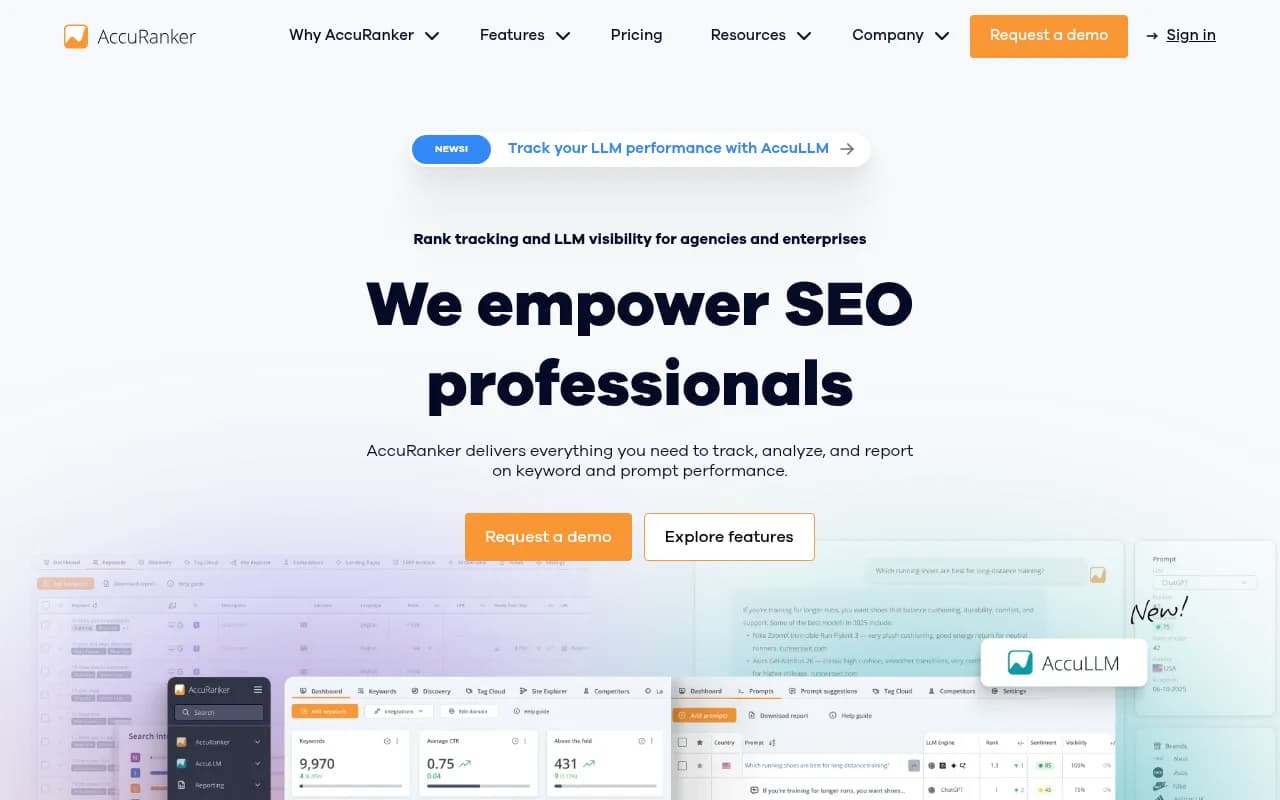
AccuRanker is a professional rank tracker for SEO agencies and enterprises, offering real-time keyword tracking, competitor analysis, AI-powered insights, and LLM visibility monitoring via AccuLLM. Trusted by Farfetch, CARFAX, and Groupon since 2013.
Key takeaways
- AccuRanker is one of the most established rank trackers on the market, with a strong reputation for speed and data accuracy since 2013.
- It now includes AccuLLM, a new module for tracking brand visibility in AI search engines like ChatGPT, Perplexity, and Google AI Overviews -- making it a partial Promptwatch competitor.
- AccuLLM is monitoring-only: it lacks content gap analysis, AI content generation, AI crawler logs, traffic attribution, Reddit/YouTube tracking, ChatGPT Shopping monitoring, and prompt volume/difficulty scoring that Promptwatch provides.
- Best suited for SEO agencies and enterprise teams that need serious keyword rank tracking at scale -- AccuRanker's core product remains best-in-class for traditional SERP tracking.
- Pricing is keyword-volume based and can get expensive at scale; no permanent free tier.
AccuRanker launched in 2013 out of Denmark and has spent over a decade building what many SEO professionals consider the gold standard for keyword rank tracking. The pitch is simple: faster data, more accurate rankings, and an interface that doesn't make you want to close the tab. It's used by agencies like Croud and Overdose, and enterprise brands including Farfetch, CARFAX, and Groupon -- which tells you something about where it sits in the market. This isn't a tool for bloggers tracking 20 keywords; it's built for operations managing thousands of keywords across multiple clients or domains.
More recently, AccuRanker has moved into AI search visibility with a new feature called AccuLLM, which tracks how brands appear in responses from ChatGPT, Perplexity, Google AI Overviews, and Google AI Mode. This is a meaningful expansion, though as we'll get into, it's still early-stage compared to dedicated GEO platforms. The core product -- rank tracking -- remains the main reason people pay for AccuRanker, and that's where it genuinely earns its reputation.
Key features
Real-time rank tracking
AccuRanker's headline claim is speed, and it's not just marketing. The platform offers on-demand rank refreshes, meaning you don't have to wait for a scheduled crawl to see where a keyword stands. For agencies managing time-sensitive campaigns or clients who want answers now, this matters. Rankings update daily by default, but you can trigger manual refreshes at any time. The system tracks rankings across Google and Bing, with support for local, mobile, and desktop results. You can track at the city or zip code level, which is useful for local SEO work.
50+ filters and segmentation
One of AccuRanker's practical strengths is how much you can slice and dice your keyword data. You can filter by search volume, ranking position, SERP features, tags, landing pages, competitors, and more. Tags let you group keywords into logical buckets (by topic, campaign, page type, etc.) and then analyze or report on those groups independently. For agencies managing large keyword sets across multiple clients, this kind of organization is what separates a usable tool from a chaotic spreadsheet.
Competitor tracking
AccuRanker lets you track competitor rankings at the domain, URL, and product level. You can add competitors to any domain and see how their rankings shift over time relative to yours. The competitor insights dashboard shows share of voice comparisons, which is a more meaningful metric than raw position for understanding competitive dynamics. You can track up to 10 competitors per domain depending on your plan.
AccuRanker Intelligence (AI models)
This is AccuRanker's proprietary AI layer, which generates metrics like "Share of Voice" (a weighted visibility score based on click-through rate curves), search intent classification, and landing page recommendations. The intent classification automatically tags keywords as informational, navigational, commercial, or transactional -- useful for prioritizing content strategy without manual tagging. These aren't groundbreaking features in 2026, but they're well-implemented and integrated directly into the workflow rather than bolted on.
Keyword database and research
Beyond tracking keywords you already know about, AccuRanker includes a keyword database for discovering new opportunities. You can analyze any domain to see what keywords it ranks for, find gaps, and add promising terms directly to your tracking list. It's not as deep as a dedicated keyword research tool like Ahrefs or Semrush, but it's useful for keeping research and tracking in the same platform.
Forecasting
AccuRanker's forecasting module lets you model the traffic and revenue impact of ranking improvements. You input assumptions about click-through rates and conversion values, and the tool projects what moving from position 8 to position 3 on a given keyword would mean in business terms. This is genuinely useful for SEO teams that need to justify budget or communicate value to clients and stakeholders who don't speak "keyword rankings."
AccuLLM (LLM visibility tracking)
This is the newest and most strategically interesting addition. AccuLLM monitors how your brand appears in AI-generated responses from ChatGPT, Perplexity, Google AI Overviews, and Google AI Mode. You can track visibility across prompts, monitor sentiment in AI responses, see which sources are being cited, and compare your performance against competitors. It's a real feature, not just a checkbox -- but it's also clearly a monitoring dashboard at this stage. There's no content gap analysis, no AI writing agent, no crawler logs showing which AI bots are hitting your site, and no traffic attribution connecting AI visibility to actual sessions or revenue. For teams that want to understand their AI search presence and take action on it, that's a significant gap.
Reporting and white-labeling
AccuRanker has solid reporting capabilities, including scheduled reports, PDF exports, and white-label options for agencies. You can build custom dashboards and share them with clients via a read-only link, which avoids the awkward "let me export this to a PDF" dance. The reporting interface is clean and the data is presented in a way that non-SEO clients can actually understand.
Unlimited users and domains
Unlike some competitors that charge per seat or per domain, AccuRanker's pricing is based on keyword volume. You get unlimited users, unlimited domains, and unlimited API calls on all plans. For agencies with large teams or many client sites, this is a meaningful cost advantage.
Who is it for
AccuRanker's sweet spot is SEO agencies managing multiple client accounts with large keyword sets. An agency tracking 500-5,000 keywords per client across 10-30 clients will find the organizational features (tags, groups, filters, white-label reporting) genuinely useful. The unlimited users and domains model means you're not penalized for growing your team or client roster -- you just pay more as your keyword volume grows.
Enterprise in-house SEO teams are the other natural fit. Companies like Farfetch or CARFAX (both listed as customers) have complex SEO operations with thousands of tracked keywords, multiple regional sites, and stakeholders who need regular reporting. AccuRanker's speed and data reliability make it defensible in those environments where a ranking discrepancy can trigger uncomfortable questions.
Freelance SEO consultants can use AccuRanker, but the pricing model may not work well at the lower end. If you're tracking fewer than 1,000 keywords across a handful of clients, there are cheaper options. AccuRanker is priced for volume, and the value proposition improves as keyword counts grow.
Who should probably look elsewhere: bloggers and content creators tracking a small number of keywords, teams that primarily need keyword research rather than tracking, and anyone whose main priority right now is AI search visibility optimization rather than traditional SERP tracking. For that last group, AccuLLM is a start, but it's not yet a complete solution.
Integrations and ecosystem
AccuRanker integrates with Google Search Console and Google Analytics, which are the two most important connections for any rank tracker. The GSC integration lets you pull in impression and click data alongside ranking data, giving you a more complete picture of search performance.
Beyond Google's tools, AccuRanker connects with Google Data Studio (Looker Studio) for custom reporting, and there are integrations with tools like Databox and AgencyAnalytics for agencies that centralize reporting. The platform has a full API with unlimited calls on all plans, which is useful for teams that want to pull ranking data into their own dashboards or automate workflows. The n8n integration (visible in third-party directories) suggests it can be connected to broader automation workflows.
There's no native Slack integration for rank change alerts, which is a minor gap for teams that live in Slack. Some competitors handle this better. Mobile apps are not a focus -- AccuRanker is primarily a desktop web application, which is fine for the professional use case but worth knowing.
Pricing and value
AccuRanker uses a keyword-volume-based pricing model with monthly and annual billing options. Annual billing comes with a 10% discount. The plans scale based on the number of keywords tracked, starting from around 1,000 keywords at the entry level and going up to enterprise volumes. Specific tier prices aren't published in a simple table on the site -- you need to use their pricing calculator or request a demo for larger volumes -- but the entry-level plans start in the range of $129-$199/month for 1,000 keywords.
There's a free trial available (no credit card required based on standard practice for the tool), but no permanent free tier. This is a paid professional tool.
Compared to alternatives: Semrush and Ahrefs bundle rank tracking with much broader toolsets (backlink analysis, site audits, content tools) at similar or higher price points, but AccuRanker is often faster and more accurate for pure rank tracking. SERPWatcher and SE Ranking are cheaper but less capable at scale. For agencies that already have Ahrefs or Semrush and want a dedicated rank tracker that's faster and more reliable, AccuRanker is a common upgrade.
The unlimited users and API calls model is genuinely good value for agencies. You're not paying per seat, which adds up fast with other tools.
Strengths and limitations
Where AccuRanker does well:
- Speed and data freshness: The on-demand refresh capability is a real differentiator. When a client calls asking why their rankings dropped, you can get current data immediately rather than waiting for the next scheduled crawl.
- Organizational depth: Tags, filters, groups, and the ability to segment thousands of keywords without the interface falling apart is something AccuRanker handles better than most competitors.
- Unlimited users and API: For agencies, not paying per seat is a meaningful cost advantage over tools like Semrush.
- Reporting quality: White-label reports and shareable dashboards are polished and client-ready without much customization work.
- Track record: Twelve years in the market with enterprise clients like Farfetch and CARFAX is a credibility signal that newer tools can't match.
Honest limitations:
- AccuLLM is monitoring-only: The new AI visibility module shows you data but doesn't help you act on it. There's no content gap analysis to show which prompts competitors rank for that you don't, no AI writing agent to create content that gets cited, no AI crawler logs to see which bots are visiting your site, and no traffic attribution to connect AI visibility to actual revenue. Platforms like Promptwatch are purpose-built for this and go significantly further.

- Not a full SEO suite: AccuRanker doesn't do backlink analysis, technical site audits, or deep keyword research. Teams that need those capabilities will still need Ahrefs, Semrush, or Screaming Frog alongside it.
- Pricing at low volumes: The keyword-volume model works well at scale but can feel expensive if you're tracking fewer than 500 keywords. There are cheaper options for smaller operations.
Bottom line
AccuRanker is the right tool if your primary need is fast, accurate, large-scale keyword rank tracking with solid reporting for clients or stakeholders. It's been doing this longer than almost anyone, and the product shows it. Agencies managing 10+ clients with thousands of keywords each will find it hard to beat on pure rank tracking quality.
If you're also trying to build a serious AI search visibility program -- understanding why AI models cite competitors instead of you, creating content that gets cited, and tracking the traffic impact -- AccuLLM is a starting point but not a complete solution. For that, you'd need to pair AccuRanker with a dedicated GEO platform like Promptwatch, or reconsider whether a monitoring-only AI module meets your needs.
Best for: SEO agencies and enterprise teams that need reliable, fast, large-scale keyword rank tracking with strong reporting capabilities.
Frequently asked questions
Similar and alternative tools to AccuRanker