Vismore Review 2026
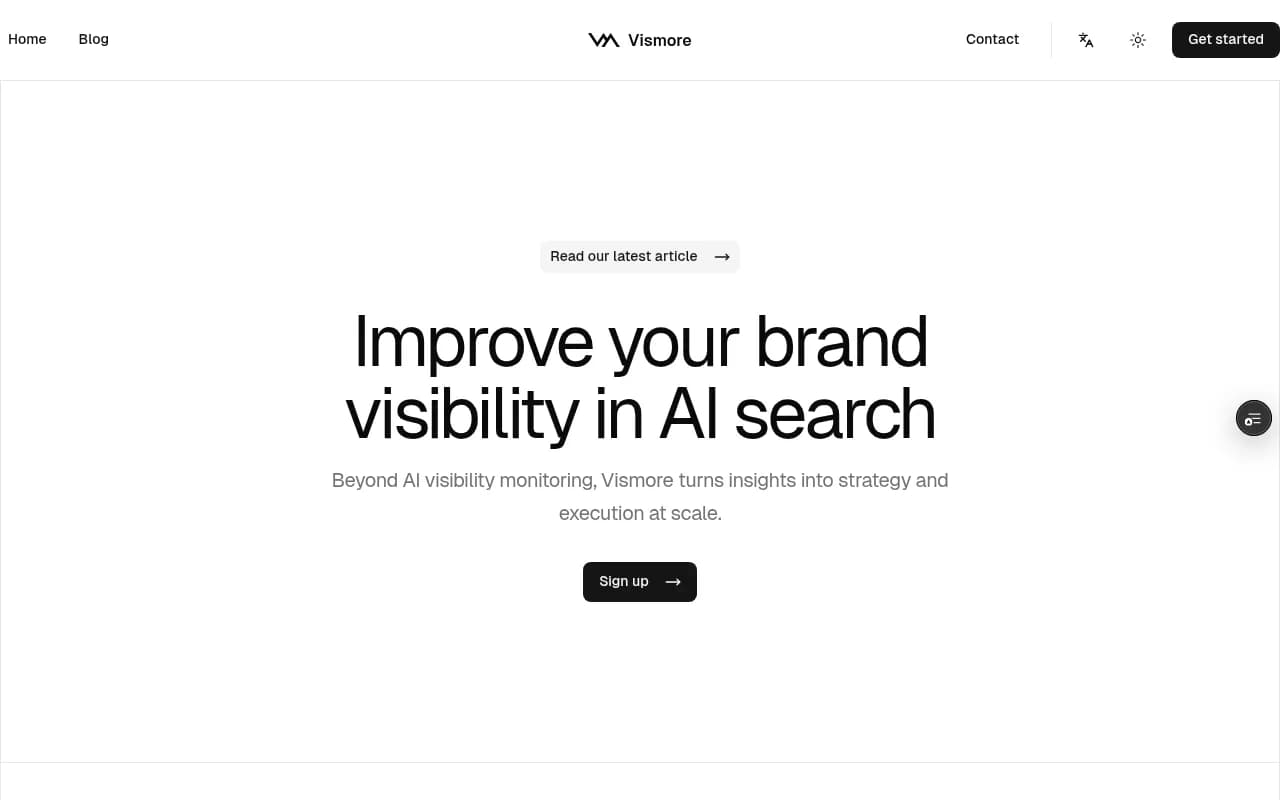
Vismore is an AI Engine Optimization (AEO) platform that goes beyond monitoring to help brands improve visibility in ChatGPT, Gemini, and Perplexity. It identifies high-value opportunities, generates actionable content strategies, and enables one-click publishing to Reddit, Medium, LinkedIn, and oth
Key takeaways
- Action-focused platform: Unlike monitoring-only tools, Vismore generates 30+ executable actions with ready-to-post content for high-authority channels like Reddit, Medium, LinkedIn, Quora, and Indie Hackers
- Lacks critical optimization features: No content gap analysis, AI crawler logs, traffic attribution, or AI writing agent that Promptwatch offers -- Vismore focuses on distribution strategy rather than comprehensive optimization
- Limited model coverage: Monitors 5+ AI platforms (ChatGPT, Gemini, Perplexity mentioned) vs Promptwatch's 10+ models including Claude, Meta AI, DeepSeek, Grok, Mistral, and Copilot
- Best for: Brands that want distribution guidance and publishing workflows but already have content creation handled internally

Vismore positions itself as an AI Engine Optimization platform that moves beyond passive monitoring. The pitch is straightforward: most AEO tools show you where you're invisible in AI search results, but Vismore tells you what to do about it. The platform targets marketing teams and agencies that want to improve brand visibility in ChatGPT, Gemini, and Perplexity without getting stuck in analysis paralysis.
The company's core argument is that monitoring alone doesn't solve the problem. You need strategy and execution. Vismore claims to deliver both by identifying opportunities, recommending which prompts to target, and generating content you can publish directly to high-authority channels. The platform launched in 2025 and is positioning itself as an execution-first alternative to tracking-only competitors.
Key features
Baseline visibility tracking: Vismore monitors where AI models mention your brand today, where competitors appear instead, and how that gap changes over time. You get trend graphs showing your mention rate across AI platforms and competitor comparison views. The dashboard shows your current AI visibility percentage and tracks movement over time. This is table stakes for any AEO platform -- the real question is what you do with the data.
Opportunity identification and prioritization: The platform analyzes what people ask AI most frequently and scores opportunities based on search volume and difficulty. You see a ranked list of prompts with recommendations on which ones to target first. Vismore claims to identify 200+ opportunities per brand on average. The scoring helps you focus on winnable battles rather than chasing every possible query. However, the methodology behind these scores isn't transparent -- you're trusting Vismore's algorithm without seeing the underlying data.
30+ generated actions: This is where Vismore differentiates itself. For each opportunity, the platform generates specific actions -- what content to create, where to publish it, and draft content you can use. The actions target high-authority channels that AI models frequently cite: Reddit threads, Medium articles, LinkedIn posts, Quora answers, and Indie Hackers discussions. The content is supposedly tailored to each platform's format and audience. In practice, the quality of these drafts varies. They're starting points, not finished pieces.
One-click publishing: Vismore integrates directly with Reddit, Medium, LinkedIn, Quora, and Indie Hackers. You can review the generated content, make edits, and publish without leaving the platform. This workflow integration is genuinely useful if you're managing campaigns across multiple channels. It saves the copy-paste dance and keeps everything in one place. The catch: you're limited to the channels Vismore supports. If your audience lives on Twitter, YouTube, or niche forums, you're back to manual publishing.
Multi-platform AI monitoring: Vismore tracks visibility across ChatGPT, Gemini, Perplexity, and claims "5+ AI search platforms covered." The exact list isn't specified, but it's notably smaller than competitors like Promptwatch that monitor 10+ models including Claude, Meta AI, DeepSeek, Grok, Mistral, and Copilot. Missing models means missing data on where your brand appears (or doesn't) in a significant portion of AI search traffic.
Competitor benchmarking: You can compare your AI visibility against competitors and see which prompts they're winning. The platform shows competitor mention rates and identifies gaps where they appear but you don't. This is useful for understanding the competitive landscape, but it's a feature most AEO platforms offer. The real differentiator would be showing you exactly what content competitors published to earn those mentions -- Vismore doesn't surface that level of detail.
Dual-edge evaluation model: Vismore mentions this in testimonials but doesn't explain it clearly on the site. It appears to be their methodology for scoring both content opportunities (what to create) and question opportunities (what prompts to target). The lack of transparency here is frustrating. You're making strategic decisions based on Vismore's recommendations without understanding how they're calculated.
Who is it for
Vismore is built for marketing teams at mid-sized companies (50-500 employees) that have budget for AI visibility but lack the time or expertise to manually research opportunities and create content for every channel. If you're a SaaS company trying to get mentioned in ChatGPT when users ask for tool recommendations, or an e-commerce brand wanting to appear in Perplexity shopping queries, Vismore gives you a starting point.
The platform works best for teams that already have content creators on staff. Vismore generates drafts and suggests topics, but you'll need someone to review, refine, and adapt the content to your brand voice. It's not a hands-off solution. You're trading research time for editing time.
Agencies managing AI visibility for multiple clients could use Vismore to scale their operations. The one-click publishing and multi-brand tracking make it easier to manage campaigns across client portfolios. However, the lack of white-label reporting and API access limits how agencies can integrate Vismore into their existing workflows.
Who should skip Vismore: Teams that need deep optimization capabilities beyond distribution strategy. If you want to understand how AI crawlers interact with your site, track which specific pages get cited, or generate content grounded in 880M+ citations like Promptwatch offers, Vismore doesn't provide those tools. It's focused on the publishing side, not the technical optimization side.
Integrations and ecosystem
Vismore integrates directly with Reddit, Medium, LinkedIn, Quora, and Indie Hackers for one-click publishing. These are the core channels the platform supports. You connect your accounts once, then publish from within Vismore's interface.
There's no mention of API access, webhooks, or developer tools. You can't export data to other platforms or build custom workflows. For teams that want to integrate AEO data into their existing marketing stack (CRM, analytics, reporting tools), this is a significant limitation.
No Looker Studio, Google Search Console, or Google Analytics integrations are mentioned. You can't correlate AI visibility with actual website traffic or conversions. This makes it hard to prove ROI or understand whether increased AI mentions translate to business results.
The platform offers a Discord community for users, which is useful for getting support and sharing strategies with other brands working on AI visibility.
Pricing and value
Vismore's pricing isn't publicly listed on their website. The site mentions "free to get started" but doesn't specify what the free tier includes or what paid plans cost. This is frustrating for buyers trying to evaluate options.
Based on their positioning and feature set, Vismore likely prices somewhere between basic monitoring tools ($50-150/mo) and comprehensive platforms like Promptwatch ($99-579/mo). The lack of transparency suggests they're using a sales-led model where pricing varies by company size and needs.
Without knowing the actual cost, it's hard to assess value. If Vismore charges $200+/mo, you're paying a premium for publishing integrations and action generation. At that price point, you could get more comprehensive optimization tools elsewhere and handle publishing manually. If they're priced under $150/mo, the convenience of integrated publishing might justify the feature gaps.
The "free to get started" claim suggests a freemium model or free trial, but the details aren't clear. Most AEO platforms offer 7-14 day trials -- Vismore should be transparent about what you get for free and for how long.
Strengths and limitations
Vismore's core strength is turning monitoring data into executable actions. Most AEO platforms stop at showing you the problem. Vismore generates specific content recommendations and provides publishing workflows to act on them. For teams that struggle with the "now what?" question after seeing their AI visibility gaps, this is genuinely helpful.
The one-click publishing to multiple high-authority channels is a real time-saver. Managing Reddit threads, Medium articles, LinkedIn posts, and Quora answers across separate platforms is tedious. Vismore centralizes that workflow. If you're running multi-channel campaigns to improve AI visibility, the convenience is worth something.
The opportunity prioritization helps you focus. Instead of trying to optimize for every possible prompt, Vismore tells you which ones are worth targeting based on volume and difficulty. This prevents wasted effort on low-value queries.
Now the limitations. Vismore lacks the optimization depth that Promptwatch provides:
-
No content gap analysis: Vismore doesn't show you exactly which topics, angles, and questions AI models want answers to but can't find on your site. You get action recommendations, but not the underlying gap analysis that explains why you're invisible.
-
No AI crawler logs: You can't see which AI models are crawling your site, which pages they're reading, or errors they encounter. This makes it impossible to diagnose indexing issues or understand how AI engines discover your content.
-
No traffic attribution: Vismore doesn't track whether increased AI visibility translates to actual website visitors or conversions. You're optimizing blind without knowing if it's working.
-
No AI writing agent: The generated content is basic drafts, not content engineered to get cited by AI models based on 880M+ citations analyzed. You're getting generic suggestions, not data-driven optimization.
-
Limited model coverage: Monitoring 5+ AI platforms vs Promptwatch's 10+ means you're missing visibility data from Claude, Meta AI, DeepSeek, Grok, Mistral, and Copilot. That's a significant blind spot.
-
No Reddit or YouTube tracking: Vismore helps you publish to Reddit but doesn't surface existing Reddit discussions or YouTube videos that influence AI recommendations. You're missing a major source of citation data.
-
No prompt intelligence: No volume estimates, difficulty scores based on real data, or query fan-outs showing how prompts branch into sub-queries. You're trusting Vismore's recommendations without seeing the underlying metrics.
The platform also lacks transparency around pricing, methodology, and data sources. You're making strategic decisions based on Vismore's black-box recommendations without understanding how they're calculated or what data they're based on.
Bottom line
Vismore is a distribution-focused AEO platform that helps you publish content to high-authority channels after identifying opportunities. If you already have strong content creation capabilities and just need help with channel strategy and publishing workflows, Vismore provides value. The one-click publishing and action generation save time.
But if you want comprehensive AI visibility optimization -- understanding how AI crawlers interact with your site, tracking which pages get cited, generating content grounded in citation data, and measuring actual traffic impact -- Promptwatch is the stronger choice. Vismore is a publishing tool with monitoring capabilities. Promptwatch is an optimization platform that helps you fix the root causes of AI invisibility, not just distribute content hoping it works.
Best use case: Mid-sized marketing teams that need distribution guidance and publishing automation but already have content strategy and creation handled internally.
Frequently asked questions
Similar and alternative tools to Vismore