Mangools Review 2026
Mangools is an affordable, beginner-friendly SEO suite with five integrated tools — KWFinder, SERPChecker, SERPWatcher, LinkMiner, and SiteProfiler — plus an AI search visibility monitor. Starting at $29/mo, it's built for freelancers, bloggers, and small teams.
Key takeaways
- Mangools is a five-tool SEO suite (KWFinder, SERPChecker, SERPWatcher, LinkMiner, SiteProfiler) built around simplicity and affordability, starting at $29/month annually
- Strong choice for freelancers, bloggers, and small marketing teams who find Ahrefs or Semrush overwhelming or overpriced
- The new AI Search Watcher adds basic LLM visibility monitoring, but it's a monitoring-only add-on with no content gap analysis, AI content generation, crawler logs, or traffic attribution — capabilities that Promptwatch provides as a full optimization platform
- 2.5 billion keywords in the database, 9.5 trillion backlinks indexed, and 65,000+ city-level locations for local SEO tracking
- Free tools (SERP Simulator, Reddit Threads Finder, AI Search Grader) are genuinely useful and require no sign-up
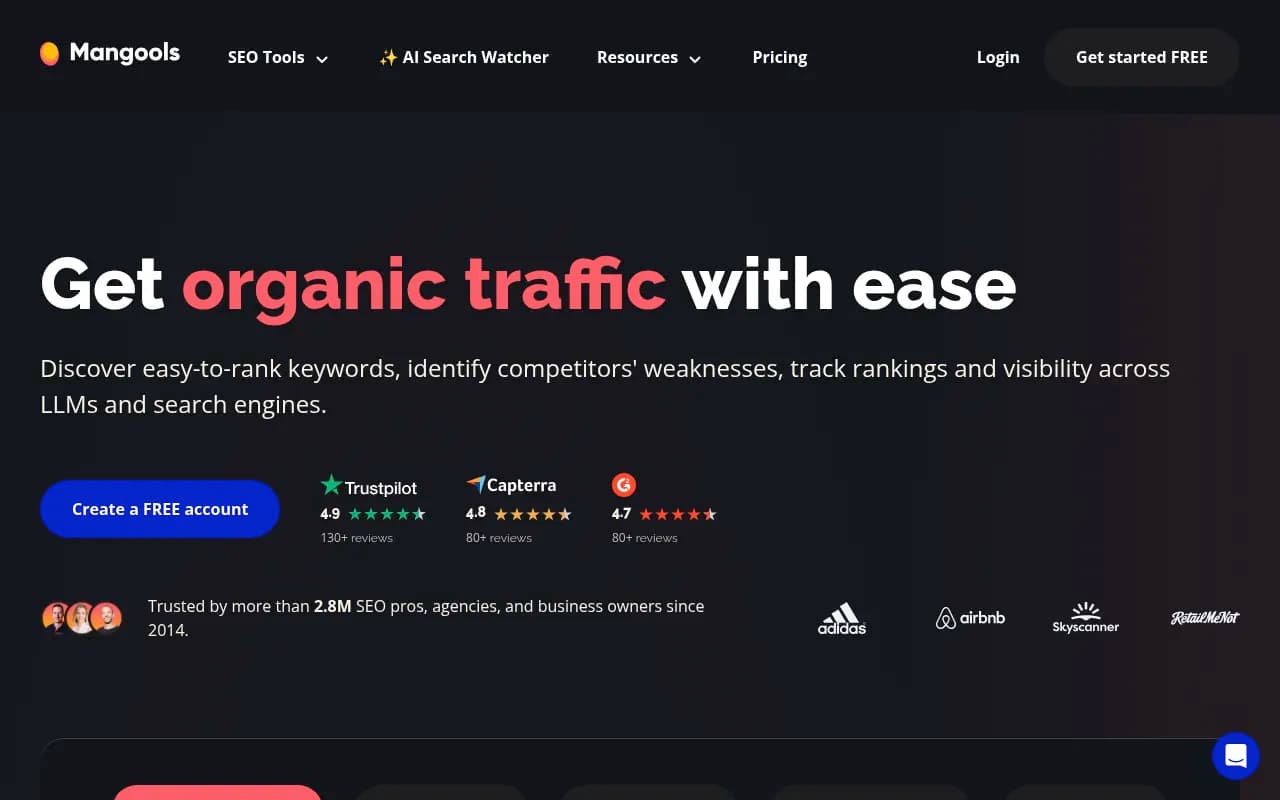
Mangools has been around since 2014, built by a small Slovak team that wanted to make SEO accessible without the enterprise price tag. The pitch is simple: you get five tightly integrated tools that cover the core SEO workflow, wrapped in a UI that doesn't require a 40-hour onboarding course to navigate. Over the years it's attracted 2.8 million users, earned endorsements from names like Brian Dean (Backlinko) and Gael Breton (AuthorityHacker), and consistently rated well on G2 (4.7), Capterra (4.8), and Trustpilot (4.9).
The target audience is clearly not enterprise SEO teams running technical audits on 10,000-page sites. Mangools is for the freelance SEO consultant managing a handful of clients, the content marketer at a startup who needs keyword data without a $500/month bill, and the small agency that wants clean client reports without building custom dashboards. That positioning has served Mangools well — it competes on value and usability, not raw data depth.
In 2025-2026, Mangools added AI Search Watcher to its lineup, a response to the growing importance of LLM visibility. It's a notable addition, though as we'll cover, it's more of a monitoring dashboard than an optimization tool.
Key features
KWFinder — keyword research
KWFinder is the tool that put Mangools on the map. It pulls from a database of 2.5 billion keywords and surfaces keyword difficulty scores, search volume trends, CPC data, and SERP snapshots for any query. The interface is genuinely clean: you type a keyword, pick a location (down to city level across 65,000+ locations), and get a ranked list of related keywords with color-coded difficulty scores that are actually interpretable at a glance.
- Competitor keyword analysis lets you enter a domain and see what keywords it ranks for
- Bulk keyword analysis handles up to 700 keywords at once on higher plans
- Search volume trends show seasonality, which matters more than people admit
- The keyword difficulty score (KD) is Mangools' own metric — it correlates reasonably well with actual ranking difficulty, though like all KD scores it's a heuristic, not a guarantee
Compared to Ahrefs' Keywords Explorer, KWFinder has a smaller database and fewer filtering options, but it's faster to get a usable answer from. For someone who just needs to find 20 good keywords for a blog post, KWFinder is genuinely faster to use.
SERPChecker — SERP analysis
SERPChecker pulls real SERP snapshots and overlays 45+ SEO metrics on each result: domain authority, page authority, citation flow, trust flow, Facebook shares, backlink counts, and more. You can see at a glance how strong the competition is for any keyword in any location.
- Downloadable SERP snapshots let you compare SERPs over time
- SERP feature analysis shows which features (featured snippets, People Also Ask, shopping results) appear for a query
- CTR curve estimates help you understand what traffic share you'd realistically capture at each ranking position
This is one of the more underrated tools in the suite. Knowing a keyword has low difficulty is one thing; seeing that the top 3 results are all DR 80+ domains with thousands of backlinks tells a different story.
SERPWatcher — rank tracking
SERPWatcher tracks keyword rankings daily across any location, with a "Dominance Index" metric that weights your rankings by search volume and position to give a single performance score. It's a smart way to summarize ranking health without drowning in a spreadsheet.
- Google Search Console import syncs your existing keyword data
- Whitelabel reports let agencies send branded PDF or interactive reports to clients
- Looker Studio connector (added recently) enables custom dashboards
- Email alerts notify you when rankings change significantly
- Tracks unlimited domains on all plans, which is genuinely generous
The interactive shareable reports are a nice touch for agencies — clients can see live data without needing a Mangools login.
LinkMiner — backlink analysis
LinkMiner taps into a database of 9.5 trillion backlinks. The standout feature is the live website preview: you click a backlink and see a preview of the linking page with the anchor text highlighted, so you can evaluate link quality without opening 20 browser tabs.
- Advanced filtering by link type (dofollow/nofollow), domain authority, anchor text, and more
- Save link opportunities to lists for later outreach
- Competitor backlink analysis lets you find link sources your competitors have that you don't
The backlink database is smaller than Ahrefs' (which indexes over 30 trillion), but for most use cases — finding guest post opportunities, checking competitor link profiles, identifying broken link targets — it's more than adequate.
SiteProfiler — site analysis
SiteProfiler is the site-level overview tool: domain authority, backlink profile, top pages by traffic, popular content, and competitor comparison. It's not a full technical SEO auditor (no crawl, no Core Web Vitals, no structured data checks), but it gives you a quick read on any domain's authority and link profile.
- Authority Score, Citation Flow, Trust Flow, and Alexa Rank all in one view
- Top content by estimated traffic and backlinks
- Competitor comparison across up to 5 domains
AI Search Watcher — LLM visibility monitoring
This is Mangools' newest product, launched in response to the shift toward AI-generated search results. It monitors how your brand appears in responses from ChatGPT, Claude, Gemini, and three other LLMs (six total on the PRO plan). You set up prompts, and the tool checks whether your brand is mentioned in the AI responses.
- Unlimited monitors on all paid plans
- 500 prompts monitored on the PRO tier (bundled with SEO plans)
- Tracks mention rate, sentiment, and which LLMs mention you
- Free AI Search Grader tool gives a quick brand visibility snapshot without sign-up
The honest assessment: AI Search Watcher is a monitoring dashboard. It tells you whether you're being mentioned. It does not tell you why competitors are mentioned and you're not, does not generate content to close those gaps, does not show you AI crawler activity on your site, and does not connect LLM visibility to actual traffic or revenue. For teams that need to move from "we know we're invisible" to "here's what we're doing about it," this tool stops short.
Free tools
Mangools offers several genuinely useful free tools that require no account:
- SERP Simulator: preview how your title and meta description look in Google
- SERP Location Changer: check local search results for any location
- Reddit Threads Finder: surface top-ranking Reddit threads for any keyword niche
- SEO Content Optimizer: GSC-powered content improvement suggestions
- Share of Search: track branded search volume trends
- SERP Volatility Checker: monitor Google algorithm fluctuations
- Browser extension: overlay SEO metrics while browsing
The Reddit Threads Finder is a recent addition that's actually useful for content research — finding where your audience is already discussing topics you want to rank for.
Who is it for
Mangools fits best with independent SEO consultants, freelance content marketers, and small in-house marketing teams at companies with 1-50 employees. The typical user is someone who understands SEO well enough to know what keyword difficulty and domain authority mean, but doesn't need the full depth of Ahrefs' site audit or Semrush's content marketing platform. A blogger running a niche site, a local business owner learning SEO, or a freelancer managing 5-10 client sites — these are the people Mangools was built for.
Small agencies (5-15 person shops) also get value here, particularly from SERPWatcher's whitelabel reports and the multi-seat options on Premium and Agency plans. The Agency plan supports 5 extra seats and 1.5k tracked keywords, which covers a modest client roster without the $400+/month price tag of enterprise tools.
Industries where Mangools particularly shines: content publishing, affiliate marketing, local services businesses, e-commerce stores doing their own SEO, and SaaS companies at the early growth stage where every dollar of tooling spend matters.
Who should look elsewhere: enterprise SEO teams running technical audits on large sites (Mangools has no site crawler), agencies managing 50+ clients who need advanced workflow automation, and any team that needs deep AI search optimization rather than just monitoring. If your primary concern in 2026 is AI visibility — understanding why ChatGPT recommends competitors, generating content that gets cited by LLMs, or attributing AI-driven traffic to revenue — Mangools' AI Search Watcher is too limited for that job.
Integrations and ecosystem
Mangools' integration story is intentionally lean. The tools are designed to work together as a suite, not as components in a larger stack.
- Google Search Console: SERPWatcher imports GSC data to seed rank tracking with your existing keyword set
- Looker Studio: SERPWatcher has a native Looker Studio connector for custom reporting dashboards
- Browser extension: Available for Chrome and Firefox, overlays KWFinder and SiteProfiler data while browsing any website or SERP
- API: Mangools does not offer a public API for programmatic data access — a notable gap for developers or teams that want to pipe data into their own systems
- Export: CSV exports are available across tools, which covers most reporting needs
- Mobile: No dedicated mobile app; the web interface is responsive but not optimized for mobile workflows
The lack of an API is a real limitation for power users. If you want to pull keyword data into a spreadsheet automatically, run bulk analyses via script, or integrate Mangools data into a custom reporting tool, you can't. Ahrefs and Semrush both offer APIs (at higher price points). For most Mangools users this won't matter, but it's worth knowing.
Pricing and value
Mangools offers three main SEO plan tiers, with annual billing saving approximately 35%:
Mangools Basic — $29/month (annual)
- 100 keyword research requests/day, 200 keyword suggestions per request
- 100 SERP analysis requests/day
- 200 tracked keywords across unlimited domains
- 100k backlink rows/month
- 20 site analysis requests/day
- No extra seats
Mangools Premium — $44/month (annual)
- 500 keyword research requests/day, unlimited suggestions
- 500 SERP analysis requests/day
- 700 tracked keywords
- 500k backlink rows/month
- 70 site analysis requests/day
- 3 extra seats
Mangools Agency — $89/month (annual)
- 1,200 keyword research requests/day, unlimited suggestions
- 1,200 SERP analysis requests/day
- 1,500 tracked keywords
- 1.2M backlink rows/month
- 150 site analysis requests/day
- 5 extra seats
Monthly billing is available at higher rates. There's a 48-hour money-back guarantee (not a full free trial, though a free account with limited usage is available).
Mangools also offers bundled plans that include AI Search Watcher PRO:
- Basic + AI SW PRO: $37/month (annual)
- Premium + AI SW PRO: $52/month (annual)
- Agency + AI SW PRO: $97/month (annual)
AI Search Watcher is also available standalone starting at $15.60/month (annual) for 500 monitored prompts.
For comparison: Ahrefs starts at $129/month, Semrush at $139/month. Mangools Basic at $29/month is genuinely hard to beat for the feature set it delivers. The value proposition is real — you're not getting everything Ahrefs has, but you're getting 80% of what most users actually use at 22% of the price.
Strengths and limitations
What Mangools does well
- Usability: The UI is consistently praised and it's earned. Onboarding takes minutes, not days. The color-coded difficulty scores, clean data tables, and logical tool flow make it accessible to SEO beginners without feeling dumbed-down for experienced users.
- Pricing: At $29/month for the Basic plan, it's one of the most affordable complete SEO suites available. The value-to-cost ratio at this tier is hard to match.
- KWFinder's local keyword data: 65,000+ city-level locations is genuinely impressive and useful for local SEO work. Most tools at this price point offer country-level targeting at best.
- Whitelabel reporting: SERPWatcher's client-facing reports are clean and professional. For small agencies, this alone justifies the subscription.
- Free tools: The free mini-tools are actually useful, not just lead magnets. The SERP Simulator and Location Changer in particular get regular use from SEOs who aren't even Mangools subscribers.
Limitations
- No site crawler or technical SEO audit: Mangools has no crawl functionality. You can't find broken links, audit page speed, check structured data, or identify crawl errors. For technical SEO work, you'll need a separate tool (Screaming Frog, Sitebulb, etc.).
- AI Search Watcher is monitoring-only: The LLM visibility tool shows you whether you're mentioned in AI responses, but stops there. There's no content gap analysis to show what topics competitors rank for that you don't, no AI content generation to close those gaps, no crawler log analysis to see how AI bots interact with your site, and no traffic attribution to connect AI visibility to actual revenue. Teams serious about AI search optimization will find this insufficient compared to dedicated platforms like Promptwatch, which covers the full cycle from gap identification to content creation to traffic measurement.
- No API: The absence of a public API limits Mangools to manual workflows. Teams that want to automate data pulls, build custom integrations, or run bulk analyses programmatically are out of luck.
- Backlink database depth: At 9.5 trillion backlinks, the database is substantial but smaller than Ahrefs (30+ trillion). For competitive link analysis in high-authority niches, you may find gaps.
Bottom line
Mangools is the right tool for freelancers, bloggers, and small marketing teams who want a complete SEO workflow without paying enterprise prices or learning a complex platform. At $29/month, the Basic plan covers keyword research, rank tracking, SERP analysis, backlinks, and site profiling — everything most content-focused SEOs need day to day.
Where it falls short is in technical SEO depth and, increasingly, in AI search optimization. The AI Search Watcher is a reasonable first step into LLM monitoring, but it's a dashboard, not an optimization tool. If your team is trying to understand why competitors appear in ChatGPT answers and you don't, and you want to actually fix that, you'll need something more capable — Promptwatch is built specifically for that full optimization loop, from identifying content gaps to generating AI-optimized content to tracking the results.
Best use case: A freelance SEO or content marketer who needs reliable keyword research, rank tracking, and backlink data at an accessible price point, without the complexity of enterprise platforms.
Tags:
Frequently asked questions
Similar and alternative tools to Mangools