Summary
- AI search traffic to Shopify stores is up 7x in 2026 -- brands that optimize for AI-powered product recommendations are capturing a massive new channel while competitors are still focused on traditional SEO
- Product discovery has moved beyond Google -- ChatGPT, Perplexity, Claude, and Google AI Overviews now recommend products directly, and Shopify merchants need structured data, answer-ready content, and citation-worthy product pages to get included
- The gap between monitoring and action is critical -- most AI visibility tools only show you where you're missing, but platforms like Promptwatch help you close the gap with content generation, answer gap analysis, and optimization workflows
- Shopify's native search has limitations -- the 25-filter cap, weak multi-language support, and thin analytics mean most merchants need third-party solutions to compete in AI-driven discovery
- Answer-first strategy wins -- rewriting product pages, category pages, and policy pages into quote-ready answer blocks with clear specs, shipping details, and return policies makes your content citation-worthy for AI models
AI Search Is Rewriting Product Discovery
Something fundamental shifted in 2025. Shopify brands started seeing traffic from sources that didn't exist a year earlier: ChatGPT referrals, Perplexity citations, Claude recommendations. By early 2026, AI-driven traffic to Shopify stores had grown 7x year-over-year.
This isn't a trend. It's a platform shift.
When someone asks ChatGPT "best running shoes for flat feet under $150," they're not clicking through to Google. They're getting a curated list of products with links, prices, and reasons to buy -- right in the chat interface. If your Shopify store isn't optimized to be cited in that response, you're invisible.
The brands winning in this new landscape aren't just running better Google Ads. They're treating AI search engines as first-class discovery channels and optimizing their product pages, category descriptions, and content accordingly.
How AI Models Recommend Products (And What That Means for Shopify)
AI models don't crawl your site the same way Google does. They look for structured, citation-worthy information that answers specific questions. When a user asks "what's the best organic baby food delivery service," the AI needs:
- Clear product specifications (ingredients, certifications, packaging)
- Transparent pricing and shipping policies
- Customer reviews and social proof
- Comparison-friendly data (vs competitors)
- Answer-ready content blocks (not marketing fluff)
Most Shopify product pages are written for humans browsing a store. AI models need something different: structured answers they can quote directly.
The Answer-First Strategy
The most effective approach for Shopify brands in 2026 is rewriting key pages into answer blocks. Instead of:
"Our premium organic cotton t-shirts are crafted with care and designed for comfort."
Write:
Material: 100% GOTS-certified organic cotton, 180 GSM weight
Fit: True to size, pre-shrunk
Care: Machine wash cold, tumble dry low
Certifications: GOTS, Fair Trade, OEKO-TEX Standard 100
Return policy: 60-day returns, free return shipping
AI models can quote the second version. The first version gets ignored.
This applies to product pages, category pages, shipping policies, return policies, and FAQ pages. Audit your five highest-revenue pages and rewrite them into quote-ready answer blocks.
Where Shopify's Native Search Falls Short
Shopify rolled out mandatory Semantic Search in March 2025. The goal was to move beyond keyword matching and understand shopper intent. For small catalogs (under 1,000 SKUs, single language), it's been fine. For everyone else, the limitations are real:
| Limitation | Impact on AI Discovery |
|---|---|
| 25-filter ceiling | Can't expose the product attributes AI models need for comparisons (size, color, material, certifications, use case, season, etc.) |
| Weak multi-language support | Predictive search defaults to English -- a blocker for international merchants trying to rank in non-English AI queries |
| Basic analytics | You can see top queries but not what's failing, what's converting, or where shoppers abandon -- impossible to optimize blind |
| Large catalog performance | Stores with 5,000+ products report inconsistent filtering; above 100,000 items, collection-level search breaks down |
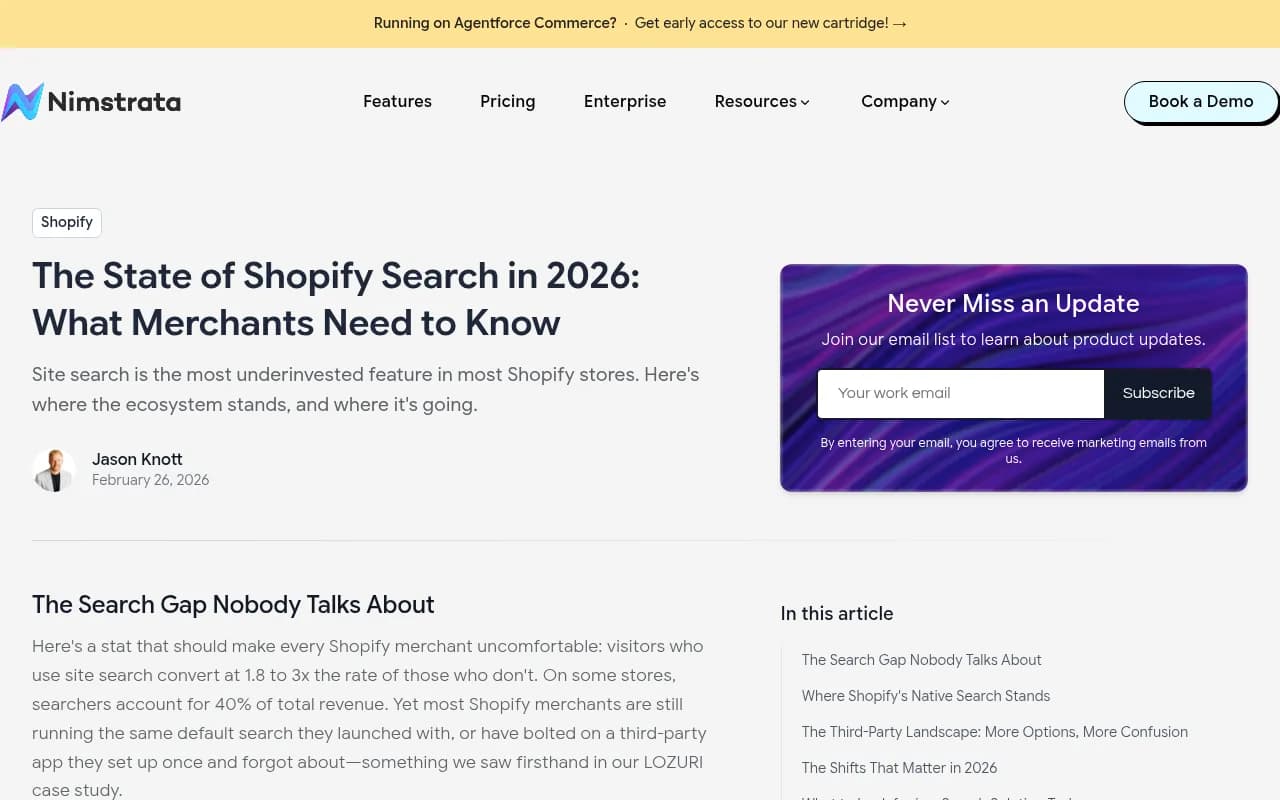
For Shopify merchants serious about AI discovery, third-party search solutions (Algolia, Bloomreach, Klevu) or AI visibility platforms become necessary.
The AI Visibility Stack for Shopify Brands
Competing in AI search requires a different stack than traditional SEO. Here's what Shopify brands are using in 2026:
1. AI Visibility Tracking
You can't optimize what you don't measure. AI visibility platforms show you:
- Which prompts trigger product recommendations (and which don't)
- Which competitors are being cited instead of you
- Which AI models are recommending your products (ChatGPT, Perplexity, Claude, Gemini, etc.)
- Which product pages are getting cited vs ignored
Promptwatch is the only platform that goes beyond monitoring to actually help you fix gaps. It shows you which prompts competitors rank for but you don't, then generates content designed to get cited by AI models.

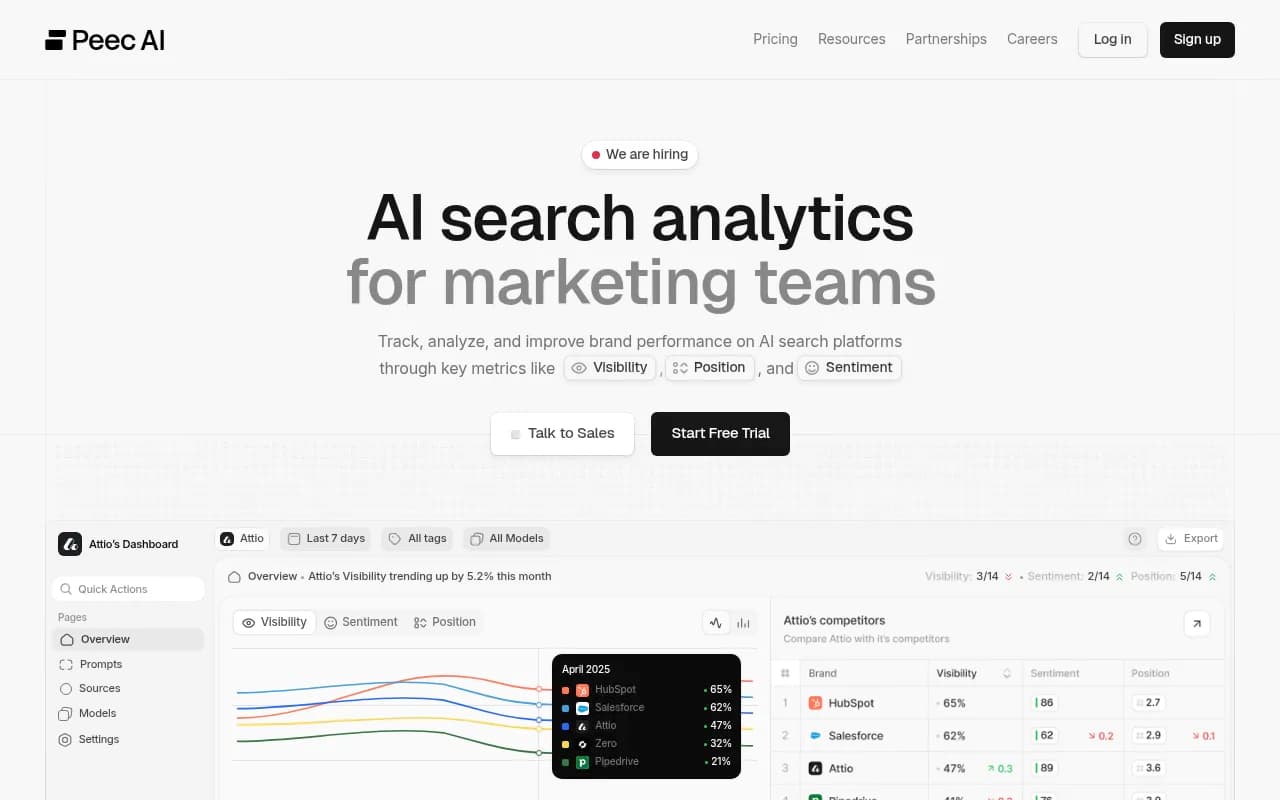
Other options include Otterly.AI (monitoring-only), Peec.ai (basic tracking), and AthenaHQ (limited optimization features). Most competitors stop at showing you the data -- Promptwatch helps you act on it.


2. Structured Data and Schema Markup
AI models love structured data. Product schema, review schema, FAQ schema, and breadcrumb schema make your content machine-readable and citation-worthy.
Shopify themes include basic schema, but most merchants need to add:
- Product specifications (material, dimensions, certifications)
- Shipping and return policies
- Customer reviews and ratings
- Comparison tables (vs competitors)
Tools like Yoast SEO (if you're on WordPress) or custom Liquid templates (for Shopify) can help.
3. Content Gap Analysis
The biggest opportunity in AI search is finding the prompts your competitors rank for but you don't. Promptwatch's Answer Gap Analysis shows exactly which content your site is missing -- the topics, angles, and questions AI models want answers to but can't find on your pages.
Once you know the gaps, you can fill them with AI-generated content grounded in real citation data (880M+ citations analyzed). This isn't generic SEO filler -- it's content engineered to get cited by ChatGPT, Claude, and Perplexity.
4. AI Crawler Logs
AI models crawl your site differently than Google. Real-time crawler logs show:
- Which pages ChatGPT, Claude, and Perplexity are reading
- Errors they encounter (404s, timeouts, blocked resources)
- How often they return to check for updates
Most AI visibility tools don't offer this. Promptwatch does -- it's one of the few platforms with native AI crawler log tracking.
5. Reddit and YouTube Insights
AI models cite Reddit threads and YouTube videos heavily when recommending products. If someone asks "best budget standing desk Reddit," the AI will pull from r/StandingDesk discussions.
Shopify brands need to:
- Monitor Reddit threads mentioning their products or category
- Engage authentically (not spam) in relevant discussions
- Create YouTube content that answers common product questions
Promptwatch surfaces Reddit and YouTube discussions that directly influence AI recommendations -- a channel most competitors ignore entirely.
Comparison: AI Visibility Platforms for Shopify
| Platform | Monitoring | Content Generation | Crawler Logs | Reddit/YouTube Tracking | Pricing |
|---|---|---|---|---|---|
| Promptwatch | ✅ 10 AI models | ✅ AI writing agent | ✅ Real-time logs | ✅ Full insights | $99-579/mo |
| Otterly.AI | ✅ Basic tracking | ❌ No | ❌ No | ❌ No | $49-199/mo |
| Peec.ai | ✅ Multi-language | ❌ No | ❌ No | ❌ No | $99-299/mo |
| AthenaHQ | ✅ 8+ AI models | ❌ No | ❌ No | ❌ No | $149-499/mo |
| Semrush | ✅ Fixed prompts | ❌ No | ❌ No | ❌ No | $139-499/mo |
| Ahrefs Brand Radar | ✅ Fixed prompts | ❌ No | ❌ No | ❌ No | $129-999/mo |
Promptwatch is the only platform rated as a "Leader" across all categories in a 2026 comparison of 12 GEO platforms. The core difference: most competitors are monitoring-only dashboards. Promptwatch is built around taking action.
ChatGPT Shopping: The New Product Discovery Channel
In late 2025, ChatGPT launched Shopping -- a feature that lets users browse and buy products directly in the chat interface. By early 2026, it was driving measurable revenue for Shopify brands.
When someone asks "best wireless earbuds under $100," ChatGPT now shows a carousel of products with:
- Product images
- Prices
- Star ratings
- Direct purchase links
Shopify brands that optimize for ChatGPT Shopping are seeing:
- Higher click-through rates (CTR) than Google Shopping
- Lower cost-per-acquisition (CPA) than paid ads
- Better conversion rates (users asking for recommendations are high-intent)
Promptwatch is one of the few platforms that tracks ChatGPT Shopping visibility -- showing when your brand appears in product carousels and how often.
Personalized Product Recommendations: The AI Advantage
AI-powered recommendation engines on Shopify stores analyze browsing history, past purchases, and real-time behavior to suggest products. In 2026, this is table stakes.
But the real opportunity is optimizing your product catalog so external AI models (ChatGPT, Perplexity, Claude) recommend your products when users ask for advice.
This requires:
- Clear product positioning -- AI models need to understand what makes your product different (not just "high-quality" or "premium")
- Comparison-friendly data -- specs, certifications, materials, use cases that AI can compare to competitors
- Social proof -- reviews, ratings, testimonials that AI can cite as evidence
- Answer-ready content -- FAQs, guides, and how-to content that AI can quote directly
Shopify brands that treat AI models as a discovery channel (not just a monitoring exercise) are winning.
The Action Loop: Find Gaps, Create Content, Track Results
Most AI visibility tools stop at showing you where you're invisible. Promptwatch is built around a different model:
- Find the gaps -- Answer Gap Analysis shows exactly which prompts competitors are visible for but you're not. You see the specific content your website is missing.
- Create content that ranks in AI -- The built-in AI writing agent generates articles, listicles, and comparisons grounded in real citation data (880M+ citations analyzed), prompt volumes, and competitor analysis.
- Track the results -- See your visibility scores improve as AI models start citing your new content. Page-level tracking shows exactly which pages are being cited, how often, and by which models.
This cycle -- find gaps, generate content, track results -- is what makes Promptwatch an optimization platform, not just another tracker.
Practical Steps for Shopify Brands in 2026
Here's what to do this week:
- Audit your top 5 product pages -- Rewrite them into answer-ready blocks with clear specs, pricing, shipping, and return policies. AI models need structured, quotable content.
- Add schema markup -- Product schema, review schema, FAQ schema. Make your content machine-readable.
- Track AI visibility -- Sign up for Promptwatch (or a competitor) and see which prompts trigger product recommendations. Identify gaps.
- Monitor Reddit and YouTube -- Find discussions about your product category. Engage authentically. Create content that answers common questions.
- Optimize for ChatGPT Shopping -- Ensure your product images, descriptions, and pricing are citation-worthy. Track when you appear in product carousels.
- Close the content gaps -- Use AI visibility data to identify missing content, then create articles, guides, and comparisons that AI models will cite.
The brands that move fast on this will dominate AI-driven product discovery. The ones that wait will be invisible.
What's Next: The Future of AI Search for E-commerce
AI search is still early. By the end of 2026, expect:
- More AI models launching shopping features -- Perplexity, Claude, and Gemini will follow ChatGPT's lead
- Voice-first product discovery -- "Alexa, find me the best organic dog food" will pull from AI-optimized Shopify stores
- AI-generated comparison pages -- AI models will create dynamic comparison tables on the fly, pulling data from structured product pages
- Real-time inventory integration -- AI models will check stock levels and recommend products that are actually available
Shopify brands that optimize for AI search now will have a massive advantage. The ones that treat it as a side project will lose.
The gap between monitoring and action is where most brands fail. Tools like Promptwatch exist to close that gap -- showing you what's missing, then helping you fix it with content generation, answer gap analysis, and optimization workflows.
AI search isn't replacing Google. It's creating a new channel. And Shopify brands that optimize for it are seeing 7x traffic growth while competitors are still stuck in 2024.