Diib Review 2026
All-in-one SEO tool with AI-powered insights, site audits, and optimization recommendations designed for ease of use and actionable results.
Key Takeaways
- Diib is a beginner-friendly SEO dashboard that automates technical audits, keyword tracking, and competitor analysis by syncing directly with Google Analytics
- Lacks AI search visibility tracking, content generation, and optimization tools that platforms like Promptwatch offer -- it's purely a monitoring and reporting tool
- Best for small businesses and agencies managing 1-30 sites who want automated SEO alerts without hiring an SEO company
- Pricing starts at $0/month for limited free monitoring, with Pro plans offering unlimited sites and Rank Guard alerts
- Strong on ease of use and benchmarking, but limited content creation support and no AI answer engine tracking
Diib is an automated SEO platform built around a simple premise: most small business owners don't have time to become SEO experts, but they still need to grow their website traffic. Founded by Daniel Urmann, a digital marketing veteran with nearly 20 years of experience, Diib targets the 500,000+ website owners worldwide who want actionable insights without the complexity of enterprise SEO tools. It's particularly popular among brick-and-mortar businesses transitioning online, solo entrepreneurs, and small agencies managing client portfolios.
The platform launched in the early 2010s and has steadily grown by focusing on automation and simplicity. Unlike technical SEO tools that require interpretation, Diib aims to tell you in plain English what's wrong and how to fix it. The core user is someone running a WordPress, Shopify, or Wix site who knows they need SEO but doesn't want to learn Screaming Frog or hire a $5,000/month agency.
Key features
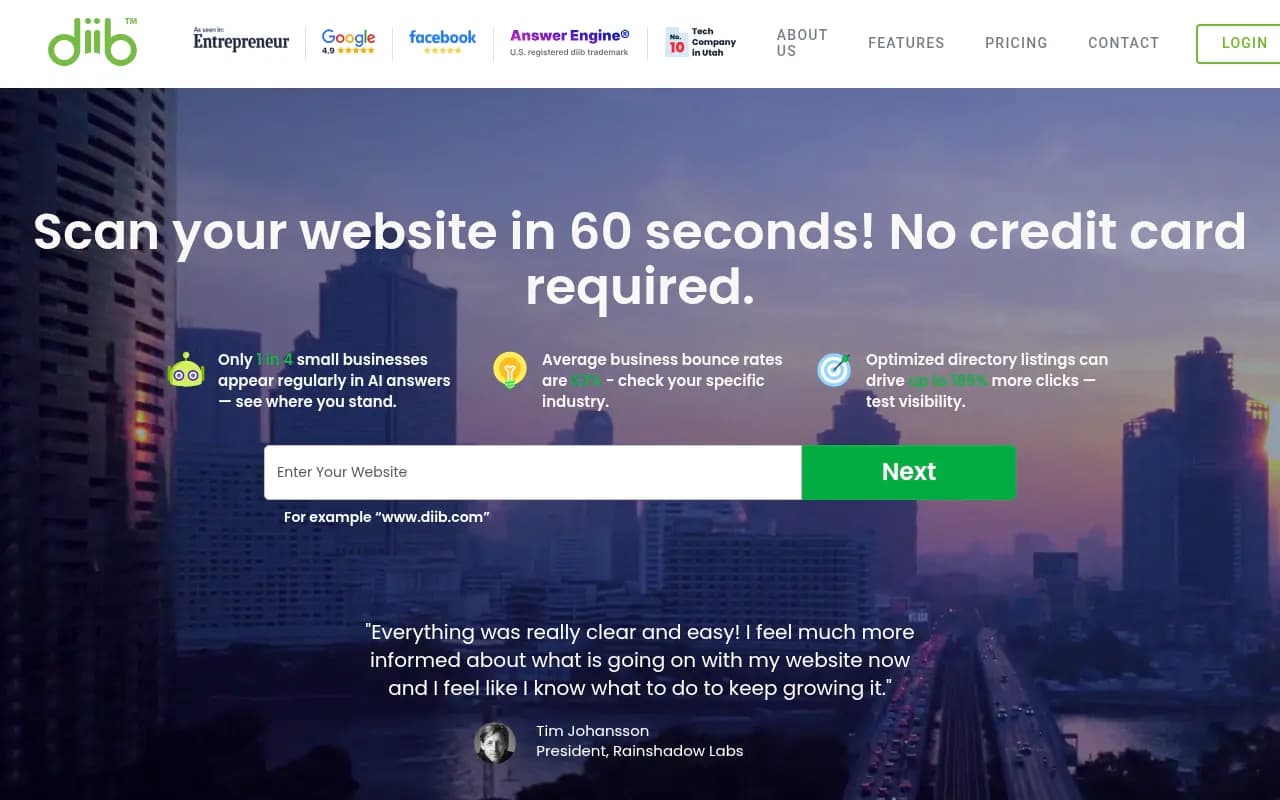
Answer Engine (Growth Plan Generator): Diib's proprietary Answer Engine analyzes your Google Analytics data, website structure, competitor activity, and industry benchmarks to generate a personalized growth plan. It takes about 60 seconds to run the initial scan and produces a prioritized list of objectives across SEO, social media, mobile optimization, and user experience. The system updates daily, automatically detecting new opportunities like keyword gaps, ranking drops, or security issues. This isn't a static report -- it's a living dashboard that adapts as your site changes. The recommendations are specific ("Add alt text to 12 images on /products page") rather than vague ("Improve on-page SEO").
Rank Guard: Included in all Pro accounts, Rank Guard monitors your keyword rankings and alerts you immediately when a page drops in Google. It doesn't just tell you the keyword moved -- it identifies which specific page was affected and what changed (competitor activity, backlink loss, technical issue). This is useful for catching problems before they tank your traffic. You can track unlimited keywords across up to 30 websites on Pro plans.
Competitor Tracking: Enter up to six competitors and Diib will monitor their keyword rankings, backlink profiles, and traffic trends. The backlink analysis is particularly helpful -- you can see which sites link to competitors but not to you, giving you outreach targets. The competitor keyword tracker shows you gaps where they rank but you don't, though it doesn't automatically generate content to fill those gaps (unlike platforms like Promptwatch that combine gap analysis with AI content generation).
Daily Health Score: A single 0-100 score that combines 12 metrics (traffic, bounce rate, speed, security, social engagement, mobile performance, etc.) into one number. It's benchmarked against similar websites in your industry, so you know if your 54% bounce rate is normal or terrible. The score adapts to seasonality and day-of-week variations, so you're not panicking over normal weekend traffic dips. It's a quick way to check if something is broken without diving into Google Analytics.
Website Monitoring: Automated alerts for speed degradation, security issues (expired SSL, malware), email deliverability problems (SPF/DKIM misconfigurations), and technical errors. Pro accounts can monitor up to 30 websites, making this useful for agencies. The monitoring runs 24/7 and sends alerts via email or dashboard notifications.
Social Media Integration: Syncs with Facebook and Instagram to analyze engagement rates, posting frequency, and follower growth. It tells you when your audience is most active and whether your posting schedule aligns. The insights are basic compared to dedicated social tools like Hootsuite, but useful for small businesses that don't have a social media manager.
Keyword Explorer: Suggests new keyword opportunities based on your existing rankings and competitor analysis. It shows search volume and difficulty scores, helping you prioritize which keywords to target. However, it doesn't generate content briefs or articles -- you still need to write (or hire someone to write) the actual content.
Benchmarking: Compares your metrics (bounce rate, session duration, pages per session, return visitor rate) against industry averages. This helps you understand if your 63% bounce rate is a problem or typical for e-commerce sites. The benchmarks are based on Diib's database of 500,000+ sites.
Weekly Snapshot Email: A summary email covering traffic changes, ranking movements (local and national), social performance, new growth opportunities, and security/speed issues. It's designed for busy owners who don't log into dashboards daily.
Growth Expert Support: Pro members get access to Diib's team of SEO specialists (average 10+ years experience) for questions about keyword selection, technical issues, platform-specific problems (WordPress, Shopify, Wix), and strategy. This is included in Pro plans, not an upsell.
Who is it for
Diib is built for small business owners and solo entrepreneurs who are managing their own SEO without a dedicated marketing team. The typical user is someone running a 5-50 page website on WordPress, Shopify, or Wix, generating anywhere from 500 to 10,000 monthly visitors, and trying to grow organically without paying for ads. The case studies on Diib's site are telling: a brick-and-mortar toy store owner in Sacramento who needed to build an online presence during COVID, a law firm partner in Birmingham tasked with improving the firm's digital footprint, a musician selling amplifiers on Shopify who invested $45k in a beautiful site that wasn't getting traffic.
Agencies managing 5-30 client sites also use Diib for automated monitoring and reporting. The ability to track 30 websites under one Pro account makes it cost-effective for small agencies that can't afford enterprise tools like BrightEdge or Conductor. The white-label reporting isn't available, so it's not ideal for agencies that need to brand deliverables.
Diib is NOT for enterprise SEO teams, large publishers, or anyone managing 100+ page sites with complex technical SEO needs. It's also not for content marketers who need AI-powered content generation or AI search visibility tracking -- Diib doesn't monitor how you appear in ChatGPT, Perplexity, or Google AI Overviews, which is increasingly important in 2026 as AI answer engines capture more search traffic.
Integrations and ecosystem
Diib integrates directly with Google Analytics (required for full functionality) and Google Search Console. It also syncs with Facebook and Instagram for social media analytics. The platform supports all major website builders and CMSs: WordPress, Shopify, Wix, BigCommerce, Squarespace, Magento, Weebly, Tumblr, Blogger, Drupal, Joomla, PrestaShop, 3DCart, OpenCart, X-Cart, and osCommerce.
There's no public API for custom integrations, and no Zapier support. The platform is self-contained -- you log into the Diib dashboard to see your data. There's no browser extension or mobile app, though the web interface is mobile-responsive.
For agencies, Diib offers the ability to manage multiple client sites under one account (up to 30 on Pro plans), but there's no client portal or white-label reporting. You can export data, but it's not designed for client-facing deliverables.
Pricing and value
Diib offers a free tier with limited functionality: you get an initial site scan, basic monitoring, and occasional alerts, but not the full daily analysis or unlimited keyword tracking. It's enough to see if the platform is useful, but not enough to replace a paid SEO tool.
Pro plans start at an undisclosed monthly rate (pricing isn't publicly listed on the site -- you need to sign up for the free scan first). Based on user reports and the feature set, Pro plans likely range from $29-99/month depending on the number of sites and features. Pro includes unlimited keyword tracking, Rank Guard alerts, competitor monitoring for up to 6 competitors, Growth Expert support, and monitoring for up to 30 websites.
Compared to competitors, Diib is positioned as a budget-friendly alternative to tools like Semrush ($139.95/mo), Ahrefs ($129/mo), or Moz Pro ($99/mo). It's less expensive because it's less comprehensive -- you're not getting the depth of backlink data, content optimization tools, or AI search tracking that higher-priced platforms offer. For small businesses that just need automated monitoring and basic SEO guidance, the price-to-value ratio is strong. For agencies or brands that need advanced features, it's limiting.
Strengths and limitations
Strengths:
- Ease of use: The interface is genuinely simple. Non-technical users can understand the recommendations without Googling SEO jargon. The Daily Health Score and Weekly Snapshot make it easy to stay on top of site health without daily logins.
- Automated monitoring: Set it and forget it. Diib runs daily scans and alerts you when something breaks or an opportunity appears. This is valuable for busy owners who can't manually check rankings every day.
- Multi-site management: Pro accounts can monitor 30 sites, making it cost-effective for small agencies or owners with multiple properties.
- Benchmarking: Knowing how your metrics compare to industry averages helps you prioritize what actually matters. A 63% bounce rate might sound bad until you learn it's average for your vertical.
- Growth Expert support: Having access to real SEO specialists (not chatbots) is rare at this price point. Users consistently mention this as a standout feature.
Limitations:
- No AI search visibility tracking: Diib doesn't monitor how you appear in ChatGPT, Perplexity, Claude, Gemini, or Google AI Overviews. In 2026, AI answer engines are capturing an increasing share of search traffic, and Diib has no visibility into this channel. Platforms like Promptwatch specialize in tracking and optimizing for AI search, offering features like AI crawler logs, citation analysis, and content gap analysis for AI models -- capabilities Diib completely lacks.
- No content generation: Diib tells you which keywords to target but doesn't help you create the content. You're on your own for writing articles or hiring writers. Competitors like Promptwatch include AI writing agents that generate optimized content based on citation data and prompt analysis.
- Limited backlink analysis: You can see your backlinks and competitors' backlinks, but the data isn't as deep as Ahrefs or Majestic. You won't get detailed link quality metrics or historical backlink data.
- No white-label reporting: Agencies can't brand the reports for clients, limiting its usefulness for client-facing deliverables.
- Unclear pricing: The lack of transparent pricing on the website is frustrating. You have to sign up for the free scan to see Pro plan costs.
Bottom line
Diib is a solid choice for small business owners and solo entrepreneurs who want automated SEO monitoring and actionable recommendations without the complexity of enterprise tools. It's particularly useful if you're managing 1-10 sites, have limited technical expertise, and need a tool that tells you what to fix in plain English. The Daily Health Score, Rank Guard alerts, and Growth Expert support make it easy to stay on top of SEO without becoming an expert.
However, if you're serious about AI search visibility -- tracking how you appear in ChatGPT, Perplexity, and other AI answer engines -- Diib won't help you. For that, you need a platform like Promptwatch, which offers AI crawler logs, citation tracking, content gap analysis, and AI-powered content generation specifically designed to rank in AI search results. Diib is a traditional SEO tool in a world where AI search is rapidly growing.

Best use case: Small businesses and agencies managing 1-30 sites who want automated SEO monitoring and beginner-friendly recommendations without hiring an SEO company.
Tags:
Frequently asked questions
Similar and alternative tools to Diib