Key takeaways
- Rankscale starts at €20/mo on a credit-based model; AthenaHQ's entry point is $295/mo ($95/mo annual) -- a significant gap that matters a lot for smaller teams
- Rankscale tracks 17+ AI engines vs AthenaHQ's 8+, giving it broader coverage across emerging and regional models
- AthenaHQ is more explicitly enterprise-focused, with clients like ZoomInfo, Coinbase, and Volkswagen, and a stronger emphasis on executive dashboards and ROI reporting
- Both platforms are primarily monitoring and analysis tools -- neither includes a built-in content generation engine to act on the gaps they find
- Rankscale includes 94+ technical checkpoints for structural and authority auditing, which is a more hands-on technical SEO angle than AthenaHQ takes
- AthenaHQ has a free audit option; Rankscale offers a free trial -- neither gives you full platform access for free
Overview
Rankscale
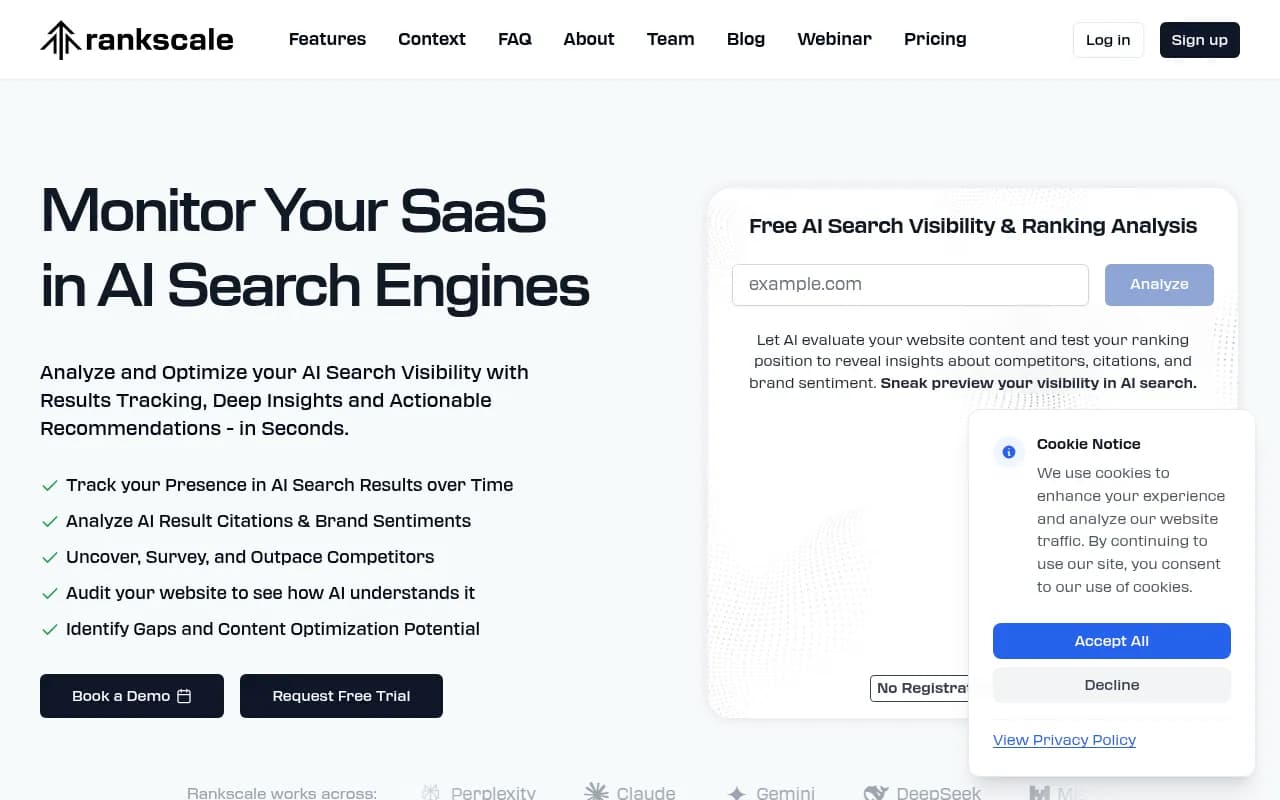
Rankscale positions itself as an AI visibility analytics platform built for brands that want granular control over how they appear across generative AI engines. It covers 17+ platforms, including the obvious ones (ChatGPT, Perplexity, Claude, Gemini) and extends to DeepSeek, Grok, Copilot, Mistral, and AI Mode. The credit-based pricing model is unusual in this space and makes it more accessible at the low end. Clients include Bosch, UBS, REWE, and agencies like Dentsu and WPP Media -- so it's clearly not just a startup toy.
The platform's standout angle is its technical depth: 94 automated checkpoints audit the structural and authority signals that AI engines use to verify and cite content. That's a more diagnostic, technical-SEO-adjacent approach than most GEO tools take.
AthenaHQ
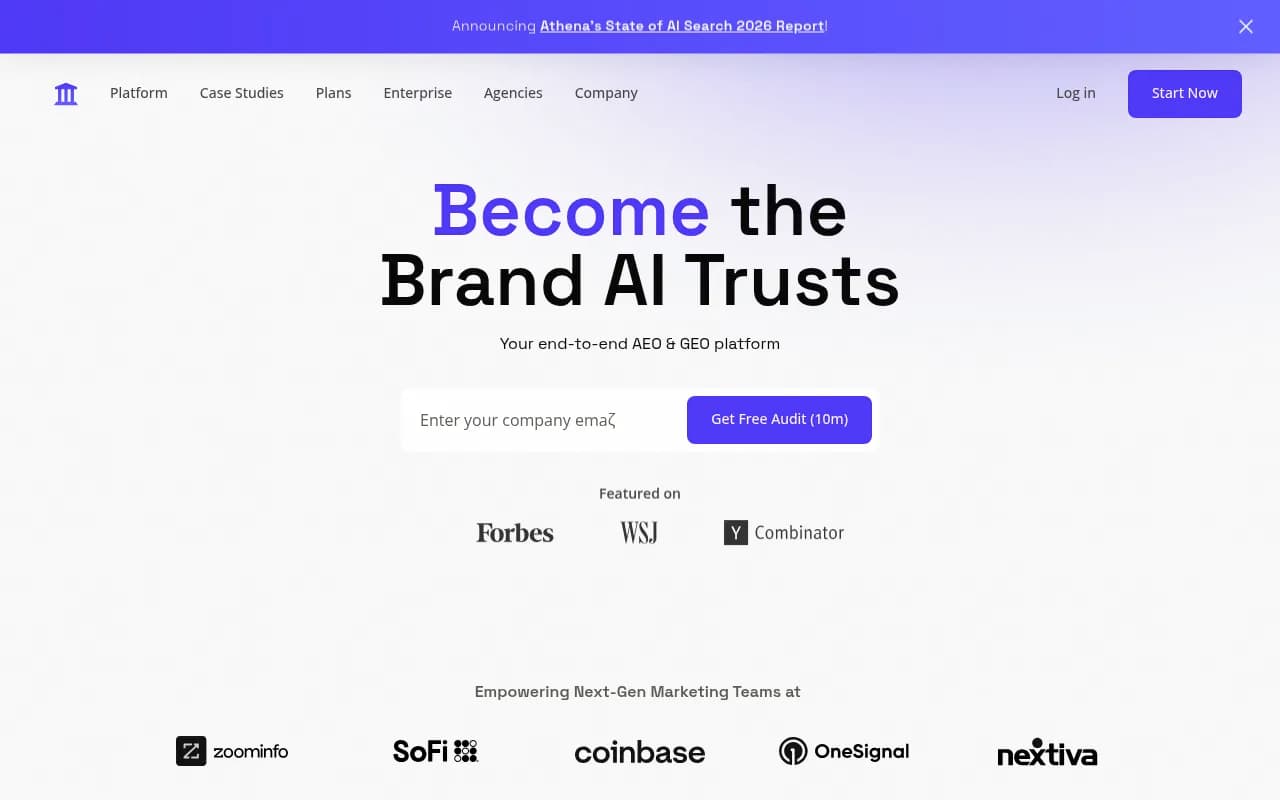
AthenaHQ calls itself an "end-to-end AEO & GEO platform" and leans hard into the enterprise buyer. It's backed by Y Combinator, has been covered by Forbes and the Wall Street Journal, and counts ZoomInfo, Coinbase, SoFi, and Volkswagen among its clients. The platform covers 8+ AI engines and is built around a unified command center concept -- one place to manage your entire AI search optimization workflow.
Where AthenaHQ differentiates is in its workflow management and executive reporting. It's designed so that an AEO/GEO manager can own the entire strategy from one dashboard, with ROI tracking and cross-team visibility baked in. The trade-off is price: at $295/mo for self-serve, it's a meaningful commitment before you've validated the ROI.
Side-by-side comparison
| Feature | Rankscale | AthenaHQ |
|---|---|---|
| Starting price | €20/mo (credit-based) | $295/mo ($95/mo annual) |
| Free trial | Yes | No (free audit only) |
| AI engines tracked | 17+ | 8+ |
| Brand monitoring | Yes | Yes |
| Competitor analysis | Yes | Yes |
| Citation analysis | Yes | Yes |
| Sentiment analysis | Yes | Yes |
| Technical auditing | 94+ checkpoints | Not specified |
| Prompt research | Yes (volume + intent) | Yes |
| Content generation | No | No |
| Executive/ROI dashboards | Limited | Yes |
| Multi-region/language | 240+ countries, all languages | Yes |
| Agency support | Yes (Dentsu, WPP, Publicis) | Not primary focus |
| Enterprise tier | Yes (custom) | Yes (custom) |
| Notable clients | Bosch, UBS, REWE, O2 | ZoomInfo, Coinbase, Volkswagen |
Head-to-head feature deep-dive
AI engine coverage
Rankscale's 17+ engine coverage is the wider net here. It tracks ChatGPT, Perplexity, Claude, Gemini, AI Overviews, DeepSeek, Grok, Copilot, Mistral, and AI Mode -- and claims to cover both chat interfaces and raw AI model outputs. That distinction matters: a brand might appear differently in ChatGPT's browsing mode vs the underlying GPT-4 model, and Rankscale tries to capture both.
AthenaHQ covers 8+ engines, which includes all the major ones but fewer of the emerging or regional players. For most brands, 8 engines is probably sufficient -- the vast majority of AI search traffic flows through ChatGPT, Perplexity, and Google's AI products. But if you're in a market where DeepSeek or Grok has meaningful traction, Rankscale's broader coverage is a real advantage.
Verdict: Rankscale wins on raw coverage. AthenaHQ covers what most brands actually need.
Technical auditing and diagnostics
This is where Rankscale has a genuinely differentiated angle. Its 94+ technical checkpoints automatically audit the structural and authority signals that AI engines use to verify and cite content. Think of it as a technical SEO audit, but calibrated for what LLMs care about rather than what Google's crawler cares about. Schema markup, E-E-A-T signals, content structure, authority indicators -- Rankscale checks all of it systematically.
AthenaHQ doesn't publicize a comparable technical audit feature. Its optimization angle is more about content recommendations and workflow management than deep technical diagnostics.
Verdict: Rankscale is stronger here. If technical auditing matters to your team, it's not close.
Prompt research
Both platforms offer prompt research, but with different emphases. Rankscale estimates prompt search volume through semantic reconstruction, decodes intent and prompt density, and helps you optimize content for likely question patterns. It's a research-first approach that helps you figure out which prompts to target before you start tracking.
AthenaHQ's prompt research is more tightly integrated into its workflow management system -- it's designed to feed directly into your optimization tasks and content recommendations rather than sitting as a standalone research module.
Verdict: Roughly even, but Rankscale's volume estimation is a useful differentiator for prioritization.
Competitor analysis
Both tools auto-identify competitors in AI search results and let you compare visibility scores, citations, and sentiment. Rankscale's competitor analysis surfaces ranking gaps and strategic advantages, while AthenaHQ frames competitor data within its broader executive reporting context.
| Capability | Rankscale | AthenaHQ |
|---|---|---|
| Auto-identify competitors | Yes | Yes |
| Compare visibility scores | Yes | Yes |
| Citation comparison | Yes | Yes |
| Sentiment comparison | Yes | Yes |
| Share of voice | Yes | Yes |
| Gap analysis | Yes | Yes |
Verdict: Comparable. Neither has a clear edge here.
Reporting and dashboards
AthenaHQ's executive dashboard is a genuine strength. It's built for the scenario where a CMO or VP of Marketing needs to understand AI search ROI without digging into raw data. The platform explicitly tracks ROI for AI optimization efforts and is designed for cross-functional visibility -- marketing, SEO, PR, and content teams can all use it without needing to be GEO specialists.
Rankscale's dashboards are more analyst-oriented. You can slice data by AI engine and timeframe, track historical trends, and get actionable recommendations -- but it's built for someone who wants to get into the numbers, not someone who needs a one-page executive summary.
Verdict: AthenaHQ wins for executive reporting. Rankscale wins for analytical depth.
Pricing and accessibility
This is the biggest practical difference between the two tools.
Rankscale's credit-based model means you pay for what you use, and the entry point is genuinely low. A small brand or agency testing the waters can start at €20/mo and scale up. That flexibility is unusual in the GEO space, where most tools have fixed seat or prompt-based tiers.
AthenaHQ's $295/mo self-serve price (or $95/mo if you commit annually) is a meaningful jump. The annual billing discount is substantial -- $95/mo vs $295/mo is a 68% difference -- but it requires a 12-month commitment before you've necessarily proven the value. There's no free trial to de-risk that decision.
Verdict: Rankscale is more accessible. AthenaHQ's annual pricing is competitive if you're ready to commit.
Content optimization (what happens after you find the gaps)
This is worth addressing directly because it's a gap both tools share. Neither Rankscale nor AthenaHQ includes a built-in AI content generation tool. AthenaHQ provides automated content optimization recommendations -- it tells you what to fix and how -- but the actual writing is still on you. Rankscale's prompt research helps you identify what content to create, but again, the creation step is manual.
If you're looking for a platform that closes the loop from "we're invisible for this prompt" to "here's the article that will fix it," neither of these tools gets you there. For that kind of end-to-end workflow, Promptwatch is worth looking at -- it combines visibility tracking with a built-in AI writing agent that generates content grounded in citation data.

Pricing comparison
| Plan | Rankscale | AthenaHQ |
|---|---|---|
| Entry-level | €20/mo (Essentials, credit-based) | $295/mo self-serve |
| Annual discount | Available | $95/mo (billed annually) |
| Professional | Credit-based tier (price varies) | Included in self-serve |
| Business | Credit-based tier (price varies) | Included in self-serve |
| Enterprise | Custom pricing | Custom pricing |
| Free trial | Yes | No |
| Free tier | No | No (free audit only) |
The pricing gap is stark. AthenaHQ's annual plan at $95/mo is actually competitive with mid-tier GEO tools, but you're locked in for a year. Rankscale's flexibility is a real advantage for teams that want to start small or have variable usage patterns.
Pros and cons
Rankscale
Pros:
- Lowest entry price in the GEO space at €20/mo
- Broadest AI engine coverage at 17+
- 94+ technical checkpoints for structural auditing -- genuinely useful for technical teams
- Free trial available
- Strong agency client base (Dentsu, WPP, Publicis Sapient)
- 240+ country coverage with full language support
Cons:
- Credit-based pricing can be harder to budget predictably at scale
- Executive/ROI reporting is less developed than AthenaHQ
- No content generation to act on the insights
- Smaller brand recognition than AthenaHQ in the US market
AthenaHQ
Pros:
- Strong enterprise client list (ZoomInfo, Coinbase, Volkswagen)
- Executive dashboards with ROI tracking built in
- Y Combinator-backed with Forbes and WSJ coverage
- Annual plan at $95/mo is competitive
- Workflow management designed for cross-functional teams
- Free audit to get initial visibility data
Cons:
- No free trial -- $295/mo self-serve is a cold-start commitment
- Only 8+ AI engines vs Rankscale's 17+
- No content generation capability
- Less technical auditing depth than Rankscale
- Annual commitment required to access the competitive price point
Who should pick which tool
Choose Rankscale if:
- You're a small team or agency that wants to start with a low monthly commitment
- Technical auditing matters -- you want to know exactly what structural signals are hurting your AI citations
- You need coverage across 17+ AI engines, including regional and emerging models
- You work with multiple brands and need flexible, usage-based pricing
- You're in Europe or a non-US market where Rankscale's regional coverage is an advantage
Choose AthenaHQ if:
- You're at a mid-size to enterprise company where executive reporting and ROI tracking are non-negotiable
- Your team includes non-technical stakeholders (CMOs, VPs) who need clean dashboards, not raw data
- You're ready to commit to an annual plan and want a lower monthly rate
- You prioritize workflow management -- having one unified place to run your entire GEO strategy
- You're in the US market where AthenaHQ's brand recognition and client list carry weight internally
Final verdict
Rankscale and AthenaHQ are both solid GEO monitoring platforms, but they're aimed at different buyers. Rankscale is the better pick for cost-conscious teams, technical practitioners, and anyone who needs broad AI engine coverage without a large upfront commitment. AthenaHQ is the better pick for enterprise teams that need executive-grade reporting and a unified workflow management system -- and who are willing to pay for it.
The honest limitation of both tools is the same: they show you where you're invisible, but they don't help you fix it. If acting on the data matters as much as collecting it, you'll need to pair either platform with a content workflow -- or look at tools that build that step in.