Wincher Review 2026
Wincher is a search visibility platform used by 700,000+ marketers offering rank tracking, keyword research, on-page SEO, local tracking, and white-label reporting. Best for SMBs and agencies wanting clean, affordable Google SEO tools.
Key takeaways
- Wincher is a focused, affordable rank tracking and SEO visibility platform built for small businesses, freelancers, and lean agency teams who want clean data without the complexity of enterprise suites
- Rated 4.8 on both G2 and Capterra, with 700,000+ users -- the product clearly resonates with its target audience
- Core strengths are daily rank tracking, keyword gap analysis, local SEO tracking, and white-label reporting; the interface is consistently praised for being intuitive
- Pricing starts at €49/month for 500 keywords, making it one of the more accessible options in the traditional SEO rank tracking space
- No AI search visibility features -- Wincher tracks Google rankings only and has no monitoring for ChatGPT, Perplexity, Claude, or other AI engines; for that, tools like Promptwatch are built specifically for the AI search layer
Wincher is a Swedish SEO platform, headquartered in Stockholm, that has built a loyal following by doing one thing particularly well: making Google rank tracking genuinely easy to use. While tools like Semrush and Ahrefs have grown into sprawling suites with steep learning curves and price tags to match, Wincher has taken the opposite approach -- a clean, focused product that covers the core SEO workflow without overwhelming users who just want to know where their pages rank and what to do about it.
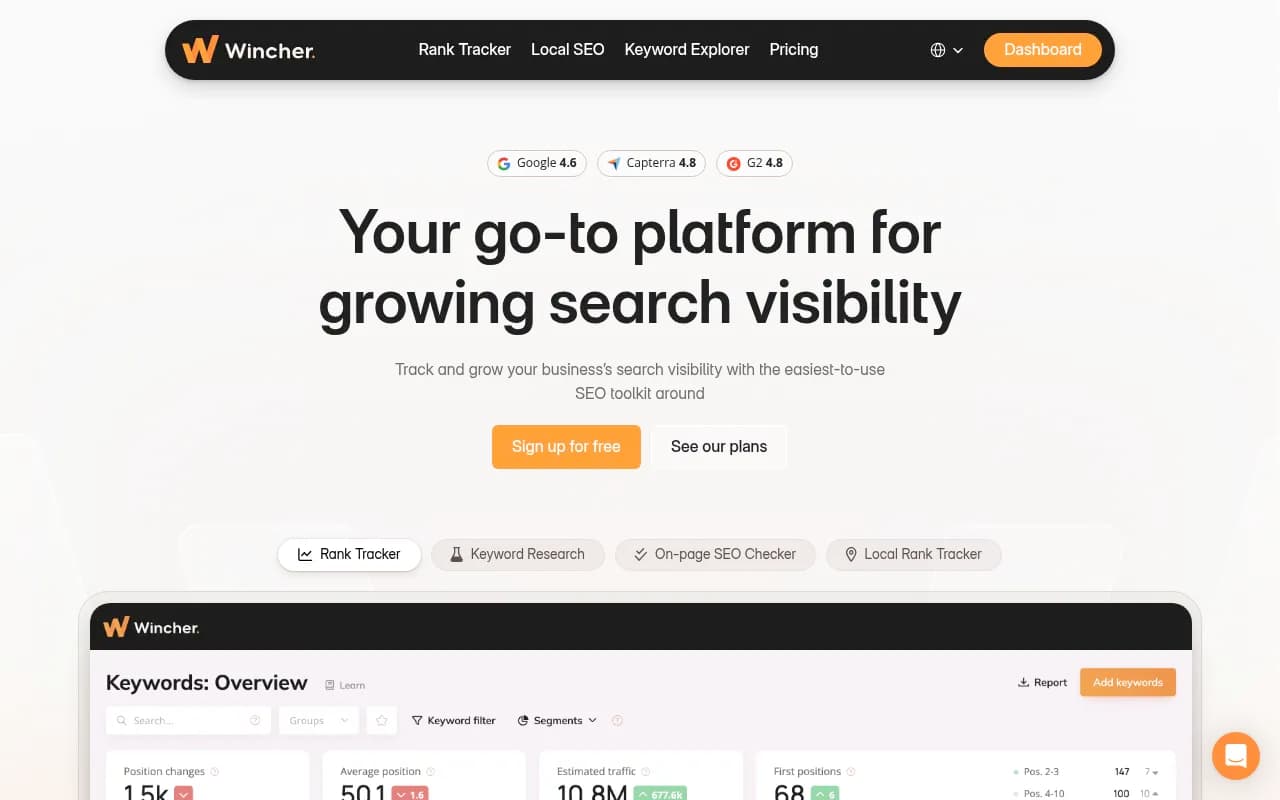
The platform serves over 700,000 marketers and business owners worldwide, which is a meaningful number for a product that doesn't try to be everything. It sits in a competitive segment alongside tools like SERPWatcher, AccuRanker, and SE Ranking, but Wincher's combination of pricing, usability, and feature depth has carved out a real niche, particularly among small-to-medium businesses and boutique agencies. Ratings across G2 (4.8), Capterra (4.8), and Google (4.6) are consistently high, and the reviews tend to highlight the same things: clean interface, reliable data, and responsive support.
Key features
Rank Tracker
The core of Wincher is its daily rank tracking for Google. You add keywords to a project, and Wincher pulls your positions each day, showing movement over time on intuitive dashboards. A few things make this more useful than basic trackers:
- On-demand ranking updates let you request a fresh data pull outside the daily cycle, useful when you've just published or updated a page
- SERP Features tracking shows which of your keywords are triggering rich results (featured snippets, local packs, etc.) and whether you're appearing in them
- Annotations let you mark events on your timeline -- a site migration, a content update, a Google algorithm update -- so you can correlate ranking changes with actual actions
- Keyword groups let you organize tracked keywords by topic, service, or page, making it easier to analyze performance at a category level rather than keyword by keyword
Competitor rank tracking
Wincher lets you add competitors to any project and track their rankings alongside yours for the same keywords. The dashboard shows side-by-side position comparisons over time, and Share of Voice metrics give you a percentage-based view of how much of the total search visibility you're capturing versus competitors. This is genuinely useful for client reporting -- showing a client that their Share of Voice grew from 12% to 19% over a quarter lands better than a spreadsheet of position changes.
Keyword Explorer
The keyword research tool covers the basics well: search volume, keyword difficulty, and search intent signals. You can enter a seed keyword and get related keyword suggestions, or paste in a URL and let Wincher's AI suggest the top keywords to track based on the page content. The Keyword Gap feature is where it gets more interesting -- you can see which keywords competitors rank for that you don't, add them to your tracking list, and prioritize based on difficulty and volume. For businesses that are still building out their keyword strategy, this is a practical starting point.
On-Page SEO Checker
This tool analyzes individual pages against a target keyword and returns a checklist of on-page factors: title tag, meta description, heading structure, keyword usage, internal links, page speed signals, and more. It's not as deep as a full technical audit tool, but for content teams optimizing existing pages, it gives clear, actionable recommendations without requiring SEO expertise to interpret. There's also a SERP Benchmark feature that compares your page against the top 10 Google results for a given keyword, showing you what the ranking pages are doing differently in terms of content length, keyword usage, and structure.
AI content outliner
Wincher added an AI-powered content outline generator that takes a keyword and a brief description, then produces a structured outline for a new article or page. You choose the content length and the AI handles the structure. This is a lightweight feature compared to dedicated AI writing tools, but it's a useful addition for content teams who want a starting point without switching to another tool. It's worth noting this generates outlines for traditional Google SEO content -- it's not designed to optimize for AI search engines like ChatGPT or Perplexity.
Local Rank Tracker
The local tracking feature monitors rankings at a city or even neighborhood level, with heatmap visualizations showing how your visibility varies across a geographic area. This is particularly useful for businesses with physical locations -- restaurants, service businesses, medical practices -- where ranking in the local pack matters more than national organic rankings. The heatmap view makes it easy to spot geographic gaps in visibility.
Reporting and white-labeling
Wincher's reporting module is one of its most praised features, especially among agency users. You can build custom reports that include only the metrics you want, schedule them for automatic delivery (daily, weekly, or monthly), and apply white-label branding so they look like they came from your agency. The ability to control exactly what goes into a report -- and to have it land in a client's inbox automatically -- saves meaningful time for agencies managing multiple accounts. One reviewer noted saving "hours and hours a month just on reporting."
Google Looker Studio integration
Wincher connects directly to Google Looker Studio, letting you pull ranking data into custom dashboards alongside data from Google Analytics, Search Console, and other sources. This is a significant feature for teams that already use Looker Studio for client reporting, as it means Wincher data can live in the same place as everything else.
Who is it for
Wincher fits best for small business owners and in-house marketing teams at companies with 1-50 employees who are managing their own SEO without a dedicated technical resource. Think an e-commerce store owner tracking 200-500 keywords across a few product categories, or a marketing manager at a regional services company who needs to show the CEO that rankings are improving. The interface is genuinely accessible -- multiple reviews specifically mention that non-SEO-experts can understand the data -- which matters a lot for this audience.
Boutique digital agencies and freelancers managing 5-20 client sites are another strong fit. The white-label reporting, multi-project structure, and competitive pricing make it practical to run client SEO reporting through Wincher without the overhead of an enterprise tool. The agency-friendly features aren't as deep as something like AgencyAnalytics, but for agencies whose primary deliverable is rank tracking and basic SEO recommendations, Wincher covers the workflow well.
Local businesses with physical locations get particular value from the Local Rank Tracker and heatmap features. A dental practice, a law firm, or a home services company trying to dominate local search in a specific city or region will find the geographic granularity useful in a way that generic rank trackers don't provide.
Who should look elsewhere: Large enterprise SEO teams managing thousands of keywords across dozens of domains will likely find Wincher's feature set too limited and will need the deeper technical audit capabilities, backlink analysis, and log file analysis that tools like Semrush or Ahrefs provide. Similarly, anyone whose primary concern is visibility in AI search engines -- ChatGPT, Perplexity, Google AI Overviews -- will find Wincher has nothing to offer in that space. It's a traditional Google SEO tool, full stop.
Integrations and ecosystem
Wincher's integration list is focused rather than exhaustive:
- Google Search Console: Connects to pull impression and click data alongside ranking data
- WordPress: A WordPress plugin lets you track rankings directly from the WordPress dashboard
- Wix: Native integration for Wix-hosted sites
- Google Looker Studio: Direct connector for custom dashboard reporting
- API: Wincher offers a documented REST API (docs at wincher.com/docs/api) for pulling ranking data into custom workflows or third-party tools
There's no native Slack integration, no Zapier connector listed on the main site, and no mobile app mentioned. The integration set covers the most common use cases for the target audience but won't satisfy teams with complex data pipeline requirements.
Data import is a notable feature: you can migrate your historical ranking data from previous providers, which removes one of the main friction points when switching rank trackers. Losing months of ranking history is a real pain, and Wincher's import capability addresses that directly.
Pricing and value
Wincher uses three main tiers, priced in euros:
- Basic: €49/month -- from 500 keywords, core rank tracking features
- Pro: €89/month -- from 1,000 keywords, includes additional features (specific feature differences between tiers aren't fully detailed on the homepage)
- Business: €319/month -- from 5,000 keywords, full feature access
A 7-day free trial is available without requiring a credit card. Annual billing discounts apply.
Compared to the main alternatives: AccuRanker starts at around $116/month for 1,000 keywords, SE Ranking starts at roughly $65/month, and SERPWatcher (part of Mangools) runs about $29/month for a more limited feature set. Wincher's pricing sits in a reasonable middle ground -- more capable than the cheapest options, significantly less expensive than enterprise tools.
One complaint that appears in reviews is the keyword counting method: tracking the same keyword on both mobile and desktop counts as two keywords against your limit. This is a common practice in rank tracking tools but worth knowing upfront, as it effectively halves your usable keyword count if you want both device types tracked.
Strengths and limitations
What Wincher does well:
- Usability: The interface is consistently praised across hundreds of reviews. Non-technical users can get meaningful insights without a learning curve, which is genuinely rare in SEO tools.
- White-label reporting: The automated, customizable, white-labeled reports are a real time-saver for agencies and a differentiator versus simpler rank trackers.
- Local SEO tracking: The heatmap-based local rank tracker is more visual and intuitive than most competitors' local tracking features.
- Pricing accessibility: At €49/month for 500 keywords, it's one of the more affordable full-featured rank tracking options available.
- Customer support: Across Google, Capterra, and G2 reviews, support responsiveness is mentioned positively far more often than negatively.
Limitations:
- No AI search visibility: Wincher tracks Google rankings only. It has no capability to monitor how your brand or content appears in ChatGPT, Perplexity, Claude, Google AI Overviews, or any other AI engine. As AI search continues to grow as a traffic source, this is a meaningful gap. Platforms built specifically for AI visibility monitoring, like Promptwatch, cover this layer entirely.
- Limited technical SEO depth: There's no backlink analysis, no full site crawl, no log file analysis, and no Core Web Vitals monitoring. For teams that need a complete technical SEO toolkit, Wincher needs to be supplemented with other tools.
- Keyword counting for mobile/desktop: Tracking the same keyword on both devices counts as two keywords, which frustrates users on lower-tier plans.
- User access on lower plans: Multiple reviews note that adding team members or clients requires higher-tier plans, which is a friction point for small agencies.
Bottom line
Wincher is a well-executed, genuinely easy-to-use rank tracking platform that delivers real value for small businesses, freelancers, and boutique agencies focused on traditional Google SEO. If your primary need is reliable daily rank tracking, keyword gap analysis, local SEO monitoring, and clean client reporting at a reasonable price, Wincher is a strong choice that won't overwhelm you or your clients.
That said, it's a Google-only, traditional SEO tool. If you're also thinking about how your brand shows up when someone asks ChatGPT for a recommendation or searches on Perplexity, Wincher won't help you there -- you'd need a dedicated AI visibility platform like Promptwatch running alongside it.
Best for: Small-to-medium businesses and boutique agencies that want reliable Google rank tracking, local SEO visibility, and white-label reporting without the complexity or cost of enterprise SEO suites.
Frequently asked questions
Similar and alternative tools to Wincher