Key Takeaways
- Price gap is massive: Promptwatch starts at $99/mo with a 7-day free trial, while Evertune starts at $3,000/mo with annual contracts -- that's a 30x difference in entry price
- Target audience split: Promptwatch serves SMBs, agencies, and mid-market brands (7,000+ customers), while Evertune focuses exclusively on Fortune 500 enterprises (WPP, Miro, Roku)
- Action vs monitoring: Promptwatch includes built-in AI content generation (5-30 articles/mo depending on plan) and Answer Gap Analysis to create content that ranks in AI search. Evertune focuses on monitoring, auditing, and strategic recommendations but doesn't generate content for you
- Crawler visibility: Promptwatch offers real-time AI crawler logs showing exactly when ChatGPT, Claude, Perplexity bots hit your site and what they read. Evertune audits your site for AI optimization but doesn't expose live crawler activity
- Self-serve vs white-glove: Promptwatch is a self-serve platform you can start using today. Evertune requires enterprise sales cycles and comes with dedicated support that "feels like an extension of your team"
Understanding the enterprise GEO landscape in 2026
AI search has moved from experimental to essential. According to 2025 industry data, AI referral traffic already accounts for 1.08% of all website traffic across major industries, with IT companies seeing 2.80% of their traffic from AI sources. By 2027, AI search is projected to reach 28% of total global search traffic.
For Fortune 500 brands, this shift creates a new visibility problem: when a customer asks ChatGPT, Gemini, or Claude a question about your industry, does your brand get mentioned? If not, you're losing visibility to competitors who do.
Two platforms have emerged as serious contenders for enterprise GEO: Promptwatch and Evertune. They take fundamentally different approaches to solving the same problem.

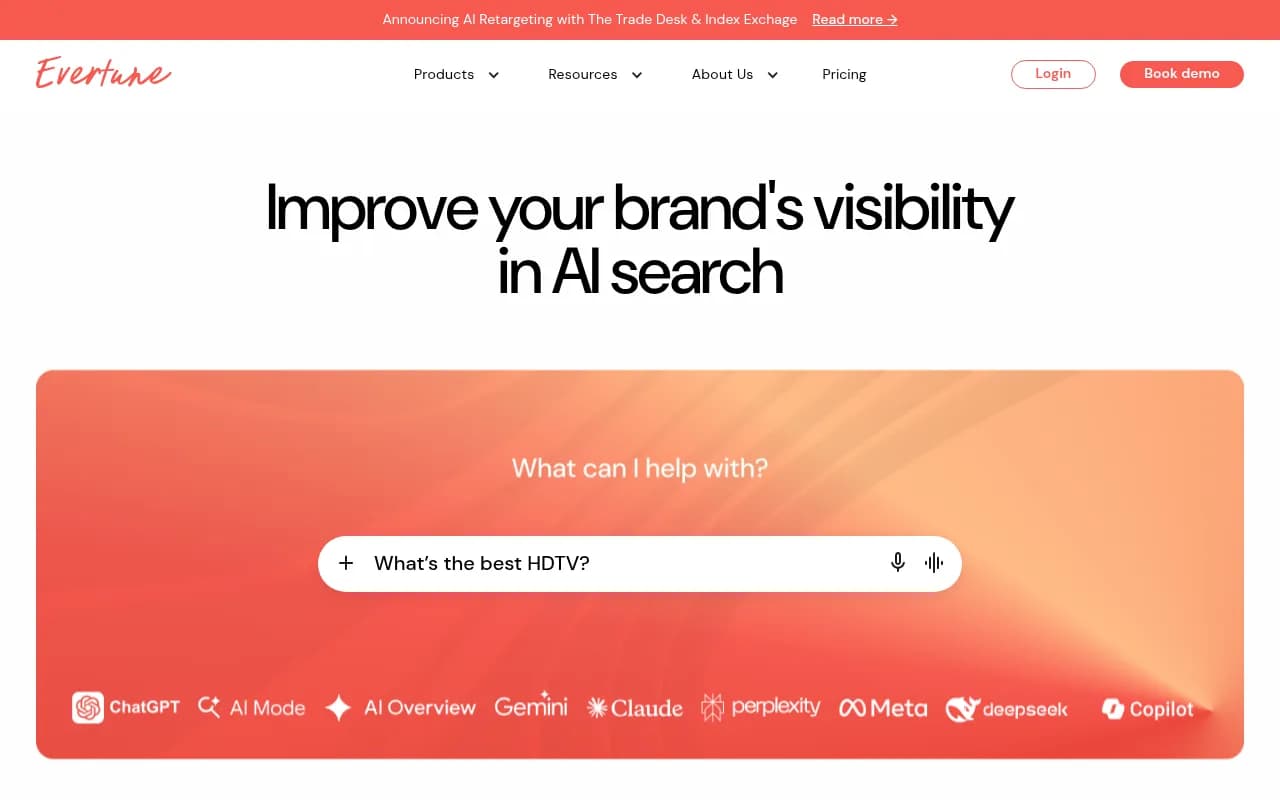
Platform comparison: Promptwatch vs Evertune
| Feature | Promptwatch | Evertune |
|---|---|---|
| Starting price | $99/mo | $3,000/mo |
| Free trial | 7 days | No (enterprise sales cycle) |
| Target audience | SMBs, agencies, mid-market | Fortune 500 only |
| AI models tracked | 10 (ChatGPT, Claude, Gemini, Perplexity, Google AI Overviews, Meta AI, DeepSeek, Grok, Mistral, Copilot) | Not publicly disclosed |
| Built-in content generation | Yes (5-30 articles/mo) | No |
| AI crawler logs | Real-time logs | Site audits (not real-time) |
| Reddit/YouTube tracking | Yes | Not highlighted |
| ChatGPT Shopping tracking | Yes | Not highlighted |
| Answer Gap Analysis | Yes | Not highlighted |
| Implementation | Self-serve | White-glove onboarding |
| Customer count | 7,000+ | Not disclosed (Fortune 500 focus) |
Pricing and accessibility
The price difference between these platforms is stark. Promptwatch starts at $99/mo for the Essential plan (1 site, 50 prompts, 5 articles), with Professional at $249/mo (2 sites, 150 prompts, 15 articles, crawler logs, state/city tracking) and Business at $579/mo (5 sites, 350 prompts, 30 articles). Agency and Enterprise custom pricing is available.
Evertune starts at $3,000/mo with annual contracts. That's a 30x difference in entry price. For a Fortune 500 brand with a $500K+ annual marketing budget, $36K/year for GEO isn't unreasonable. For a mid-market SaaS company or agency, it's a non-starter.
Promptwatch offers a 7-day free trial. You can sign up, connect your site, and start tracking AI visibility today. Evertune requires an enterprise sales cycle -- demos, proposals, contracts. The implementation timeline reflects the target audience: Promptwatch is built for teams that want to move fast; Evertune is built for organizations that move deliberately.
The action loop: monitoring vs optimization
The core philosophical difference between these platforms is what happens after you see the data.
Promptwatch is built around an action loop:
- Find the gaps: Answer Gap Analysis shows exactly which prompts competitors are visible for but you're not. You see the specific content your website is missing -- the topics, angles, and questions AI models want answers to but can't find on your site.
- Create content that ranks in AI: The built-in AI writing agent generates articles, listicles, and comparisons grounded in real citation data (880M+ citations analyzed), prompt volumes, persona targeting, and competitor analysis. This isn't generic SEO filler -- it's content engineered to get cited by ChatGPT, Claude, Perplexity, and other AI models.
- Track the results: See your visibility scores improve as AI models start citing your new content. Page-level tracking shows exactly which pages are being cited, how often, and by which models. Close the loop with traffic attribution (code snippet, GSC integration, or server log analysis) to connect visibility to actual revenue.
This cycle -- find gaps, generate content, track results -- is what makes Promptwatch an optimization platform, not just another tracker.
Evertune takes a different approach. It focuses on monitoring, auditing, and strategic recommendations. The platform shows you where you're visible and where you're not, audits your site for AI optimization opportunities, and provides strategic guidance. But it doesn't generate content for you. You still need to go build the content yourself or hire an agency.
For a Fortune 500 brand with a large in-house content team or agency relationships, this works. You get the intelligence layer and handle execution separately. For a smaller team that needs to move fast, the lack of built-in content generation is a gap.
AI crawler logs: real-time visibility vs audits
One of Promptwatch's most distinctive features is real-time AI crawler logs. You see exactly when ChatGPT, Claude, Perplexity, and other AI bots hit your website, which pages they read, errors they encounter, and how often they return. This is the AI equivalent of server logs -- raw visibility into how AI engines discover and index your content.
Most competitors (Otterly.AI, Peec.ai, AthenaHQ, Search Party) don't offer this at all. Evertune audits your site for AI optimization but doesn't expose live crawler activity. The difference: Promptwatch shows you what's happening right now; Evertune tells you what should be happening.
For technical teams that want to debug indexing issues or understand crawl patterns, real-time logs are invaluable. For marketing teams that just want strategic recommendations, audits may be enough.
Reddit and YouTube tracking
Promptwatch surfaces Reddit threads and YouTube videos that influence AI recommendations. When ChatGPT cites a Reddit discussion or a YouTube video in its response, Promptwatch shows you exactly which threads and videos are being cited.
This matters because AI models don't just cite your website -- they cite the entire internet. If a Reddit thread about your product is being cited more than your official product page, you need to know. If a competitor's YouTube tutorial is dominating AI responses for a key use case, you need to see it.
Evertune doesn't publicly highlight Reddit or YouTube tracking in their feature set. That doesn't mean they don't track it, but it's not positioned as a core capability.
ChatGPT Shopping tracking
Promptwatch monitors when your brand appears in ChatGPT's product recommendations and shopping carousels. As ChatGPT evolves into a commerce platform, this becomes critical for e-commerce and DTC brands.
Evertune's focus on Fortune 500 enterprises suggests they're more oriented toward B2B and brand visibility than e-commerce. ChatGPT Shopping tracking isn't highlighted in their positioning.
Implementation and support
Promptwatch is self-serve. You sign up, connect your site, add your prompts, and start tracking. The interface is designed for marketers and SEO teams who want to move fast without waiting for onboarding calls.
Evertune is white-glove. You go through an enterprise sales cycle, get dedicated onboarding, and receive ongoing support that "feels like an extension of your team." For a Fortune 500 brand that wants strategic guidance and doesn't want to figure things out alone, this is valuable. For a team that wants to start tracking today, it's friction.
Customer profiles
Promptwatch serves 7,000+ customers including Booking.com, Center Parcs, Typeform, Wortell, and Elaboratum. The customer base spans SMBs, agencies, and mid-market brands. The platform is built for teams that need to move fast and don't have unlimited budgets.
Evertune focuses exclusively on Fortune 500 enterprises. Their customer roster includes WPP, Miro, and Roku. The platform is built for organizations that have large budgets, complex needs, and want strategic partnership over self-serve tools.
Data and insights
Promptwatch has processed over 1.1 billion citations, clicks, and prompts. The platform's data has been featured in the Wall Street Journal, Yahoo Finance, Seeking Alpha, and Axios. The citation database (880M+ citations analyzed) powers the AI content generation engine -- it knows what content gets cited and why.
Evertune positions itself as having "unmatched GEO insights" but doesn't publicly disclose citation volumes or data scale. For a Fortune 500 brand, the data scale may matter less than the strategic guidance and white-glove support.
Competitive positioning
In a 2026 comparison of 12 GEO platforms (Search Party, Otterly.AI, Peec.ai, Profound, AthenaHQ, Scrunch, Brandlight.ai, Bluefish, Searchable, Semrush, Ahrefs Brand Radar), Promptwatch is the only platform rated as a "Leader" across all categories. The core difference: most competitors are monitoring-only dashboards that show you data but leave you stuck. Promptwatch is built around taking action.
Evertune isn't included in most public comparisons because it operates in a different tier. The platform doesn't compete with $99/mo tools -- it competes with enterprise solutions like Profound and Bluefish at the high end of the market.
Which platform is right for your enterprise?
If you're a Fortune 500 brand with a $500K+ annual marketing budget, complex organizational needs, and want strategic partnership over self-serve tools, Evertune is worth evaluating. The white-glove support and enterprise focus may justify the $3,000/mo starting price.
If you're a mid-market brand, agency, or enterprise team that wants to move fast, track AI visibility across 10 models, generate optimized content, and see real-time crawler logs without waiting for sales cycles, Promptwatch is the better fit. The $99-$579/mo pricing makes it accessible, and the 7-day free trial lets you evaluate without commitment.
The platforms aren't direct competitors -- they serve different segments of the market. Evertune is built for the Fortune 500. Promptwatch is built for everyone else who wants to rank in AI search.
Getting started
Promptwatch offers a 7-day free trial. Sign up at promptwatch.com, connect your site, and start tracking AI visibility today.
Evertune requires an enterprise sales cycle. Visit their website to request a demo and discuss custom pricing.
Both platforms solve the same problem -- making your brand visible in AI search. The question is which approach fits your organization's budget, timeline, and support needs.