Key takeaways
- ChatGPT and other AI engines are actively recommending products to shoppers -- and most e-commerce brands have no idea whether they're being mentioned or ignored
- Traditional SEO rank trackers don't work for AI search; you need tools that monitor brand mentions, citations, and sentiment inside AI-generated responses
- The best tools in 2026 go beyond monitoring: they help you identify content gaps, generate content that gets cited, and track the impact on real traffic
- Promptwatch is the only platform rated "Leader" across all GEO categories in 2026, combining tracking, gap analysis, and AI content generation in one loop
- Free trials exist for most tools, but the meaningful ROI comes from platforms that connect visibility data to actual revenue attribution
Why e-commerce brands can't ignore AI search anymore
Something shifted in 2025 that most marketing teams still haven't fully processed. Shoppers stopped comparing ten browser tabs of product listings and started asking ChatGPT, Perplexity, and Gemini what to buy. A Forbes analysis found that 60% of organic traffic now flows directly from AI-generated responses rather than traditional blue links.
For e-commerce, this is a different kind of problem than SEO. When someone asks "what's the best running shoe for flat feet under $150," ChatGPT doesn't return a ranked list of pages. It synthesizes sources and names brands. If your brand isn't in that answer, you don't exist for that buyer at that moment -- and you probably won't even know it's happening.
The brands winning in AI product recommendations right now share a few traits: they publish content that directly answers the questions shoppers ask AI, they appear in sources that AI models trust (specific publications, Reddit threads, YouTube reviews), and they actively monitor which prompts they're visible for versus which ones competitors own.
This guide covers the tools that help you do all of that.
What "brand visibility" actually means in AI search
Before comparing tools, it's worth being precise about what you're measuring. AI visibility for e-commerce isn't one number -- it's several overlapping signals:
- Brand mention rate: How often does your brand name appear in AI responses to relevant prompts?
- Citation frequency: How often do AI models cite your website as a source?
- Sentiment: When you are mentioned, is it positive, neutral, or negative?
- Prompt coverage: What percentage of the purchase-intent prompts in your category do you appear in?
- Competitor gap: Which prompts are competitors winning that you're not?
The best tools in 2026 track all of these, not just one. A tool that only counts brand mentions will miss the fact that a competitor is being cited 3x more often for the highest-converting prompts in your category.
The tools worth using in 2026
Promptwatch -- best overall for e-commerce brands that want to act, not just monitor
Promptwatch is the platform I'd recommend first to any e-commerce team that's serious about AI visibility. The reason isn't just the breadth of monitoring (10 AI models including ChatGPT, Perplexity, Gemini, Claude, Grok, and Google AI Overviews) -- it's that the platform is built around a closed loop that most competitors break out of.
The loop works like this: Answer Gap Analysis shows you exactly which prompts competitors appear for that you don't. You see the specific content your site is missing. Then the built-in AI writing agent generates articles, product comparisons, and listicles grounded in real citation data (880M+ citations analyzed). Then you track whether those new pages start getting cited. Then you connect that to actual traffic via GSC integration or server log analysis.
For e-commerce specifically, the ChatGPT Shopping tracking is worth calling out. Promptwatch monitors when your brand appears in ChatGPT's product recommendation carousels -- a feature most competitors don't have at all. The AI Crawler Logs also show you which of your product pages AI bots are actually reading, how often, and what errors they're hitting.
Pricing starts at $99/month for one site with 50 prompts. The Professional plan at $249/month adds crawler logs, state/city tracking, and 15 AI-generated articles per month.

Otterly.AI -- best for agencies managing multiple e-commerce clients
Otterly.AI is a solid entry point for teams that need cross-engine brand monitoring without a steep learning curve. It tracks brand mentions across ChatGPT, Perplexity, and other AI engines, with a Brand Visibility Index and sentiment scoring. The GEO audit feature is useful for identifying quick wins.
At $29/month, it's the most affordable option on this list with meaningful features. The tradeoff is that it's monitoring-only -- there's no content generation, no crawler logs, and no traffic attribution. You'll see the data but you'll need other tools to act on it.

SE Visible (SE Ranking) -- best for brands that want strategic reporting
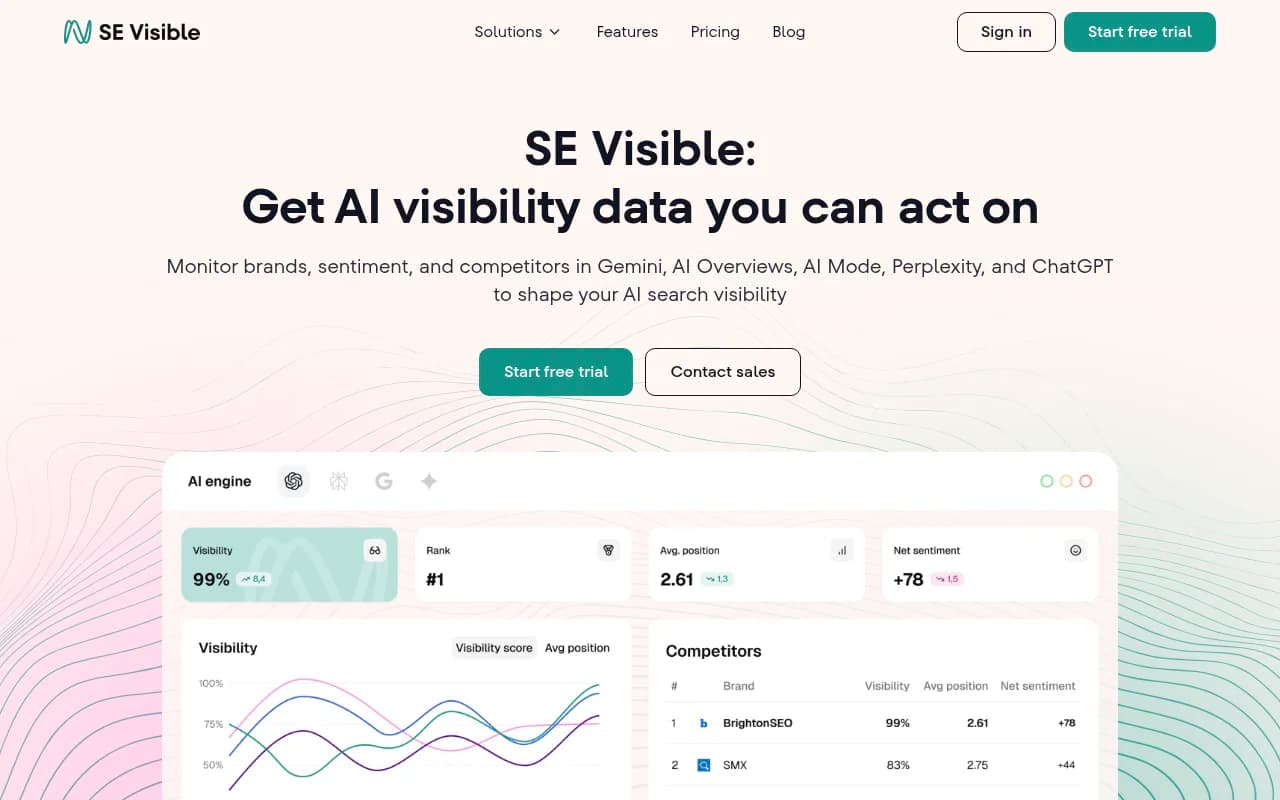
SE Visible is SE Ranking's dedicated AI visibility product. It tracks visibility scores, Net Sentiment Scores, and competitor benchmarks across AI engines. The reporting is polished and the data is presented in a way that works well for CMO-level presentations.
At $189/month, it's priced for marketing leaders rather than individual contributors. The main limitation is that data export is CSV-only, which frustrates teams that want to pipe data into custom dashboards. Like Otterly, it's primarily a monitoring and reporting tool rather than an optimization platform.
Profound -- best for enterprise e-commerce with complex brand portfolios
Profound is built for large brands that need to track AI narrative control across multiple product lines and regions. The conversation volume data and trend analysis are genuinely useful for understanding how AI discussions about your category are evolving over time.
The enterprise focus shows in the pricing -- meaningful features are locked to higher plans, and the entry point at $99/month is limited. For a mid-size e-commerce brand, Profound may be more platform than you need. For a brand with 50+ SKUs across multiple markets, it's worth evaluating.
ZipTie -- best for teams that want a clear action score
ZipTie takes an interesting approach: it gives you an AI Success Score that distills your visibility performance into a single number, then shows you citation optimization recommendations. It covers Google AI Overviews, ChatGPT, and Perplexity.
The credit-based billing model is a bit unusual and can create friction if you want to run frequent analyses. Report generation also has delays that some teams find frustrating. But for marketing leaders who want a clear, prioritized action list rather than a data dump, ZipTie's approach is genuinely useful.
Nightwatch -- best for teams that want hybrid SEO + AI tracking
Nightwatch started as a traditional SEO rank tracker and added AI visibility as a paid add-on ($99/month on top of the base $39/month plan). If your team still cares about traditional search rankings alongside AI visibility, Nightwatch lets you manage both in one place.
The AI tracking covers generative rankings, visibility scores, and citations. It's not as deep as dedicated AI visibility tools, but the hybrid approach means you're not maintaining two separate platforms.
Brand24 -- best for tracking brand sentiment across the full web
Brand24 is primarily a social listening tool, but it's worth including here because it monitors brand mentions across 25M+ sources including news, blogs, and social media. For e-commerce brands, understanding where your brand is being discussed -- and what's being said -- directly influences what AI models learn about you.
It doesn't track AI model responses directly, but it's a useful complement to a dedicated AI visibility tool.
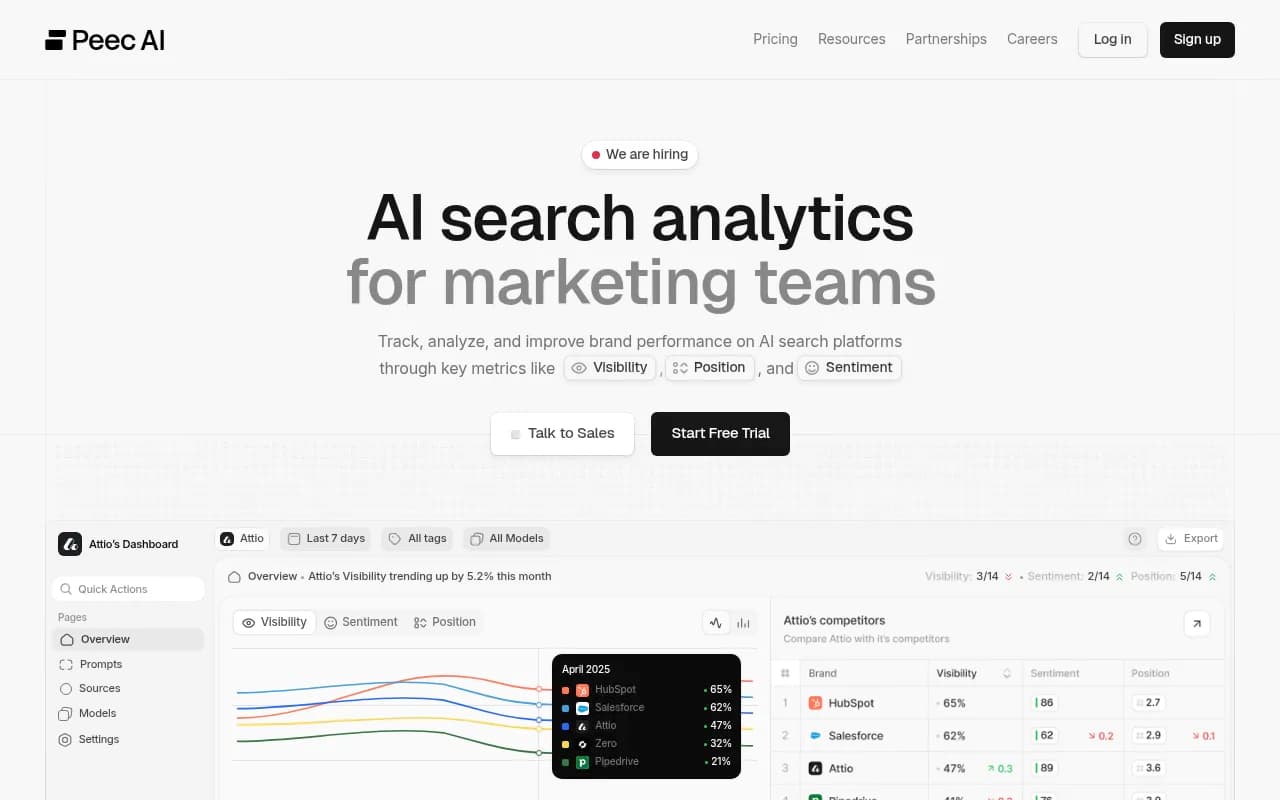
Peec AI -- best for international e-commerce
If you're selling across multiple languages and regions, Peec AI's multi-language monitoring is worth a look. Most tools in this space are English-first and treat international tracking as an afterthought. Peec AI was built with multi-language support as a core feature.
Feature comparison table
| Tool | AI models tracked | Content generation | Crawler logs | ChatGPT Shopping | Traffic attribution | Starting price |
|---|---|---|---|---|---|---|
| Promptwatch | 10 (ChatGPT, Claude, Gemini, Perplexity, Grok, DeepSeek, Copilot, Mistral, Meta AI, Google AIO) | Yes (built-in AI writer) | Yes | Yes | Yes (GSC, logs) | $99/mo |
| Otterly.AI | ChatGPT, Perplexity, others | No | No | No | No | $29/mo |
| SE Visible | Multiple | No | No | No | No | $189/mo |
| Profound | Multiple | No | No | No | Limited | $99/mo |
| ZipTie | ChatGPT, Perplexity, Google AIO | No | No | No | No | $69/mo |
| Nightwatch | Multiple (add-on) | No | No | No | No | $39/mo + $99 add-on |
| Brand24 | N/A (web monitoring) | No | No | No | No | ~$79/mo |
| Peec AI | Multiple | No | No | No | No | Custom |
What to look for when evaluating these tools
Prompt coverage for purchase-intent queries
The most important prompts for e-commerce are purchase-intent ones: "best [product category] for [use case]," "is [brand] worth it," "[brand] vs [competitor]." Make sure any tool you evaluate lets you track these specific prompt types, not just generic brand mention queries.
Competitor benchmarking
Knowing your own visibility score is useful. Knowing that a competitor has 3x your visibility for the prompts that drive your highest-margin category is actionable. Prioritize tools that show competitor data alongside your own.
Source analysis
AI models cite specific pages, Reddit threads, YouTube videos, and publications. Understanding which sources are being cited in your category tells you where to publish content and what to optimize. Tools that show source-level data are significantly more useful than those that only show aggregate scores.
Traffic attribution
Visibility scores are vanity metrics unless you can connect them to revenue. The best tools let you tie AI citations to actual website visits and conversions -- either through a code snippet, Google Search Console integration, or server log analysis. This is the piece most monitoring-only tools skip entirely.
How to actually improve your visibility in ChatGPT product recommendations
Tracking is step one. Here's what the brands winning in AI product recommendations are actually doing:
Publish content that answers the exact prompts shoppers use. If ChatGPT is being asked "best waterproof hiking boots under $200" and your site has no content targeting that question, you won't appear. Use a tool with Answer Gap Analysis to find the specific prompts your competitors are winning that you're not, then create content for those prompts.
Get cited by the sources AI trusts. AI models don't just crawl your website -- they synthesize information from across the web. Publications like Wirecutter, Reddit product communities, and YouTube review channels carry significant weight. Getting your products featured in these sources improves your AI visibility even if you don't change a word on your own site.
Fix technical issues that prevent AI crawlers from reading your pages. Many e-commerce sites have JavaScript-heavy product pages that AI crawlers struggle to index. Crawler log analysis (available in Promptwatch's Professional plan) shows you exactly which pages AI bots are hitting, which they're skipping, and what errors they're encountering.
Monitor sentiment, not just mentions. Being mentioned negatively in AI responses is worse than not being mentioned at all. Track sentiment trends and respond to the underlying issues (product quality, shipping complaints, customer service) that are generating negative AI narratives.
Track at the page level, not just the domain level. Your homepage might have decent AI visibility while your product category pages are invisible. Page-level tracking shows you exactly which pages are being cited and which need work.
The monitoring-only trap
One pattern worth flagging: most tools in this space are dashboards that show you data and stop there. You can see that your brand appears in 12% of relevant ChatGPT responses while a competitor appears in 34%. That's useful information. But what do you do with it?
The tools that generate real ROI in 2026 are the ones that close the loop -- they show you the gap, help you create content to close it, and then track whether that content actually gets cited. That's a fundamentally different product than a monitoring dashboard, and it's why the distinction between "tracking tools" and "optimization platforms" matters more than it did a year ago.
For e-commerce teams with limited bandwidth, the ability to generate AI-optimized content directly inside the same platform where you're doing your gap analysis is a meaningful time saver. Running between a visibility tracker, a content brief tool, and a separate writing tool adds friction that most teams eventually abandon.
Recommended setup by team size
For small e-commerce teams (1-3 people in marketing), start with Otterly.AI for monitoring and add Promptwatch when you're ready to start optimizing content. The combination gives you affordable monitoring plus a real path to improvement.
For mid-size brands with a dedicated SEO or content team, Promptwatch's Professional plan at $249/month covers monitoring, content generation, and crawler logs in one place. This is the tier where the closed-loop approach starts to pay off clearly.
For enterprise brands with multiple product lines or international markets, Promptwatch's Business or Enterprise plans, or Profound for narrative control, are worth evaluating. At this scale, the ability to track visibility across regions and connect it to revenue becomes critical.
Whatever tool you choose, the most important thing is to start tracking now. The brands that understand their AI visibility today are the ones building the content and citation footprint that will compound over the next 12-18 months. The ones waiting for AI search to "mature" before paying attention are falling further behind every week.