Summary
- Content gap analysis identifies the specific prompts and topics where competitors are visible in AI search but you're not -- it's the bridge between tracking and optimization
- Most AI visibility tools only monitor citations. Platforms with gap analysis show you what content to create, not just what's missing.
- Promptwatch leads the category with Answer Gap Analysis that surfaces missing content, then generates articles grounded in 880M+ citations to fill those gaps
- The best platforms combine gap detection with prompt intelligence (volumes, difficulty scores), citation data, and content generation -- not just dashboards
- Pricing ranges from $99/mo (Promptwatch Essential) to $1,000+/mo (enterprise platforms like Profound and Evertune)

What is content gap analysis for AI visibility?
Content gap analysis for AI search identifies the specific prompts, questions, and topics where your competitors are being cited by ChatGPT, Claude, Perplexity, and other AI models -- but you're not. It's the difference between knowing you're invisible and knowing exactly why.
Traditional AI visibility tools show you a dashboard of citations and visibility scores. That's useful, but it leaves you stuck. You see the problem but have no roadmap to fix it. Content gap analysis changes that. It tells you:
- Which prompts competitors rank for that you don't
- What topics and angles AI models want answers to but can't find on your site
- Which content types (listicles, comparisons, how-to guides) are missing from your content library
- Where the highest-value opportunities are based on prompt volume and difficulty
The result: instead of guessing what to write next, you have a data-driven content roadmap grounded in real AI search behavior.
Why content gap analysis matters more than monitoring
Most AI visibility platforms are monitoring-only dashboards. They track citations, show competitor heatmaps, and surface sentiment. That's table stakes. But monitoring without action is just expensive data.
Content gap analysis closes the loop. It shows you what's missing, then helps you fix it. Here's why that matters:
AI models cite what exists, not what should exist. If your site doesn't have an article answering a specific question, ChatGPT will cite your competitor instead. Gap analysis surfaces those missing pieces.
Prompt volumes are uneven. Some prompts get asked 10,000 times a month. Others get asked 50 times. Gap analysis prioritizes high-volume, winnable prompts instead of leaving you to guess.
Content types matter. AI models prefer certain formats for certain queries. Comparison tables for "X vs Y" prompts. Step-by-step guides for how-to queries. Listicles for "best X" searches. Gap analysis tells you which formats to create.
Competitors are moving fast. If a rival publishes a comprehensive guide on a topic you're ignoring, they'll own that prompt cluster until you catch up. Gap analysis flags those threats before they become permanent.
The platforms below don't just track AI visibility. They help you optimize it.
How we evaluated these platforms
We tested 20+ AI visibility tools and narrowed the list to platforms that offer genuine content gap analysis -- not just citation tracking. Our criteria:
Gap detection depth: Does the tool show you specific prompts competitors rank for but you don't? Or just vague "you're behind" signals?
Prompt intelligence: Volume estimates, difficulty scores, query fan-outs, persona targeting. The more context, the better.
Citation and source analysis: Which pages, domains, Reddit threads, and YouTube videos are AI models citing? You need to know where to publish and what to optimize.
Content generation or optimization: Does the platform help you create content that fills the gaps? Or leave you to figure it out yourself?
AI model coverage: Tracking ChatGPT alone isn't enough. The best platforms monitor 6-10 models including Perplexity, Claude, Gemini, Google AI Overviews, and Copilot.
Pricing transparency: We prioritized platforms with clear pricing and accessible entry tiers.
The best AI visibility platforms with content gap analysis
Promptwatch: action-first platform with Answer Gap Analysis
Promptwatch is the only AI visibility platform rated as a "Leader" across all categories in a 2026 comparison of 12 GEO tools. The reason: it's built around the action loop -- find gaps, create content, track results.
Answer Gap Analysis is the core differentiator. It shows you exactly which prompts competitors are visible for but you're not, then surfaces the specific content your website is missing. You see the topics, angles, and questions AI models want answers to but can't find on your site.
Once you know the gaps, Promptwatch's built-in AI writing agent generates articles, listicles, and comparisons grounded in real citation data (880M+ citations analyzed), prompt volumes, persona targeting, and competitor analysis. This isn't generic SEO filler -- it's content engineered to get cited by ChatGPT, Claude, and Perplexity.
The platform tracks 10 AI models: ChatGPT, Perplexity, Google AI Overviews, Google AI Mode, Claude, Gemini, Meta/Llama, DeepSeek, Grok, Mistral, and Copilot. Page-level tracking shows exactly which pages are being cited, how often, and by which models. Traffic attribution (code snippet, GSC integration, or server log analysis) connects visibility to revenue.
Additional capabilities:
- AI Crawler Logs: real-time logs of AI crawlers hitting your site -- which pages they read, errors they encounter, how often they return
- Prompt Intelligence: volume estimates, difficulty scores, query fan-outs
- Citation & Source Analysis: see which pages, Reddit threads, YouTube videos, and domains AI models cite
- Reddit & YouTube Insights: surface discussions that influence AI recommendations
- ChatGPT Shopping Tracking: monitor product recommendations and shopping carousels
- Competitor Heatmaps: compare visibility vs competitors across LLMs
- Multi-language & Multi-region: monitor AI responses in any language, from any country
Pricing: Essential $99/mo (1 site, 50 prompts, 5 articles), Professional $249/mo (2 sites, 150 prompts, 15 articles, crawler logs), Business $579/mo (5 sites, 350 prompts, 30 articles). Free trial available.
Best for: Marketing teams, SEO teams, and agencies that want to close content gaps and optimize for AI search, not just monitor it.
Profound: enterprise AI visibility with 400M+ prompt insights
Profound is the highest-rated AI visibility platform with an AEO score of 92/100. It tracks 10+ AI engines and offers 400M+ prompt insights, making it a strong choice for enterprise teams that need deep data.
The platform's gap analysis identifies prompts where competitors are cited but you're not, then surfaces content opportunities based on prompt volume and competitive intensity. Profound also offers SOC 2 Type II compliance, which matters for regulated industries.
What sets Profound apart: granular prompt categorization and query clustering. You can see how one broad prompt branches into sub-queries, then prioritize the highest-value clusters. The platform also tracks sentiment and hallucination detection -- useful for brand safety.
Pricing: Custom enterprise pricing, typically $1,000+/mo.
Best for: Enterprise brands with compliance requirements and large content teams.
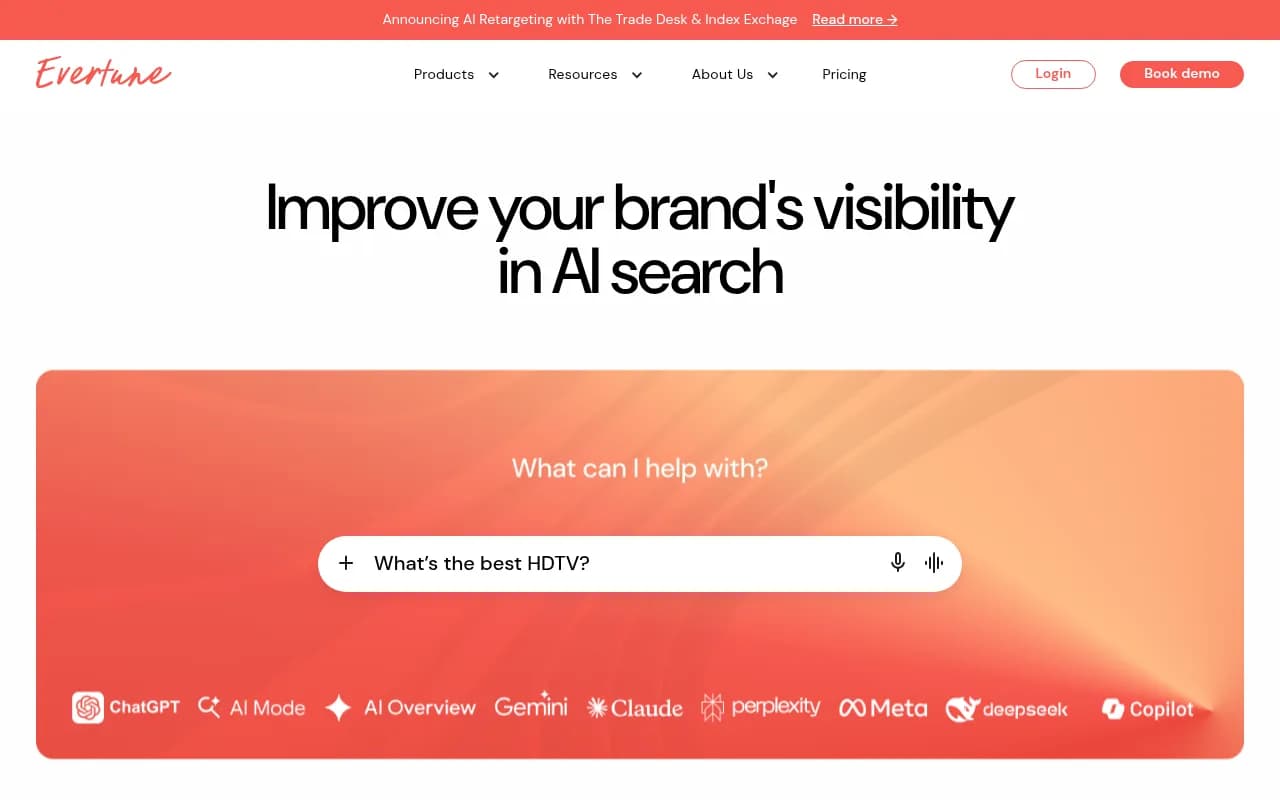
Evertune: Fortune 500-trusted GEO platform
Evertune is the enterprise GEO platform trusted by Fortune 500 brands to dominate AI search. It monitors brand visibility and mentions across ChatGPT, Perplexity, and other leading AI systems.
Evertune's gap analysis focuses on competitive benchmarking. You see where competitors are winning for specific prompts, then get recommendations on content types and angles to compete. The platform also offers white-glove onboarding and strategic consulting -- useful if you're building a GEO program from scratch.
The trade-off: Evertune is expensive and built for large teams. If you're a small business or solo marketer, the pricing and feature set will be overkill.
Pricing: Custom enterprise pricing.
Best for: Fortune 500 brands building comprehensive GEO programs with dedicated teams.
Peec AI: multi-language AI visibility with smart suggestions
Peec AI is a multi-language AI visibility platform that tracks brand mentions across ChatGPT, Perplexity, Claude, and Gemini. The platform's gap analysis surfaces prompts where competitors are cited but you're not, then offers smart content suggestions based on prompt intent and language.
What makes Peec unique: strong multi-language support. If you're optimizing for AI search in multiple markets (e.g. English, Spanish, French, German), Peec handles persona targeting and regional variations better than most competitors.
The downside: Peec lacks content generation. It tells you what to write but doesn't help you write it.
Pricing: Not publicly listed. Contact for quote.
Best for: Global brands optimizing for AI search in multiple languages.

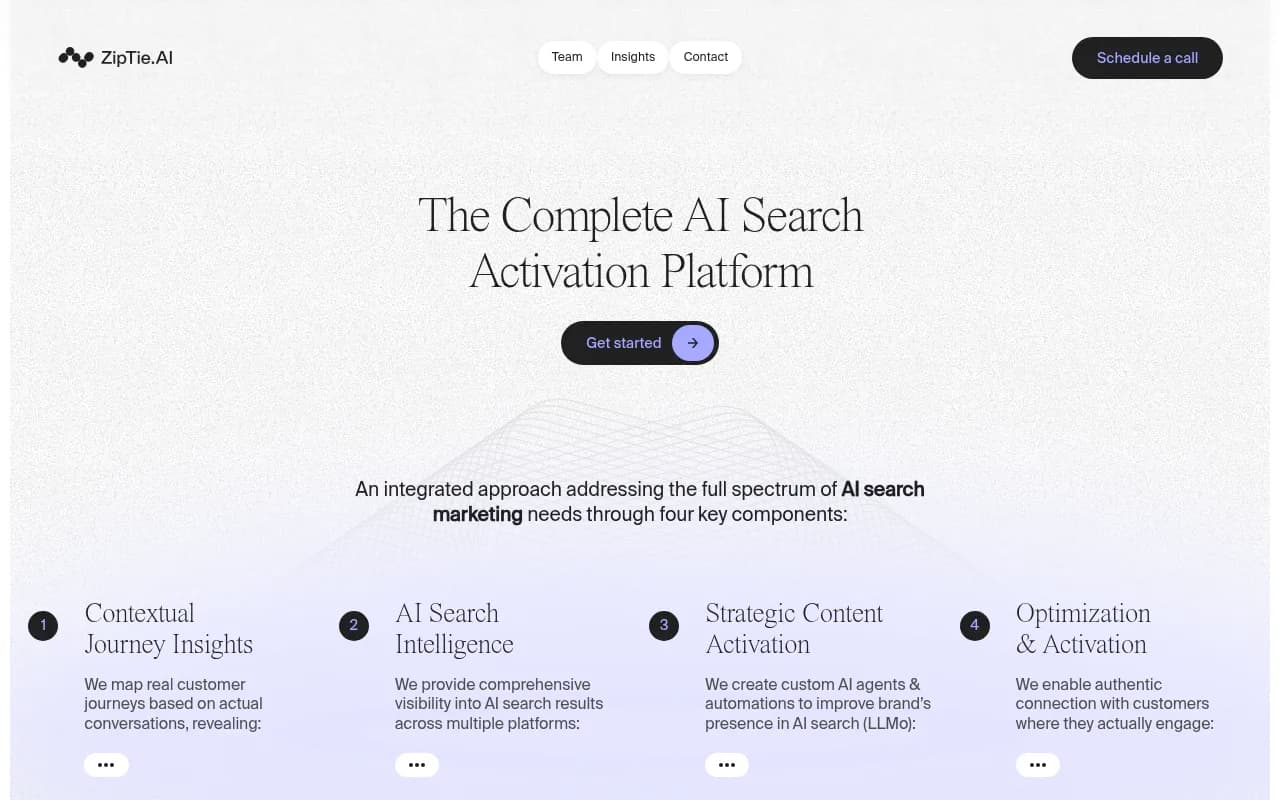
ZipTie: deep analysis and reporting for AI search visibility
ZipTie offers deep analysis and reporting for AI search visibility. The platform's gap analysis identifies missing content opportunities, then provides detailed reports on prompt volumes, citation sources, and competitor strategies.
ZipTie's strength is reporting depth. You get granular breakdowns of which domains AI models cite, which content formats perform best, and how your visibility trends over time. This is useful for agencies and consultants who need to present data to clients.
The trade-off: ZipTie is reporting-heavy but light on optimization tools. You get great insights but limited help creating content to fill the gaps.
Pricing: Not publicly listed.
Best for: Agencies and consultants who need detailed reporting for clients.
Similarweb: side-by-side SEO and GEO tracking
Similarweb is a digital market intelligence platform that recently added AI visibility tracking. The platform's gap analysis compares your SEO performance (traditional Google rankings) with your GEO performance (AI search citations) side by side.
This is useful if you're trying to understand how AI search is cannibalizing traditional search traffic. You can see which keywords are shifting from Google to ChatGPT, then adjust your content strategy accordingly.
The downside: Similarweb's AI visibility features are newer and less mature than dedicated GEO platforms. Gap analysis is surface-level compared to Promptwatch or Profound.
Pricing: Custom enterprise pricing.
Best for: Enterprise teams that want to track SEO and GEO performance in one platform.
Semrush: AI visibility tracking for existing Semrush users
Semrush added AI visibility tracking to its all-in-one digital marketing platform in 2025. The feature tracks brand mentions across ChatGPT, Perplexity, and Google AI Overviews.
Semrush's gap analysis is basic: it shows you prompts where competitors are cited but you're not, then suggests related keywords from its traditional SEO database. This works if you're already a Semrush user and want to add AI visibility tracking without switching platforms.
The limitation: Semrush uses fixed prompts, not custom queries. You can't track the specific prompts your customers are actually asking. This makes gap analysis less actionable than platforms like Promptwatch that let you define your own prompt sets.
Pricing: Included with Semrush subscriptions starting at $139.95/mo.
Best for: Existing Semrush users who want basic AI visibility tracking.
Ahrefs Brand Radar: brand monitoring in AI search
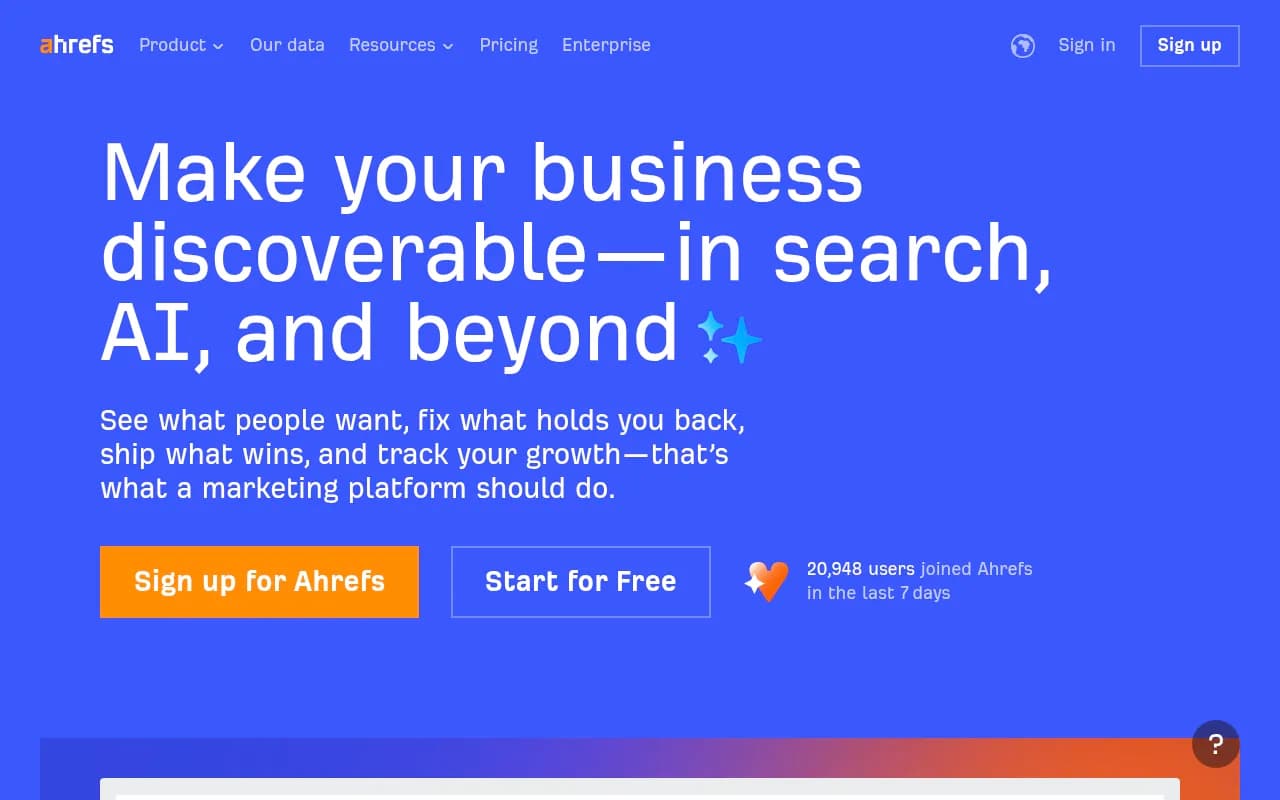
Ahrefs Brand Radar tracks brand mentions across ChatGPT, Perplexity, Gemini, Copilot, Google AI Overviews, and Google AI Mode. It also scans YouTube for brand mentions.
The platform's gap analysis is limited. You can see when competitors are mentioned but you're not, but there's no prompt volume data, difficulty scoring, or content recommendations. Ahrefs also uses fixed prompts, not custom queries.
The upside: if you're already an Ahrefs user, Brand Radar is included in your subscription. It's a low-friction way to start monitoring AI visibility.
Pricing: Included with Ahrefs subscriptions starting at $129/mo.
Best for: Ahrefs users who want basic brand monitoring in AI search.
Comparison table: key features and pricing
| Platform | Gap analysis depth | Content generation | AI models tracked | Starting price |
|---|---|---|---|---|
| Promptwatch | Answer Gap Analysis with prompt volumes, difficulty, query fan-outs | Built-in AI writing agent | 10 (ChatGPT, Perplexity, Claude, Gemini, etc.) | $99/mo |
| Profound | Prompt clustering and competitive benchmarking | No | 10+ | Custom (typically $1,000+/mo) |
| Evertune | Competitive benchmarking with strategic consulting | No | ChatGPT, Perplexity, others | Custom |
| Peec AI | Multi-language gap detection with smart suggestions | No | ChatGPT, Perplexity, Claude, Gemini | Contact for quote |
| ZipTie | Detailed reporting on missing content opportunities | No | Multiple | Contact for quote |
| Similarweb | Side-by-side SEO/GEO comparison | No | Multiple | Custom |
| Semrush | Basic gap detection with fixed prompts | No | ChatGPT, Perplexity, Google AI Overviews | $139.95/mo |
| Ahrefs Brand Radar | Basic competitor mention tracking | No | 6 (ChatGPT, Perplexity, Gemini, Copilot, Google AI) | $129/mo |
What to look for in a content gap analysis platform
Not all gap analysis features are created equal. Here's what separates useful tools from dashboards that just show you problems without solutions:
Prompt-level granularity: The platform should show you specific prompts competitors rank for, not just vague "you're behind in this category" signals. You need to see the exact questions AI models are answering with competitor content.
Volume and difficulty data: Knowing a gap exists isn't enough. You need to know if the gap is worth filling. Prompt volume estimates tell you how often a query is asked. Difficulty scores tell you how hard it will be to compete.
Query fan-outs: One broad prompt (e.g. "best CRM software") branches into dozens of sub-queries ("best CRM for small business", "best CRM for real estate", "CRM vs marketing automation"). The best platforms map these relationships so you can prioritize clusters, not individual prompts.
Citation source analysis: Which pages, domains, Reddit threads, and YouTube videos are AI models citing for the prompts you're missing? This tells you where to publish and what format to use.
Content generation or optimization: Does the platform help you create content to fill the gaps? Or leave you to figure it out yourself? Platforms with built-in AI writing agents (like Promptwatch) close the loop. Monitoring-only tools leave you stuck.
Multi-model coverage: Tracking ChatGPT alone isn't enough. Different AI models cite different sources. The best platforms monitor 6-10 models including Perplexity, Claude, Gemini, Google AI Overviews, and Copilot.
How to use content gap analysis to improve AI visibility
Here's the action loop for turning gap analysis into results:
Step 1: Identify high-value gaps. Run a gap analysis to see which prompts competitors rank for but you don't. Filter by prompt volume and difficulty to prioritize winnable, high-traffic opportunities.
Step 2: Analyze citation sources. For each gap, look at which pages, domains, and content types AI models are citing. Are they citing comparison tables? How-to guides? Reddit threads? This tells you what format to create.
Step 3: Create content that fills the gap. Write articles, listicles, or comparisons that directly answer the prompts you're missing. Use platforms like Promptwatch that generate content grounded in citation data, or write manually using the gap analysis as a brief.
Step 4: Track results. Monitor your visibility scores and page-level citations to see if the new content is getting picked up by AI models. If it's not working after 2-4 weeks, adjust the content or try a different format.
Step 5: Repeat. Content gap analysis isn't a one-time project. Competitors are publishing new content, AI models are updating their training data, and user behavior is shifting. Run gap analysis monthly to stay ahead.
Common mistakes to avoid
Here are the traps teams fall into when using content gap analysis:
Chasing low-volume prompts. Just because a gap exists doesn't mean it's worth filling. Focus on prompts with meaningful volume and commercial intent.
Ignoring content format. AI models prefer certain formats for certain queries. If competitors are getting cited with comparison tables and you publish a generic blog post, you'll lose.
Creating content without optimization. Writing an article isn't enough. You need to optimize it for AI crawlers -- clear structure, concise answers, authoritative sources, and proper schema markup.
Monitoring without action. The biggest mistake: running gap analysis, seeing the opportunities, then doing nothing. Gap analysis is only valuable if you close the gaps.
Final thoughts
Content gap analysis is the difference between monitoring AI visibility and actually improving it. Most platforms show you the problem. The best platforms show you the problem, tell you how to fix it, then help you create the content that closes the gap.
Promptwatch leads the category because it's the only platform that combines gap detection, prompt intelligence, citation analysis, and content generation in one workflow. You find the gaps, generate the content, and track the results -- all in one place.
If you're serious about AI visibility, start with a platform that helps you take action, not just collect data.