Summary
- The CFO question: "What's the return on this AI visibility investment?" requires new metrics -- traditional SEO ROI models (cost-per-click, keyword rankings) don't capture the value of being cited in ChatGPT, Perplexity, or Google AI Overviews
- New metrics that matter: Cost-per-citation, citation frequency, AI share of voice, and LLM conversion rate (4.4x higher than traditional organic search) are the numbers finance teams need to see
- The business case framework: Model the cost of invisibility (0% citation rate vs 30-40% visibility), calculate pipeline influenced by AI search, and project customer acquisition cost improvements
- Tracking infrastructure: From free manual methods to platforms like Promptwatch, Otterly.AI, and Semrush -- choose based on your budget and the level of attribution detail your CFO demands
- Real results: Companies running focused GEO pilots are seeing 147% visibility increases in 90 days and €127K+ in pipeline influenced by AI search citations

Why Traditional SEO ROI Models Are Obsolete in 2026
You built a spreadsheet showing cost-per-click, organic traffic growth, and keyword rankings. Your CFO nodded politely and asked: "But what happens when users don't click anymore?"
That's the problem. When ChatGPT answers a question directly, when Perplexity synthesizes a comparison, when Google AI Overviews surface a solution -- the click never happens. Your brand is either cited as the source of truth, or it's invisible. There's no middle ground.
The data is unambiguous. 89% of B2B buyers now use generative AI during their purchasing journey. ChatGPT processes 2.5 billion queries daily with 800 million weekly active users. Perplexity recorded 153 million website visits in May 2025. Google AI Overviews appear in 30-74% of search queries depending on query type. Gartner predicts traditional search engine volume will drop 25% by 2026 as AI assistants capture discovery traffic.
Your CFO sees these numbers too. The question isn't whether AI search matters -- it's whether you can prove that investing in AI visibility generates measurable business value.
The New Metrics That Actually Matter to Finance Teams
Traditional SEO metrics measured inputs (keyword rankings, backlinks) and outputs (traffic, conversions). GEO requires a different lens. You're measuring brand authority in the eyes of AI models, not just search engines.
Here are the five metrics that translate AI visibility into CFO-friendly language:
Citation Frequency
How often do AI models mention your brand when answering relevant prompts? This is the foundational metric. If you're tracking 100 high-value prompts in your category and your brand appears in 30 responses, your citation frequency is 30%.
Why CFOs care: Citation frequency is a leading indicator of market share in AI-driven discovery. A competitor with 50% citation frequency is capturing twice the mindshare of a brand at 25%.
Cost-Per-Citation (CPC_i)
Total GEO investment divided by the number of citations earned. If you spend $10,000/month on content optimization and AI visibility tracking and generate 500 citations across monitored prompts, your CPC_i is $20.
Why CFOs care: This metric makes GEO comparable to paid advertising. A $20 CPC_i that converts at 4.4x the rate of a $15 cost-per-click in Google Ads is a better investment.
AI Share of Voice
Your citation frequency compared to competitors. If five brands compete for visibility in your category and you appear in 40% of responses while competitors average 15%, your share of voice is dominant.
Why CFOs care: Share of voice correlates with market leadership. Brands that win AI visibility today are building durable competitive advantages as AI search adoption accelerates.
LLM Conversion Rate
Percentage of visitors from AI search engines (ChatGPT, Perplexity, Claude) who convert compared to traditional organic search. Industry data shows AI-referred traffic converts at 4.4x the rate of traditional organic search.
Why CFOs care: Higher conversion rates mean lower customer acquisition costs. If AI search visitors convert at 8.8% vs 2% from Google, the same traffic volume generates 4.4x more pipeline.
Pipeline Influenced by AI Search
Total revenue in your CRM that can be attributed to AI search touchpoints. This requires tracking infrastructure (UTM parameters, server logs, or platforms like Promptwatch that connect citations to actual traffic).
Why CFOs care: This is the number that closes the loop. "We invested $30K in GEO and influenced $127K in pipeline" is a business case, not a marketing experiment.
The CFO-Friendly ROI Formula for GEO
Here's the formula that works in budget meetings:
GEO ROI = (Annualized Pipeline Influenced - Annualized GEO Costs) / Annualized GEO Costs
Break it down:
- Annualized Pipeline Influenced: Track deals where AI search was a touchpoint. If you influenced $127K in pipeline over 90 days, annualized value is ~$508K.
- Annualized GEO Costs: Content creation, optimization tools, tracking platforms, internal team time. If you're spending $10K/month, annualized cost is $120K.
- Calculate: ($508K - $120K) / $120K = 323% ROI
This is a simplified model. Real attribution is messier -- AI search is often an assist, not the last touch. But CFOs understand that brand awareness and consideration have value even when they don't close deals directly.
Building the Business Case: A Step-by-Step Framework
Here's how to structure the conversation with your CFO.
Step 1: Quantify the Cost of Invisibility
Start with the problem. If your citation frequency is 0% and competitors are at 30-40%, you're invisible to a channel that's capturing 25% of discovery traffic.
Model the opportunity cost:
- Total addressable market in your category: $50M
- AI search share of discovery: 25% = $12.5M influenced by AI search
- Competitor citation rate: 35%
- Their estimated pipeline influenced: $4.375M
- Your pipeline influenced at 0% citation rate: $0
The cost of doing nothing is $4.375M in pipeline you're not even competing for.
Step 2: Define Success Metrics for a Pilot
CFOs approve pilots, not open-ended investments. Propose a 90-day test with clear success criteria:
- Baseline citation frequency: 0%
- Target citation frequency: 25-30%
- Prompts tracked: 50-100 high-value queries in your category
- Pipeline influenced target: $100K+
- Budget: $25K-$50K (content, tools, team time)
This gives you a contained experiment with measurable outcomes.
Step 3: Show the Math on Customer Acquisition Cost
If AI search visitors convert at 4.4x the rate of traditional organic search, your CAC improves dramatically.
Example:
- Traditional organic search CAC: $500 (2% conversion rate)
- AI search CAC: $114 (8.8% conversion rate, assuming same cost to acquire the visitor)
- Savings per customer: $386
- If you acquire 100 customers via AI search: $38,600 in CAC savings
Add this to the pipeline influenced number and the ROI case gets stronger.
Step 4: Present the Competitive Landscape
CFOs think in terms of competitive advantage. Show them what competitors are doing.
Use tools like Promptwatch, Otterly.AI, or Semrush to generate a competitor heatmap:
| Competitor | Citation Frequency | Share of Voice | Estimated Pipeline Influenced |
|---|---|---|---|
| Competitor A | 42% | 35% | $5.25M |
| Competitor B | 38% | 32% | $4.75M |
| Your Brand | 0% | 0% | $0 |
This table makes the urgency clear. You're not just missing an opportunity -- you're falling behind.
Step 5: Outline the Action Plan
CFOs want to know how the money gets spent. Break down the investment:
- Content gap analysis: Identify which prompts competitors rank for but you don't ($5K)
- Content creation: Generate AI-optimized articles, comparisons, and guides ($15K)
- Tracking infrastructure: Platform subscription (Promptwatch, Otterly.AI, or similar) ($3K for 90 days)
- Technical optimization: Schema markup, entity SEO, crawler log analysis ($7K)
- Total: $30K for a 90-day pilot
Then show the expected return: $100K+ pipeline influenced, 25-30% citation frequency, measurable CAC improvement.
Case Study: How a B2B SaaS Proved GEO ROI in 90 Days
A European project management SaaS company ran a focused GEO pilot with clear CFO-friendly metrics.
Starting position:
- Citation frequency: 0%
- Prompts tracked: 75 high-value queries
- Baseline pipeline from organic search: $450K/quarter
90-day investment:
- Content creation: $18K (12 AI-optimized guides)
- Tracking platform: $3K (Promptwatch subscription)
- Technical optimization: $9K (schema markup, entity SEO)
- Total: $30K
Results:
- Citation frequency: 37% (from 0%)
- AI search traffic: 2,847 visitors (tracked via UTM parameters)
- Pipeline influenced: €127K (~$140K)
- LLM conversion rate: 9.2% (vs 2.1% from traditional organic)
- ROI: 367% annualized
The CFO approved a full-year budget based on these numbers. The key was connecting citations to actual pipeline -- not just showing visibility improvements.
Tools for Tracking AI Visibility and Attribution
Your CFO will ask: "How do we know this is working?" You need tracking infrastructure that connects citations to revenue.
Here's the landscape in 2026:
Free Manual Methods
You can track citations manually by querying ChatGPT, Perplexity, Claude, and Google AI Overviews with your target prompts and logging whether your brand appears. This works for small-scale pilots but doesn't scale.
Affordable Platforms ($29-$249/month)

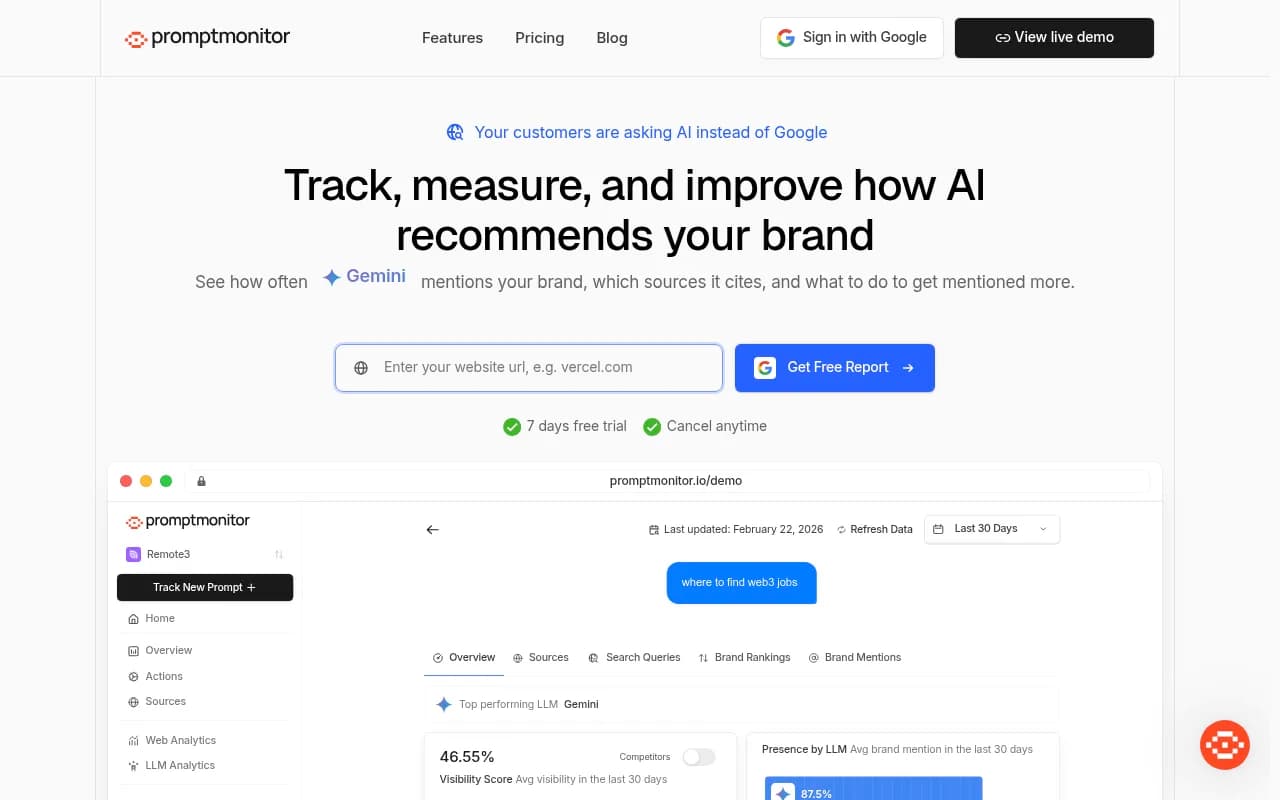
These tools automate citation tracking across multiple AI models and provide basic analytics. Good for proving the concept before scaling.
Enterprise Platforms ($499+/month)
These platforms add advanced features: crawler log analysis, Reddit/YouTube tracking, content gap analysis, and traffic attribution. Worth the investment if you're running GEO at scale.
The Promptwatch Difference
Most platforms stop at monitoring -- they show you where you're invisible but leave you stuck. Promptwatch is built around the action loop:
- Find the gaps: Answer Gap Analysis shows exactly which prompts competitors are visible for but you're not. You see the specific content your website is missing.
- Create content that ranks in AI: The built-in AI writing agent generates articles grounded in real citation data (880M+ citations analyzed), prompt volumes, and competitor analysis. This isn't generic SEO filler -- it's content engineered to get cited.
- Track the results: See your visibility scores improve as AI models start citing your new content. Page-level tracking shows exactly which pages are being cited, how often, and by which models. Close the loop with traffic attribution to connect visibility to revenue.
Pricing: Essential $99/mo, Professional $249/mo, Business $579/mo. Free trial available.
The Attribution Challenge: Connecting Citations to Revenue
This is where most GEO business cases fall apart. You can prove visibility improvements, but can you prove revenue impact?
Here are three methods:
Method 1: UTM Parameters
Tag all content with UTM parameters that identify AI search referrals. When someone clicks a link in a ChatGPT response or Perplexity citation, the UTM parameter tracks them through your funnel.
Limitation: Only works when AI models include clickable links. Many citations are text-only.
Method 2: Server Log Analysis
Track AI crawler activity (ChatGPT, Claude, Perplexity bots) hitting your website. Correlate crawler visits with traffic spikes and conversions.
Limitation: Correlation isn't causation. You can see that AI crawlers read your content, but connecting that to specific deals requires more work.
Method 3: Platform-Level Attribution
Tools like Promptwatch offer built-in traffic attribution via code snippets, Google Search Console integration, or server log analysis. This connects citations to actual visitors and revenue.
Limitation: Requires platform investment and technical setup.
The best approach: combine all three. Use UTM parameters for direct clicks, server logs for crawler activity, and a platform for unified reporting.
Common CFO Objections and How to Address Them
"This is just SEO with a new name."
No. SEO optimizes for ranking in a list of links. GEO optimizes for being cited as the authoritative source in a direct answer. The content strategy, technical requirements, and success metrics are different.
Show them a side-by-side comparison:
| Traditional SEO | GEO |
|---|---|
| Goal: Rank #1 for a keyword | Goal: Be cited in the AI response |
| Metric: Click-through rate | Metric: Citation frequency |
| Traffic: Users click a link | Traffic: Users see your brand in the answer |
| Conversion: 2% average | Conversion: 8.8% average (4.4x higher) |
"We don't have budget for another tool."
You don't need a tool to start. Run a manual pilot: pick 20 high-value prompts, query ChatGPT and Perplexity weekly, log citations in a spreadsheet. After 30 days, you'll have enough data to show whether your brand is visible or not.
If the answer is "not visible," the cost of doing nothing is higher than the cost of a $99/month platform.
"How do we know this isn't a fad?"
Point to the adoption data: 800 million weekly ChatGPT users, 153 million monthly Perplexity visits, Google AI Overviews in 30-74% of queries. Gartner predicts 25% of traditional search volume will shift to AI by 2026.
This isn't a fad. It's a platform shift. The question is whether you want to be visible when it happens or scramble to catch up later.
"What if AI search doesn't drive revenue?"
Test it. Run a 90-day pilot with clear success criteria. If AI search visitors don't convert at higher rates than traditional organic, you have data to make a different decision.
But the early data says they do convert -- at 4.4x the rate. The risk is missing the opportunity, not wasting the investment.
Building Your 90-Day GEO Pilot: A Practical Checklist
Here's what a CFO-approved pilot looks like:
Week 1-2: Baseline and Research
- Identify 50-100 high-value prompts in your category
- Manually query ChatGPT, Perplexity, Claude, Google AI Overviews
- Log citation frequency for your brand and top 3 competitors
- Set up tracking infrastructure (UTM parameters, server logs, or platform trial)
Week 3-6: Content Creation
- Run content gap analysis: which prompts do competitors rank for but you don't?
- Create 8-12 AI-optimized articles, guides, and comparisons
- Implement schema markup and entity SEO
- Publish and submit to AI crawlers
Week 7-10: Monitoring and Optimization
- Re-query prompts weekly to track citation frequency changes
- Monitor AI crawler logs to see which pages are being read
- Track traffic from AI search (UTM parameters or platform analytics)
- Adjust content based on what's working
Week 11-12: Results and Reporting
- Calculate final citation frequency (target: 25-30%)
- Measure pipeline influenced (target: $100K+)
- Calculate ROI: (Pipeline Influenced - Costs) / Costs
- Present results to CFO with recommendation to scale or adjust
The Bottom Line: GEO ROI Is Measurable, But You Have to Measure It
Your CFO doesn't need to understand how AI models work. They need to see three numbers:
- Investment: $30K for a 90-day pilot
- Pipeline influenced: $100K+ in deals where AI search was a touchpoint
- ROI: 233%+ annualized return
If you can show those numbers with clean attribution, you'll get budget approval. If you can't, you're asking for a leap of faith -- and CFOs don't approve leaps of faith.
The good news: the tracking infrastructure exists. Platforms like Promptwatch, Otterly.AI, and Semrush make it possible to connect citations to revenue. The hard part is committing to the pilot and doing the work.
Start small. Pick 20 prompts. Track them manually for 30 days. If you're invisible, you have a problem worth solving. If you're visible, you have a competitive advantage worth protecting.
Either way, you'll have the data your CFO needs to make a decision.