Key Takeaways
- Promptwatch is the specialist: Built from the ground up for AI search visibility with 880M+ citations analyzed, real-time crawler logs, and Reddit/YouTube tracking. Writesonic pivoted from AI writing to add visibility features, resulting in less depth.
- Content generation approach differs: Promptwatch generates content grounded in citation data and Answer Gap Analysis to fix specific visibility gaps. Writesonic offers general AI writing templates without the same level of citation-driven optimization.
- Pricing reflects focus: Writesonic starts cheaper at $49/mo but lacks crawler logs and page-level tracking. Promptwatch costs more ($99/mo entry) but delivers actionable data like prompt volumes, difficulty scores, and query fan-outs that justify the price for serious optimization work.
- Crawler visibility is Promptwatch-only: Real-time logs of AI bots (ChatGPT, Claude, Perplexity) crawling your site are exclusive to Promptwatch. You can't diagnose indexing issues or optimize for AI crawlers with Writesonic.
- Integration depth matters: Promptwatch connects to GSC, offers Looker Studio integration, and has a full API. Writesonic's integration story is murkier and less robust.
- If you're choosing: Pick Promptwatch if AI visibility is a revenue channel you're serious about optimizing. Pick Writesonic if you mainly need AI writing tools and want basic visibility tracking as a bonus feature.
Overview
Promptwatch: The AI visibility specialist

Promptwatch is an end-to-end AI Search Visibility platform used by 7,000+ brands including Booking.com, Center Parcs, and Typeform. It tracks how your brand appears across ChatGPT, Claude, Perplexity, Gemini, Grok, DeepSeek, Copilot, Mistral, Meta AI, and Google AI Overviews. The platform has processed over 1.1 billion citations, clicks, and prompts, with data featured in the Wall Street Journal, Yahoo Finance, and Axios.
What sets Promptwatch apart is the action loop: it doesn't just show you where you're invisible -- it helps you fix it. Answer Gap Analysis reveals exactly which prompts competitors rank for but you don't, then the built-in AI writing agent generates content engineered to get cited by AI models. You close the loop with page-level tracking and traffic attribution to connect visibility to revenue.
Core capabilities include AI crawler logs (see which pages ChatGPT and Claude are reading), prompt intelligence (volume estimates and difficulty scores), citation and source analysis, Reddit and YouTube insights, ChatGPT Shopping tracking, and competitor heatmaps. It's the only platform rated as a "Leader" across all categories in a 2026 comparison of 12 GEO platforms.
Writesonic: AI writing tool with visibility features
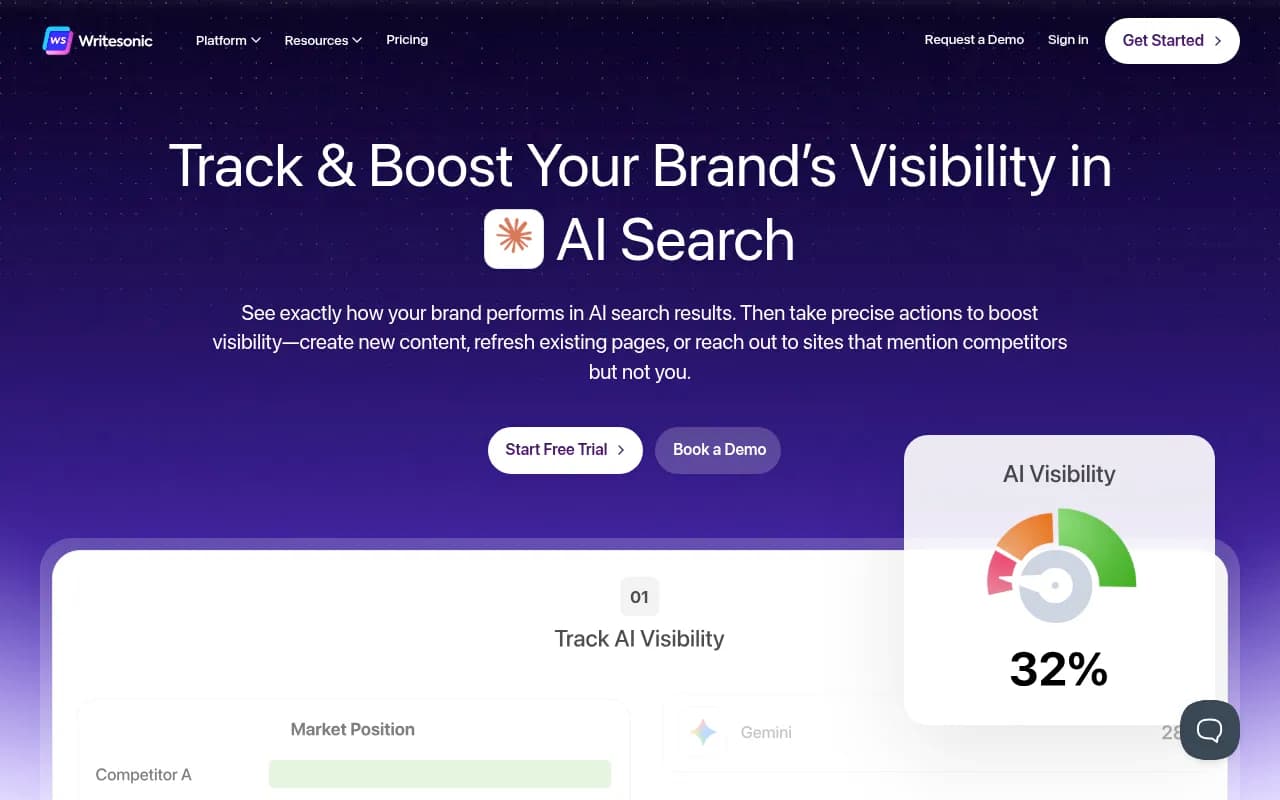
Writesonic started as an AI content generation platform and has since expanded into AI search visibility tracking. It monitors brand mentions across ChatGPT, Perplexity, Gemini, and 10+ AI engines, positioning itself as a complete GEO platform that combines tracking with content creation and SEO automation.
The platform offers visibility monitoring, citation gap identification, and content generation capabilities. Writesonic emphasizes its ability to not just track mentions but also create and refresh content, plus target Reddit and UGC forums. Pricing starts at $49/mo for the Lite plan with a free trial available.
Writesonic's pitch is that it handles everything from tracking to action to results. However, the depth of its visibility tracking features and the sophistication of its prompt intelligence appear less developed compared to platforms purpose-built for AI search optimization.
Side-by-Side Comparison
| Feature | Promptwatch | Writesonic |
|---|---|---|
| Starting price | $99/mo (Essential) | $49/mo (Lite) |
| Free trial | 7 days | Yes (duration unclear) |
| AI models tracked | 10 (ChatGPT, Claude, Perplexity, Gemini, Grok, DeepSeek, Copilot, Mistral, Meta AI, Google AI Overviews) | 10+ (ChatGPT, Perplexity, Gemini, others) |
| AI crawler logs | ✓ Real-time logs with page-level detail | ✗ Not available |
| Prompt intelligence | ✓ Volume estimates, difficulty scores, query fan-outs | Limited/unclear |
| Citation analysis | ✓ 880M+ citations analyzed, source tracking | Basic mention tracking |
| Reddit tracking | ✓ Dedicated Reddit insights module | Mentioned but less detailed |
| YouTube tracking | ✓ Dedicated YouTube insights | Not clearly documented |
| ChatGPT Shopping | ✓ Product recommendation tracking | ✗ Not available |
| Content generation | ✓ Citation-driven AI writing agent | ✓ General AI writing templates |
| Answer Gap Analysis | ✓ Shows exactly what content you're missing | Basic gap identification |
| Traffic attribution | ✓ Code snippet, GSC integration, server logs | Unclear/limited |
| Looker Studio integration | ✓ Yes | ✗ Not documented |
| API access | ✓ Full API | Unclear |
| Multi-language support | ✓ Any language, any region | Not clearly specified |
| Competitor heatmaps | ✓ Compare visibility across LLMs | Basic competitor tracking |
| Page-level tracking | ✓ See which specific pages get cited | Limited visibility |
| Primary use case | AI search visibility optimization | AI content writing + visibility |
| Company focus | Pure-play GEO platform | AI writing tool with GEO features |
Head-to-head feature deep-dive
AI crawler visibility and indexing
Promptwatch gives you real-time logs of AI crawlers hitting your website. You see exactly which pages ChatGPT, Claude, Perplexity, and other AI bots are reading, how often they return, and what errors they encounter. This is critical for diagnosing why AI models aren't citing your content -- maybe they can't access it, maybe they're hitting 404s, maybe your robots.txt is blocking them.
Writesonic does not offer AI crawler logs. You can see whether your brand gets mentioned in AI responses, but you can't see whether AI models are actually discovering and indexing your content in the first place. This is a fundamental gap if you're trying to optimize for AI search systematically.
Verdict: Promptwatch wins decisively. Without crawler visibility, you're flying blind on half the optimization equation.
Prompt intelligence and research
Promptwatch provides volume estimates for each prompt (how many people are asking this question), difficulty scores (how hard it is to rank), and query fan-outs that show how one prompt branches into related sub-queries. This helps you prioritize high-value, winnable prompts instead of guessing.
Writesonic's prompt intelligence capabilities are less documented. The platform tracks prompts and mentions but doesn't appear to offer the same depth of volume data, difficulty scoring, or query relationship mapping.
Verdict: Promptwatch offers significantly more actionable prompt data for strategic planning.
Citation and source analysis
Promptwatch has analyzed 880M+ citations across AI models. You can see exactly which pages, Reddit threads, YouTube videos, and domains AI models cite in their responses. This tells you where to publish content and what to optimize.
Writesonic offers citation gap identification and tracks which sites mention competitors but not you. However, the depth of citation analysis and the size of the underlying dataset appear smaller.
Verdict: Promptwatch's citation database is orders of magnitude larger, giving you more reliable insights.
Reddit and YouTube tracking
Promptwatch has dedicated modules for Reddit and YouTube insights. It surfaces the specific discussions and videos that influence AI recommendations -- a channel most competitors ignore entirely. You can see which Reddit threads AI models cite and optimize your presence accordingly.
Writesonic mentions targeting Reddit and UGC forums in its marketing copy, but the actual feature depth is unclear. There's no evidence of a dedicated Reddit insights module comparable to Promptwatch's.
Verdict: Promptwatch treats Reddit and YouTube as first-class data sources. Writesonic's UGC tracking appears more superficial.
Content generation for AI search
Promptwatch's AI writing agent generates articles, listicles, and comparisons grounded in real citation data, prompt volumes, persona targeting, and competitor analysis. The content is engineered to get cited by AI models based on what's actually working. Answer Gap Analysis shows you exactly which topics and angles your site is missing, then the agent creates content to fill those gaps.
Writesonic offers AI content generation through templates for blog posts, essays, emails, and other formats. It's a general-purpose AI writing tool that can create content, but the generation isn't specifically optimized for AI search citation based on prompt intelligence and citation analysis.
Verdict: Promptwatch's content generation is purpose-built for AI visibility. Writesonic's is a general AI writing tool that happens to exist alongside visibility tracking.
Pricing and value
Promptwatch costs more upfront but delivers more actionable data:
- Essential $99/mo: 1 site, 50 prompts, 5 articles
- Professional $249/mo: 2 sites, 150 prompts, 15 articles, crawler logs, state/city tracking
- Business $579/mo: 5 sites, 350 prompts, 30 articles
Writesonic starts cheaper:
- Lite $49/mo: Basic visibility tracking
- Higher tiers: Pricing not fully documented on website
The question is what you get for the money. Promptwatch includes crawler logs, prompt volumes, difficulty scores, Reddit/YouTube tracking, ChatGPT Shopping, page-level tracking, and traffic attribution. Writesonic's lower price point reflects less depth in these areas.
Verdict: Promptwatch costs more but justifies it with features Writesonic doesn't offer. If AI visibility is a serious revenue channel, the extra $50/mo is worth it.
Integration and workflow
Promptwatch integrates with Google Search Console for traffic attribution, offers a code snippet for visitor tracking, supports server log analysis, has Looker Studio integration for custom reporting, and provides a full API for custom workflows.
Writesonic's integration capabilities are less documented. There's no clear information about GSC integration, analytics tracking, or API access.
Verdict: Promptwatch has a mature integration story. Writesonic's is unclear at best.
Platform focus and roadmap
Promptwatch is a pure-play AI search visibility platform. The entire product is built around one goal: helping you rank in AI search results. Every feature -- crawler logs, citation analysis, prompt intelligence, content generation -- serves that mission.
Writesonic is an AI writing platform that added visibility tracking. The core product is still content generation templates. Visibility features feel like an add-on rather than the main event.
Verdict: Promptwatch's singular focus means faster feature development and deeper capabilities in the AI visibility domain.
Pricing comparison
| Plan | Promptwatch | Writesonic |
|---|---|---|
| Entry tier | Essential $99/mo<br>1 site, 50 prompts, 5 articles | Lite $49/mo<br>Basic tracking |
| Mid tier | Professional $249/mo<br>2 sites, 150 prompts, 15 articles, crawler logs | Not clearly documented |
| High tier | Business $579/mo<br>5 sites, 350 prompts, 30 articles | Not clearly documented |
| Free trial | 7 days | Yes (duration unclear) |
| Annual discount | Available | Unknown |
| Enterprise | Custom pricing | Unknown |
Pros and cons
Promptwatch pros
- Real-time AI crawler logs show exactly what AI bots are indexing
- 880M+ citations analyzed provides massive dataset for insights
- Prompt intelligence (volumes, difficulty, fan-outs) enables strategic prioritization
- Dedicated Reddit and YouTube tracking surfaces UGC influence
- ChatGPT Shopping monitoring for e-commerce brands
- Content generation grounded in citation data and Answer Gap Analysis
- Full integration suite (GSC, Looker Studio, API)
- Purpose-built platform with singular focus on AI visibility
- Rated "Leader" across all categories in 2026 GEO comparison
Promptwatch cons
- Higher starting price ($99/mo vs $49/mo)
- May be overkill if you only need basic mention tracking
- Steeper learning curve due to feature depth
Writesonic pros
- Lower entry price point ($49/mo)
- Includes general AI writing templates for various content types
- Tracks mentions across 10+ AI engines
- Easier to get started if you're new to AI visibility
- Free trial available
Writesonic cons
- No AI crawler logs -- can't diagnose indexing issues
- Less depth in prompt intelligence and citation analysis
- Reddit/YouTube tracking appears superficial
- No ChatGPT Shopping monitoring
- Integration capabilities unclear or limited
- Content generation not optimized for AI search citation
- Platform focus split between writing and visibility
- Smaller citation dataset means less reliable insights
Who should pick which tool
Pick Promptwatch if:
- AI search visibility is a serious revenue channel you're actively optimizing
- You need to diagnose why AI models aren't citing your content (crawler logs)
- You want data-driven prioritization (prompt volumes, difficulty scores)
- Reddit and YouTube influence your industry and you need to track UGC
- You're an e-commerce brand that needs ChatGPT Shopping monitoring
- You need content generation specifically engineered for AI citation
- You want deep integrations (GSC, Looker Studio, API)
- You're comparing multiple GEO platforms and want the market leader
- You have budget for a specialist tool ($99-579/mo)
Pick Writesonic if:
- You primarily need an AI writing tool and want basic visibility tracking as a bonus
- Budget is tight and $49/mo is your ceiling
- You only need surface-level mention tracking, not deep optimization
- You're just starting to explore AI visibility and want an easy entry point
- You don't need crawler logs, prompt intelligence, or advanced analytics
- General content templates matter more to you than citation-optimized generation
Consider alternatives if:
- You need monitoring-only without content generation: Look at Otterly.AI or Peec.ai (cheaper but less actionable)
- You're an agency managing many clients: Promptwatch has agency pricing; also consider Search Party
- You want traditional SEO + AI visibility in one tool: Semrush or Ahrefs have basic AI tracking but lack depth
Final verdict
Promptwatch is the clear winner for anyone serious about AI search optimization. The platform delivers what Writesonic promises but doesn't fully execute: a complete loop from tracking to action to results.
The deciding factors are crawler logs, citation depth, and content optimization. Promptwatch's real-time crawler visibility lets you diagnose indexing issues that Writesonic can't see. The 880M+ citation database provides insights grounded in actual AI model behavior, not guesswork. And the AI writing agent generates content specifically engineered to get cited based on Answer Gap Analysis and prompt intelligence.
Writesonic is a decent AI writing tool that added visibility features, but it feels like two products duct-taped together. If you're shopping for AI writing templates and want basic mention tracking on the side, it's fine. But if AI visibility is a revenue channel you're investing in, Promptwatch's extra $50/mo buys you features that actually move the needle.
The price difference matters less than the capability gap. You can't optimize what you can't measure, and Writesonic's measurement is too shallow for systematic optimization work. Promptwatch gives you the data and tools to actually improve your AI search rankings, not just watch them.
One-liner: Promptwatch is the specialist platform for AI visibility optimization; Writesonic is an AI writing tool with visibility tracking bolted on.