Key Takeaways
- Promptwatch is an end-to-end optimization platform (find gaps → create content → track results) while Radarkit is primarily a monitoring dashboard with sentiment analysis
- Promptwatch includes AI Crawler Logs, content generation, Answer Gap Analysis, and Reddit/YouTube tracking -- features Radarkit lacks entirely
- Radarkit has transparent visibility scoring and a cleaner interface but doesn't help you fix what's broken
- Promptwatch pricing starts at $99/mo with clear limits; Radarkit doesn't publicly list pricing (estimated $29/mo+ based on positioning)
- Both track the major AI models (ChatGPT, Perplexity, Gemini, Claude, Copilot, Google AI Overviews) but Promptwatch covers more models including DeepSeek, Grok, Meta AI, and Mistral
- If you need to actually improve your AI visibility (not just watch it), Promptwatch is the clear choice. If you just want a simple monitoring dashboard, Radarkit might work.
Overview
Promptwatch

Promptwatch is the market-leading AI search visibility and optimization platform used by 7,000+ brands including Booking.com, Center Parcs, and Typeform. It tracks how your brand appears across 10 AI models (ChatGPT, Perplexity, Gemini, Claude, Copilot, Google AI Overviews, DeepSeek, Grok, Meta AI, Mistral) and helps you fix visibility gaps with built-in content generation, crawler log monitoring, and citation analysis. The platform has processed over 1.1 billion citations and prompts, with data featured in the Wall Street Journal, Yahoo Finance, and Axios.
The core difference: Promptwatch doesn't just show you where you're invisible -- it helps you create content that gets cited by AI models, then tracks the results.
Radarkit
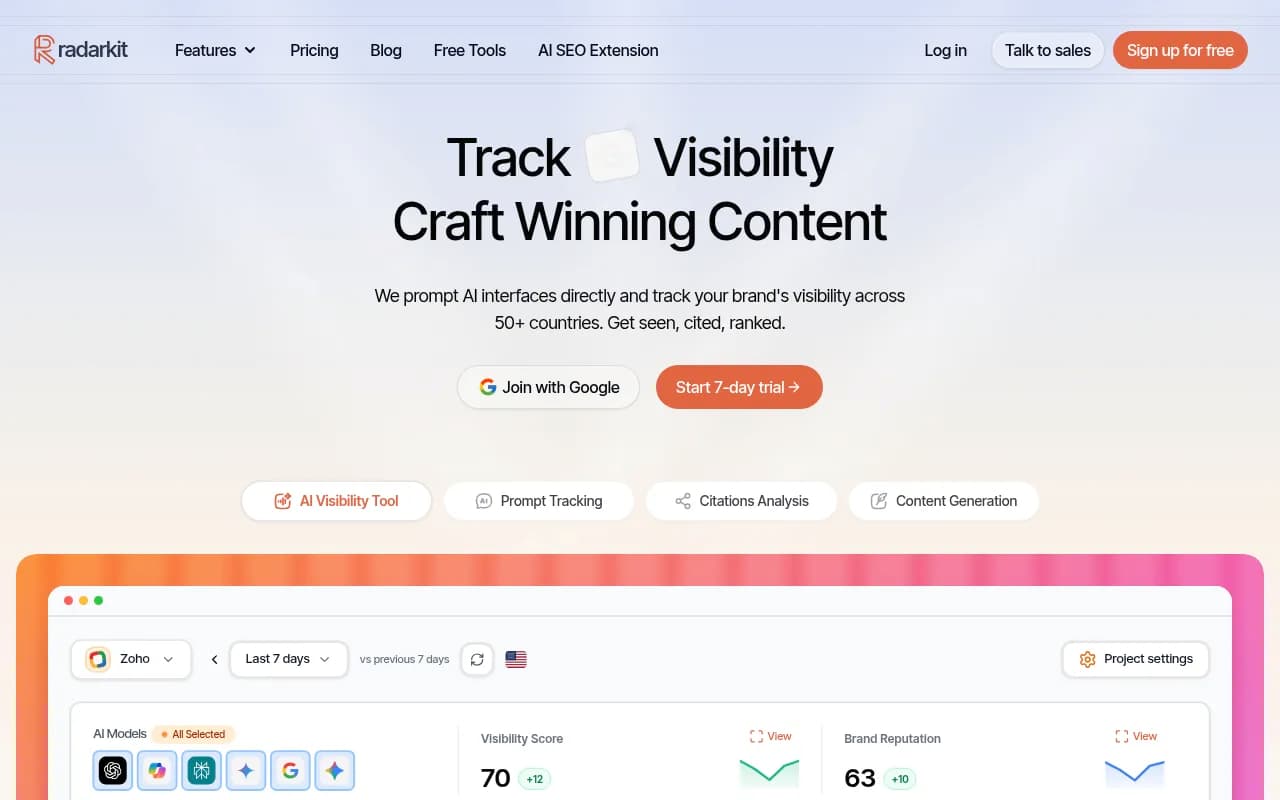
Radarkit is an AI search tracking platform that monitors brand visibility across ChatGPT, Perplexity, Gemini, Google AI Overviews, Copilot, and Google AI Mode. It focuses on visibility scoring, sentiment analysis, and ranking position tracking across 50+ countries. The interface is clean and straightforward, with a dashboard showing visibility scores, average position, sentiment breakdowns, and competitor rankings. Radarkit offers a 7-day free trial but doesn't publicly list pricing on their website.
Side-by-Side Comparison
| Feature | Promptwatch | Radarkit |
|---|---|---|
| AI models tracked | 10 (ChatGPT, Perplexity, Gemini, Claude, Copilot, Google AI Overviews, DeepSeek, Grok, Meta AI, Mistral) | 6 (ChatGPT, Perplexity, Gemini, Copilot, Google AI Overviews, Google AI Mode) |
| Content generation | ✓ Built-in AI writing agent | ✗ Not available |
| Crawler logs | ✓ Real-time AI crawler monitoring | ✗ Not available |
| Answer Gap Analysis | ✓ Shows prompts competitors rank for but you don't | ✗ Not available |
| Reddit/YouTube tracking | ✓ Surface discussions influencing AI | ✗ Not available |
| Sentiment analysis | Basic mention sentiment | ✓ Detailed sentiment breakdowns |
| Pricing transparency | ✓ Public pricing from $99/mo | ✗ Not publicly listed (est. $29/mo+) |
| Free trial | 7 days | 7 days |
| Prompt intelligence | ✓ Volume estimates, difficulty scores, query fan-outs | Basic prompt tracking |
| Citation source analysis | ✓ See which pages/domains AI cites | Limited |
| Multi-language support | ✓ Any language, any region | ✓ 50+ countries |
| Traffic attribution | ✓ Code snippet, GSC integration, server logs | Not specified |
| API access | ✓ Full API + Looker Studio integration | Not specified |
Content optimization and creation
This is where the platforms diverge completely.
Promptwatch includes a built-in AI writing agent that generates articles, listicles, and comparison pages based on 880M+ citations analyzed, prompt volumes, persona targeting, and competitor analysis. The content isn't generic SEO filler -- it's engineered to get cited by ChatGPT, Claude, Perplexity, and other AI models based on what those models actually look for. You can see which topics your competitors are visible for but you're not (Answer Gap Analysis), then generate content to fill those gaps. The platform tracks which pages get cited, how often, and by which models, so you can measure whether your content is working.
Radarkit doesn't offer content generation at all. It shows you visibility scores and sentiment analysis, but if you want to improve those scores, you're on your own. There's no gap analysis, no content suggestions, no writing tools. It's a monitoring dashboard, not an optimization platform.
Verdict: If you need help creating content that ranks in AI search, Promptwatch is the only option here.
AI crawler monitoring
Promptwatch includes real-time AI Crawler Logs showing when ChatGPT, Claude, Perplexity, and other AI crawlers hit your website. You can see which pages they read, errors they encounter, how often they return, and whether they're indexing your content properly. This is critical for understanding whether AI models can even discover your content in the first place. Most visibility issues start with indexing problems, not content problems.
Radarkit doesn't offer crawler log monitoring. You can see whether AI models mention your brand in responses, but you have no visibility into whether they're actually crawling your site or encountering errors.
Verdict: Promptwatch is the only platform here with crawler logs. If you're serious about AI visibility, this feature is non-negotiable.
Prompt tracking and intelligence
Both platforms let you track specific prompts to see when AI models mention your brand.
Promptwatch adds layers of intelligence on top: volume estimates for each prompt (how often people are asking this), difficulty scores (how hard it is to rank), and query fan-outs showing how one prompt branches into sub-queries. This helps you prioritize high-value, winnable prompts instead of guessing. The Answer Gap Analysis shows which prompts your competitors are visible for but you're not, with specific content recommendations.
Radarkit shows prompt tracking with visibility scores and sentiment analysis. You can see your average position for each prompt and how it changes over time. The interface is clean and the sentiment breakdowns are detailed (positive/mixed/negative with specific insights like "budget-conscious teams" or "known for affordability"). But there's no volume data, no difficulty scoring, no gap analysis.
Verdict: Promptwatch gives you more actionable data. Radarkit gives you cleaner presentation of simpler metrics.
Competitor analysis
| Capability | Promptwatch | Radarkit |
|---|---|---|
| Competitor heatmaps | ✓ Compare visibility across LLMs | ✗ |
| Answer Gap Analysis | ✓ See prompts competitors rank for | ✗ |
| Citation source tracking | ✓ Which pages/domains competitors get cited from | Limited |
| Ranking position | ✓ Track position vs competitors | ✓ Simple table |
| Sentiment comparison | Basic | ✓ Detailed |
Promptwatch's Answer Gap Analysis is the standout feature here. It shows you exactly which prompts your competitors are visible for but you're not, then helps you create content to close those gaps. The competitor heatmaps show who's winning for each prompt across different AI models. You can see which Reddit threads, YouTube videos, and domains are getting cited in responses about your competitors.
Radarkit shows a simple ranking table with your position vs competitors for each prompt. You can see average position and sentiment breakdowns, but there's no gap analysis or citation source tracking.
Verdict: Promptwatch is built for competitive intelligence. Radarkit shows you the scoreboard but not the playbook.
Citation and source analysis
Promptwatch tracks 880M+ citations across AI models and shows you exactly which pages, Reddit threads, YouTube videos, and domains AI models cite in their responses. This tells you where to publish content and what to optimize. The Reddit and YouTube insights surface discussions that directly influence AI recommendations -- a channel most competitors ignore entirely. You can see which of your pages are being cited, how often, and by which models.
Radarkit shows basic citation tracking but doesn't offer the depth of source analysis that Promptwatch does. You can see when your domain is mentioned but not the full citation context or alternative sources AI models are using.
Verdict: Promptwatch gives you the full picture of where citations come from. Radarkit gives you the highlights.
Pricing comparison
| Plan | Promptwatch | Radarkit |
|---|---|---|
| Entry tier | Essential: $99/mo (1 site, 50 prompts, 5 articles/mo) | Not publicly listed (estimated $29/mo+) |
| Mid tier | Professional: $249/mo (2 sites, 150 prompts, 15 articles/mo, crawler logs, state/city tracking) | Not publicly listed |
| High tier | Business: $579/mo (5 sites, 350 prompts, 30 articles/mo) | Not publicly listed |
| Enterprise | Custom pricing | Not publicly listed |
| Free trial | 7 days | 7 days |
| Annual discount | Available | Unknown |
Promptwatch has transparent pricing with clear limits on sites, prompts, and articles. The Essential plan at $99/mo is reasonable for small teams testing AI visibility. Professional at $249/mo adds crawler logs and deeper tracking. Business at $579/mo is for agencies or brands managing multiple properties.
Radarkit doesn't list pricing publicly. Based on market positioning and feature set, it's likely priced lower than Promptwatch (estimated $29-99/mo range) but without knowing the actual limits on prompts, sites, or features, it's hard to compare value directly. The lack of pricing transparency is a red flag -- it suggests either very early-stage product-market fit or a sales-driven model.
Verdict: Promptwatch wins on transparency. You know exactly what you're getting at each tier.
User interface and ease of use
Radarkit has a cleaner, simpler interface. The dashboard shows visibility scores, average position, sentiment breakdowns, and competitor rankings in a straightforward layout. It's easy to understand at a glance. The onboarding is quick and the learning curve is gentle.
Promptwatch has more data and more features, which means more complexity. The dashboard shows visibility scores, page-level tracking, crawler logs, citation sources, Reddit/YouTube insights, and content gap analysis. It takes longer to learn but gives you more actionable insights once you're up to speed. The interface is functional but not as polished as Radarkit's.
Verdict: Radarkit is easier to get started with. Promptwatch requires more time investment but pays off with deeper insights.
Traffic attribution and ROI tracking
Promptwatch offers three ways to track traffic from AI search: a code snippet you add to your site, Google Search Console integration, or server log analysis. This lets you connect visibility improvements to actual traffic and revenue. You can see which pages are getting traffic from AI referrals and measure ROI on your content investments.
Radarkit doesn't specify traffic attribution capabilities on their website. It's unclear whether they offer any way to connect visibility scores to actual traffic or conversions.
Verdict: Promptwatch has clear traffic attribution. Radarkit's capabilities here are unknown.
ChatGPT Shopping and product recommendations
Promptwatch tracks when your brand appears in ChatGPT's product recommendations and shopping carousels. This is critical for e-commerce brands and SaaS companies that want to show up when people ask ChatGPT for product recommendations.
Radarkit doesn't mention ChatGPT Shopping tracking on their website.
Verdict: Promptwatch covers this channel. Radarkit doesn't (or doesn't advertise it).
Pros and cons
Promptwatch pros
- End-to-end optimization platform (track → analyze → create → measure)
- AI Crawler Logs show indexing issues most competitors miss
- Built-in content generation based on 880M+ citations analyzed
- Answer Gap Analysis shows exactly which prompts competitors rank for but you don't
- Reddit/YouTube tracking surfaces discussions influencing AI recommendations
- ChatGPT Shopping tracking for product recommendations
- Transparent pricing with clear limits
- Traffic attribution connects visibility to revenue
- 10 AI models tracked (most in the market)
- Prompt intelligence with volume estimates and difficulty scores
Promptwatch cons
- Steeper learning curve due to feature depth
- Higher price point ($99/mo minimum)
- Interface is functional but not as polished as some competitors
- Might be overkill for teams that just want basic monitoring
Radarkit pros
- Clean, simple interface that's easy to understand
- Detailed sentiment analysis with specific insights
- Quick onboarding and gentle learning curve
- 7-day free trial
- Tracks 6 major AI models
- Multi-country support (50+ countries)
Radarkit cons
- No content generation or optimization tools
- No AI crawler logs or indexing monitoring
- No Answer Gap Analysis or competitive intelligence features
- No Reddit/YouTube tracking
- Pricing not publicly listed (transparency issue)
- Limited citation source analysis
- No traffic attribution (or not advertised)
- Monitoring-only platform -- doesn't help you fix problems
Who should pick which tool
Pick Promptwatch if you:
- Need to actually improve your AI visibility, not just watch it decline
- Want content creation tools that generate AI-optimized articles based on real citation data
- Need to understand why AI models aren't indexing your content (crawler logs)
- Want to know which prompts your competitors rank for but you don't (Answer Gap Analysis)
- Care about Reddit and YouTube discussions influencing AI recommendations
- Need to track ChatGPT Shopping and product recommendations
- Want to measure traffic and ROI from AI search visibility
- Manage multiple brands or client sites (agency use case)
- Have budget for a comprehensive platform ($99-579/mo)
Pick Radarkit if you:
- Just want a simple monitoring dashboard with visibility scores
- Care more about sentiment analysis than content optimization
- Prefer a clean interface over feature depth
- Don't need content generation or gap analysis tools
- Are comfortable with opaque pricing (no public pricing listed)
- Don't need crawler logs or indexing monitoring
- Want to dip your toes into AI visibility tracking without committing to a full optimization platform
Final verdict
Promptwatch is the better platform for anyone serious about AI search visibility. It's the only tool here that closes the full loop: find gaps, create content, track results. Radarkit is a monitoring dashboard with nice sentiment analysis, but it leaves you stuck when you want to actually improve your scores.
The deciding factor: do you need help fixing your AI visibility, or do you just want to watch it? If you need to fix it, Promptwatch is the clear choice. If you just want a simple scoreboard, Radarkit might work -- but you'll likely outgrow it quickly once you realize monitoring alone doesn't move the needle.
For most teams, the extra $70/mo (assuming Radarkit is ~$29/mo) for Promptwatch's Essential plan is worth it for the content generation, crawler logs, and Answer Gap Analysis alone. Those features pay for themselves if they help you rank for even one high-value prompt.