Key takeaways
- Orchly.ai starts at $49/month with a free trial; Meridian requires a demo and custom pricing, which almost always means a higher spend.
- Orchly.ai is a combined SEO + AI visibility platform -- it tracks Google organic rankings alongside ChatGPT, Claude, Perplexity, and Gemini. Meridian is AI-search-only.
- Meridian leans on "expert-led execution" -- it's more of a managed service than a pure SaaS tool. Orchly.ai is fully self-serve.
- Orchly.ai has a built-in AI content writer with auto-publish, brand voice training, and content scheduling. Meridian has no self-serve content creation.
- Both offer sentiment analysis and competitive benchmarking, but Orchly.ai adds white-label reporting, making it more agency-friendly out of the box.
- If you want someone to do the work for you and have the budget, Meridian's managed approach has appeal. If you want to own the workflow yourself, Orchly.ai is the more practical choice.
Overview
Meridian
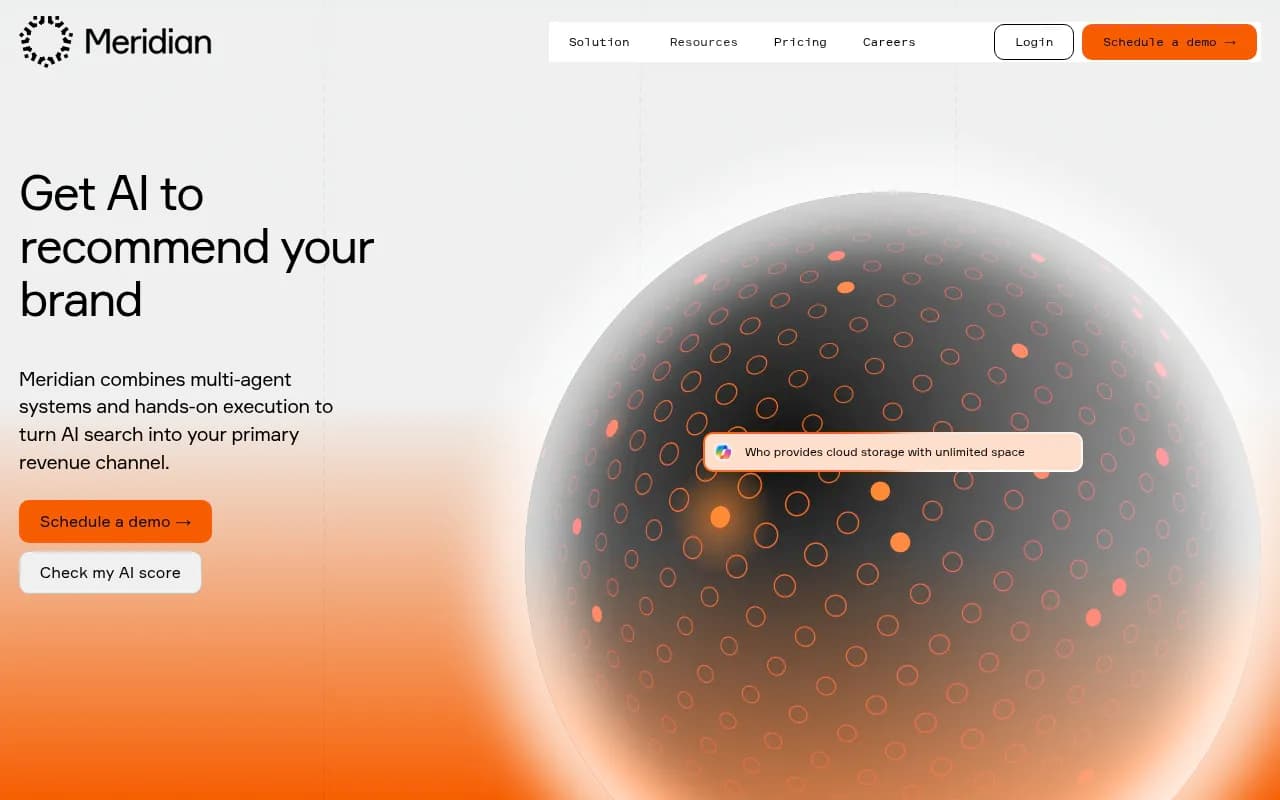
Meridian positions itself as a premium, expert-led platform for winning in generative search. The pitch is that AI search is too complex to just monitor -- you need agents and human experts working together to turn it into a revenue channel. The product tracks brand visibility across ChatGPT, Perplexity, Gemini, Google AI, Grok, Claude, Copilot, DeepSeek, and Meta AI, with category-level tracking, sentiment scoring, and competitive benchmarking. The "expert-led" angle is the differentiator: Meridian isn't just a dashboard you log into -- it's closer to a managed service where their team helps execute.
That's a real value proposition for enterprise marketing teams that don't want to figure out GEO from scratch. The trade-off is that there's no self-serve option, no public pricing, and no way to try it without talking to sales first.
Orchly.ai

Orchly.ai takes a different approach. It's built for marketing teams that want to handle content strategy, SEO, and AI visibility in one place -- without hiring an agency or waiting for a demo call. The platform combines AI search tracking (ChatGPT, Claude, Perplexity, Gemini, Grok, Google AI) with traditional Google keyword rank tracking, a built-in AI content writer, website audit tools, internal/external link management, and an action center that surfaces what to fix next.
The content creation side is genuinely differentiated: brand voice training, style guide integration, content scheduling, and auto-publish mean you can go from "we're invisible in AI search" to "we've published 10 optimized articles" without leaving the platform. White-label reports make it usable for agencies too.
Side-by-side comparison
| Feature | Meridian | Orchly.ai |
|---|---|---|
| Pricing model | Custom (demo required) | Freemium; from $49/mo |
| Free trial | No | Yes |
| Self-serve access | No | Yes |
| AI search tracking | Yes (9 platforms) | Yes (6+ platforms) |
| Google organic rank tracking | No | Yes |
| Sentiment analysis | Yes | Yes |
| Competitive benchmarking | Yes | Yes |
| Content creation / AI writer | No | Yes |
| Auto-publish | No | Yes |
| Brand voice training | No | Yes |
| White-label reports | Not confirmed | Yes |
| Website audit | No | Yes |
| Internal/external link management | No | Yes |
| Bot/AI crawler traffic analytics | Not confirmed | Yes |
| API access | Not confirmed | Yes |
| Target audience | Enterprise brands | SMBs, agencies, marketing teams |
| Managed/expert execution | Yes | No |
Head-to-head feature deep-dive
AI search visibility tracking
Both tools cover the platforms that matter: ChatGPT, Perplexity, Gemini, Claude, Grok, and Google AI. Meridian also lists Copilot, DeepSeek, and Meta AI explicitly. Orchly.ai's public-facing list is slightly shorter but covers the same high-traffic models.
Where they differ is in what the tracking data actually shows you. Meridian surfaces visibility scores, sentiment scores, and position rankings per prompt -- the demo UI shows a clean breakdown with percentage changes over time. Orchly.ai shows similar data (visibility %, sentiment breakdown, competitor positions) but also ties it to an action center that tells you what to do next.
Meridian's tracking feels more polished as a standalone reporting surface. Orchly.ai's tracking is more tightly integrated into a workflow that ends with published content.
Verdict: Roughly equal on raw tracking depth. Orchly.ai wins on actionability; Meridian wins on presentation polish.
Content creation and optimization
This is the biggest gap between the two tools. Orchly.ai has a full AI content writer with:
- Brand voice training so output matches your tone
- Style guide integration
- SEO and AEO optimization built into the writing process
- Content scheduling and auto-publish to your CMS
- Internal and external link suggestions
Meridian has none of this as a self-serve feature. Their "agent-powered" execution model implies that content work happens through their team, not through a tool you operate yourself. That might be fine if you're paying for a managed service, but it means you're dependent on their team's bandwidth and priorities.
Verdict: Orchly.ai wins clearly. If content creation is part of your workflow, Meridian can't replace it.
Competitive benchmarking and sentiment
Both platforms let you track competitor visibility in AI search. Meridian's UI shows position rankings alongside competitor logos -- you can see where you sit relative to named competitors for specific prompts. Orchly.ai shows competitor AI visibility percentages per platform and tracks sentiment (positive/neutral/negative) with example quotes pulled from AI responses.
Orchly.ai's sentiment breakdown is more granular in the UI -- you get percentage splits and representative quotes, which is useful for understanding how AI models are actually describing your brand. Meridian shows sentiment as a score, which is cleaner but less explanatory.
Verdict: Tie. Meridian has a cleaner competitive view; Orchly.ai has more granular sentiment data.
Traditional SEO features
Orchly.ai tracks Google organic keyword rankings daily, runs website audits, manages internal and external links, and includes keyword research. This makes it a genuine all-in-one SEO + AEO platform. If your team is currently paying for a separate rank tracker, Orchly.ai could replace it.
Meridian is AI-search-only. There's no Google rank tracking, no site audit, no keyword research. It's a focused tool for a specific problem.
Verdict: Orchly.ai wins by default -- Meridian doesn't compete here.
Ease of use and onboarding
Orchly.ai has a free trial and a self-serve signup. You can be tracking AI visibility within minutes. The action center is designed to reduce the "now what?" problem -- it surfaces specific tasks based on your current visibility gaps.
Meridian requires a demo call before you can access anything. That's a real friction point for teams that want to evaluate tools quickly. The upside is that you get a human expert walking you through setup, which can be valuable if your team is new to GEO. But for anyone who prefers to explore a tool before committing, the demo-first model is a barrier.
Verdict: Orchly.ai wins on accessibility. Meridian's onboarding is better for teams that want hand-holding.
Agency and team features
Orchly.ai explicitly supports white-label reports, API access, and multi-platform tracking -- the building blocks for an agency workflow. Meridian's agency positioning isn't clear from public information; it appears to target brands directly.
Verdict: Orchly.ai is the better fit for agencies.
Pricing comparison
| Plan | Meridian | Orchly.ai |
|---|---|---|
| Free tier | No | Free trial available |
| Entry-level | Custom (demo required) | $49/mo (Essential) |
| Mid-tier | Custom | $125/mo (Pro) |
| Enterprise | Custom | Custom |
| Annual discount | Unknown | 25% off |
Meridian's custom pricing model is a significant unknown. "Custom pricing" in the GEO space typically starts in the hundreds per month and scales quickly with the number of prompts, brands, and markets tracked. Without a public price, it's impossible to compare directly -- but the demo-first model signals this is not a tool aimed at sub-$500/month budgets.
Orchly.ai's $49/month entry point is genuinely accessible. The Pro tier at $125/month is competitive for what it includes (AI tracking + content creation + SEO). The 25% annual discount brings Essential down to roughly $37/month, which is hard to argue with for a combined SEO/AEO platform.
Pros and cons
Meridian
Pros:
- Expert-led execution means you're not figuring out GEO alone
- Clean, polished tracking UI with position, visibility, and sentiment in one view
- Covers 9 AI platforms including Meta AI, DeepSeek, and Copilot
- Multi-language and multi-region tracking (shown in demo UI)
- Good fit for enterprise teams that want a managed approach
Cons:
- No public pricing -- requires a demo before you can evaluate cost
- No self-serve access or free trial
- No content creation tools
- No traditional SEO features (keyword tracking, site audit)
- Dependent on their team's execution capacity
- Limited public information about API, integrations, or white-label support
Orchly.ai
Pros:
- Free trial with no sales call required
- Affordable entry point at $49/month
- Combines Google SEO tracking with AI search visibility in one platform
- Built-in AI content writer with brand voice training and auto-publish
- White-label reports for agencies
- Website audit, internal links, keyword research -- genuinely replaces multiple tools
- Action center surfaces specific next steps
Cons:
- Tracks 6 AI platforms prominently (vs Meridian's 9)
- No managed/expert execution -- you're doing the work yourself
- Newer platform with less public track record than established GEO players
- Content quality from AI writer depends on how well you configure brand voice
Who should pick which tool
Pick Meridian if:
- You're at an enterprise brand with a dedicated marketing budget and want expert guidance
- You don't have internal bandwidth to run GEO workflows yourself
- You want a managed service where someone else is accountable for results
- You're primarily focused on AI search visibility (not traditional SEO)
- You're comfortable with custom pricing and a sales-led process
Pick Orchly.ai if:
- You want to start tracking AI visibility today without a demo call
- Your team handles content creation in-house and wants to streamline it
- You need both Google SEO tracking and AI search visibility in one tool
- You're an agency that needs white-label reports
- Budget matters and you want transparent pricing
- You want to own the workflow rather than outsource it
A note on the broader GEO landscape
If you're evaluating either of these tools, it's worth knowing that the GEO space has matured quickly in 2026. Platforms like Promptwatch have raised the bar on what "actionable" looks like -- combining answer gap analysis, AI content generation grounded in 880M+ citations, crawler log monitoring, and traffic attribution in one platform. Worth a look if you want to compare the full range of options before committing.

Final verdict
Orchly.ai is the more practical choice for most teams in 2026. It's accessible, affordable, and genuinely covers more ground -- traditional SEO, AI search tracking, content creation, and publishing in one place. The free trial means you can validate it before spending a dollar.
Meridian is a credible option for enterprise teams that want expert execution and don't want to run GEO workflows themselves. But the lack of public pricing, no free trial, and no self-serve content tools make it a hard sell for anyone who isn't already sold on the managed-service model.
If you're a marketing team of 2-20 people trying to get visible in AI search without hiring an agency, Orchly.ai is the straightforward answer. If you're a large brand that wants someone else to own the problem, Meridian is worth the demo call.