Key takeaways
- Omnia has a free trial and self-serve sign-up; Meridian requires a demo call before you can access anything
- Meridian monitors 9 AI engines including Meta AI, Grok, and DeepSeek; Omnia focuses on 6 engines (ChatGPT, Perplexity, Gemini, Google AI Overviews, Google AI Mode, Copilot)
- Both tools go beyond pure monitoring -- Meridian leans on "expert-led execution" (think managed service), while Omnia provides a self-serve roadmap with content and technical SEO recommendations
- Meridian's website shows multi-language examples (Japanese, English), suggesting stronger international tracking; Omnia doesn't prominently advertise this
- Neither tool publishes pricing -- both require contact or sign-up to get numbers, which makes direct cost comparison impossible without a sales conversation
- Omnia is clearly built for SEO and marketing practitioners who want to move fast; Meridian feels more enterprise-oriented, with a heavier services layer
Overview
Meridian
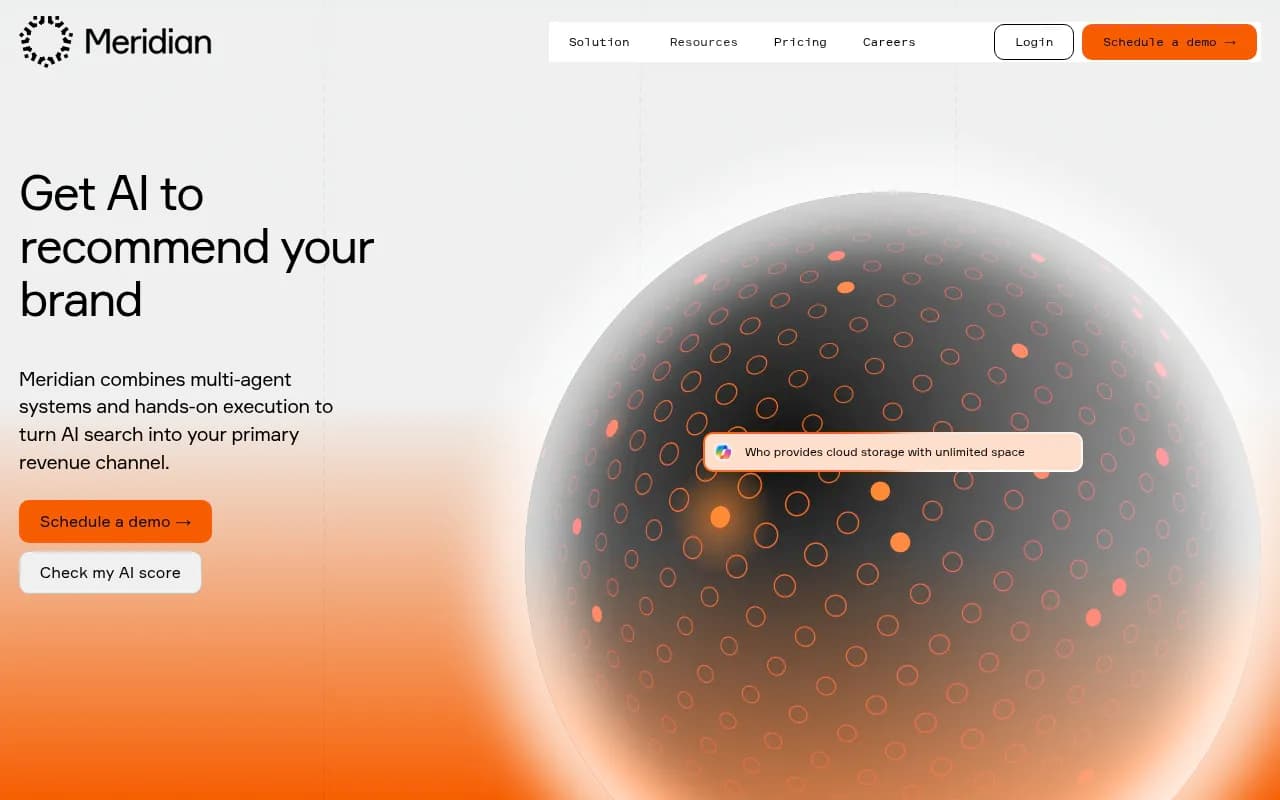
Meridian describes itself as combining "multi-agent systems and hands-on execution" to turn AI search into a revenue channel. The pitch is less "here's a dashboard" and more "here's a team plus technology working together." It monitors visibility, sentiment, and competitive position across ChatGPT, Perplexity, Gemini, Google AI, Meta AI, Claude, Copilot, Grok, and DeepSeek. The demo-first model and emphasis on "expert-led" work suggests this is aimed at brands that want someone else doing a lot of the heavy lifting -- not a tool you spin up yourself on a Tuesday afternoon.
Omnia
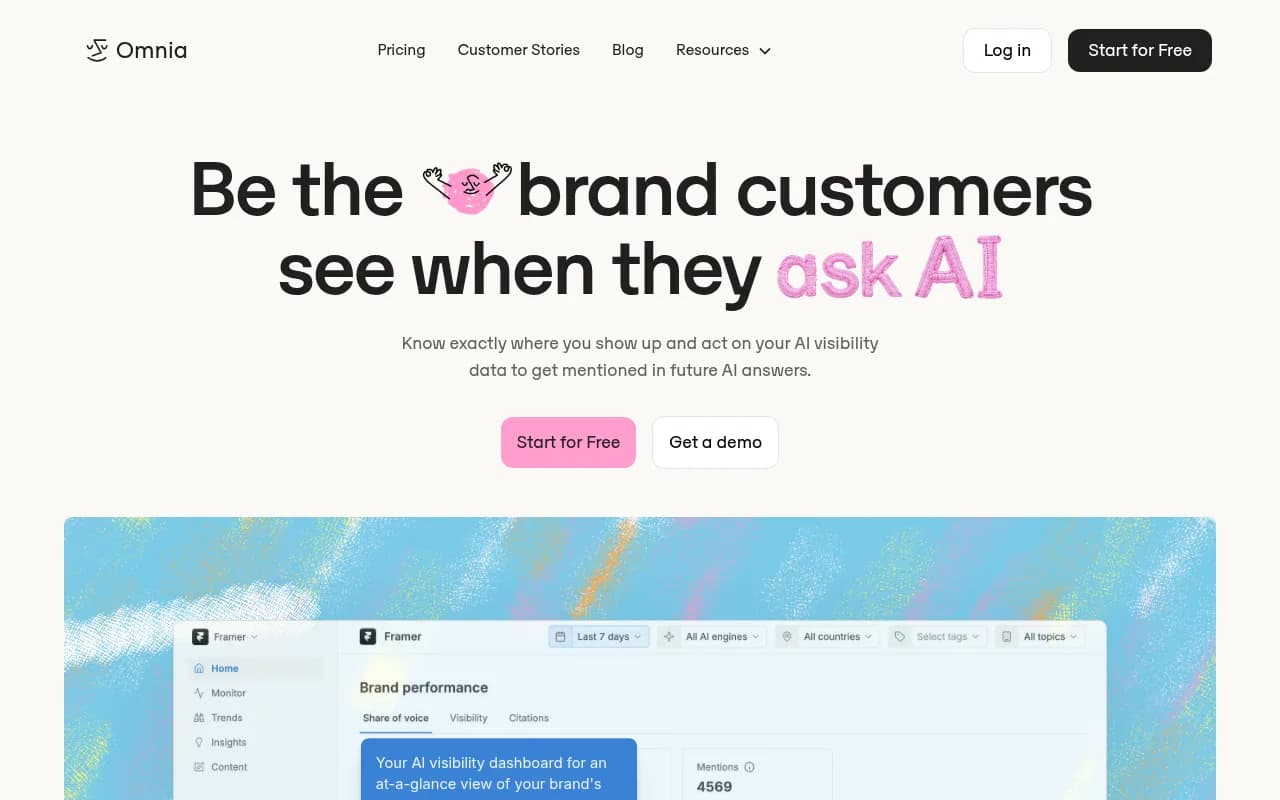
Omnia is a self-serve AI visibility platform built specifically for SEO and marketing teams. You can sign up and start a free trial without talking to anyone. It monitors citations and mentions across ChatGPT, Perplexity, Google Gemini, Google AI Overviews, Google AI Mode, and Microsoft Copilot, then translates that data into a step-by-step roadmap covering content creation, technical SEO, and content placement. The positioning is clear: practitioners who want to understand their AI search presence and act on it themselves.
Side-by-side comparison
| Feature | Meridian | Omnia |
|---|---|---|
| Free trial | No (demo required) | Yes (self-serve sign-up) |
| Pricing model | Custom (demo required) | Flexible; Pro plan on request |
| AI engines monitored | 9 (ChatGPT, Perplexity, Gemini, Google AI, Meta AI, Claude, Copilot, Grok, DeepSeek) | 6 (ChatGPT, Perplexity, Gemini, Google AI Overviews, Google AI Mode, Copilot) |
| Sentiment tracking | Yes | Not prominently featured |
| Competitive benchmarking | Yes | Yes |
| Citation tracking | Yes | Yes |
| Actionable roadmap | Via expert-led execution | Yes (self-serve, step-by-step) |
| Content recommendations | Via managed service layer | Yes (content creation, placement) |
| Technical SEO guidance | Not specified | Yes |
| Multi-language support | Yes (Japanese example shown) | Not prominently advertised |
| Target audience | Enterprise brands | SEO/marketing practitioners |
| Onboarding | Demo call required | Self-serve |
| Prompt discovery | Not specified | Yes (real questions customers ask) |
Head-to-head feature deep-dive
AI engine coverage
Meridian covers nine engines: ChatGPT, Perplexity, Gemini, Google AI, Meta AI, Claude, Copilot, Grok, and DeepSeek. That's a meaningful breadth -- Meta AI and DeepSeek in particular are engines that many competitors skip. Omnia covers six: ChatGPT, Perplexity, Gemini, Google AI Overviews, Google AI Mode, and Copilot. The Google AI Overviews and Google AI Mode distinction is worth noting -- Omnia explicitly separates these, which matters for brands heavily invested in Google search traffic.
Verdict: Meridian wins on raw engine count. Omnia's Google-specific granularity is a genuine advantage for SEO teams, but if you need Meta AI, Grok, or DeepSeek coverage, Omnia doesn't have it.
Monitoring and tracking
Both tools track brand mentions, citations, and competitive position in AI responses. Meridian surfaces visibility scores, sentiment scores, and position rankings per prompt -- the demo UI shows a clean breakdown with percentage changes over time. Omnia monitors where you show up, what citations AI engines pull, and how you benchmark against competitors. Omnia also explicitly surfaces the sources AI engines cite, which helps you understand which third-party pages are driving (or hurting) your visibility.
Verdict: Roughly comparable on core monitoring. Meridian's sentiment scoring is a differentiator if that matters to your use case.
Actionability and roadmap
This is where the two tools diverge most sharply. Meridian's "actionability" comes through its managed service layer -- the "expert-led execution" model means humans are involved in turning data into action. That's powerful if you want a partner, but it's also slower and almost certainly more expensive than a self-serve tool.
Omnia takes a different approach: it translates tracking data into a step-by-step roadmap that covers content creation, technical SEO fixes, and content placement decisions. You're doing the work yourself, but you have a clear list of what to do next. For a lean marketing team, that's often exactly what's needed.
Verdict: Depends on your team. If you want execution support, Meridian's model is compelling. If you want to move fast with your own team, Omnia's self-serve roadmap is more practical.
Prompt and question discovery
Omnia explicitly surfaces "real questions people ask AI" -- helping you know which prompts to monitor and discover what customers are actually asking about your industry. This is a meaningful feature for teams building out their prompt tracking lists from scratch.
Meridian's website doesn't prominently feature prompt discovery as a standalone capability. The focus is more on monitoring existing visibility and improving it through execution.
Verdict: Omnia wins here. Knowing which prompts to track in the first place is half the battle, and Omnia addresses it directly.
Onboarding and ease of access
Omnia has a "Start for Free" button that takes you directly to a sign-up flow. No sales call, no demo, no waiting. For a practitioner who wants to evaluate a tool quickly, this is a significant advantage.
Meridian gates everything behind a demo. That's not inherently bad -- complex enterprise tools often need a proper onboarding conversation -- but it does mean you can't evaluate the product on your own terms before committing time to a sales process.
Verdict: Omnia wins for speed-to-value. Meridian's demo-first model suits enterprise buyers who expect that process.
Multi-language and international support
Meridian's homepage shows tracking examples in both English and Japanese, which is a clear signal that multi-language, multi-region monitoring is supported. This matters a lot for global brands tracking AI visibility in non-English markets.
Omnia doesn't prominently advertise multi-language support on its website. That doesn't mean it's absent, but it's not a selling point they're leading with.
Verdict: Meridian appears stronger here, though you'd need to confirm specifics in a demo.
Pricing comparison
Neither tool publishes pricing publicly, which is frustrating for anyone trying to make a quick decision.
| Plan | Meridian | Omnia |
|---|---|---|
| Free tier | No | Free trial (sign-up required) |
| Entry-level | Custom (demo required) | Pro plan (pricing on request) |
| Enterprise | Custom | Custom |
| Pricing transparency | None | Minimal |
The key practical difference: Omnia lets you start a free trial before you have any pricing conversation. Meridian requires a demo first, which means you're in a sales process before you've seen the product. If budget is a concern or you're evaluating multiple tools, Omnia's approach is less friction.
Pros and cons
Meridian
Pros:
- Broad AI engine coverage (9 engines including Meta AI, Grok, DeepSeek)
- Sentiment scoring alongside visibility and position data
- Expert-led execution model -- useful if you want a partner, not just a tool
- Multi-language support (confirmed via website examples)
- Clean, detailed per-prompt analytics UI
Cons:
- No free trial -- demo required before you can evaluate anything
- Pricing is completely opaque
- Managed service model may be overkill (and expensive) for teams that just want a tracking tool
- Prompt discovery not prominently featured
- Newer brand with less public track record than some competitors
Omnia
Pros:
- Free trial with self-serve sign-up -- no sales call needed
- Self-serve roadmap with content, technical SEO, and placement recommendations
- Explicitly surfaces real customer questions for prompt discovery
- Google AI Overviews and Google AI Mode tracked separately (useful for SEO teams)
- Clear positioning for SEO and marketing practitioners
Cons:
- Fewer AI engines covered (6 vs Meridian's 9) -- no Meta AI, Grok, or DeepSeek
- Sentiment tracking not prominently featured
- Multi-language support unclear
- Pro pricing still requires a conversation
- Smaller brand with a narrower customer base shown publicly
Who should pick which tool
Pick Meridian if:
- You're at a larger brand that wants a partner, not just software
- You need Meta AI, Grok, or DeepSeek coverage
- Multi-language and multi-region tracking is a requirement
- You're comfortable with a demo-first sales process and custom pricing
- Sentiment analysis is important to your reporting
Pick Omnia if:
- You're an SEO or marketing practitioner who wants to start immediately
- You want a self-serve roadmap that tells you what to fix, not just what's broken
- Google AI Overviews and Google AI Mode are your primary focus
- You want to evaluate a tool before talking to sales
- You're running a lean team that will execute recommendations in-house
A note on the broader AI visibility space
Both Meridian and Omnia are monitoring-plus-recommendations tools, which puts them a step ahead of pure trackers. If you're also looking to track AI crawler activity on your own site -- which pages AI bots are reading, how often they return, and whether they're hitting errors -- Promptwatch covers that angle with its AI Crawler Logs feature, alongside content gap analysis and an AI writing agent for creating content engineered to get cited.

Final verdict
Omnia is the more accessible tool for most marketing and SEO teams in 2026. The free trial, self-serve roadmap, and practitioner-focused design make it easy to evaluate and act on quickly. Meridian is the better choice if you want broader AI engine coverage (especially Meta AI and DeepSeek), multi-language tracking, or a managed execution partner rather than a self-serve platform. The catch with Meridian is that you won't know what it costs or how it works until you've sat through a demo -- which is a real barrier for teams doing quick evaluations.
If speed-to-value matters, start with Omnia. If you're running a global brand and want someone in your corner doing the work, Meridian is worth the demo call.