Key takeaways
- LLMrefs starts at $79/mo with a free trial and no credit card required. Meridian is custom-priced and demo-only -- expect a meaningful step up in cost.
- Meridian positions itself as a managed, expert-led service. LLMrefs is a self-serve analytics platform. These are genuinely different products for different buyers.
- LLMrefs uses a keyword-first tracking model (you enter keywords, not prompts). Meridian tracks by category and brand, with sentiment scores baked in alongside visibility and position.
- Both cover the major AI engines -- ChatGPT, Perplexity, Gemini, Claude, Grok, Copilot, Meta AI. Coverage is roughly comparable.
- LLMrefs supports unlimited projects and team seats on its base plan, which makes it practical for agencies. Meridian's model is better suited to brands that want hands-on strategic support.
- Neither tool offers AI content generation or crawler log analysis -- if you need those capabilities, you'll want to look beyond both of these.
Overview
Meridian
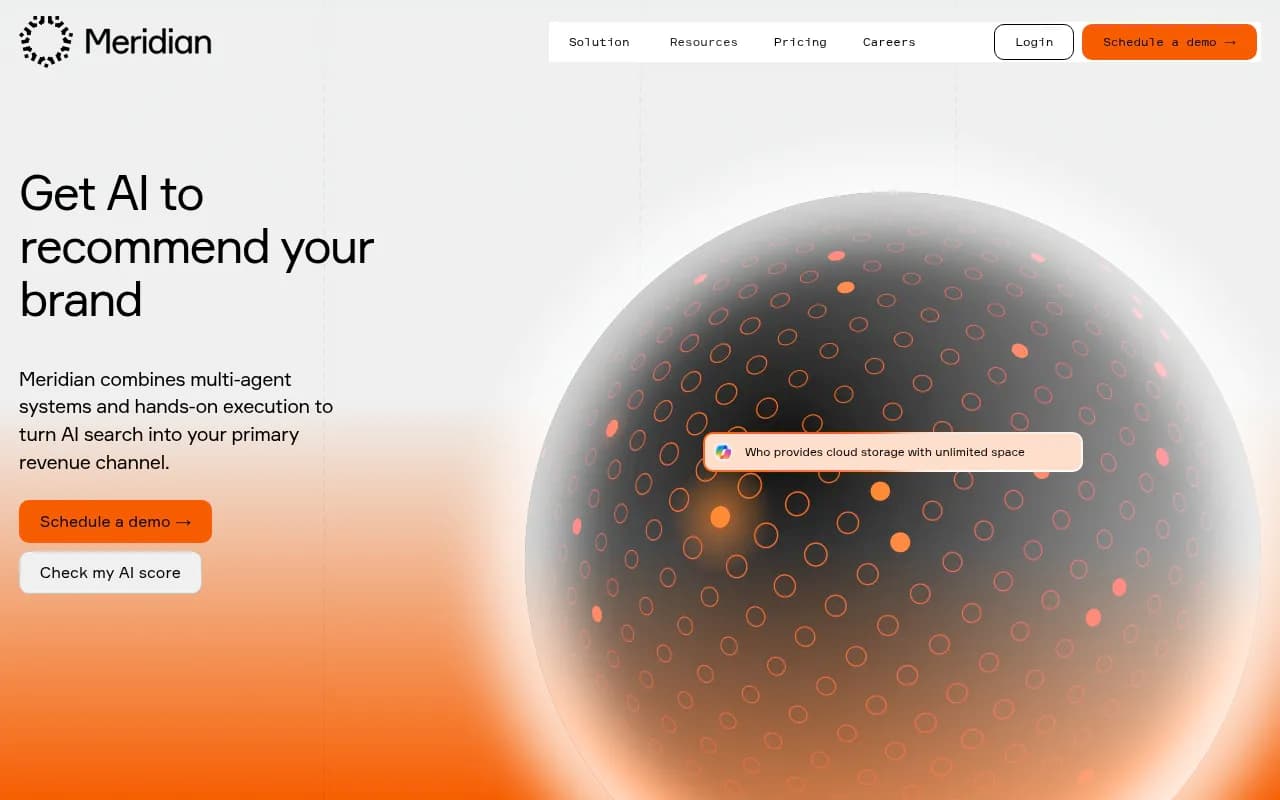
Meridian's pitch is "get AI to recommend your brand." It's not just a dashboard -- it combines multi-agent monitoring systems with hands-on execution, meaning the team at Meridian actively works with you to improve your AI search presence. The platform tracks visibility, sentiment, and position across ChatGPT, Perplexity, Gemini, Google AI, Claude, Grok, Copilot, Meta AI, and DeepSeek. The demo-first, custom-pricing model signals that this is aimed at growth-stage brands and enterprises willing to invest in a managed approach.
LLMrefs
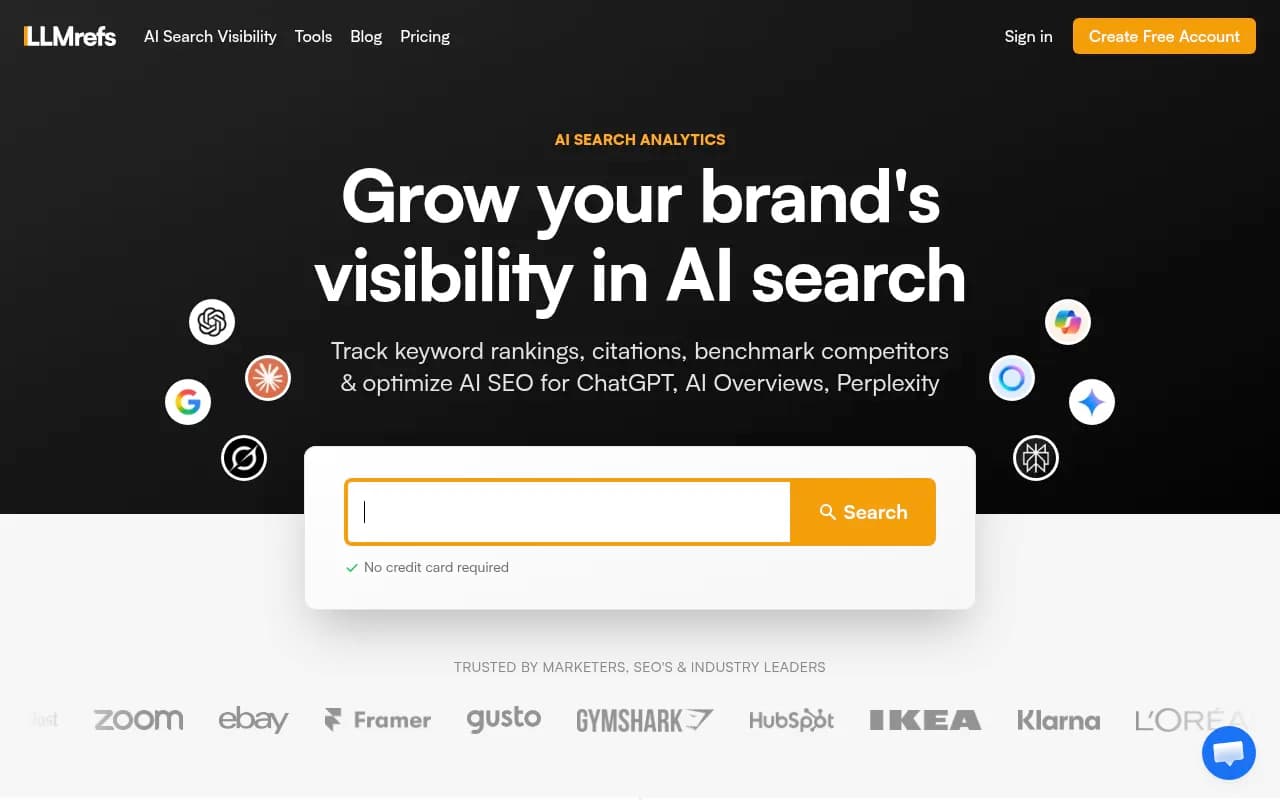
LLMrefs takes the opposite approach: transparent pricing, self-serve sign-up, and a keyword-centric tracking model. You enter keywords (like "best womens running shoes"), and LLMrefs tells you how brands rank across AI engines for those terms. It covers 50+ countries, supports unlimited projects and team seats, and has a customer list that includes eBay, HubSpot, Shopify, Gymshark, and IKEA. At $79/mo, it's one of the more accessible options in the AI search tracking space.
Side-by-side comparison
| Feature | Meridian | LLMrefs |
|---|---|---|
| Pricing model | Custom (demo required) | $79/mo flat |
| Free trial | No | 7-day, no credit card |
| Tracking approach | Category + brand | Keyword-based |
| Sentiment analysis | Yes (scored) | Not highlighted |
| AI engines covered | 9 (ChatGPT, Perplexity, Gemini, Claude, Grok, Copilot, Meta AI, DeepSeek, Google AI) | 8 (ChatGPT, Claude, Google AI Mode, Grok, Copilot, Meta AI, Gemini, Perplexity) |
| Competitor benchmarking | Yes | Yes |
| Citation tracking | Yes | Yes |
| Multi-country/language | Yes (shown in demo) | 50+ countries |
| Unlimited team seats | Not specified | Yes |
| Unlimited projects | Not specified | Yes |
| Managed execution / expert support | Yes (core differentiator) | No |
| AI content generation | No | No |
| Crawler log analysis | No | No |
| Self-serve sign-up | No | Yes |
| Target audience | Growth brands, enterprise | Marketers, SEOs, agencies |
Head-to-head feature deep-dive
Tracking model and data structure
This is the most meaningful difference between the two tools, and it's worth understanding before you pick one.
LLMrefs is keyword-first. You enter a keyword or phrase, and the platform queries multiple AI engines to see which brands appear, how often, and in what position. It's the same mental model as traditional rank tracking -- just applied to AI search. That makes it immediately familiar to anyone with an SEO background.
Meridian tracks at the category and brand level. You're not just asking "where do I rank for this keyword?" -- you're asking "how visible is my brand across this entire category of queries, and what does AI say about me when it mentions me?" The sentiment score (which Meridian surfaces alongside visibility and position) is a good example of this broader framing.
Verdict: If you think in keywords and want to track specific terms, LLMrefs fits your workflow. If you want a higher-level view of brand perception and category presence, Meridian's model is more suited to that.
Sentiment analysis
Meridian explicitly surfaces sentiment as a first-class metric. In their demo UI, you can see a sentiment score (e.g., 93, up 6%) alongside visibility and position for any tracked query. That's genuinely useful -- knowing you're mentioned is one thing, knowing whether AI is saying positive or negative things about you is another.
LLMrefs doesn't highlight sentiment as a core feature. Its focus is on rankings, citations, and competitor visibility. You can see who gets cited and how often, but the qualitative dimension of what AI says about a brand isn't surfaced the same way.
Verdict: Meridian wins on sentiment. For brands where reputation management matters as much as raw visibility, this is a real differentiator.
Competitive benchmarking
Both tools let you benchmark against competitors. LLMrefs shows how your brand stacks up against others for the same keywords across AI engines -- you can see who's winning for "best project management software" in ChatGPT vs. Perplexity, for example. Meridian does similar competitive tracking at the category level, showing which brands appear alongside you and how your position compares.
LLMrefs's approach is more granular at the keyword level. Meridian's is more holistic at the brand/category level. Neither is strictly better -- it depends on what questions you're trying to answer.
Verdict: Tie, with LLMrefs edging ahead for keyword-level competitive analysis and Meridian better for category-level brand benchmarking.
Managed service vs. self-serve
This is where the two products diverge most sharply.
Meridian describes itself as combining "multi-agent systems and hands-on execution." That means you're not just getting a dashboard -- you're getting a team that actively works on improving your AI search presence. For brands that don't have in-house SEO or GEO expertise, or that want a strategic partner rather than another tool to manage, this is genuinely valuable.
LLMrefs is entirely self-serve. You sign up, connect your keywords, and interpret the data yourself. There's no managed layer. That's fine if you have the internal capability to act on the data -- but if you're a lean team that needs someone to tell you what to do with the numbers, LLMrefs leaves that gap open.
Verdict: Depends entirely on what you need. Managed service = Meridian. Self-serve analytics = LLMrefs.
Pricing and accessibility
LLMrefs is one of the more straightforward pricing models in this space: $79/mo for 500 prompts, unlimited projects, unlimited team seats, 7-day free trial, no credit card required. You can be up and running in under 10 minutes.
Meridian requires a demo call before you see any pricing. That's not unusual for enterprise software, but it does mean you can't evaluate the product without talking to a salesperson first. Custom pricing also typically means higher costs -- this isn't a tool you'll pick up for $79/mo.
Verdict: LLMrefs wins on accessibility and price transparency. Meridian's pricing model is a barrier for smaller teams or anyone who wants to evaluate before committing.
AI engine coverage
| Engine | Meridian | LLMrefs |
|---|---|---|
| ChatGPT / OpenAI | Yes | Yes |
| Perplexity | Yes | Yes |
| Google Gemini | Yes | Yes |
| Google AI Overviews / AI Mode | Yes | Yes |
| Claude | Yes | Yes |
| Microsoft Copilot | Yes | Yes |
| Grok (xAI) | Yes | Yes |
| Meta AI | Yes | Yes |
| DeepSeek | Yes | Not listed |
| Mistral | Not listed | Not listed |
Coverage is broadly comparable. Both hit the engines that matter most for most brands. Meridian lists DeepSeek explicitly; LLMrefs's page doesn't call it out but the list may not be exhaustive.
Verdict: Effectively a tie for most use cases.
Multi-language and multi-region support
LLMrefs supports 50+ countries, which is a concrete, verifiable number. Meridian's demo UI shows Japanese-language queries being tracked (東京でホテルを予約するにはどこ?), which confirms multi-language capability, but the exact scope isn't publicly documented.
Verdict: LLMrefs has clearer, more documented international coverage.
Pricing comparison
| Plan | Meridian | LLMrefs |
|---|---|---|
| Free trial | No | 7-day (no credit card) |
| Entry-level | Custom (demo required) | $79/mo (500 prompts) |
| Mid-tier | Custom | Not publicly listed beyond base plan |
| Enterprise | Custom | Custom / contact |
| Team seats | Not specified | Unlimited on base plan |
| Projects | Not specified | Unlimited on base plan |
The pricing gap here is real. LLMrefs gives you a concrete number to evaluate against your budget. Meridian doesn't, which makes budget planning harder and signals a higher price point.
Pros and cons
Meridian
Pros:
- Sentiment scoring alongside visibility and position -- a genuinely useful metric most trackers skip
- Managed execution layer means you're not just getting data, you're getting help acting on it
- Category-level tracking gives a broader brand perception view
- Multi-language support confirmed in demo UI
- Good AI engine coverage including DeepSeek
Cons:
- No public pricing -- you have to book a demo to find out what it costs
- No free trial or self-serve sign-up
- No AI content generation or crawler log analysis
- Managed model means less flexibility for teams that want to run their own analysis
- Relatively new and less publicly documented than competitors
LLMrefs
Pros:
- Clear, accessible pricing at $79/mo
- 7-day free trial, no credit card required
- Unlimited projects and team seats on the base plan -- great for agencies
- 50+ country coverage documented
- Keyword-first model is immediately familiar to SEO teams
- Used by recognizable brands (eBay, HubSpot, Shopify, IKEA)
Cons:
- No sentiment analysis as a core feature
- No managed service or expert support
- No AI content generation
- No crawler log analysis
- Self-serve only -- you need internal expertise to act on the data
Who should pick which tool
Pick Meridian if:
- You want a managed partner, not just a dashboard
- Sentiment and brand perception are as important to you as raw visibility rankings
- You're a growth-stage brand or enterprise with budget for a strategic service
- You want someone else to handle the execution, not just the reporting
- Category-level brand tracking matters more to you than keyword-level granularity
Pick LLMrefs if:
- You want to start tracking AI search visibility today without a sales call
- You're an SEO team or agency that thinks in keywords and wants familiar rank-tracking mechanics
- You need unlimited projects and team seats without paying per seat
- Budget is a real constraint and $79/mo is the right entry point
- You have the internal capability to interpret and act on the data yourself
Worth noting: if you're also looking to track how your brand appears in AI search results and want to go beyond monitoring into content gap analysis and optimization, Promptwatch covers that angle with built-in AI content generation and crawler log analysis that neither Meridian nor LLMrefs currently offer.

Final verdict
These two tools are solving the same problem from opposite ends of the market. LLMrefs is the practical, accessible choice for teams that want to get started quickly, track keywords across AI engines, and manage multiple clients or projects without per-seat fees. Meridian is for brands that want a strategic partner to actively improve their AI search presence -- not just a report showing where they stand.
If you're evaluating both, start with LLMrefs's free trial to understand what AI search tracking actually looks like in practice. If you find yourself wanting someone to interpret the data and execute a strategy for you, then Meridian's managed model is worth the demo call.