Key takeaways
- LLM Pulse has transparent, self-serve pricing starting at €49/month with a 14-day free trial. Meridian is custom-priced only — you have to book a demo before you see a number.
- Meridian positions itself as an "expert-led, agent-powered" service, meaning you get human execution alongside the software. LLM Pulse is a pure SaaS product you run yourself.
- Both tools track a similar set of AI models (ChatGPT, Perplexity, Gemini, Google AI, Grok, DeepSeek, Copilot), but LLM Pulse locks several models (Claude, Grok, DeepSeek, Meta AI, Copilot) behind Enterprise plans.
- LLM Pulse is trusted by 500+ brands and has a fast setup (2 minutes by their claim). Meridian targets brands looking to make AI search a "primary revenue channel" — a bigger promise that comes with a bigger commitment.
- Neither tool offers the depth of content gap analysis or AI-native content generation that more advanced platforms provide. They're both primarily monitoring-focused.
- If you want to try before you buy, LLM Pulse wins easily. If you want managed execution alongside the data, Meridian is worth the demo call.
Overview
Meridian
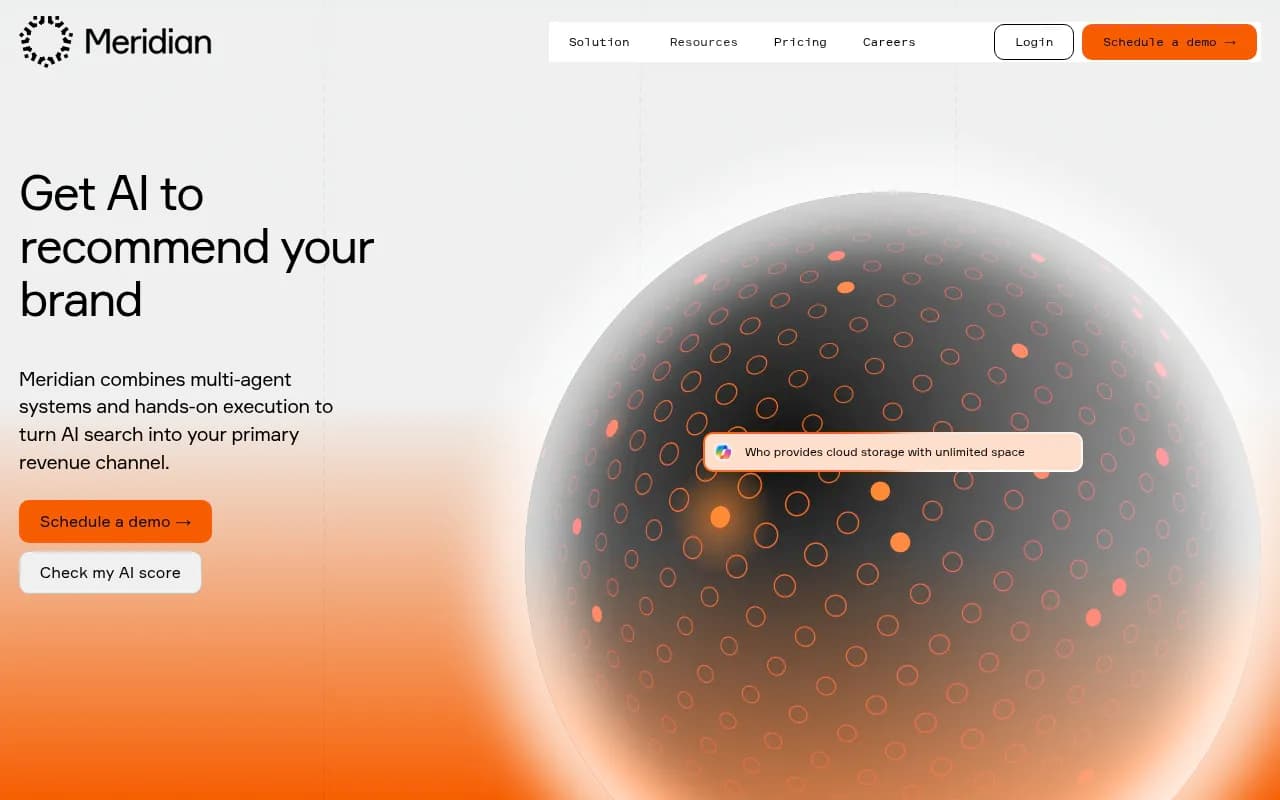
Meridian describes itself as combining "multi-agent systems and hands-on execution" to turn AI search into a revenue channel. The pitch is more ambitious than a typical tracker — it's not just showing you a dashboard, it's promising to help you act on what you find. The platform covers visibility, sentiment, citation tracking, and competitive benchmarking across ChatGPT, Perplexity, Gemini, Google AI, Grok, DeepSeek, and Copilot. The catch: there's no self-serve option. Everything starts with a demo, and pricing is custom. That's a deliberate positioning choice — Meridian is going after brands that want a partner, not just a tool.
LLM Pulse
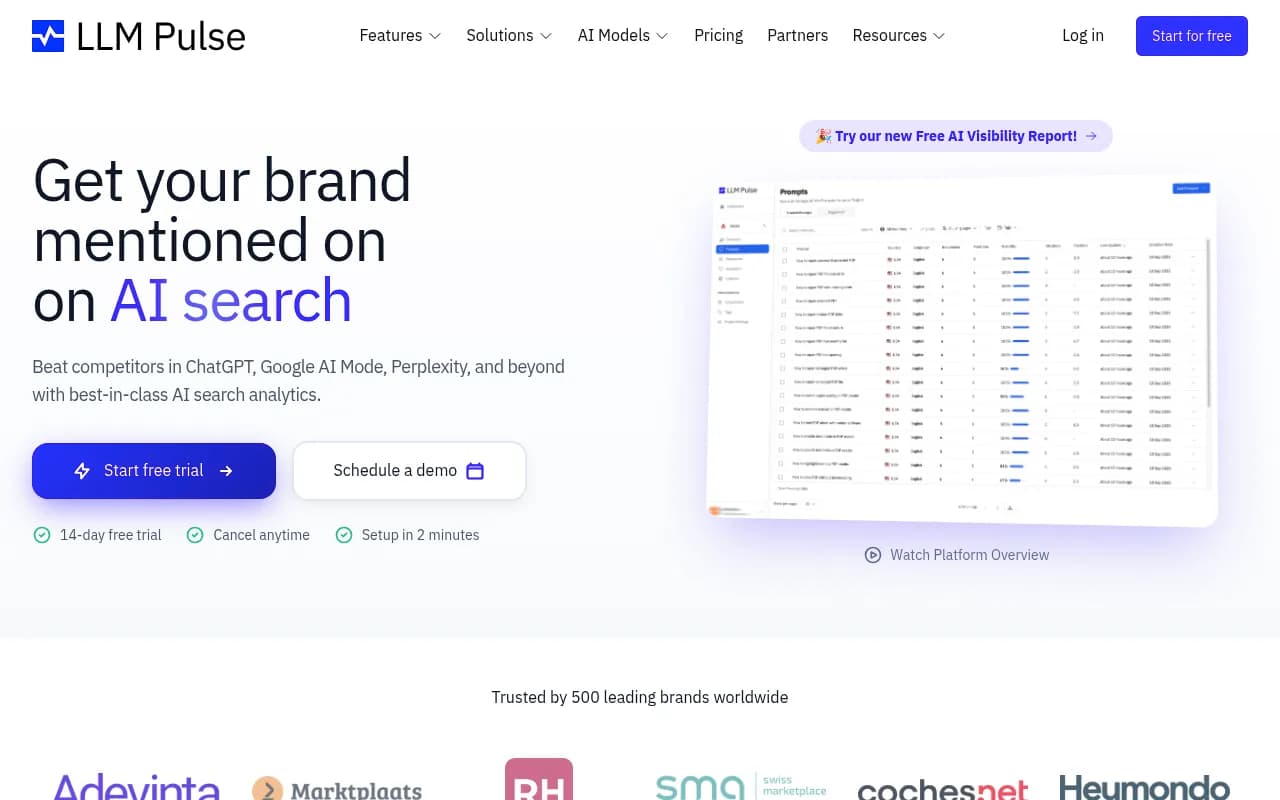
LLM Pulse takes the opposite approach. It's a clean, self-serve SaaS platform built for marketers and SEO teams who want to start tracking AI visibility without a sales call. The product covers prompt tracking, citation analysis, sentiment scoring, share of voice, and competitor benchmarking. Setup takes minutes, there's a 14-day free trial, and plans are published openly on the website. It's used by 500+ brands and covers 10+ AI models, though the full model set requires an Enterprise plan. The positioning is straightforward: know what AI says about your brand before your customers do.
Side-by-side comparison
| Feature | Meridian | LLM Pulse |
|---|---|---|
| Pricing model | Custom (demo required) | €49–€299/mo + Enterprise |
| Free trial | No | 14-day free trial |
| Self-serve signup | No | Yes |
| AI models covered | ChatGPT, Perplexity, Gemini, Google AI, Grok, DeepSeek, Copilot, Meta AI | ChatGPT, Perplexity, Gemini, Google AI Mode, AI Overviews + 5 more (Enterprise) |
| Prompt tracking | Yes | Yes (40–300 prompts/plan) |
| Sentiment analysis | Yes | Yes |
| Citation tracking | Yes | Yes |
| Competitor benchmarking | Yes | Yes |
| Managed/expert execution | Yes (core differentiator) | No |
| AI-powered recommendations | Yes (multi-agent) | Yes (basic) |
| Setup time | Demo-gated | ~2 minutes |
| Target audience | Mid-market to enterprise brands | SMBs, agencies, marketing teams |
| Multi-language/region | Yes (shown in demo UI) | Not prominently featured |
| API access | Not publicly stated | Not prominently featured |
Head-to-head feature deep-dive
Pricing and accessibility
This is where the two tools diverge most sharply. LLM Pulse publishes four tiers:
| Plan | Price | Projects | Prompts |
|---|---|---|---|
| Starter | €49/month | 1 | 40 |
| Growth | €99/month | 2 | 100 |
| Pro | €199/month | 3 | 200 |
| Scale | €299/month | 5 | 300 |
| Enterprise | Custom | Custom | Custom |
Annual billing saves 17% across all plans. The 14-day free trial requires no credit card.
Meridian publishes no pricing at all. The entire funnel runs through a demo call. This isn't unusual for enterprise software, but it does mean you can't evaluate cost without a sales conversation. Based on the positioning (managed execution, multi-agent systems, expert-led growth), expect pricing well above LLM Pulse's range.
Verdict: LLM Pulse wins on accessibility. Meridian's model suits buyers who are already committed to investing seriously in AI visibility.
AI model coverage
Both platforms cover the major models. LLM Pulse's website lists 10 models but flags several as Enterprise-only: DeepSeek, Grok, Claude, Copilot, and Meta AI. On the standard paid plans, you're primarily tracking ChatGPT, Perplexity, Gemini, Google AI Mode, and AI Overviews.
Meridian's homepage shows logos for Meta AI, Perplexity, Gemini, Claude, Google, Copilot, Grok, DeepSeek, and ChatGPT — suggesting broad coverage, though the exact model availability per tier isn't documented publicly.
Verdict: Roughly equivalent, with the caveat that LLM Pulse's full model set requires Enterprise, and Meridian's model availability is unclear without a demo.
Monitoring and analytics
Both tools cover the core monitoring stack: prompt tracking over time, visibility scores, sentiment, citation analysis, and competitor benchmarking. LLM Pulse's interface shows specific metrics like citation rate, share of voice, and per-model breakdowns. The "Detailed Responses" feature lets you read the exact text AI models produce about your brand — useful for catching inaccurate or negative framing early.
Meridian's demo UI (visible on the homepage) shows visibility scores, sentiment scores, position rankings, and competitor mentions per prompt. The multi-language capability is visible in the demo — one example shows a Japanese-language hotel booking prompt, which suggests real multi-region support.
Where Meridian differentiates is in the "expert-led execution" layer. The platform isn't just a dashboard — it claims to pair the data with human specialists and multi-agent systems that take action. That's a fundamentally different product model than LLM Pulse, which gives you the data and leaves the execution to you.
Verdict: For raw monitoring features, they're comparable. For teams that want someone else to act on the data, Meridian has a clear edge. For teams that want to own the process themselves, LLM Pulse is more practical.
Optimization and content features
This is where both tools show their limits. LLM Pulse offers "AI-powered recommendations" as the third step in its Track > Analyze > Optimize loop, but the specifics are vague — it's not clear whether this means content briefs, gap analysis, or just suggestions surfaced in the dashboard.
Meridian's "multi-agent systems" claim is more interesting but also less transparent. The promise is that agents actively work to improve your AI search presence, not just report on it. Whether that means content creation, outreach, or technical optimization isn't spelled out publicly.
Neither tool appears to offer the kind of structured content gap analysis or citation-grounded AI writing that more advanced platforms provide. If content generation and optimization is a priority — not just tracking — it's worth looking at what else is available. Promptwatch is one platform that goes further here, with built-in answer gap analysis and an AI writing agent trained on citation data from 880M+ sources.

Verdict: Both tools are primarily monitoring platforms with optimization features bolted on. Meridian's managed execution model is the most credible path to actual improvement, but it comes at a cost and opacity that won't suit everyone.
Ease of use and onboarding
LLM Pulse is explicitly built for fast onboarding. "Setup in 2 minutes" is a headline claim, and the free trial means you can validate that yourself before spending anything. The self-serve model means no sales calls, no waiting for a demo slot.
Meridian requires a demo to get started. That's a higher friction entry point, but it also means you get a guided onboarding experience rather than figuring things out alone. For enterprise buyers who expect white-glove treatment, this is a feature, not a bug.
Verdict: LLM Pulse is faster to start. Meridian is better supported from day one if you're a larger organization.
Target audience fit
| Use case | Better fit |
|---|---|
| Solo marketer or small team | LLM Pulse |
| Agency managing multiple clients | LLM Pulse (multi-project plans) |
| Mid-market brand wanting managed service | Meridian |
| Enterprise with budget for expert execution | Meridian |
| Budget-conscious team wanting to self-serve | LLM Pulse |
| Brand wanting multi-language AI monitoring | Meridian (based on demo UI) |
| Team that needs a free trial to get buy-in | LLM Pulse |
Pricing comparison
| Plan | LLM Pulse | Meridian |
|---|---|---|
| Entry-level | €49/month (Starter, 1 project, 40 prompts) | Custom (demo required) |
| Mid-tier | €199/month (Pro, 3 projects, 200 prompts) | Custom |
| Top published tier | €299/month (Scale, 5 projects, 300 prompts) | Custom |
| Enterprise | Custom | Custom |
| Free trial | 14 days, no credit card | None |
| Annual discount | 17% | Not stated |
Pros and cons
LLM Pulse
Pros:
- Transparent pricing with four published tiers
- 14-day free trial, no credit card required
- Fast self-serve setup
- Covers 10+ AI models (full set on Enterprise)
- Clean prompt tracking with weekly cadence
- Citation analysis and competitor benchmarking included on all plans
- 500+ brands using it — reasonable social proof
Cons:
- Several key AI models (Claude, Grok, DeepSeek, Copilot, Meta AI) locked to Enterprise
- No managed execution — you're on your own with the data
- Optimization features are vague; unclear how deep the recommendations go
- Multi-language/region support not prominently documented
- Prompt limits per plan can feel restrictive at lower tiers (40 prompts on Starter)
Meridian
Pros:
- Expert-led execution model — not just a dashboard, but a managed service
- Multi-agent systems claim suggests more sophisticated automation
- Broad AI model coverage including Meta AI, Claude, and others
- Multi-language and multi-region support visible in demo UI
- Suited to brands that want a partner, not just a tool
- Category-level AI tracking and sentiment insights
Cons:
- No published pricing — requires a demo to even get a quote
- No free trial
- Higher friction to evaluate and adopt
- Less transparent about what "multi-agent execution" actually means in practice
- Not suitable for small teams or budget-conscious buyers
- Limited public documentation of features compared to LLM Pulse
Who should pick which tool
Pick LLM Pulse if:
- You want to start tracking AI visibility today without a sales call
- Your budget is under €300/month
- You're a marketer, SEO specialist, or small agency who prefers self-serve tools
- You need a free trial to validate the value before committing
- You're managing 1–5 projects and want a clean, focused dashboard
Pick Meridian if:
- You're a mid-market or enterprise brand with budget for a managed service
- You want human experts and AI agents working on your AI search presence, not just reporting on it
- You need multi-language and multi-region monitoring at scale
- You're comfortable with a demo-first buying process
- You want a partner relationship rather than a software subscription
Final verdict
These two tools are solving the same problem but for very different buyers. LLM Pulse is the practical, accessible choice — you can be up and running in minutes, the pricing is fair, and the core monitoring features are solid. Meridian is a bigger commitment: no trial, no published pricing, and a model that only makes sense if you're willing to invest in managed execution alongside the software.
If you're a small to mid-sized team trying to understand your AI search presence for the first time, LLM Pulse is the obvious starting point. If you're a larger brand that wants someone to actually move the needle — not just show you a dashboard — Meridian's expert-led model is worth the demo call to find out what it costs.