Key takeaways
- Meridian and Clearscope are not direct competitors -- Meridian is a brand monitoring and AI visibility tracker, while Clearscope is a content optimization and writing tool. You might actually use both.
- Clearscope has public pricing starting at $189/month. Meridian requires a demo call and offers only custom pricing, which typically means higher costs aimed at enterprise buyers.
- If your team writes content and needs help ranking in Google and AI search, Clearscope is the obvious pick. If you need to monitor how your brand is perceived and positioned across LLMs, Meridian is more relevant.
- Clearscope's content editor is its core strength -- real-time grading, topic clusters, search intent analysis. Meridian has no content editor; it's a dashboard for tracking and competitive benchmarking.
- Meridian covers multi-language, multi-region AI monitoring with sentiment scoring. Clearscope's AI visibility features are newer and less specialized on the monitoring side.
- Neither tool closes the full loop from gap analysis to content creation to traffic attribution -- for that, Promptwatch is worth a look as a complementary platform.
Overview
Meridian
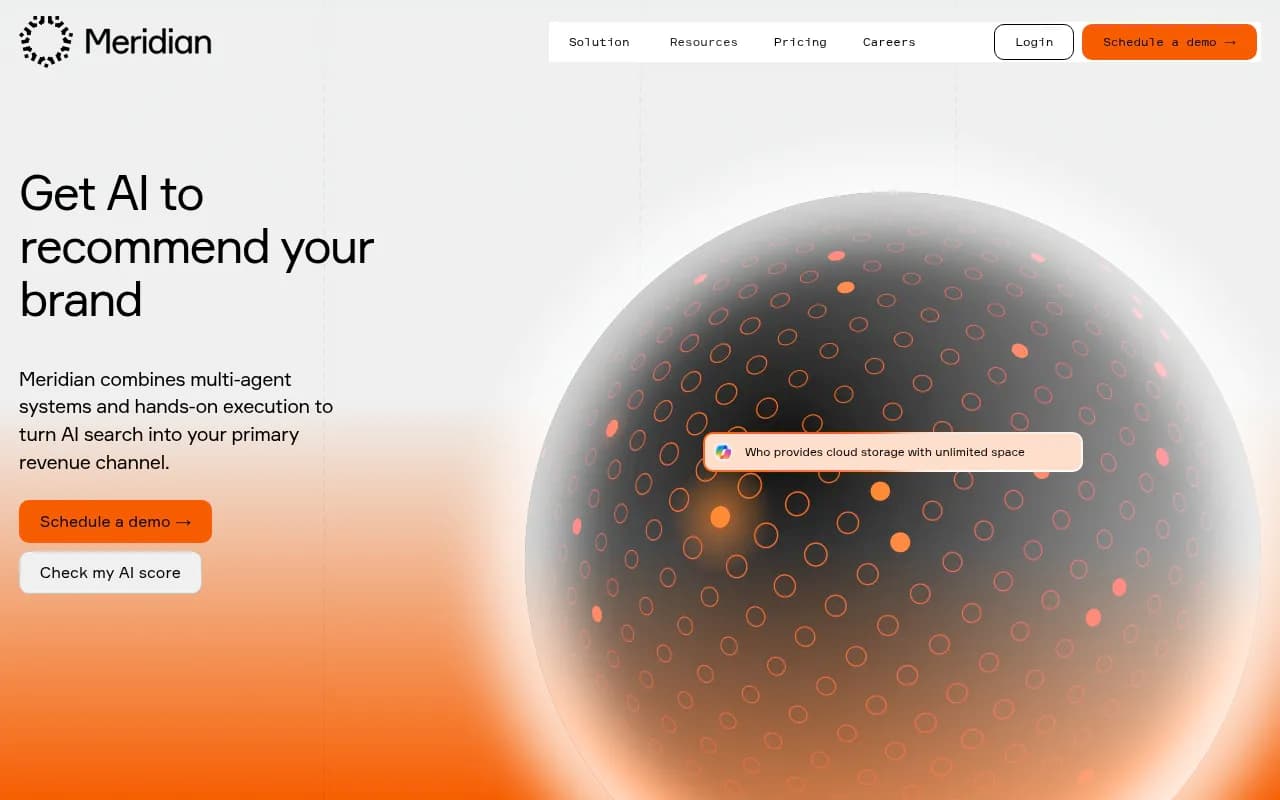
Meridian positions itself as an "expert-led, agent-powered" AI search visibility platform. The pitch is straightforward: your brand is being recommended (or not) by ChatGPT, Perplexity, Gemini, and other AI engines every day, and Meridian helps you track where you stand, how your sentiment compares to competitors, and what position you hold for key category queries. The demo on their homepage shows visibility scores, sentiment ratings, and competitor mentions across prompts in multiple languages -- suggesting genuine multi-region support.
It's a monitoring-first product. There's no content editor, no keyword grading tool, no article generator. The value is in the intelligence layer: knowing your AI visibility score, tracking it over time, and benchmarking against competitors. Meridian appears to be targeting mid-market and enterprise brands that want a dedicated AI brand intelligence tool, not a content workflow platform.
Clearscope
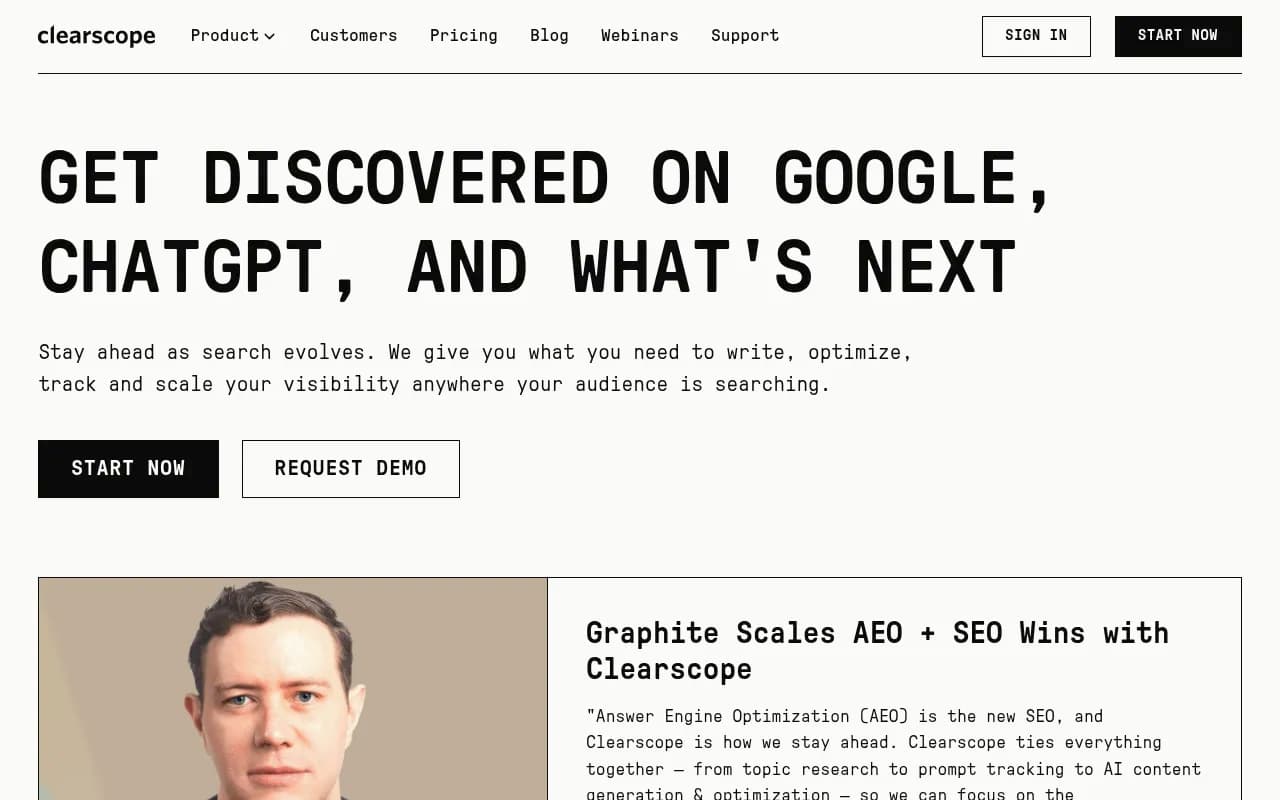
Clearscope started as a content optimization tool for Google SEO and has been expanding into AI search visibility. The core product is a content editor that grades your writing in real time against top-ranking competitors, suggests terms to include, and helps you build topical authority across a subject area. More recently, they've added AI visibility tracking -- showing which sources LLMs are pulling from and how your content performs in ChatGPT and Gemini responses.
Their customer base is content teams: writers, SEO managers, and agencies that produce articles at scale. The Graphite case study on their homepage captures this well -- their CEO describes Clearscope as the tool that "ties everything together from topic research to prompt tracking to AI content generation and optimization." It's a workflow tool as much as an analytics tool.
Side-by-side comparison
| Feature | Meridian | Clearscope |
|---|---|---|
| Primary use case | AI brand monitoring & competitive intelligence | Content optimization & SEO writing |
| Content editor | No | Yes (real-time grading) |
| AI search visibility tracking | Yes (core feature) | Yes (newer addition) |
| LLMs monitored | ChatGPT, Perplexity, Gemini, Google AI, Claude, Copilot, Grok, DeepSeek, Meta AI | ChatGPT, Gemini (expanding) |
| Sentiment analysis | Yes | No |
| Competitive benchmarking | Yes | Limited |
| Topic cluster / keyword research | No | Yes |
| Search intent analysis | No | Yes |
| AI content generation | No | Yes (AI drafts) |
| Multi-language / multi-region | Yes | Limited |
| Free tier | No | No |
| Pricing model | Custom (demo required) | Public pricing from $189/mo |
| Target user | Brand/marketing teams, enterprise | Content writers, SEO teams, agencies |
| API access | Not confirmed | Not confirmed |
Head-to-head feature deep-dive
AI search visibility tracking
This is where both tools overlap, but they approach it differently.
Meridian is built around this from the ground up. You get a visibility score per prompt or category, sentiment ratings, position tracking (e.g., "#1" or "#12" for a given query), and a breakdown of which competitors are being mentioned alongside you. The homepage demo shows this working across Japanese and English queries, which suggests real multi-language capability. The data updates regularly and is designed to be the primary thing you look at.
Clearscope added AI visibility tracking as an expansion of its core SEO product. Their framing is "turn on the lights" -- showing you which sources LLMs are using to compile answers. It's useful context for a content team, but it's not the same depth of brand monitoring that Meridian provides. Clearscope doesn't show sentiment scores or competitive position rankings in the same structured way.
Verdict: Meridian wins for dedicated AI brand monitoring. Clearscope's AI visibility features are a useful add-on for content teams, not a replacement for a purpose-built monitoring tool.
Content creation and optimization
Clearscope's content editor is genuinely good. You paste in a draft or start from scratch, and it grades your content in real time against top-ranking pages, suggesting terms to include, flagging gaps, and scoring your overall comprehensiveness. The topic exploration feature helps you map out an entire subject area before writing, so you're building content clusters rather than one-off articles. Search intent analysis tells you the "why" behind each query, which helps writers match tone and depth to what readers actually want.
Meridian has none of this. It's a monitoring dashboard, not a writing tool. If you need to create content that ranks in AI search, Meridian won't help you write or optimize it.
Verdict: Clearscope wins this category outright. There's no competition.
Competitive intelligence
Meridian tracks which competitors are being mentioned in AI responses for your target prompts, how their sentiment compares to yours, and how their position changes over time. This is genuinely useful for brand strategy -- knowing that a competitor jumped from position #5 to #2 for a key category query is actionable intelligence.
Clearscope's competitive analysis is more content-focused: it shows you what top-ranking pages include so you can match or exceed their comprehensiveness. That's useful for writing, but it's not the same as tracking brand-level competitive positioning in AI responses.
Verdict: Meridian is stronger for brand-level competitive intelligence. Clearscope is stronger for content-level competitive analysis.
Sentiment analysis
Meridian includes sentiment scoring as a core metric. You can see whether AI models are describing your brand positively or negatively, and track that score over time. For brands managing reputation or launching in a new market, this matters.
Clearscope doesn't offer sentiment analysis. It's not part of their product at all.
Verdict: Meridian only.
Multi-language and multi-region support
Meridian's homepage demo explicitly shows a Japanese-language query ("東京でホテルを予約するにはどこ?") being tracked alongside English queries. That's a real signal that multi-language monitoring is built in, not bolted on.
Clearscope supports multiple languages in its content editor to some extent, but its AI visibility tracking appears primarily focused on English-language search. If you're a global brand tracking AI visibility across markets, Meridian is the more capable option here.
Verdict: Meridian has a clear edge for international brands.
Ease of use and onboarding
Clearscope is self-serve. You can sign up, pick a plan, and start using the content editor the same day. The interface is clean and writers can get up to speed quickly without needing a sales call.
Meridian requires a demo to get started. There's no self-serve option, no free trial listed publicly, and no pricing on the website. That's a meaningful friction point for smaller teams or anyone who wants to evaluate the tool before committing.
Verdict: Clearscope is much easier to get started with. Meridian's sales-led model suits enterprise buyers but frustrates everyone else.
Integrations and workflow
Clearscope integrates with Google Docs and WordPress, which matters a lot for content teams. Writers can use the grading tool directly inside their existing workflow without switching tabs.
Meridian's integrations aren't publicly documented. Given the enterprise focus and custom pricing, it likely supports some reporting exports or API access, but this isn't confirmed from public information.
Verdict: Clearscope wins on documented integrations for content workflows.
Pricing comparison
| Plan | Meridian | Clearscope |
|---|---|---|
| Free tier | No | No |
| Entry-level | Custom (demo required) | $189/mo (Essentials) |
| Mid-tier | Custom | $399/mo (Business) |
| Enterprise | Custom | Custom |
| Annual discount | Unknown | Likely (not confirmed) |
| Free trial | Not confirmed | Not confirmed |
Clearscope's transparent pricing is a real advantage for buyers who want to evaluate cost before a sales conversation. The $189/month Essentials plan is accessible for small teams or solo SEO practitioners. The $399/month Business plan adds more seats and features for growing content operations.
Meridian's custom pricing model means you won't know what it costs until you've been through a demo. That's not unusual for enterprise software, but it does make direct cost comparison impossible. Based on the product positioning and target market, expect Meridian to be priced higher than Clearscope's published tiers.
If you're also looking to track how your brand shows up across AI search engines with full traffic attribution and content gap analysis, Promptwatch offers transparent pricing starting at $99/month -- worth comparing alongside both tools.

Pros and cons
Meridian
Pros:
- Purpose-built for AI brand monitoring -- visibility scores, sentiment, competitive position all in one place
- Multi-language and multi-region support built in
- Tracks a wide range of LLMs including Meta AI, Grok, DeepSeek, and Copilot
- Sentiment analysis gives brand teams a metric most content tools ignore
- Agent-powered execution model suggests hands-on support, not just a dashboard
Cons:
- No content editor or writing tools -- you can't act on what you find without another tool
- Custom pricing only -- no way to evaluate cost without a sales call
- No confirmed free trial or self-serve onboarding
- Integrations and API access not publicly documented
- Newer platform with limited public reviews and case studies
Clearscope
Pros:
- Excellent content editor with real-time grading -- genuinely useful for writers
- Transparent public pricing starting at $189/month
- Topic cluster and search intent analysis help teams build comprehensive content strategies
- Google Docs and WordPress integrations fit existing workflows
- AI drafts help teams break through blank-page paralysis
- Established product with a real customer base and case studies
Cons:
- AI visibility tracking is newer and less specialized than dedicated monitoring tools
- No sentiment analysis or brand-level competitive positioning
- Multi-language AI monitoring is limited compared to Meridian
- Content editor focus means it's less useful for teams that don't produce written content
- No free tier
Who should pick which tool
Pick Meridian if:
- You're a brand or marketing team that needs to monitor how AI engines describe and recommend your brand
- Competitive intelligence in AI search (who's being mentioned, at what position, with what sentiment) is a core business need
- You operate in multiple languages or regions and need AI visibility data across markets
- You have budget for an enterprise tool and want hands-on support alongside the platform
Pick Clearscope if:
- You have a content team that writes articles, guides, or blog posts and needs help ranking in Google and AI search
- You want a self-serve tool you can start using today without a sales call
- Topic research, keyword grading, and search intent analysis are part of your workflow
- You're on a defined budget and need transparent pricing to get internal approval
Consider both if:
- You're a larger marketing organization that needs both content production (Clearscope) and brand monitoring (Meridian) -- these tools don't overlap enough to replace each other
Final verdict
Meridian and Clearscope are solving different problems, which makes a head-to-head comparison a bit awkward. Meridian is a brand intelligence tool for AI search. Clearscope is a content optimization tool that happens to include some AI visibility features. Choosing between them really comes down to what your team actually does day-to-day.
If you write content and need it to rank, use Clearscope. If you need to know how AI models are talking about your brand and how you stack up against competitors, Meridian is the more focused tool. The teams most likely to be genuinely torn between these two are probably using neither correctly -- they need a content tool AND a monitoring tool, not one or the other.