Key takeaways
- AthenaHQ has transparent, self-serve pricing starting at $95/month (annual). Meridian requires a demo call and has no published pricing -- expect enterprise-level costs.
- Both platforms track 8-9 AI models including ChatGPT, Perplexity, Gemini, Claude, and Grok. Coverage is roughly equivalent.
- AthenaHQ is backed by Y Combinator and has named enterprise clients (ZoomInfo, Coinbase, SoFi). Meridian is newer with fewer publicly verifiable customer references.
- Neither tool includes built-in AI content generation -- both are primarily monitoring and optimization recommendation platforms.
- AthenaHQ offers a free audit with no sales call required. Meridian gates everything behind a demo.
- If you want to move fast and self-serve, AthenaHQ wins. If you want a managed, hands-on service model, Meridian might be worth the conversation.
Overview
Meridian
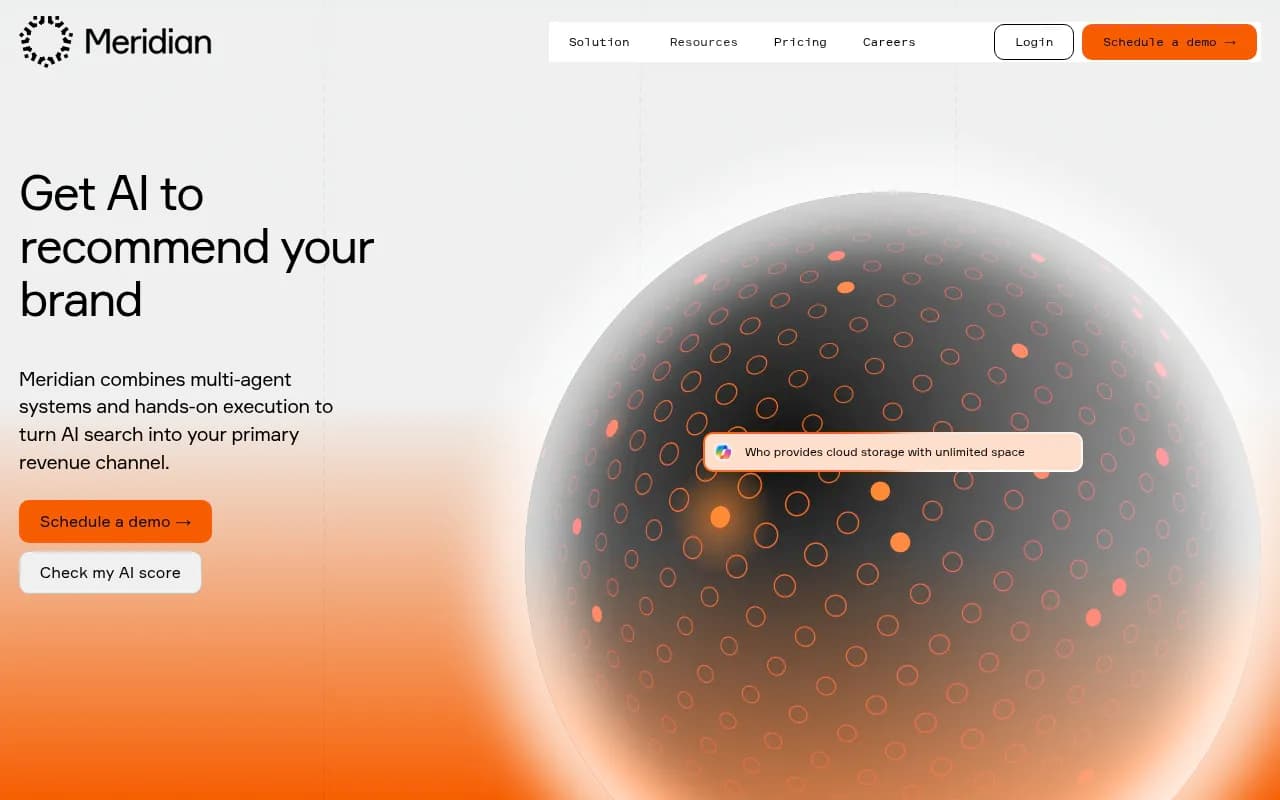
Meridian pitches itself as an "expert-led, agent-powered growth system" for AI search. The framing is interesting -- it's not purely a SaaS dashboard. The website emphasizes multi-agent systems combined with hands-on execution, which suggests a hybrid between a software tool and a managed service. You track brand visibility across ChatGPT, Perplexity, Gemini, Google AI, and more, and get category-level tracking, sentiment scoring, citation analysis, and competitive benchmarking. But you can't just sign up and start -- everything goes through a demo, and pricing is custom.
The product is clearly early-stage. The website is polished but thin on specifics: no case studies with named clients, no published pricing, no feature documentation you can browse before talking to sales. That's not necessarily a dealbreaker, but it does mean you're buying on faith until you get on a call.
AthenaHQ

AthenaHQ is a GEO (Generative Engine Optimization) platform that came out of Y Combinator and has moved quickly to establish itself in the enterprise market. The client list is genuinely impressive for a young company: ZoomInfo, Coinbase, SoFi, PagerDuty, Nextiva. It tracks 8+ AI models, provides citation source analysis, sentiment tracking, competitive benchmarking, and content optimization recommendations -- all from a self-serve dashboard.
The platform is designed for multiple personas: AEO/GEO managers, CMOs, SEO teams, PR, and content marketing. That breadth is both a strength and a potential source of complexity. But the fact that you can get a free audit without talking to anyone is a meaningful differentiator in a space where most vendors want a 30-minute discovery call before showing you anything.
Side-by-side comparison
| Feature | Meridian | AthenaHQ |
|---|---|---|
| Pricing model | Custom (demo required) | Self-serve from $95/mo (annual) / $295/mo monthly |
| Free tier / trial | None | Free audit available |
| AI models tracked | 9 (ChatGPT, Perplexity, Gemini, Claude, Google AI, Copilot, Grok, DeepSeek, Meta AI) | 8+ LLMs (ChatGPT, Perplexity, Gemini, Claude, Google AI Overviews, Grok, Copilot, others) |
| Sentiment analysis | Yes | Yes |
| Citation tracking | Yes | Yes |
| Competitive benchmarking | Yes | Yes |
| Content optimization recommendations | Yes (agent-powered) | Yes (automated recommendations) |
| Built-in content generation | No | No |
| AI crawler logs | Not mentioned | Not mentioned |
| Self-serve onboarding | No | Yes |
| Named enterprise clients | Not publicly listed | ZoomInfo, Coinbase, SoFi, PagerDuty |
| Backed by / notable investors | Not disclosed | Y Combinator |
| Free audit | No | Yes |
| Multi-language / multi-region | Not specified | Not specified |
| API access | Not mentioned | Not mentioned |
Head-to-head feature deep-dive
Pricing and access
This is the sharpest difference between the two tools, and it matters a lot depending on your situation.
AthenaHQ publishes its pricing. Self-serve plans start at $295/month on monthly billing, or $95/month on annual billing. There's an enterprise tier with custom pricing for larger organizations. You can also get a free audit -- a snapshot of your current AI search visibility -- without any sales interaction. That's a genuinely low barrier to entry.
Meridian shows you nothing until you book a demo. There's no pricing page, no feature breakdown, no trial. This is a common pattern for managed-service-style products where the "price" depends on scope, but it does mean you're committing time before you know if the product fits your budget. For a startup or a mid-market marketing team, that friction alone might be disqualifying.
Verdict: AthenaHQ wins on accessibility. Meridian may make sense if you specifically want a managed service relationship, but you won't know the cost until you're already in a sales conversation.
AI model coverage
Both platforms cover the models that matter most in 2026. Meridian's homepage shows nine logos: ChatGPT, Perplexity, Gemini, Claude, Google AI, Copilot, Grok, DeepSeek, and Meta AI. AthenaHQ advertises "8+ LLMs" with a similar lineup.
In practice, the coverage is close enough that it shouldn't be a deciding factor. What matters more is the depth of data per model -- sentiment scores, citation frequency, position tracking -- and both platforms claim to offer that. Without a side-by-side trial, it's hard to verify which does it more accurately.
Verdict: Roughly equivalent. Neither has a clear edge here based on available information.
Monitoring and analytics
AthenaHQ's dashboard is built around a few core views: AI visibility scores by model, citation source analysis (which pages and domains are being cited), sentiment tracking, and competitive benchmarking. The "AEO/GEO Manager Command Center" framing suggests a fairly comprehensive workflow tool, not just a reporting dashboard.
Meridian tracks visibility, sentiment, and position ranking per prompt, and shows which competitors are appearing alongside you. The demo UI on their homepage shows a clean interface with visibility scores, sentiment percentages, and position numbers. It looks solid, but there's limited public documentation on what's actually inside the product beyond the homepage.
Verdict: AthenaHQ has more publicly verifiable depth here, with documented features and enterprise client validation. Meridian looks promising but is harder to evaluate without a demo.
Content optimization
Both platforms offer optimization recommendations rather than content generation. AthenaHQ describes "automated content optimization recommendations" as part of its GEO workflow. Meridian talks about "agent-powered" execution, which implies some level of automated analysis and suggested actions.
Neither tool will write an article for you. If you need a platform that closes the loop from "here's what's missing" to "here's the content to fix it," you'd need to look elsewhere. For context, Promptwatch is one platform that does include a built-in AI writing agent specifically trained on citation data -- worth knowing about if content generation is a priority for your team.

Verdict: Roughly equivalent on recommendations. Neither generates content directly.
Trust signals and track record
AthenaHQ has a clear advantage here. Y Combinator backing, coverage in Forbes and the Wall Street Journal, and a client list that includes publicly recognizable enterprise brands. They also published a "State of AI Search 2026" report, which signals investment in thought leadership and data.
Meridian is newer and more opaque. The website is well-designed but lacks case studies, named clients, or third-party coverage. That's not unusual for an early-stage product, but it does mean you're taking more of a risk.
Verdict: AthenaHQ has a stronger track record. Meridian is an unknown quantity.
Service model
This is where Meridian's positioning is genuinely different. The "expert-led, agent-powered" framing suggests you're not just buying software -- you're buying access to a team that helps you execute. If your marketing team is small or lacks GEO expertise, that could be valuable.
AthenaHQ is self-serve software. You get the tools, the recommendations, and the data, but execution is on you. They do have enterprise support, but it's not positioned as a managed service.
Verdict: Depends entirely on what you need. Managed service (Meridian) vs. self-serve SaaS (AthenaHQ) is a fundamental product philosophy difference, not a feature gap.
Pricing comparison
| Plan | Meridian | AthenaHQ |
|---|---|---|
| Free / audit | Not available | Free audit (no credit card) |
| Entry-level | Custom (demo required) | $95/mo (annual) / $295/mo (monthly) |
| Mid-tier | Custom | Not publicly specified |
| Enterprise | Custom | Custom pricing |
AthenaHQ is the only one of the two with transparent pricing. Meridian's custom model means costs could be anywhere from a few hundred to several thousand dollars per month depending on scope.
Pros and cons
Meridian
Pros:
- Managed, expert-led service model -- good if you want execution support, not just data
- Tracks 9 AI models including Meta AI and DeepSeek
- Clean UI with clear visibility, sentiment, and position metrics
- Multi-agent approach may deliver more automated analysis than a pure dashboard
Cons:
- No published pricing -- requires a demo before you know if it's affordable
- No free trial or audit
- Very few publicly verifiable customer references or case studies
- Newer platform with limited third-party coverage or validation
- Hard to evaluate without committing to a sales conversation
AthenaHQ
Pros:
- Transparent self-serve pricing starting at $95/month (annual)
- Free audit available with no sales call required
- Y Combinator backed with strong enterprise client list (ZoomInfo, Coinbase, SoFi)
- Featured in Forbes and WSJ -- credible third-party validation
- Comprehensive GEO workflow covering monitoring, citation analysis, and optimization recommendations
- Designed for multiple team personas (CMO, SEO, PR, content)
Cons:
- No built-in content generation -- recommendations only
- No published information on AI crawler logs or traffic attribution
- Monthly pricing ($295/mo) is steep for smaller teams
- Self-serve model means you need internal expertise to act on the data
- No free trial beyond the initial audit
Who should pick which tool
Pick Meridian if:
- You want a managed service, not just software -- you need someone to help you execute, not just report
- You're a larger brand willing to pay for a bespoke engagement and don't mind the sales process
- You specifically want a team that combines AI agents with human expertise
- You're evaluating options and a demo call fits your procurement process
Pick AthenaHQ if:
- You want to start immediately without a sales conversation
- Budget transparency matters -- you need to know what you're paying before committing
- You have an in-house GEO or SEO team that can act on the data
- You want a platform with a proven enterprise track record and named clients
- The $95-$295/month range fits your budget
Final verdict
For most teams in 2026, AthenaHQ is the more practical choice. It has transparent pricing, a free audit, Y Combinator credibility, and a client list that validates its enterprise capabilities. You can evaluate it without talking to anyone, which matters when you're comparing multiple tools.
Meridian is an interesting option if you specifically want a managed service model -- the "expert-led" positioning is a real differentiator, not just marketing language. But the lack of pricing transparency and the absence of publicly verifiable customer references make it a harder sell for teams that need to justify a purchase internally before getting on a demo call.
If neither fully fits -- particularly if you need content generation as part of your AI visibility workflow, not just monitoring and recommendations -- it's worth looking at what else is in the market before committing to either.