Summary
- Promptwatch leads for small teams with end-to-end optimization: tracks visibility, identifies content gaps, generates AI-optimized articles, and monitors crawler behavior -- all starting at $99/month
- Otterly.AI offers the most affordable entry point for basic monitoring across multiple AI models, ideal for teams just starting to track AI visibility
- Peec AI provides smart optimization suggestions and multi-language support, making it a strong choice for international brands on a budget
- ZipTie delivers deep analysis and reporting capabilities for teams that need detailed insights but don't require enterprise features
- SE Visible (by SE Ranking) combines AI visibility tracking with traditional SEO tools, perfect for teams already using SE Ranking who want a unified platform
Why small marketing teams need AI visibility tools now
Your customers aren't Googling like they used to. They're asking ChatGPT for product recommendations. They're querying Claude for buying guides. They're using Perplexity to research solutions. And if your brand isn't showing up in those AI-generated answers, you're invisible to a growing segment of potential customers.
The shift is real and measurable. ChatGPT usage continues to surge, and Google's AI Overviews now appear in nearly half of all search results. Traditional SEO still matters, but Generative Engine Optimization (GEO) -- optimizing for how AI models cite and recommend brands -- is the new frontier.
The problem: most AI visibility platforms were built for enterprise budgets and enterprise complexity. Small marketing teams get stuck choosing between expensive tools they can't afford and basic trackers that show data but offer no path to improvement.
This guide focuses on platforms that solve real problems for small teams: affordable pricing, actionable insights, and features that help you actually improve your AI visibility instead of just watching competitors pull ahead.
What to look for in an AI visibility platform
Before diving into specific tools, here's what actually matters when you're evaluating AI visibility platforms as a small team:
Multi-model coverage: The tool should track at least ChatGPT, Claude, Perplexity, and Google AI Overviews. Brands appear differently across models -- you need visibility into all of them.
Citation tracking: You need to see which websites, Reddit threads, YouTube videos, and other sources AI models are citing when they mention (or don't mention) your brand. This tells you where to focus your content efforts.
Competitor comparison: Knowing your visibility score means nothing without context. The platform should show how you stack up against competitors for the same prompts.
Actionable insights: Data without direction is noise. The best platforms tell you what's missing and what to do about it -- whether that's content gaps, optimization opportunities, or technical fixes.
Pricing that scales with your team: Enterprise platforms charge $1,000+ per month. Small teams need tools that start affordable and scale as you grow.
Ease of use: You don't have time for a two-week onboarding process. The platform should deliver insights quickly without requiring a data science degree.
Now let's look at the five platforms that deliver on these criteria.
1. Promptwatch -- Best for end-to-end optimization
Promptwatch is the only platform on this list that goes beyond monitoring to actually help you fix visibility gaps. It's built around an action loop: find what's missing, create content that ranks in AI search, then track the results.

Small teams love Promptwatch because it solves the "now what?" problem. Most competitors show you a dashboard of visibility scores and leave you stuck. Promptwatch shows you exactly which prompts competitors are visible for but you're not (Answer Gap Analysis), then helps you create content engineered to get cited by AI models.
The built-in AI writing agent generates articles, listicles, and comparisons grounded in real citation data -- over 880 million citations analyzed. This isn't generic SEO filler. It's content designed to answer the specific questions AI models want answers to but can't find on your site.
What you get:
- Tracking across 10 AI models: ChatGPT, Claude, Perplexity, Gemini, Google AI Overviews, Meta AI, DeepSeek, Grok, Mistral, Copilot
- Answer Gap Analysis showing exactly which content you're missing
- AI content generation to fill those gaps
- AI Crawler Logs -- real-time visibility into which AI crawlers are reading your site, which pages they access, and errors they encounter
- Citation and source analysis showing where AI models find information
- Reddit and YouTube insights (channels most competitors ignore)
- ChatGPT Shopping tracking for product recommendations
- Competitor heatmaps comparing your visibility vs rivals
- Multi-language and multi-region support
- Page-level tracking with traffic attribution
Pricing:
- Essential: $99/month (1 site, 50 prompts, 5 AI-generated articles)
- Professional: $249/month (2 sites, 150 prompts, 15 articles, crawler logs, state/city tracking)
- Business: $579/month (5 sites, 350 prompts, 30 articles)
- Free trial available
Best for: Teams that want to improve AI visibility, not just track it. If you need a platform that shows you what's wrong and helps you fix it, Promptwatch is the clear choice.
2. Otterly.AI -- Best for affordability
Otterly.AI is the most affordable way to start tracking AI visibility. It covers the basics well: monitor how your brand appears across multiple AI models, track competitor mentions, and see which prompts trigger citations.

The platform is straightforward -- you won't find advanced features like content generation or crawler logs, but you will get reliable monitoring data at a price point that makes sense for small teams just getting started with GEO.
Otterly.AI tracks ChatGPT, Claude, Perplexity, and Google AI Overviews. You can set up alerts for brand mentions, monitor sentiment, and compare your visibility against competitors. The interface is clean and easy to navigate, which matters when you're learning a new discipline.
What you get:
- Multi-model tracking (ChatGPT, Claude, Perplexity, Google AI Overviews)
- Brand mention alerts
- Competitor comparison
- Sentiment analysis
- Basic reporting and dashboards
What's missing:
- No content generation or optimization features
- No crawler logs or technical GEO insights
- Limited prompt intelligence (no volume estimates or difficulty scores)
- No Reddit or YouTube tracking
Pricing: Starts significantly lower than enterprise platforms, with tiered plans based on the number of prompts tracked.
Best for: Teams that need basic AI visibility monitoring without advanced optimization features. If your goal is to understand where you stand before investing in improvement, Otterly.AI is a solid starting point.
3. Peec AI -- Best for smart suggestions and multi-language support
Peec AI stands out for its optimization suggestions and strong multi-language capabilities. The platform doesn't just show you data -- it actively suggests what to do about it.
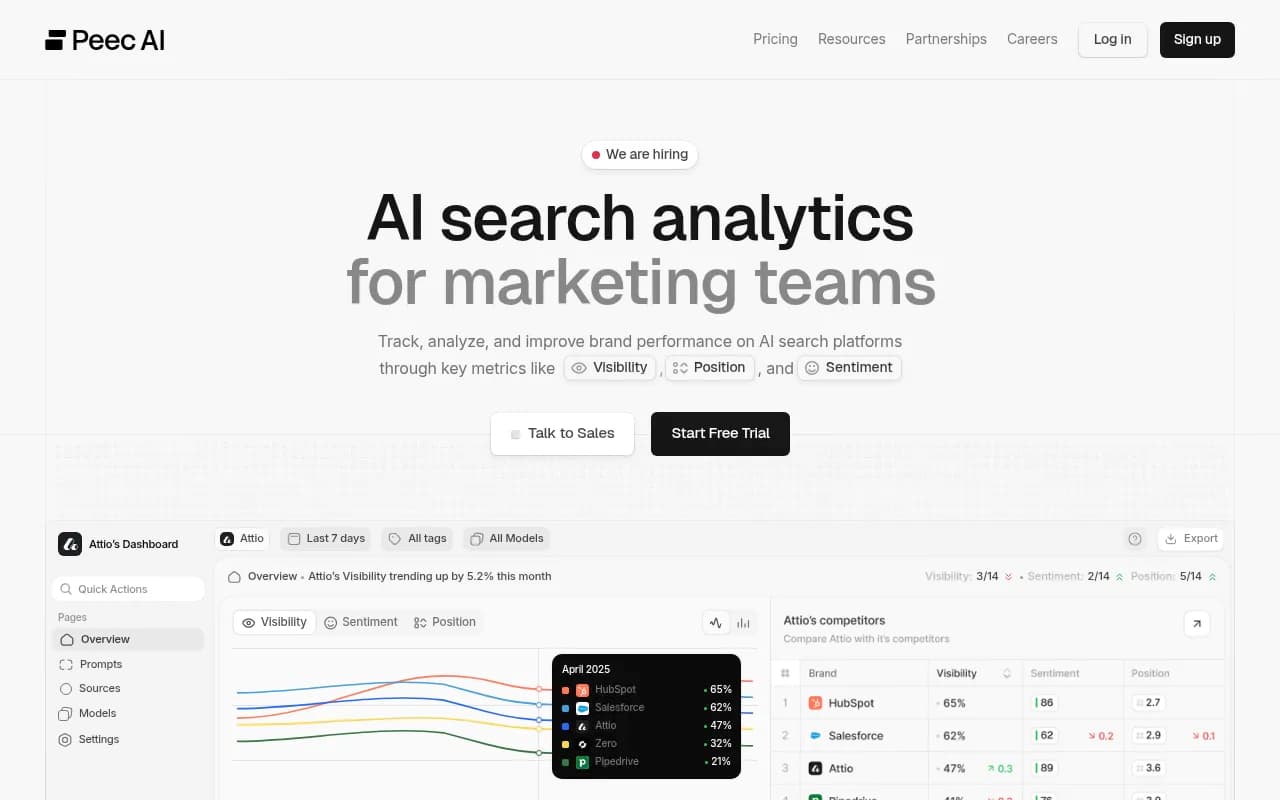
Peec AI analyzes your visibility gaps and provides specific recommendations: which content to create, how to optimize existing pages, and where to focus your efforts for maximum impact. The suggestions are grounded in data from how AI models actually cite content, making them more actionable than generic SEO advice.
The multi-language support is particularly strong. If you're targeting customers in multiple countries or languages, Peec AI tracks how your brand appears in AI responses across different languages and regions. Most competitors either don't offer this or charge enterprise pricing for it.
What you get:
- AI visibility tracking across major models
- Smart optimization suggestions based on citation patterns
- Multi-language and multi-region monitoring
- Competitor analysis
- Content gap identification
- Sentiment tracking
What's missing:
- No built-in content generation (suggestions only)
- Limited crawler log visibility
- Fewer AI models covered than Promptwatch
Pricing: Mid-tier pricing between Otterly.AI and enterprise platforms, with plans based on sites and prompts tracked.
Best for: International brands or teams that want actionable suggestions without paying for full content generation. If you have writers in-house and just need direction on what to create, Peec AI delivers.
4. ZipTie -- Best for deep analysis and reporting
ZipTie is built for teams that need detailed analysis and custom reporting without enterprise complexity. The platform excels at breaking down exactly why AI models cite certain sources and not others.
ZipTie's strength is depth. You can drill into individual prompts to see citation patterns, analyze how different AI models weight various sources, and understand the specific factors that influence visibility. The reporting capabilities are strong -- you can create custom dashboards and export data for presentations to leadership.
The platform is more technical than Otterly.AI or Peec AI, which means a steeper learning curve but more granular insights once you're up to speed. If your team includes someone comfortable with data analysis, ZipTie gives you the raw material to build sophisticated optimization strategies.
What you get:
- Deep citation analysis showing why AI models cite specific sources
- Custom reporting and dashboards
- Multi-model tracking
- Competitor benchmarking
- Prompt-level insights
- Export capabilities for further analysis
What's missing:
- No content generation
- Interface requires more technical comfort
- Fewer pre-built optimization suggestions than Peec AI
Pricing: Mid-to-upper tier, with pricing based on analysis depth and reporting needs.
Best for: Teams with analytical capabilities that want to build custom optimization strategies based on deep data. If you need to present detailed reports to stakeholders or want to understand the mechanics of AI citations, ZipTie delivers.
5. SE Visible (by SE Ranking) -- Best for unified SEO and GEO tracking
SE Visible is SE Ranking's AI visibility platform. If you're already using SE Ranking for traditional SEO, SE Visible gives you AI search tracking in the same interface.
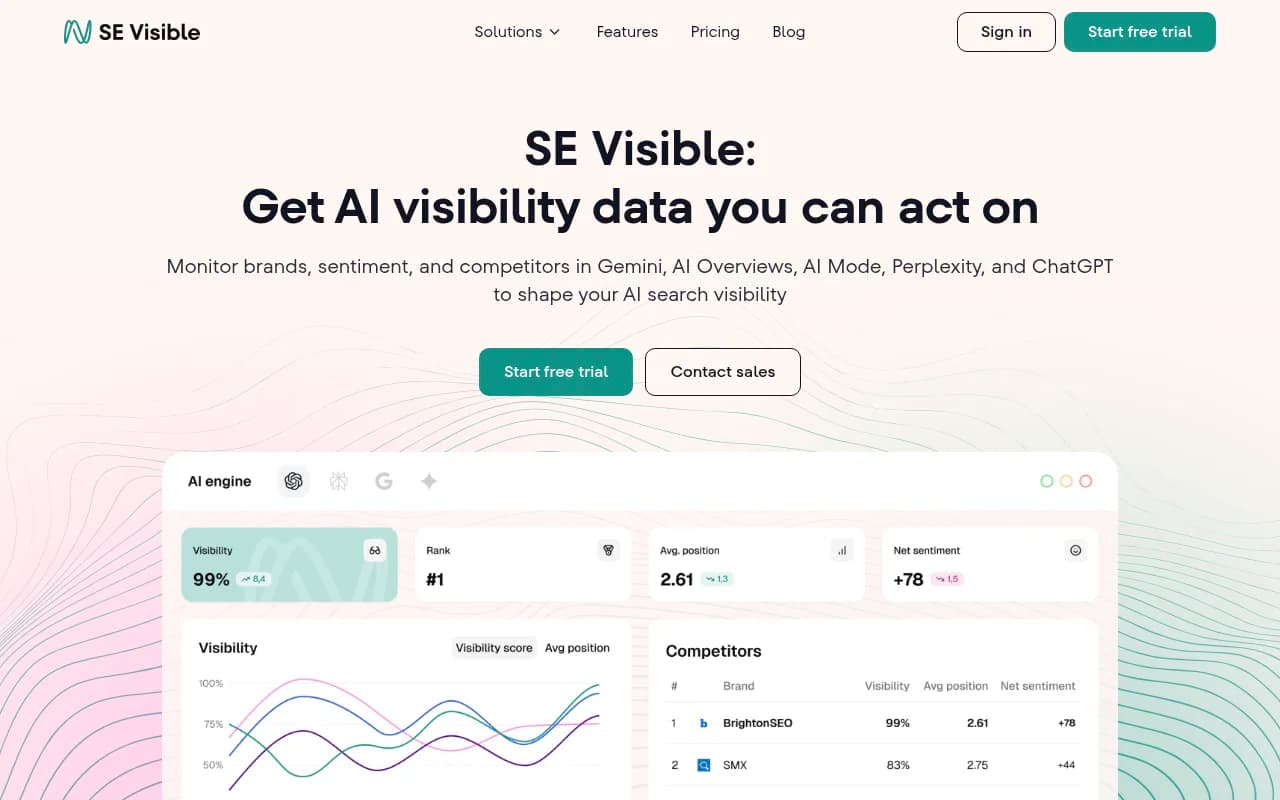
The integration is the key advantage. You can see traditional search rankings alongside AI visibility metrics, track how changes in one affect the other, and manage both SEO and GEO from a single platform. For small teams juggling multiple tools, this consolidation saves time and reduces context switching.
SE Visible tracks brand visibility and sentiment across major AI search engines, monitors competitor performance, and provides basic optimization insights. It's not as feature-rich as Promptwatch for GEO-specific capabilities, but the unified platform approach has real value if you're already in the SE Ranking ecosystem.
What you get:
- AI visibility tracking integrated with SE Ranking's SEO tools
- Brand sentiment monitoring
- Competitor comparison
- Unified dashboard for SEO and GEO metrics
- Standard SE Ranking reporting capabilities
What's missing:
- No content generation
- Fewer AI models covered than dedicated GEO platforms
- Limited advanced features compared to Promptwatch or ZipTie
Pricing: Bundled with SE Ranking subscriptions or available as an add-on. Pricing varies based on your existing SE Ranking plan.
Best for: Teams already using SE Ranking who want to add AI visibility tracking without adopting a separate platform. The unified interface and combined reporting make it a practical choice for consolidation.
Platform comparison table
| Platform | Starting Price | AI Models Tracked | Content Generation | Crawler Logs | Best For |
|---|---|---|---|---|---|
| Promptwatch | $99/mo | 10 (ChatGPT, Claude, Perplexity, Gemini, etc.) | Yes | Yes | End-to-end optimization |
| Otterly.AI | Low-tier | 4 (ChatGPT, Claude, Perplexity, Google) | No | No | Affordable monitoring |
| Peec AI | Mid-tier | Major models | No (suggestions only) | Limited | Multi-language + suggestions |
| ZipTie | Mid-to-upper | Major models | No | Limited | Deep analysis + reporting |
| SE Visible | Varies (add-on) | Major models | No | No | Unified SEO/GEO platform |
How to choose the right platform for your team
Here's a decision framework based on your team's specific situation:
Choose Promptwatch if:
- You want to improve AI visibility, not just track it
- You need content generation to fill visibility gaps
- You want crawler logs to understand how AI models discover your content
- You're serious about GEO as a growth channel
- You need comprehensive tracking across 10+ AI models
Choose Otterly.AI if:
- You're just starting with AI visibility tracking
- Budget is the primary constraint
- You want basic monitoring before investing in optimization
- You have content creation handled in-house
Choose Peec AI if:
- You operate in multiple languages or regions
- You want optimization suggestions but not full content generation
- You have writers who can execute based on strategic direction
- Multi-language support is a priority
Choose ZipTie if:
- You need deep analytical capabilities
- Custom reporting and data export are important
- Your team includes data-savvy members who can build strategies from raw insights
- You need to present detailed analysis to leadership
Choose SE Visible if:
- You're already using SE Ranking for SEO
- Platform consolidation is a priority
- You want unified SEO and GEO reporting
- You prefer managing everything in one interface
What about the enterprise platforms?
You'll see platforms like Profound, Semrush, and Ahrefs Brand Radar mentioned in other AI visibility guides. These are solid tools, but they're built for enterprise budgets and enterprise needs.
Profound starts at significantly higher price points and includes features most small teams won't use. Semrush's AI visibility features are limited to fixed prompts (you can't customize what you track). Ahrefs Brand Radar similarly uses fixed prompts and lacks AI traffic attribution.
For small teams, these platforms represent overkill. You'll pay for capabilities you don't need while missing features that actually matter at your scale (like affordable content generation or actionable gap analysis).
The five platforms in this guide were chosen specifically because they deliver value at small-team budgets without sacrificing the core capabilities you need to compete in AI search.
Getting started with AI visibility tracking
Once you've chosen a platform, here's how to get value quickly:
Week 1: Baseline your current visibility
- Set up tracking for your brand and 2-3 key competitors
- Identify 20-30 high-value prompts relevant to your business (product recommendations, buying guides, comparison queries)
- Run initial scans to see where you stand
Week 2: Identify quick wins
- Look for prompts where competitors are cited but you're not
- Find prompts where you're mentioned but ranked low
- Identify content gaps -- topics AI models want to cite but can't find on your site
Week 3-4: Create and optimize content
- If using Promptwatch: generate AI-optimized content for your top gaps
- If using other platforms: create content based on gap analysis and optimization suggestions
- Optimize existing pages that are close to getting cited
Month 2+: Monitor and iterate
- Track visibility score changes as new content gets indexed
- Monitor which pages AI crawlers are accessing (if your platform provides crawler logs)
- Refine your prompt list based on what's actually driving results
- Expand tracking to more competitors and prompts as you scale
The bottom line
Small marketing teams don't need enterprise AI visibility platforms. You need tools that deliver actionable insights at reasonable prices -- platforms that show you what's wrong and help you fix it.
Promptwatch leads this category by combining monitoring, gap analysis, content generation, and technical optimization in one platform starting at $99/month. It's the only tool that closes the loop from "here's where you're invisible" to "here's the content that will fix it" to "here's proof it's working."
Otterly.AI, Peec AI, ZipTie, and SE Visible each serve specific needs -- affordability, multi-language support, deep analysis, and platform consolidation respectively. Choose based on your team's priorities and constraints.
The key is to start now. AI search isn't the future -- it's how your customers are finding solutions today. The brands that master GEO in 2026 will have an unfair advantage. The ones that wait will watch competitors capture visibility they didn't know they were losing.