Key takeaways
- Brand Visibility Score (sometimes called AI Share of Voice) measures how often your brand appears in AI-generated answers compared to competitors, across platforms like ChatGPT, Perplexity, Claude, and Gemini.
- The score is calculated by dividing your brand's mentions across a set of tracked prompts by the total number of responses analyzed, then benchmarking that against competitors.
- Traditional metrics like organic rankings and click-through rates don't capture AI-driven discovery -- you need AI-specific KPIs to understand your real presence.
- Improving your score requires closing content gaps, not just publishing more -- AI models cite what they can find and trust, so the content you're missing matters as much as what you have.
- Platforms like Promptwatch go beyond tracking to help you identify gaps and generate content that actually gets cited.
Why your old visibility metrics are lying to you
Here's a scenario that's playing out at a lot of companies right now: your organic traffic looks fine, your keyword rankings are holding steady, and your SEO team is reporting green across the board. But your sales team is hearing from prospects that they found a competitor through "an AI recommendation." You're invisible where it counts.
Over 60% of Google searches now surface AI-generated answers, according to research from AirOps. That number is only going up. When someone asks ChatGPT "what's the best project management tool for remote teams" or asks Perplexity "which CRM is easiest to set up," they're not clicking through ten blue links. They're reading a synthesized answer -- and if your brand isn't in that answer, you don't exist for that query.
This is why Brand Visibility Score (also called AI Share of Voice, or AI SOV) has become one of the most important metrics in marketing in 2026. It measures something clicks and rankings simply can't: whether AI models are recommending you.
What is a Brand Visibility Score?
At its core, a Brand Visibility Score is a percentage. It represents how often your brand appears in AI-generated responses across a defined set of prompts, relative to the total number of responses analyzed.
The basic formula looks like this:
Brand Visibility Score = (Responses mentioning your brand / Total responses analyzed) × 100
So if you're tracking 100 prompts and your brand shows up in 34 of the AI responses, your visibility score is 34%.
But the more sophisticated platforms don't stop there. They layer in several additional dimensions:
- Which AI models are citing you (ChatGPT vs. Perplexity vs. Gemini can give very different results)
- Whether you're mentioned as a primary recommendation or buried in a list
- The sentiment of the mention (positive, neutral, or negative)
- Which specific pages on your site are being cited as sources
- How your score compares to named competitors across the same prompt set
That last point is where "Share of Voice" comes in. Your raw visibility score tells you how often you appear. Your Share of Voice tells you how that compares to everyone else competing for the same AI real estate.
How AI search trackers actually calculate the score
Different tools use slightly different methodologies, but the underlying process is fairly consistent across the category.
Step 1: Define the prompt set
You (or the tool) define a set of prompts that represent how your target customers actually search. These might be category queries ("best CRM for small business"), comparison queries ("HubSpot vs Salesforce"), or problem-based queries ("how do I reduce customer churn").
The quality of your prompt set matters enormously. A narrow or poorly chosen set will give you a misleading score. Better platforms offer prompt volume estimates and difficulty scores so you can prioritize prompts that are actually worth winning.
Step 2: Query the AI models
The tracker sends each prompt to the AI platforms you're monitoring -- typically a mix of ChatGPT, Perplexity, Claude, Gemini, Google AI Overviews, and others. Most platforms run these queries on a regular cadence (daily or weekly) to track changes over time.
Step 3: Parse the responses
Each AI response is analyzed to detect brand mentions. This sounds simple but gets complicated fast. Your brand might be mentioned by name, by product name, by URL, or even paraphrased. Good trackers handle all of these. They also note whether the mention includes a citation link (which carries more weight than a bare mention).
Step 4: Score and aggregate
Mentions are counted, weighted, and aggregated into a score. The weighting varies by platform -- some weight primary recommendations more heavily than list mentions, some factor in citation links, some adjust for prompt difficulty or search volume.
Step 5: Benchmark against competitors
Your score is compared against the same calculation run for your competitors across the same prompt set. This produces your Share of Voice: the percentage of total brand mentions across all tracked responses that belong to you.
AI Share of Voice = (Your brand mentions / Total mentions for all tracked brands) × 100
If your brand gets 40 mentions and your three competitors get 30, 20, and 10 respectively, your SOV is 40%.
The metrics that actually matter
Not all visibility metrics are equally useful. Here's a breakdown of what's worth tracking and why.
| Metric | What it measures | Why it matters |
|---|---|---|
| AI Share of Voice (SOV) | % of AI mentions vs. competitors | Core competitive benchmark |
| Brand mention rate | % of tracked prompts where you appear | Raw visibility across your prompt set |
| Citation rate | % of mentions that include a source link | Signals deeper AI trust in your content |
| Primary recommendation rate | % of times you're the top/first recommendation | Highest-value visibility signal |
| Mention sentiment | Tone of AI mentions (positive/neutral/negative) | Not all visibility is good visibility |
| Prompt coverage | % of your target prompts where you appear | Identifies specific gaps to close |
| Page-level citation data | Which pages are being cited, and by which models | Tells you what's working and what to replicate |
The citation rate deserves special attention. Research from AirOps found that brands earning both a mention and a citation in AI-generated answers are up to 40% more likely to maintain ongoing visibility. A citation means the AI model is actively pointing users to your content as a source -- that's a fundamentally different signal than a passing mention.
Sentiment is also underrated. It's entirely possible to have high visibility but negative framing -- being cited as "a common complaint" or "a tool that users find frustrating" is worse than not being cited at all. Platforms that track sentiment help you catch this before it damages your brand.
Share of Voice vs. Share of Answer: what's the difference?
You'll see both terms used in the industry, sometimes interchangeably. There is a distinction worth knowing.
Share of Voice (SOV) is the broader competitive metric: out of all brand mentions in AI responses for your category, what percentage are yours? It's a relative measure.
Share of Answer is more granular: for a specific prompt or question, does your brand appear in the answer? It's binary at the prompt level (yes/no) but aggregated across prompts gives you a coverage percentage.
In practice, most platforms blend these concepts into a single visibility score. The important thing is understanding what your tool is actually measuring -- and making sure you're comparing apples to apples when benchmarking.
Why scores vary so much across AI models
One thing that surprises people when they first start tracking AI visibility is how different their scores can be across platforms. You might have strong visibility on Perplexity but be nearly absent from ChatGPT responses. Or you might dominate Google AI Overviews but barely appear in Claude.
This happens because each AI model has different training data, different retrieval mechanisms, and different content preferences. Perplexity is heavily web-retrieval-based, so it tends to cite recent, well-structured content. ChatGPT's responses blend training knowledge with browsing capabilities. Google AI Overviews pull heavily from established, high-authority domains. Claude tends to be more conservative about citing specific brands.
This is why tracking across multiple models matters. A single-platform score gives you a distorted picture. Your overall AI visibility is the aggregate across the models your customers actually use -- and that mix varies by industry and audience.
What drives your score up (and down)
Understanding the score is one thing. Moving it is another.
The factors that most consistently improve AI visibility scores:
Content that directly answers the prompts you're targeting. AI models cite content that matches the intent of the query. If someone asks "what's the best accounting software for freelancers" and you have a well-structured article that answers exactly that question, you're a candidate for citation. If you don't have that content, you're not.
Structured, authoritative content. AI models favor content with clear structure (headers, lists, defined terms), demonstrated expertise, and factual specificity. Thin, generic content rarely gets cited.
Fresh content. AI search engines, particularly retrieval-augmented ones like Perplexity, prioritize recently updated content. A page that hasn't been touched in two years is at a disadvantage.
Citation signals from other sources. If your content is being linked to, discussed on Reddit, referenced on YouTube, or cited in other authoritative sources, AI models are more likely to trust it. This is the AI-era equivalent of backlinks.
Technical accessibility. If AI crawlers can't access your content -- due to robots.txt restrictions, JavaScript rendering issues, or slow load times -- it can't be cited. Crawler log data showing which pages AI bots are actually visiting (and which they're skipping) is genuinely useful here.
What drives scores down: outdated content, thin pages, negative press that gets cited more than your own content, and competitors publishing better answers to the prompts you care about.
Tools for tracking and improving your AI visibility score
The market for AI visibility tools has grown fast. Here's a practical overview of the main options.
| Tool | Best for | Monitoring | Content generation | Crawler logs |
|---|---|---|---|---|
| Promptwatch | Full-cycle optimization | Yes (10 models) | Yes | Yes |
| Profound | Enterprise monitoring | Yes | No | No |
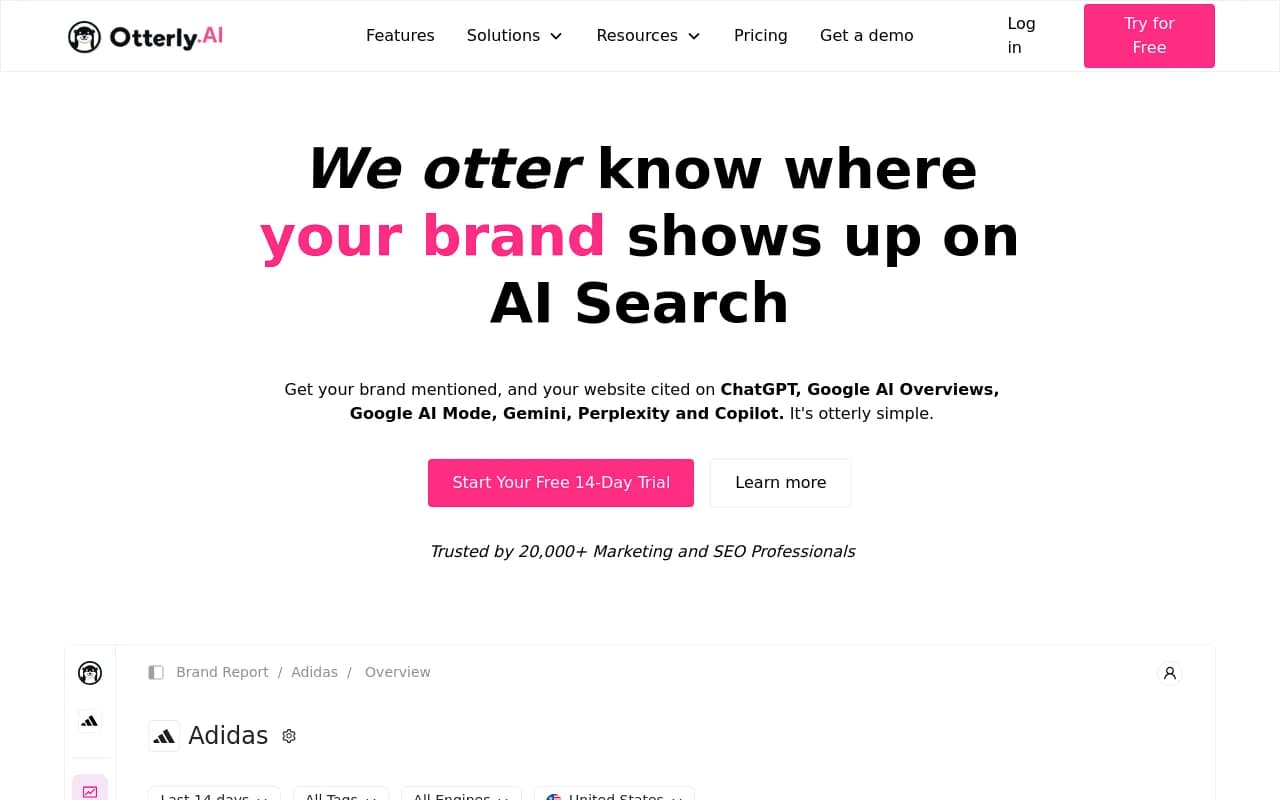
| Otterly.AI | Budget monitoring | Yes | No | No |
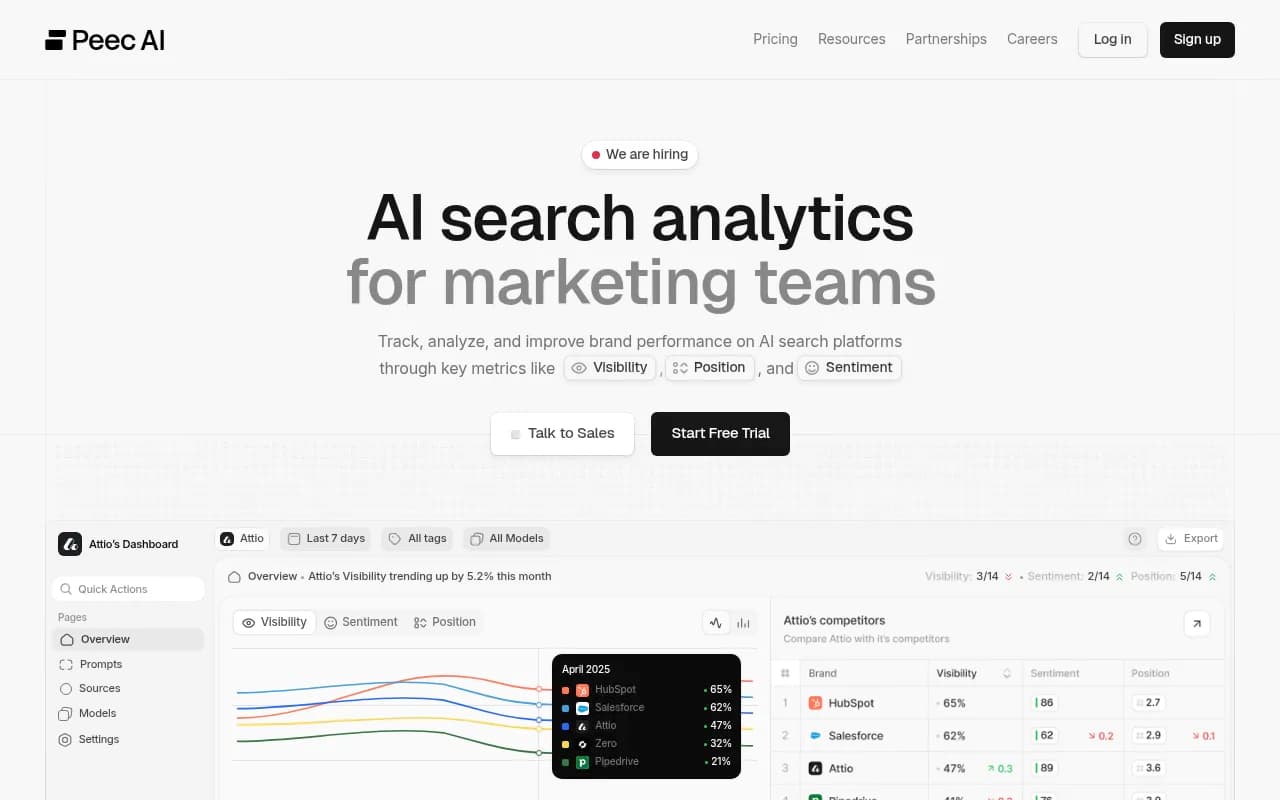
| Peec AI | Multi-language tracking | Yes | No | No |
| AthenaHQ | Mid-market monitoring | Yes | No | No |
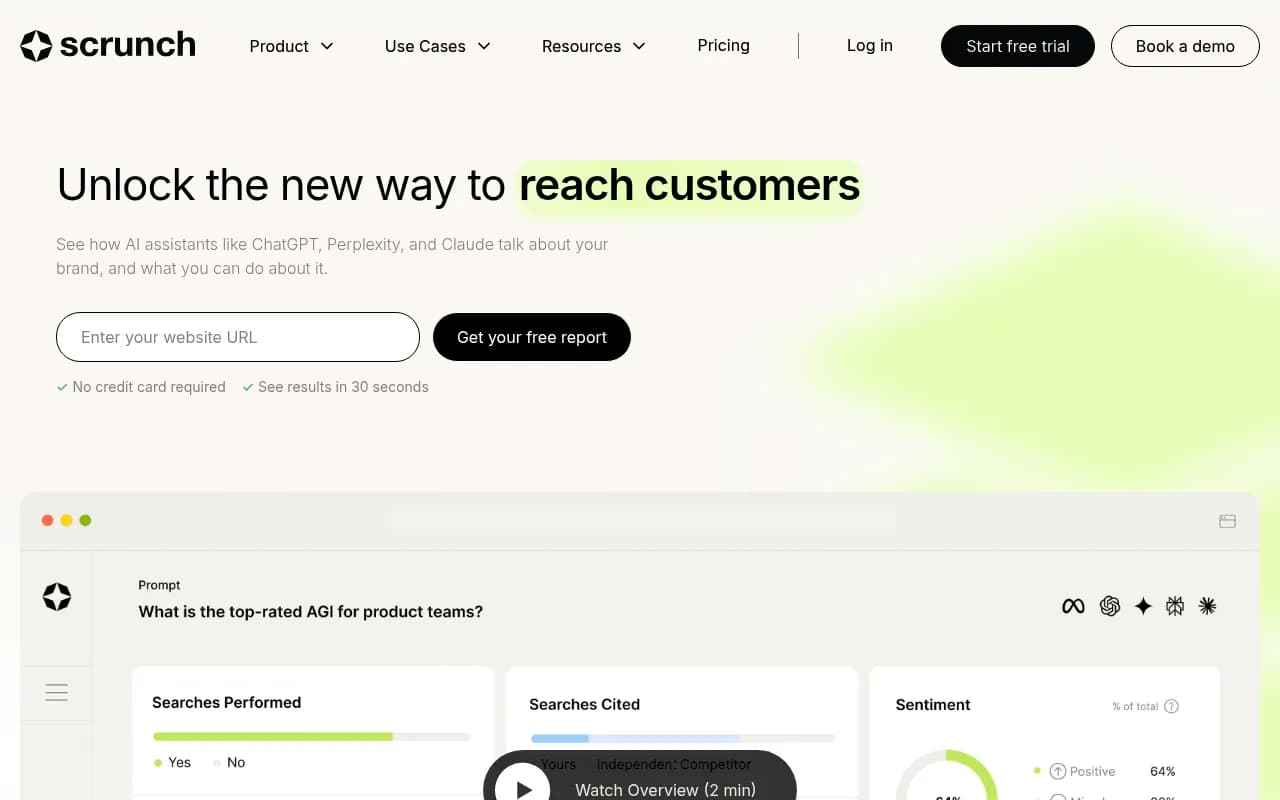
| Scrunch | Brand monitoring | Yes | No | No |
| Semrush | Traditional SEO + basic AI | Partial | No | No |
| Ahrefs Brand Radar | Brand monitoring | Partial | No | No |
Most of these tools are monitoring dashboards -- they show you your score and your competitors' scores, and that's largely where they stop. That's useful, but it leaves you with the hardest question unanswered: what do I actually do about it?
The tools that go further -- identifying which specific prompts you're losing, what content you'd need to create to win them, and then helping you create that content -- are a different category entirely.
Promptwatch is built around this full loop: find the gaps, generate content to close them, then track whether the new content improves your score. Its Answer Gap Analysis shows you the exact prompts where competitors are visible and you're not, and the built-in AI writing agent generates content grounded in citation data from 880M+ analyzed citations.

For teams that just need basic monitoring without the optimization layer, Otterly.AI and Peec AI are reasonable starting points at lower price points.
For enterprise teams with complex multi-brand or multi-region requirements, Profound and Scrunch offer deeper reporting capabilities.
How to set up your first AI visibility tracking workflow
If you're starting from scratch, here's a practical sequence:
1. Define your prompt set. Start with 20-50 prompts that represent real customer questions in your category. Include category queries, comparison queries, and problem-based queries. Don't just track branded queries -- you want to know how visible you are when customers are in discovery mode.
2. Run a baseline. Query your chosen platforms and record where you appear (and where you don't). This is your starting point.
3. Identify your biggest gaps. Where are competitors appearing and you're not? Which high-value prompts are you completely absent from? These are your priorities.
4. Audit your existing content. Before creating new content, check whether you have pages that should be ranking for these prompts but aren't. Sometimes a refresh or restructure of existing content is enough.
5. Create content for the gaps. Write articles, guides, and comparisons that directly address the prompts you're missing. Be specific, be structured, and be authoritative.
6. Monitor the impact. Track your visibility score weekly. It typically takes 4-8 weeks for new content to start appearing in AI citations, but you should see movement within that window if the content is good.
7. Connect visibility to revenue. Visibility scores are a leading indicator, but the end goal is traffic and conversions. Set up attribution tracking (via a code snippet, Google Search Console integration, or server log analysis) to connect your AI visibility improvements to actual business outcomes.
The gap between monitoring and optimization
One thing worth being direct about: knowing your score doesn't improve it. A lot of teams invest in AI visibility tracking, get a dashboard full of numbers, and then aren't sure what to do next.
The score is the starting point, not the destination. The question it should prompt is: "Which specific prompts am I losing, and what content would I need to create to win them?" That's the work. The score just tells you where to focus.
Tools that help you answer that second question -- not just show you the first number -- are where the real leverage is in 2026.