Key Takeaways
- Promptwatch is built for AI search optimization (ChatGPT, Claude, Perplexity, Gemini), while Diib focuses on traditional SEO audits and Google Analytics insights—completely different use cases
- Diib is significantly cheaper and easier to start: free tier available, likely $29-99/month for Pro vs Promptwatch's $99-579/month plans, and Diib requires zero learning curve
- Promptwatch includes content creation tools (AI writing agent, gap analysis, prompt intelligence) that Diib lacks entirely—it's an optimization platform, not just a monitoring dashboard
- Diib excels at classic SEO health checks: site speed, mobile optimization, backlink analysis, Google keyword tracking—areas Promptwatch doesn't cover
- For AI visibility tracking depth, Promptwatch is unmatched: 10 AI models monitored, 880M+ citations analyzed, crawler logs, Reddit/YouTube insights, ChatGPT Shopping tracking vs Diib's basic AI visibility scan
- Best combo strategy: Use Diib for Google SEO fundamentals ($29-99/mo) + Promptwatch for AI search visibility ($99+/mo) if you're serious about both channels
Overview: Two tools solving different problems
Promptwatch: AI search visibility and optimization

Promptwatch is an end-to-end platform for tracking and improving how your brand appears in AI search engines. It monitors 10 AI models—ChatGPT, Claude, Perplexity, Gemini, Google AI Overviews, Meta AI, DeepSeek, Grok, Mistral, and Copilot—showing exactly which prompts trigger citations to your website, which competitors are winning visibility you're not, and what content gaps are costing you traffic.
The platform goes beyond monitoring. It includes an AI writing agent that generates articles, listicles, and comparison pages grounded in real citation data (880M+ citations analyzed), prompt volumes, and competitor research. You also get AI crawler logs (see when ChatGPT or Claude bots hit your site), Reddit and YouTube insights (surface discussions influencing AI recommendations), and ChatGPT Shopping tracking (monitor product recommendation carousels).
Used by 7,000+ brands including Booking.com, Center Parcs, and major agencies. Pricing starts at $99/month. Dutch company (Promptwatch B.V.).
Diib: Automated SEO and website health analyzer
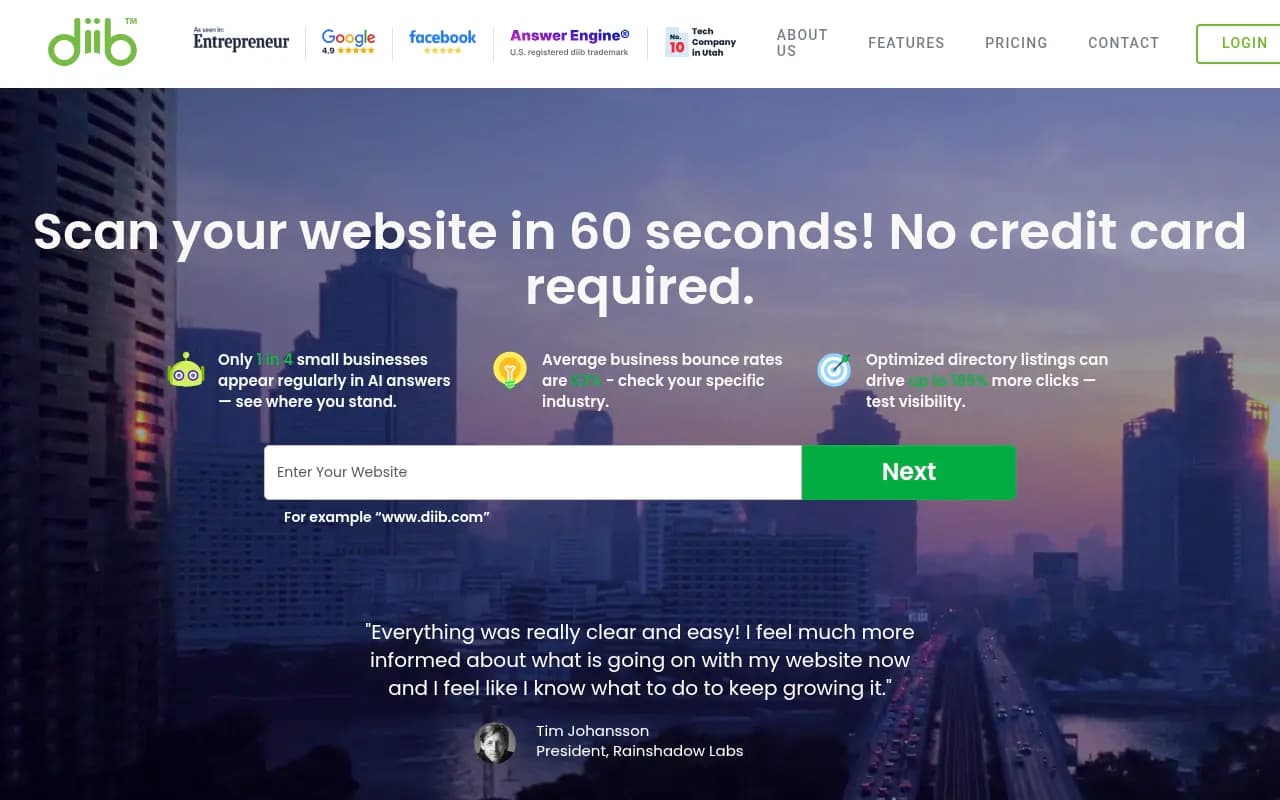
Diib is an all-in-one SEO tool designed for simplicity. It syncs with your Google Analytics account in about 60 seconds, then uses algorithms to scan your website and deliver a plain-English growth plan. The focus is traditional SEO: keyword rankings, backlink analysis, site speed, mobile optimization, social media integration, and visitor experience benchmarks.
The platform automatically monitors your Google rankings, alerts you to drops, and suggests fixes. It benchmarks your metrics against industry averages (bounce rates, session duration, traffic sources) and color-codes priorities so you know what to tackle first. Diib recently added basic AI visibility checks—it'll tell you if your brand appears in AI search results—but this feature is shallow compared to dedicated AI visibility platforms.
Used by 500,000+ website owners. Free tier available; Pro plans likely $29-99/month based on feature set (unlimited keyword tracking, Rank Guard, competitor monitoring, support for up to 30 websites). Works with WordPress, Shopify, Wix, BigCommerce, and most major platforms.
Side-by-Side Comparison
| Feature | Promptwatch | Diib |
|---|---|---|
| Primary focus | AI search visibility (ChatGPT, Claude, Perplexity, etc.) | Traditional SEO + Google Analytics insights |
| AI models monitored | 10 (ChatGPT, Claude, Perplexity, Gemini, Google AI Overviews, Meta AI, DeepSeek, Grok, Mistral, Copilot) | Basic AI visibility check (limited depth) |
| Prompt tracking | Yes—track specific prompts, volumes, difficulty scores, query fan-outs | No |
| Citation analysis | Yes—880M+ citations analyzed, see which pages/domains AI models cite | No |
| Content gap analysis | Yes—shows exactly which prompts competitors rank for that you don't | No |
| AI content generation | Yes—built-in AI writing agent for articles, listicles, comparisons | No |
| AI crawler logs | Yes—real-time logs of ChatGPT, Claude, Perplexity bots hitting your site | No |
| Google SEO tracking | No—doesn't track Google keyword rankings or backlinks | Yes—core feature with Rank Guard alerts |
| Site speed/mobile audits | No | Yes—automated scans with benchmarks |
| Backlink analysis | No | Yes—tracks backlink profile and quality |
| Social media insights | No | Yes—traffic and engagement from social channels |
| Reddit/YouTube tracking | Yes—surfaces discussions influencing AI recommendations | No |
| ChatGPT Shopping tracking | Yes—monitor product recommendation carousels | No |
| Google Analytics integration | Optional (for traffic attribution) | Required—syncs automatically |
| Learning curve | Moderate—requires understanding AI search mechanics | Very low—plain-English dashboard |
| Free tier | No (7-day free trial) | Yes—basic scans and insights |
| Starting price | $99/month (Essential plan) | Free tier; Pro likely $29-99/month |
| Target audience | Marketing teams optimizing for AI search, agencies, brands tracking LLM visibility | Small business owners, solopreneurs, anyone needing basic SEO health checks |
Head-to-head feature deep-dive
AI search visibility tracking
Promptwatch: This is the entire reason the platform exists. You get granular tracking across 10 AI models. For each prompt you monitor, Promptwatch shows:
- Which AI models cite your brand and in what position
- Exact citation text and context
- Competitor visibility for the same prompts
- Prompt volume estimates and difficulty scores
- Query fan-outs (how one prompt branches into sub-queries)
- Historical trends—track visibility changes over time
You can filter by AI model, region, language, and persona (e.g. "tech-savvy millennial" vs "enterprise buyer"). The platform processes over 1.1 billion citations and has been featured in the Wall Street Journal and Yahoo Finance for its AI search data.
Diib: Added a basic AI visibility check in 2025. It scans whether your brand appears in AI search results and flags if you're missing. That's it. No prompt-level tracking, no citation analysis, no competitor comparison, no multi-model monitoring. It's a yes/no indicator, not a tool for optimization.
Verdict: Promptwatch by a mile if AI search matters to you. Diib's AI feature is a checkbox, not a solution.
Content optimization and creation
Promptwatch: The platform includes a full content optimization workflow:
- Answer Gap Analysis: Shows exactly which prompts competitors are visible for that you're not—the specific topics, angles, and questions AI models want but can't find on your site
- AI Writing Agent: Generates articles, listicles, and comparison pages grounded in citation data, prompt volumes, persona targeting, and competitor analysis—not generic SEO filler
- Page-level tracking: See which pages get cited, how often, and by which models
- Traffic attribution: Connect visibility to revenue via code snippet, Google Search Console integration, or server log analysis
This is the "action loop" that separates Promptwatch from monitoring-only tools. You find gaps, create content that ranks in AI search, then track results.
Diib: No content creation tools. No gap analysis. Diib tells you "your content needs improvement" and suggests general topics based on Google keyword data, but it doesn't generate anything or show you what's missing for AI search.
Verdict: Promptwatch if you want to actually create content that ranks in AI search. Diib doesn't play in this space.
Traditional SEO and Google tracking
Promptwatch: Doesn't track Google keyword rankings, backlinks, site speed, or mobile optimization. It's laser-focused on AI search visibility. If you need Google SEO data, you'll need another tool.
Diib: This is Diib's bread and butter. You get:
- Unlimited keyword tracking with Rank Guard (alerts when rankings drop)
- Backlink monitoring and quality analysis
- Site speed audits with specific fix recommendations
- Mobile optimization checks
- Bounce rate and session duration benchmarks vs industry averages
- Social media traffic and engagement tracking
- Competitor monitoring (track up to 30 competitor websites on Pro plans)
Diib syncs with Google Analytics automatically and translates the data into plain-English action items. It's designed for people who don't want to become SEO experts—just tell me what to fix.
Verdict: Diib wins decisively. Promptwatch doesn't compete here at all.
Ease of use and onboarding
Promptwatch: Moderate learning curve. You need to understand:
- What prompts to track (requires research or using their prompt discovery tools)
- How citation analysis works
- What Answer Gap Analysis means and how to act on it
- How to interpret visibility scores across different AI models
The platform is powerful but not plug-and-play. Expect a few hours to get oriented. Best suited for marketing teams or agencies with some technical chops.
Diib: Extremely beginner-friendly. The onboarding process:
- Enter your website URL
- Connect Google Analytics (optional but recommended)
- Wait 60 seconds while Diib scans your site
- Get a color-coded dashboard with priorities ranked by impact
No jargon, no configuration needed. Diib tells you "fix these 3 things this week" in plain English. Perfect for small business owners who just want to grow without becoming SEO nerds.
Verdict: Diib by a landslide. Promptwatch requires more upfront investment to understand.
Pricing and value
Promptwatch:
- Essential: $99/month—1 site, 50 prompts, 5 AI-generated articles, basic tracking
- Professional: $249/month—2 sites, 150 prompts, 15 articles, AI crawler logs, state/city tracking
- Business: $579/month—5 sites, 350 prompts, 30 articles, full feature set
- Agency/Enterprise: Custom pricing for larger teams
- 7-day free trial available
Annual billing discounts available. The pricing reflects the depth of AI search data and content generation tools included.
Diib:
- Free tier: Basic site scans, limited insights, good for testing
- Pro plans: Not publicly listed, but likely $29-99/month based on feature set (unlimited keyword tracking, Rank Guard, competitor monitoring, support for up to 30 websites)
Diib is significantly cheaper, especially for solo users or small businesses just starting with SEO.
| Plan | Promptwatch | Diib |
|---|---|---|
| Free tier | No (7-day trial) | Yes—basic scans |
| Entry-level paid | $99/month (Essential) | ~$29-49/month (estimated Pro) |
| Mid-tier | $249/month (Professional) | ~$79-99/month (estimated Pro+) |
| High-tier | $579/month (Business) | Not applicable |
| What you get | AI visibility tracking, content generation, crawler logs, citation analysis | Google SEO tracking, site audits, backlink analysis, competitor monitoring |
Verdict: Diib offers better value for traditional SEO at a lower price point. Promptwatch costs more but includes unique AI search capabilities Diib can't match. You're paying for different things.
Integrations and data sources
Promptwatch:
- Google Search Console (optional, for traffic attribution)
- Looker Studio (export data for custom reporting)
- API access (build custom workflows)
- Server log analysis (track AI crawler behavior)
Promptwatch pulls data directly from AI models—it's not relying on third-party APIs that might break. The platform runs its own prompts across ChatGPT, Claude, Perplexity, etc. and analyzes responses in real time.
Diib:
- Google Analytics (core integration—required for full functionality)
- Works with WordPress, Shopify, Wix, BigCommerce, Squarespace, Magento, Weebly, Tumblr, Blogger, and most major platforms
- Social media accounts (Facebook, Twitter, Instagram—pulls traffic and engagement data)
Diib is platform-agnostic and integrates with whatever you're already using. The Google Analytics sync is seamless.
Verdict: Tie. Both integrate well with their respective ecosystems. Promptwatch focuses on AI model data, Diib focuses on Google Analytics and website platforms.
Reporting and analytics
Promptwatch:
- Visibility scores by AI model, prompt, and time period
- Citation heatmaps (compare your visibility vs competitors)
- Page-level tracking (which pages get cited, how often)
- Crawler logs (real-time view of AI bots hitting your site)
- Reddit and YouTube insights (discussions influencing AI recommendations)
- ChatGPT Shopping tracking (product recommendation carousels)
- Export to Looker Studio or via API
Reports are data-dense and designed for teams that want to dig into the numbers. You can slice by model, region, language, persona, and time range.
Diib:
- Color-coded dashboard with priorities ranked by impact
- Bounce rate, session duration, traffic sources benchmarked vs industry averages
- Keyword ranking trends with Rank Guard alerts
- Backlink profile and quality scores
- Site speed and mobile optimization scores
- Social media traffic and engagement metrics
- Competitor comparison reports
Reports are simplified and action-oriented. Diib tells you "your bounce rate is 15% higher than average—here's how to fix it" instead of dumping raw data.
Verdict: Depends on your audience. Promptwatch for teams that want granular AI search data. Diib for solo users who want simple, actionable insights.
Competitor analysis
Promptwatch:
- Track competitor visibility across all 10 AI models
- See exactly which prompts competitors rank for that you don't (Answer Gap Analysis)
- Citation heatmaps showing head-to-head visibility
- Analyze competitor content to understand why they're getting cited
- Reddit and YouTube tracking (see what discussions mention competitors)
The competitor analysis is prompt-specific and AI-model-specific. You can see "Competitor X ranks #2 in ChatGPT for 'best CRM for small business' but doesn't appear in Claude"—that level of granularity.
Diib:
- Monitor up to 30 competitor websites (Pro plans)
- Compare keyword rankings, backlink profiles, traffic estimates
- See which keywords competitors rank for that you don't
- Benchmark your site speed, mobile optimization, and social presence vs competitors
Diib's competitor analysis is Google-focused. It shows you what competitors are doing in traditional search, not AI search.
Verdict: Promptwatch for AI search competitive intelligence. Diib for Google SEO competitive intelligence. Different battlegrounds.
Pros and cons
Promptwatch pros
- Only platform that tracks 10 AI models with prompt-level granularity
- Includes content creation tools (AI writing agent, gap analysis) that actually help you rank in AI search
- AI crawler logs show exactly when ChatGPT, Claude, Perplexity bots hit your site
- Reddit and YouTube insights surface discussions influencing AI recommendations
- ChatGPT Shopping tracking for product recommendation carousels
- 880M+ citations analyzed—real data, not guesses
- Traffic attribution connects AI visibility to revenue
- Used by major brands (Booking.com, Center Parcs) and featured in Wall Street Journal, Yahoo Finance
Promptwatch cons
- Expensive—starts at $99/month, goes up to $579/month for Business plan
- Moderate learning curve—not plug-and-play for beginners
- Doesn't track Google keyword rankings, backlinks, or traditional SEO metrics
- Overkill if you're not actively optimizing for AI search
- Requires ongoing effort to monitor prompts, create content, and act on insights
Diib pros
- Extremely beginner-friendly—60-second setup, plain-English dashboard
- Free tier available for testing
- Affordable Pro plans (likely $29-99/month)
- Covers all traditional SEO bases: keywords, backlinks, site speed, mobile, social
- Rank Guard alerts catch ranking drops before they hurt traffic
- Works with all major website platforms (WordPress, Shopify, Wix, etc.)
- Benchmarks your metrics vs industry averages so you know where you stand
- Supports up to 30 websites on Pro plans—great for agencies or multi-site owners
Diib cons
- AI visibility feature is shallow—just a yes/no check, no depth
- No content creation tools or gap analysis
- No prompt tracking, citation analysis, or AI crawler logs
- Relies heavily on Google Analytics integration—less useful if you don't use GA
- Reports are simplified to the point of sometimes lacking detail for advanced users
- Competitor analysis is Google-focused, doesn't cover AI search
Who should pick which tool
Pick Promptwatch if you:
- Want to rank in AI search engines (ChatGPT, Claude, Perplexity, Gemini)
- Need to track brand mentions and citations across multiple AI models
- Are actively creating content to improve AI visibility
- Want to see which prompts competitors rank for that you don't
- Need AI crawler logs to understand how LLMs discover your content
- Care about Reddit and YouTube discussions influencing AI recommendations
- Sell products and want to track ChatGPT Shopping recommendations
- Have a marketing team or agency with budget and technical chops
- Are willing to invest time learning the platform and acting on insights
Pick Diib if you:
- Need traditional SEO health checks (Google rankings, backlinks, site speed)
- Want a simple, beginner-friendly tool that requires zero learning curve
- Are a small business owner or solopreneur without an SEO background
- Have a tight budget (free tier or ~$29-99/month)
- Use Google Analytics and want automated insights from that data
- Need to monitor multiple websites (up to 30 on Pro plans)
- Want benchmarks vs industry averages to know where you stand
- Don't care about AI search visibility (or only need a basic check)
Use both if you:
- Want comprehensive coverage of both Google SEO and AI search visibility
- Have the budget ($130-680/month combined depending on plans)
- Are serious about dominating both traditional search and the emerging AI search channel
- Run an agency managing multiple clients across both channels
The combo makes sense: Diib keeps your Google SEO fundamentals strong (site speed, mobile, backlinks, keyword rankings) while Promptwatch ensures you show up when people ask ChatGPT or Perplexity for recommendations in your space. They don't overlap—they complement.
Final verdict
Promptwatch and Diib solve completely different problems. Promptwatch is for teams that want to rank in AI search engines like ChatGPT, Claude, and Perplexity—it's the only platform with the depth to actually optimize for AI visibility, not just monitor it. Diib is for small business owners who need traditional SEO health checks and Google Analytics insights without the complexity.
If you're asking "which is better," you're probably asking the wrong question. The real question is: do you care about AI search visibility? If yes, Promptwatch is the only serious option in this comparison. If no, Diib gives you better value for traditional SEO at a fraction of the cost.
For most businesses in 2026, the smart play is to cover both bases—use Diib for Google SEO fundamentals and Promptwatch for AI search optimization. But if you can only pick one, pick based on where your customers are searching. If they're asking ChatGPT for recommendations, you need Promptwatch. If they're still Googling, Diib will serve you well.