Key takeaways
- Qwairy has a free tier (100 credits, no card required) and self-serve access; Meridian requires a demo call before you can even see pricing.
- Qwairy covers 10 AI models with transparent documentation; Meridian covers a similar set but is less explicit about its exact coverage on its public site.
- Meridian leans into a managed, expert-led execution model -- you're partly buying a service, not just software. Qwairy is pure self-serve SaaS.
- Qwairy includes site diagnostics, crawler analytics, and a content studio. Meridian focuses on brand visibility and sentiment without technical auditing.
- For teams that want to move fast and experiment without a sales cycle, Qwairy is the obvious starting point. Meridian suits brands that want a partner to run the work for them.
- Neither tool is a full replacement for the other -- they're aimed at different buyer profiles.
Overview
Meridian
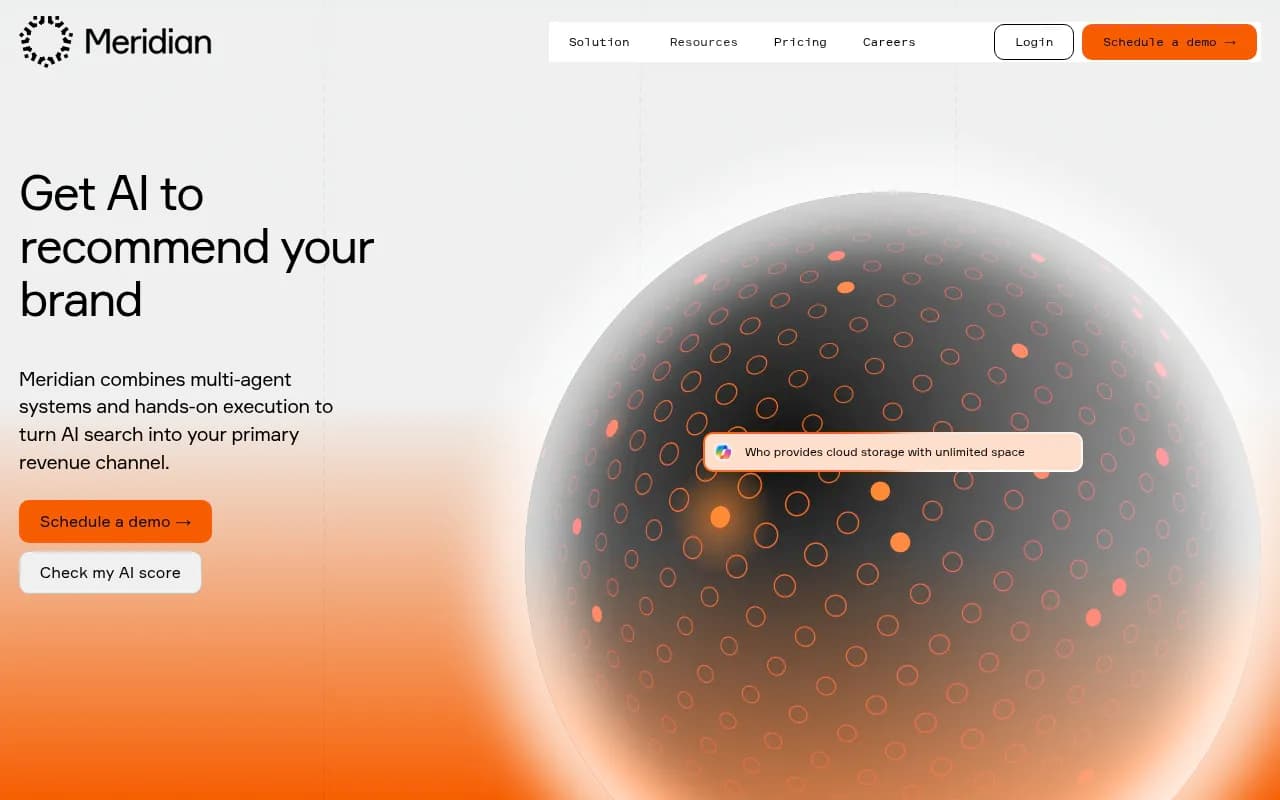
Meridian positions itself as an "expert-led, agent-powered growth system" for AI search. The pitch is that it doesn't just show you data -- it combines multi-agent AI systems with hands-on human execution to turn AI search into a revenue channel. Think of it less as a dashboard and more as a managed growth service with software underneath. It monitors brand visibility across ChatGPT, Perplexity, Gemini, Google AI, Copilot, Grok, DeepSeek, and others, and surfaces sentiment scores, competitive positioning, and citation data. But you can't just sign up and start clicking around -- everything goes through a demo and custom pricing conversation.
Qwairy

Qwairy is a self-serve GEO (Generative Engine Optimization) platform that covers the full workflow from monitoring to optimization. It tracks brand mentions across 10 AI models, audits your site for AI-readiness, surfaces content gaps, and has a built-in Content Studio for acting on what you find. It's trusted by 2,000+ brands and agencies including TotalEnergies, Air Transat, Match Group, and Razorfish. The free tier (100 credits, no credit card) makes it easy to test before buying, and the platform is clearly built for teams who want to own the work themselves.
Side-by-side comparison
| Feature | Meridian | Qwairy |
|---|---|---|
| Free tier | No | Yes (100 credits, no card) |
| Pricing model | Custom (demo required) | Credit-based, paid plans available |
| Self-serve signup | No | Yes |
| AI models covered | ChatGPT, Perplexity, Gemini, Google AI, Copilot, Grok, DeepSeek, Claude (8+) | ChatGPT, Claude, Perplexity, Gemini, Copilot, Grok, Google AI Overview, Google AI Mode, Mistral, DeepSeek (10) |
| Sentiment analysis | Yes | Yes |
| Citation tracking | Yes | Yes |
| Competitor benchmarking | Yes | Yes |
| Site diagnostics / technical audit | No | Yes (AEO, tech, content, speed scores) |
| Content studio / generation | Managed execution (not self-serve) | Yes (Content Studio, Content Opportunities) |
| Crawler analytics | Not documented | Yes |
| Social signals (Reddit, YouTube, HN) | Not documented | Yes |
| Google Search Console integration | Not documented | Yes |
| Bing Webmaster Tools integration | Not documented | Yes |
| Query fan-out analysis | Not documented | Yes |
| Shopping / local / ads monitoring | Not documented | Yes |
| Team management | Not documented | Yes |
| Setup time | Demo required | ~2 minutes |
| Target buyer | Mid-market to enterprise, wants managed service | SMBs, agencies, in-house teams wanting self-serve |
Head-to-head feature deep-dive
AI model coverage
Both tools cover the major AI search engines. Qwairy's public documentation is more explicit: ChatGPT (API + UI), Perplexity (API + UI), Copilot (UI), Gemini (API + UI), Google AI Overview (API), Grok (API + UI), Claude (API), Mistral (API), Google AI Mode (UI), and DeepSeek (API). That's 10 models with clear notes on whether coverage is via API or live UI testing -- a useful distinction since UI and API responses can differ.
Meridian's homepage shows logos for Meta AI, Perplexity, Gemini, Claude, Google, Copilot, Grok, DeepSeek, and ChatGPT. That's a comparable list, but the documentation stops there. You don't know if it's API-based, UI-based, or some mix.
Verdict: Qwairy is more transparent about how it monitors each model. If that distinction matters to you (and it should), Qwairy wins on clarity.
Monitoring and visibility tracking
Meridian shows visibility scores, sentiment scores, and position rankings per prompt, with trend data over time. The UI demo on their homepage shows a clean card-based layout with metrics like "Visibility: 7, +1%" and "Position: #12, -2" alongside competitor logos. It's polished and easy to read.
Qwairy's visibility module covers prompts, responses, citation sources, and competitor mentions. You can filter by AI model, see which sources are being cited, and track how your position changes over time. The platform also surfaces query fan-outs -- how a single prompt branches into related sub-queries -- which is genuinely useful for understanding the full surface area of a topic.
Verdict: Both do solid monitoring. Qwairy has more granular data points (fan-outs, source-level citation analysis). Meridian's UI looks cleaner in demos, but you can't verify that without a sales call.
Content optimization and gap analysis
This is where the two tools diverge most sharply.
Qwairy has a full Content Studio built into the platform. There's a Content Opportunities module that surfaces what you're missing, a Content Optimization tool for improving existing pages, and integrations with Google Search Console and Bing Webmaster Tools to connect AI visibility to traditional search data. You can act on gaps yourself, inside the platform, without waiting for anyone.
Meridian's approach is different by design. Its "agent-powered execution" model means the optimization work is done for you -- by a combination of AI agents and human experts. That's a genuine value proposition for teams that don't have the bandwidth or expertise to do it themselves. But it also means you're dependent on Meridian's team and timelines, and you can't just spin up a content brief at 11pm because you spotted a gap.
Verdict: Depends entirely on what you want. Self-serve content tooling: Qwairy. Managed execution where someone else does the work: Meridian.
Technical site diagnostics
Qwairy's Site Diagnostics module audits your pages across four dimensions: Tech (meta, structure), Content (quality, AEO), AEO (AI optimization score), and Speed (Core Vitals). The dashboard shows per-page scores and flags specific issues. For a site like Nike's example in their demo, you can see that /jordan/air-jordan-1 has a tech score of 65 and an AEO score of 61 -- actionable, specific, and prioritizable.
Meridian has no equivalent feature documented anywhere on its public site. Its focus is on how AI models respond to prompts about your brand, not on the technical state of your website.
Verdict: Qwairy wins outright. If technical AI-readiness auditing matters to you, Meridian isn't the tool.
Insights beyond AI responses
Qwairy's Insights module pulls in signals from Reddit, YouTube, Hacker News, and other social sources. This matters because AI models frequently cite Reddit threads and YouTube content -- knowing what's being discussed there gives you a head start on what AI will recommend. There's also a Shopping Results tracker, Local Businesses monitoring, and Ads Monitoring.
Meridian doesn't document any equivalent social listening or Reddit/YouTube tracking on its public site.
Verdict: Qwairy covers more of the ecosystem that actually influences AI recommendations.
Pricing and accessibility
This is probably the most important practical difference.
Qwairy starts free. 100 credits, no credit card, 2-minute setup. You can have real data about your brand's AI visibility before you've spoken to anyone. Paid plans are credit-based, though exact pricing isn't listed publicly -- you'd need to sign up to see tier details.
Meridian requires a demo. There's no pricing page, no free trial, no self-serve option. That's a deliberate choice that signals "we're selling to companies with budget and a procurement process," not "we're trying to get individual marketers to try us out."
Verdict: Qwairy is accessible to anyone. Meridian is for buyers who are already committed to a vendor evaluation process.
Pricing comparison
| Plan | Meridian | Qwairy |
|---|---|---|
| Free tier | None | 100 credits, no card required |
| Starter / entry paid | Custom (demo required) | Credit-based plans (pricing on signup) |
| Enterprise | Custom | Custom |
| Trial available | No | Yes (free credits) |
| Pricing transparency | None | Partial (credit system disclosed, tiers on signup) |
Pros and cons
Meridian
Pros:
- Managed execution model means you're not doing all the work yourself
- Clean, polished UI based on demo materials
- Covers major AI models including Meta AI
- Sentiment and position tracking with trend data
- Good fit for brands that want a growth partner, not just a tool
Cons:
- No free trial or self-serve access
- No pricing transparency whatsoever
- No technical site auditing
- No documented social signal tracking (Reddit, YouTube)
- Dependent on Meridian's team for optimization work -- not fully in your control
- Hard to evaluate without committing to a sales process
Qwairy
Pros:
- Free tier with no credit card required
- 10 AI models covered with clear API/UI documentation
- Full site diagnostics with AEO scoring
- Content Studio and Content Opportunities built in
- Reddit, YouTube, Hacker News signal tracking
- Google Search Console and Bing Webmaster Tools integrations
- Crawler analytics and referrer analytics
- Query fan-out analysis
- Trusted by recognizable brands and agencies
Cons:
- Paid pricing not fully transparent on the public site
- Credit-based model can feel unpredictable for heavy users
- No managed execution option -- you're doing the work yourself
- Newer platform, so the feature set is still evolving (v1.15 recently shipped)
Who should pick which tool
Pick Meridian if:
- You want a managed service where experts handle the optimization work alongside the software
- You're a mid-market or enterprise brand with budget for a vendor relationship
- You're comfortable with a sales process and don't need to self-serve
- Your primary concern is brand visibility and sentiment in AI responses, not technical site health
Pick Qwairy if:
- You want to start immediately without a sales call
- You need a full-stack GEO platform: monitoring, technical auditing, content optimization, and analytics in one place
- You're an agency managing multiple brands and need team management features
- You want to track social signals (Reddit, YouTube) that influence AI recommendations
- Budget is a constraint and you want to test before paying
Final verdict
Meridian and Qwairy are solving the same core problem -- getting your brand recommended by AI search engines -- but they're built for different buyers. Meridian is a managed growth service with software attached; Qwairy is a self-serve platform with a comprehensive feature set.
For most marketing and SEO teams in 2026, Qwairy is the more practical starting point. The free tier removes all friction, the feature set is broader (especially on technical diagnostics and content tooling), and you stay in control of the work. Meridian makes sense if you genuinely want a partner to run the execution and you're willing to pay a premium for that -- but you won't know what that premium is until you've sat through a demo.
If you're also tracking how your brand appears in AI search results more broadly, Promptwatch is worth knowing about -- it covers 10+ AI models with crawler log analysis, prompt volume scoring, and a built-in content generation tool that's specifically engineered to get cited by AI engines.
