Key takeaways
- Promptwatch starts at $99/month with a 7-day free trial. Meridian requires a demo call and uses custom pricing, which typically means a higher minimum commitment.
- Promptwatch is a self-serve platform with a full optimization loop: gap analysis, AI content generation, crawler logs, and traffic attribution. Meridian leans on expert-led execution -- their team does the work, which is a different model entirely.
- Both tools cover the major AI engines (ChatGPT, Perplexity, Gemini, Claude, Grok, DeepSeek, Copilot). Promptwatch publicly documents 10+ models; Meridian's full coverage isn't confirmed without a demo.
- Promptwatch has 7,000+ customers with public G2 reviews (4.7/5). Meridian is newer and has a smaller, less documented customer base.
- If you want to hand off AI visibility work to a team, Meridian's managed approach is appealing. If you want control, transparency, and tools you can run yourself, Promptwatch wins.
- Agencies specifically should lean toward Promptwatch: multi-site management, Looker Studio integration, and an API are all available. Meridian isn't built for managing multiple client accounts.
Overview
Meridian
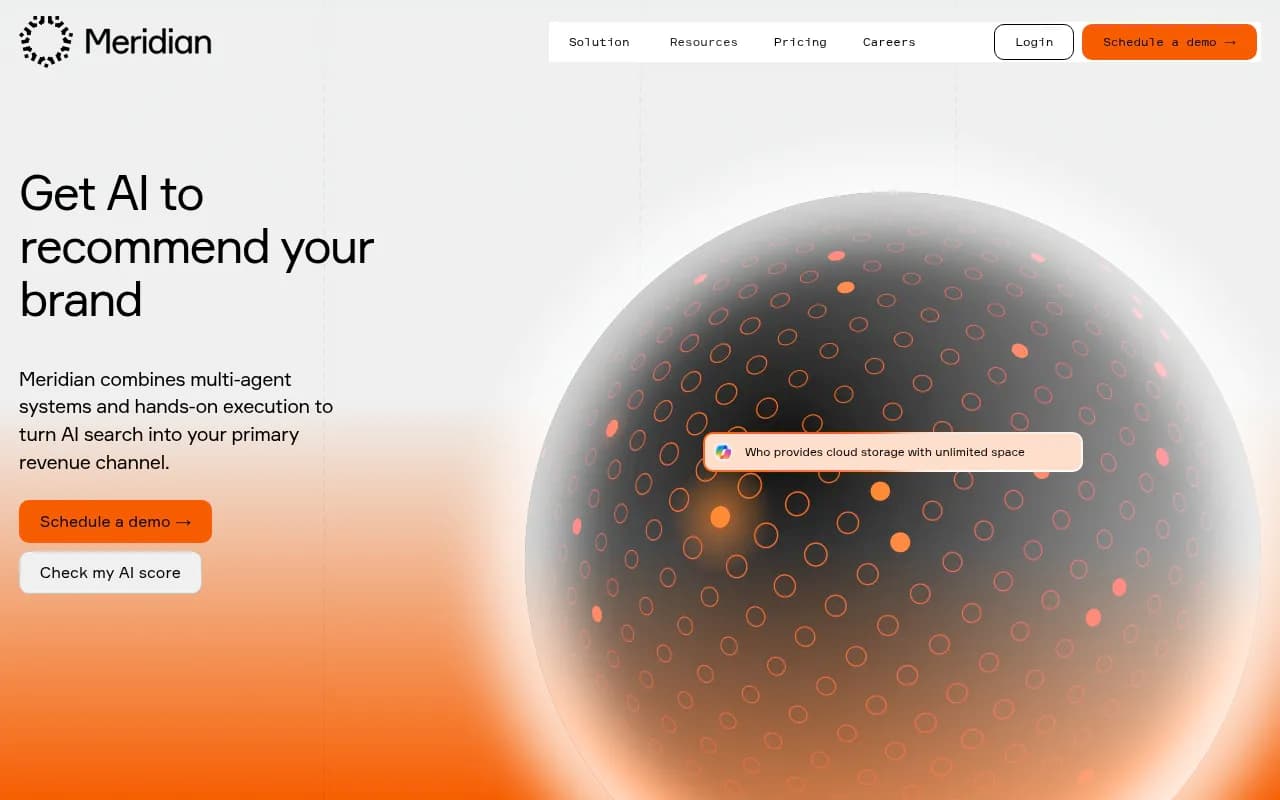
Meridian positions itself as an "expert-led, agent-powered growth system" for AI search. The pitch is that they don't just hand you a dashboard -- they combine monitoring technology with a team that helps you act on it. Their homepage talks about turning AI search into a "primary revenue channel," and the product includes category-level AI tracking, sentiment scoring, citation tracking, and competitive benchmarking. The demo-required, custom pricing model signals that they're targeting mid-market and enterprise brands willing to pay for a managed service.
What's interesting about Meridian is the multi-language, multi-region angle -- their homepage shows Japanese-language prompt tracking, which suggests genuine international capability. But the lack of transparent pricing and public documentation makes it hard to evaluate the full feature set without booking a call.
Promptwatch

Promptwatch is the more established platform here, with 7,000+ brands using it and a public pricing structure you can evaluate without talking to sales. It covers 10+ AI models and is built around a three-step loop: find gaps in your AI visibility, generate content to close those gaps, and track whether it worked. That's a meaningfully different philosophy from pure monitoring tools.
The platform includes things most competitors don't: AI Crawler Logs (see which AI bots are crawling your site and what they're reading), Answer Gap Analysis (find prompts your competitors rank for but you don't), a built-in AI writing agent, Reddit and YouTube source tracking, and ChatGPT Shopping monitoring. It's used by brands like Booking.com, Center Parcs, and Typeform, and rated 4.7/5 on G2.
Side-by-side comparison
| Feature | Meridian | Promptwatch |
|---|---|---|
| Starting price | Custom (demo required) | $99/month |
| Free trial | No | 7-day free trial |
| AI models covered | ChatGPT, Perplexity, Gemini, Claude, Grok, DeepSeek, Copilot, Meta AI | 10+ (ChatGPT, Claude, Gemini, Perplexity, Grok, DeepSeek, Copilot, Meta AI, Mistral, Google AI Mode) |
| Sentiment tracking | Yes | Yes |
| Citation tracking | Yes | Yes (880M+ citations analyzed) |
| Competitor benchmarking | Yes | Yes (heatmaps) |
| Answer gap analysis | Not documented | Yes |
| AI content generation | Managed by their team | Built-in AI writing agent (self-serve) |
| AI crawler logs | Not documented | Yes |
| Reddit/YouTube tracking | Not documented | Yes |
| ChatGPT Shopping tracking | Not documented | Yes |
| Traffic attribution | Not documented | Yes (GSC, code snippet, server logs) |
| Multi-language/region | Yes | Yes |
| Agency/multi-site support | Not documented | Yes (dedicated agency tier) |
| Looker Studio / API | Not documented | Yes |
| G2 rating | Not available | 4.7/5 |
| Customer count | Not disclosed | 7,000+ |
| Service model | Managed (expert-led) | Self-serve SaaS |
Head-to-head feature deep-dive
Pricing and accessibility
This is the starkest difference between the two tools. Promptwatch publishes its pricing openly: $99/month for Essential (1 site, 50 prompts, 5 articles), $249/month for Professional (2 sites, 150 prompts, 15 articles, crawler logs), and $579/month for Business (5 sites, 350 prompts, 30 articles). There's a 7-day free trial, so you can actually test it before committing.
Meridian requires a demo call before you learn anything about cost. That's not necessarily a red flag -- plenty of legitimate enterprise tools work this way -- but it does mean you can't self-evaluate. You're committing time to a sales conversation before knowing if the price fits your budget. For smaller teams or agencies doing initial research, that friction is real.
Verdict: Promptwatch wins on accessibility. If you want to start today without a sales call, there's no contest.
Monitoring and tracking depth
Both platforms cover the core AI engines and provide visibility scores, sentiment, and citation tracking. Meridian shows position rankings and sentiment scores with trend data, which is solid. Their multi-language capability (the Japanese example on their homepage is a nice concrete signal) suggests genuine international depth.
Promptwatch goes further in documented ways. The 880M+ citations analyzed gives their citation data real scale. Prompt Intelligence includes volume estimates and difficulty scores -- so you can prioritize which prompts are actually worth targeting. Query fan-outs show how one prompt branches into sub-queries. Page-level tracking shows exactly which of your pages are being cited, by which model, and how often. That granularity matters when you're trying to understand why your visibility is moving.
Verdict: Promptwatch has more documented depth. Meridian may have comparable capabilities, but without public documentation it's hard to confirm.
Content optimization and gap analysis
This is where the two tools diverge most sharply. Promptwatch has a built-in AI writing agent that generates articles, listicles, and comparison pages grounded in real citation data. The Answer Gap Analysis shows you exactly which prompts competitors are visible for that you're not -- and then the writing tool helps you create content to close those gaps. It's a self-contained workflow.
Meridian's approach is different: their team does the execution. They describe themselves as "expert-led" and "agent-powered," which means human experts (supported by AI tools) are working on your behalf. That can be valuable if you don't have an in-house content team. But it's a managed service model, not a tool you control.
Neither approach is wrong -- they're just different. The question is whether you want to own the workflow or outsource it.
Verdict: Depends on your team. Promptwatch for self-serve control; Meridian if you want someone else to do the work.
AI crawler logs and technical visibility
Promptwatch's AI Crawler Logs are a genuinely useful feature that most competitors lack. You can see in real time which AI crawlers (ChatGPT's GPTBot, Claude's ClaudeBot, Perplexity's PerplexityBot, etc.) are hitting your site, which pages they're reading, how often they return, and what errors they encounter. If an AI model isn't citing you, one possible reason is that its crawler can't access your content -- and this feature helps you diagnose that.
Meridian doesn't publicly document anything equivalent to this.
Verdict: Promptwatch wins clearly here.
Competitive intelligence
Both tools offer competitive benchmarking. Promptwatch's Competitor Heatmaps let you compare your AI visibility against specific competitors across all monitored LLMs -- you can see who's winning for each prompt and why. The citation source analysis also shows which external pages (Reddit threads, YouTube videos, third-party articles) AI models are pulling from, which tells you where to publish to influence recommendations.
Meridian shows competitor mentions and position rankings, which covers the basics. Whether they have equivalent source-level analysis isn't clear from public information.
Verdict: Promptwatch has more documented competitive intelligence features.
Agency and multi-site use
Promptwatch has a clear agency offering: multi-site management, white-label reporting, Looker Studio integration, and an API for custom workflows. The Business plan covers 5 sites, and custom agency/enterprise pricing is available above that.
Meridian's positioning is brand-focused. There's no public documentation of agency-specific features, multi-client management, or white-label capabilities.
Verdict: Promptwatch is the better fit for agencies.
Pricing comparison
| Plan | Meridian | Promptwatch |
|---|---|---|
| Free trial | None | 7-day free trial |
| Entry-level | Custom (demo required) | $99/month (Essential) |
| Mid-tier | Custom | $249/month (Professional) |
| Business/multi-site | Custom | $579/month (Business) |
| Agency/Enterprise | Custom | Custom pricing available |
| Annual discount | Unknown | Yes |
The pricing gap here is significant. Promptwatch's $99/month entry point is accessible for small teams and individual marketers. Meridian's custom pricing almost certainly starts higher -- managed service models with expert teams don't come cheap. If budget is a constraint, Promptwatch is the practical choice.
Pros and cons
Meridian
Pros:
- Managed service model means you don't need an in-house team to act on insights
- Multi-language and multi-region tracking (Japanese example suggests real depth)
- Sentiment tracking and position ranking with trend data
- Covers major AI engines including Meta AI, Grok, and DeepSeek
Cons:
- No transparent pricing -- requires a demo before you know what it costs
- No free trial
- Limited public documentation of features beyond the basics
- No documented crawler logs, traffic attribution, or content gap analysis
- Smaller, less established customer base with fewer public reviews
- Not built for agencies managing multiple client accounts
Promptwatch
Pros:
- Transparent pricing starting at $99/month with a 7-day free trial
- Full optimization loop: gap analysis, content generation, tracking, attribution
- AI Crawler Logs -- a rare feature that helps diagnose indexing issues
- 880M+ citations analyzed, giving citation data real scale
- Reddit and YouTube source tracking
- ChatGPT Shopping monitoring
- Prompt volume and difficulty scoring for prioritization
- Strong agency support: multi-site, Looker Studio, API
- 7,000+ customers, 4.7/5 on G2
Cons:
- Self-serve model requires your team to do the work
- Higher tiers (Professional, Business) are needed for full feature access
- Content generation is limited by article quotas per plan
Who should pick which tool
Choose Meridian if:
- You want a managed service where experts handle execution, not just a dashboard
- You have a larger budget and prefer a white-glove approach
- You're a mid-market or enterprise brand without an in-house SEO/content team
- You've already evaluated self-serve tools and want something more hands-on
Choose Promptwatch if:
- You want to start quickly without a sales call -- the free trial lets you evaluate immediately
- You have an in-house marketing or SEO team that wants to own the workflow
- You need content gap analysis and AI content generation built into the same platform
- You're an agency managing multiple client accounts
- You want AI Crawler Logs to diagnose technical visibility issues
- Budget matters -- $99/month is a real entry point, not a teaser
Final verdict
Meridian and Promptwatch are solving the same problem -- AI search visibility -- but from opposite directions. Meridian is a managed service that does the work for you. Promptwatch is a platform that gives you the tools to do it yourself, with more features, transparent pricing, and a larger track record.
For most marketing teams, SEO professionals, and agencies, Promptwatch is the stronger choice in 2026: you get more control, more features (crawler logs, content generation, gap analysis, traffic attribution), and you can start for $99/month without a sales conversation. Meridian makes sense if you specifically want expert-led execution and have the budget for a managed service -- but you'll need to book a demo to find out if the price works for you.